What Color Do Blue and Green Make When Mixed?
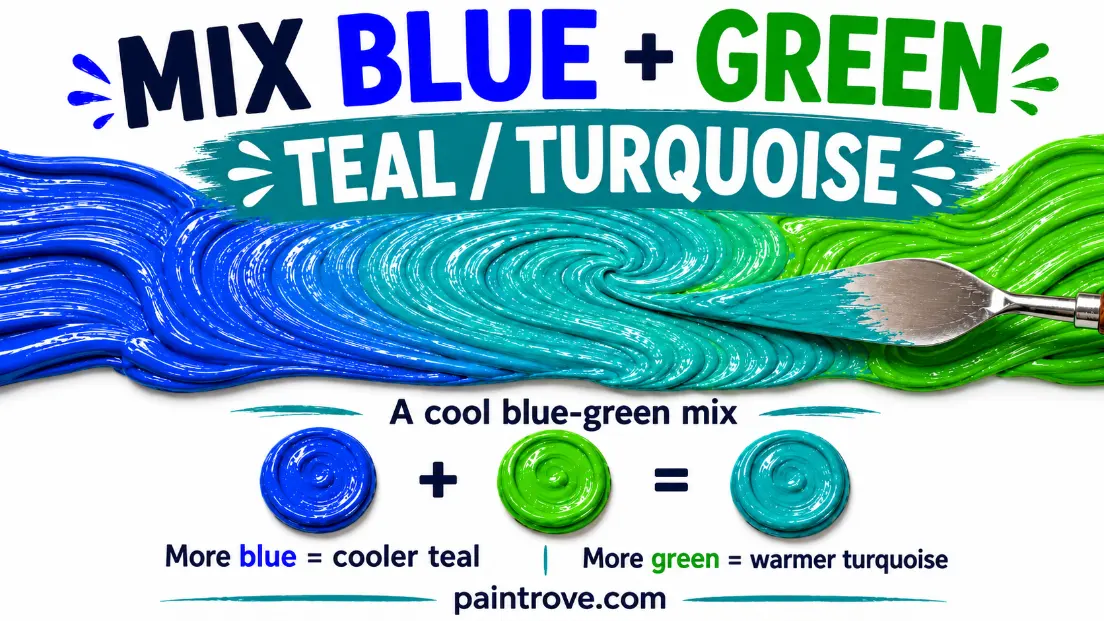
What Color Do Blue and Green Make? Mix blue and green together and you get teal, a deep blue-green that sits at hex #008080. Shift the balance and the same mix produces the whole aquatic family: more green and white gives you turquoise at hex #40E0D0, more blue pushes toward a deep ocean blue-green, and generous white lightens everything into aqua and seafoam.
Blue and green mixed is one of the most reliable combinations on the palette. The two colors are neighbors on the color wheel, so they blend cleanly with no risk of mud. The only real question is which blue-green you want, and that comes down to ratio, pigment choice, and what you add afterward.
This guide covers all of it: exact ratios with hex codes, the best pigments for vivid results, the difference between teal, turquoise, cyan, and aqua, and what happens when you mix blue and green as light instead of paint.
Why Blue and Green Make Teal
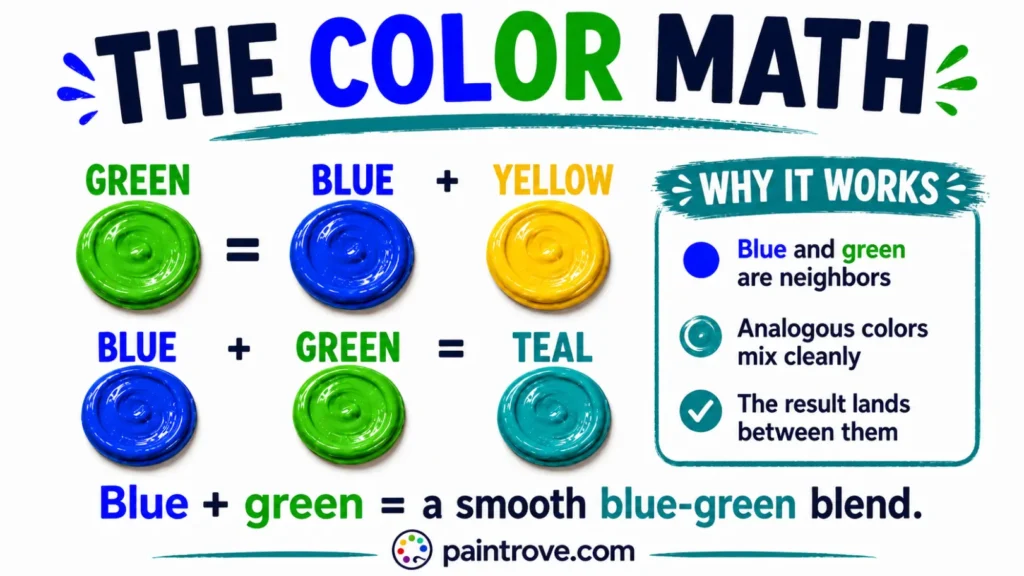
Look at the color wheel and you will find green sitting right beside blue. Colors that sit next to each other like this are called analogous colors, and mixing them is the gentlest kind of color mixing there is. Nothing cancels out, nothing muddies. The mix simply lands between its parents.
There is also a family relationship hiding inside this mix. Green is not a primary color. It is a secondary color, made from blue and yellow, as covered in our guide to what blue and yellow make. So when you mix blue with green, you are really just adding more blue to a blue-yellow mix. The green’s yellow half gets diluted, the blue side strengthens, and the result slides along the wheel from green toward blue, landing on blue-green.
In color theory terms, that makes teal a tertiary color: a primary (blue) mixed with its neighboring secondary (green). Blue-green is one of the six tertiary colors, sitting alongside blue-violet, red-violet, red-orange, yellow-orange, and yellow-green. Its warm-side twin, by the way, is what you get from yellow and green mixed: chartreuse, the yellow-green on the opposite shoulder of green.
Teal, Turquoise, Cyan, Aqua: What Is the Difference?
The blue-green family collects names the way the ocean collects ships, and the labels get mixed up constantly. Here is how they actually differ:
| Color | Hex code | Character |
|---|---|---|
| Teal | Hex #008080 | Deep, muted, sophisticated blue-green |
| Turquoise | Hex #40E0D0 | Bright, light, leans slightly green |
| Cyan | Hex #00FFFF | Electric, pure blue-green of light and printing |
| Aqua | Hex #00FFFF (digital) | Interchangeable with cyan digitally, softer in paint |
| Seafoam | Hex #93E9BE | Pale, whitened green-leaning mix |
| Mint | Hex #98FF98 | Even greener, soft and pale |
| Sea green | Hex #2E8B57 | Darker, green-dominant |
| Peacock | Hex #005F69 | Deep, blue-dominant teal |
The quick way to keep them straight:
Teal is the dark one. Named after the teal duck, whose eye stripe carries the color. Equal blue and green, no white, slightly muted.
Turquoise is the bright one. Named after the gemstone. Blue and green plus a lift of white, leaning green.
Cyan is the pure one. The exact midpoint of blue and green in light. Screens produce it perfectly; paint can only approximate its intensity. In printing, cyan is not a mix at all but one of the four base inks of the CMYK color model.
Aqua and seafoam are the soft ones. Whitened, gentle versions that dominate coastal design palettes.
For the full deep dive into this family’s brightest member, see our complete guide to what colors make turquoise.
Mixing Ratios: From Deep Teal to Pale Seafoam
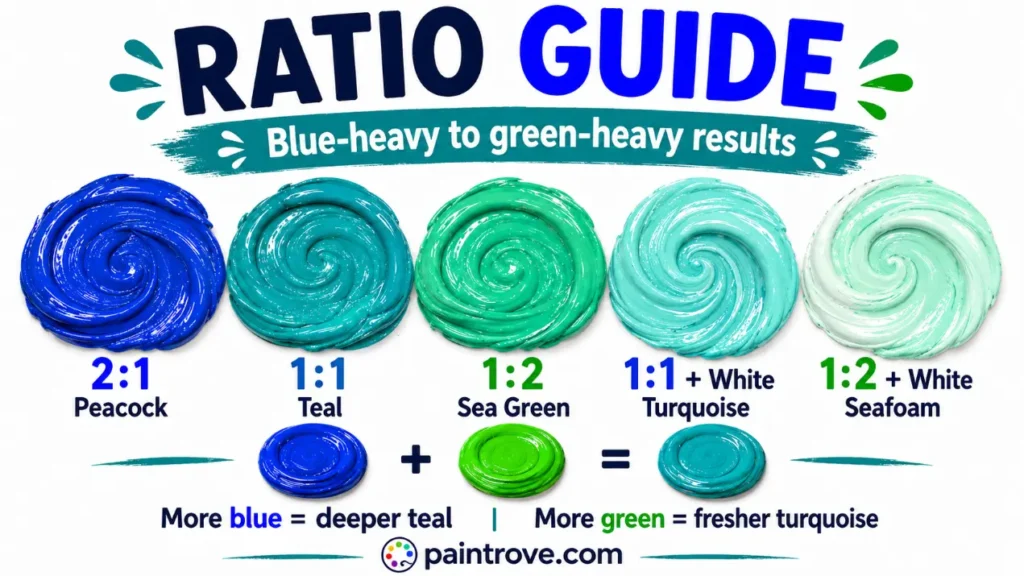
The blue-to-green ratio decides where in the family you land. Here is the working chart, with hex code targets in plain text:
| Ratio (Blue : Green) | Resulting shade | Hex code |
|---|---|---|
| 1 : 1 | Teal | Hex #008080 |
| 2 : 1 | Deep blue-green / peacock | Hex #005F69 |
| 3 : 1 | Ocean blue with green undertone | Hex #0A4F63 |
| 1 : 2 | Green-teal / sea green | Hex #2E8B57 |
| 1 : 3 | Blue-leaning green | Hex #17A589 |
| 1 : 1 plus white | Turquoise | Hex #40E0D0 |
| 1 : 2 plus generous white | Seafoam | Hex #93E9BE |
| 2 : 1 plus a touch of black | Dark slate teal | Hex #1F4E4E |
Practical mixing notes:
- Add green to blue rather than the other way around if you want control, since most greens shift a blue faster than blue shifts a green.
- Judge the mix on white paper, not the palette. Blue-greens read very differently against different backgrounds.
- If the mix looks close but slightly dull, a whisper of white often reveals the hue and brings it to life.
- Acrylics dry a touch darker, so aim one step brighter than your target.
Which Blue and Which Green to Use
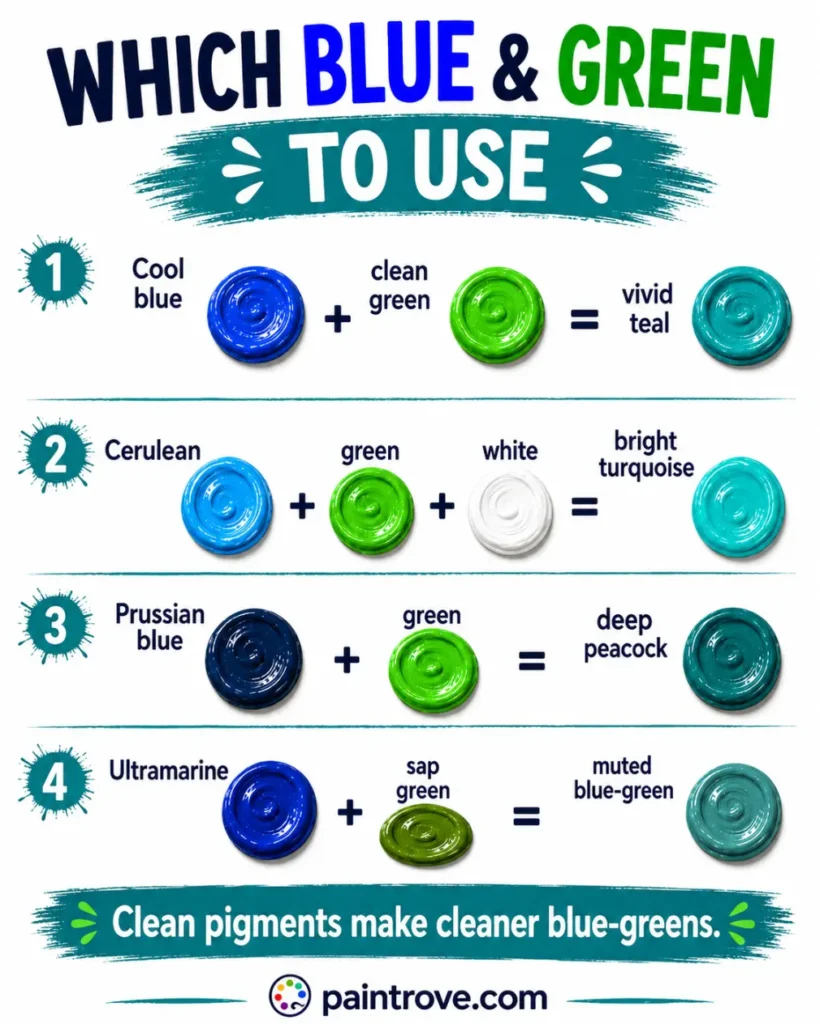
Pigment choice matters more here than ratio. Blue-greens live or die on the cleanliness of their parents:
| Goal | Blue to use | Green to use | Result |
|---|---|---|---|
| Vivid teal | Phthalo blue | Phthalo green | Intense, saturated teal |
| Bright turquoise | Cerulean blue | Phthalo green plus white | Clean gemstone turquoise |
| Soft coastal aqua | Cerulean blue | Light green plus white | Gentle, airy aqua |
| Deep peacock | Prussian blue | Phthalo green | Moody, dark blue-green |
| Muted sage-teal | Ultramarine | Sap green | Softer, grayer blue-green |
The pattern: cool, green-leaning blues make the cleanest blue-greens. Phthalo and cerulean already lean toward green, so they merge with it seamlessly. Ultramarine leans the other way, toward violet, and that hidden red content mutes the mix slightly. Sometimes a muted blue-green is exactly right for a subject, but if you want turquoise that glows, phthalo is the engine. Just add it sparingly, because phthalo pigments overpower everything they touch.
Every Shade You Can Make from Blue and Green
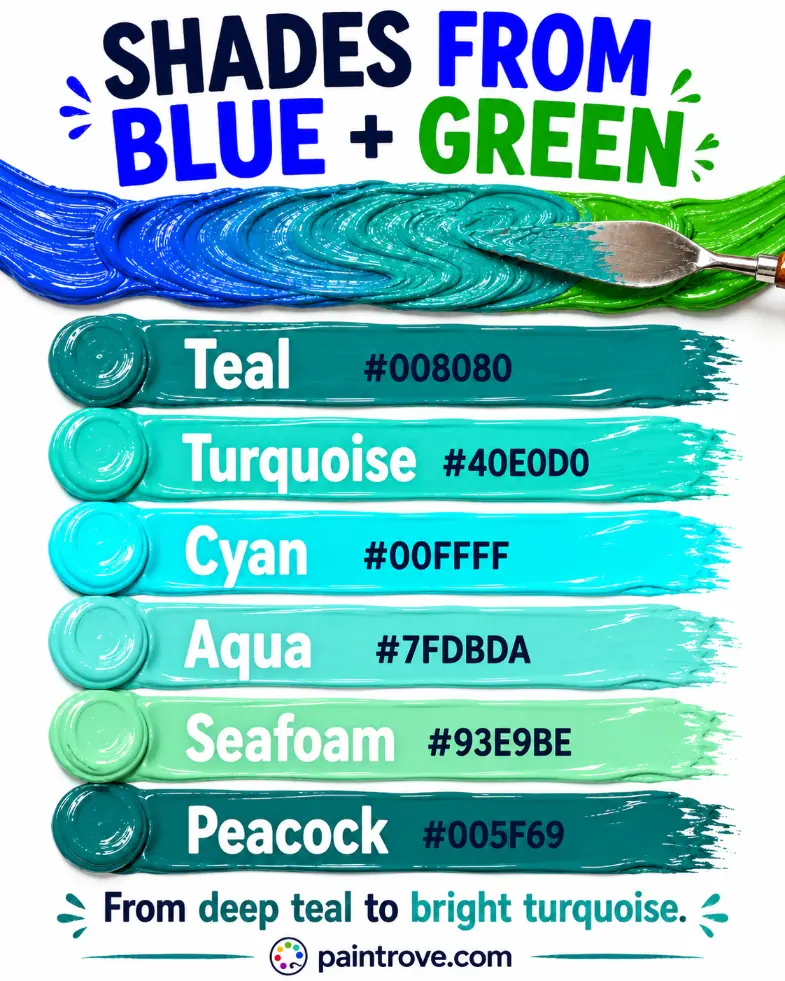
Between ratio shifts and additions of white, black, or gray, blue and green cover the entire aquatic corridor. The reference table:
| Shade | Hex code | How to mix it |
|---|---|---|
| Teal | Hex #008080 | Equal parts blue and green |
| Turquoise | Hex #40E0D0 | Equal mix plus white, slight green lean |
| Cyan | Hex #00FFFF | Perfect blue-green midpoint at full brightness |
| Aqua | Hex #7FDBDA | Equal mix plus generous white |
| Seafoam | Hex #93E9BE | Green-heavy mix plus generous white |
| Mint | Hex #98FF98 | Mostly green plus white, touch of blue |
| Sea green | Hex #2E8B57 | Two parts green, one part blue |
| Jade | Hex #00A86B | Green-heavy mix, touch of white |
| Peacock blue | Hex #005F69 | Two parts blue, one part green |
| Petrol | Hex #005F6A | Blue-heavy mix plus a touch of black |
| Dark teal | Hex #014D4E | Equal mix plus a touch of black |
| Verdigris | Hex #43B3AE | Equal mix plus white and a whisper of gray |
| Slate teal | Hex #1F4E4E | Equal mix plus gray and black |
Lighter Versions (Tints)
White is the key that unlocks the most loved members of this family. Teal plus white steps through turquoise into aqua and seafoam. These tints keep their freshness because neither parent color carries any red to gray them out. The same principle powers the individual guides to blue and white mixed and green and white mixed, and it is why coastal palettes lean so hard on this corner of the wheel.
Darker Versions (Shades)
A touch of black turns teal into petrol and dark slate teal, some of the most fashionable dark colors in interior design. Go carefully, since black overwhelms quickly. Blue-heavy mixes darken more gracefully than green-heavy ones; a deep peacock made from Prussian blue and phthalo green barely needs black at all. The dedicated guides to blue and black mixed and green and black mixed cover the technique on each side.
Muted Versions (Tones)
Gray softens teal into verdigris and dusty sage-teal territory, the weathered-copper colors of old roofs and statues. A little gray goes far, as shown in our guides to green and gray mixed and blue and gray mixed. Alternatively, a tiny touch of red or orange, the complements of this family, mutes a blue-green more naturally than gray, in the same way painters mute every color with its opposite.
Blue and Green in Light: The Cyan Answer
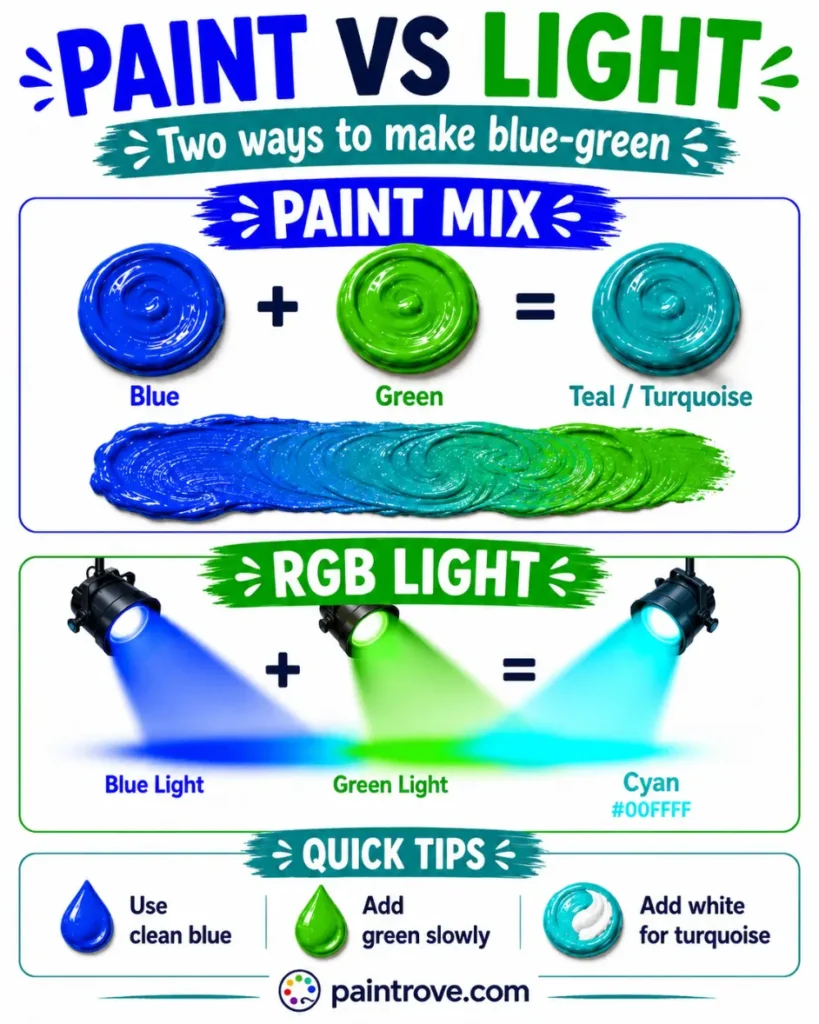
Everything above describes paint. Mix blue and green as light and the result is different: cyan, at hex #00FFFF, brighter than either parent.
Screens and stage lights use the RGB model, where colors combine by addition. Overlap a blue light and a green light and both sets of wavelengths reach your eye together, which your brain reads as cyan, a color more brilliant than any teal paint can manage. Paint works by subtraction, each pigment absorbing wavelengths, so pigment mixes always end darker than light mixes.
| System | Type | Blue + Green makes | Hex code |
|---|---|---|---|
| RYB (paint) | Subtractive | Teal | Hex #008080 |
| RGB (light and screens) | Additive | Cyan | Hex #00FFFF |
| CMYK (printing) | Subtractive | Cyan is a base ink | Hex #00FFFF equivalent |
Printing flips the relationship completely: cyan is one of the four foundation inks, and printers build blues and greens from cyan rather than mixing cyan from them. Three systems, three different answers to the same question.
Troubleshooting Blue-Green Mixes
The mix looks gray or dull. One of your parents carries red. Ultramarine blue leans violet, and some greens (especially olive-toned ones) carry warm bias. Switch to phthalo or cerulean blue and a clean green, and the mix will clear up.
The mix is too dark to read. Phthalo pigments in particular produce nearly black mixes at full strength. Add white to a test pile to reveal the true hue, then adjust the master mix.
The turquoise looks chalky. Too much white too fast. Rebuild with less white and a slightly brighter base, or restore saturation with a touch more phthalo green.
The mix leans too green or too blue. Simply add the other parent in small steps. Analogous mixes are forgiving; you can steer them back and forth without penalty.
You want cyan brightness in paint. You will not fully get there, since pigment cannot match emitted light. The closest routes: phthalo blue plus phthalo green plus white, or a dedicated cyan pigment such as PB17.
Teal and Turquoise in Art, Fashion, and Design
The blue-green family carries a rare double meaning: the calm of blue plus the renewal of green, which is why designers reach for it when they want colors that feel both peaceful and alive.
In Art
Turquoise the gemstone gave the color its name and its history. Ancient Egyptians mined it five thousand years ago and paired it with gold in burial masks, including Tutankhamun’s. Persian architecture wrapped entire mosque domes in turquoise tile. In painting, blue-greens do the heavy lifting in water and atmosphere: the shallows of a coastline, the shadowed side of a wave, tropical light. Verdigris, the blue-green of oxidized copper, was one of the few strong greens available to medieval painters, and its descendants still color every aged bronze statue and copper roof in the world.
In Fashion
Teal is one of fashion’s most dependable jewel tones, deep enough to act like a neutral but far more interesting than navy. It flatters nearly every skin tone, which few saturated colors manage. Turquoise and aqua own resort wear and summer collections, carrying instant associations with clear water. The gemstone itself anchors an entire jewelry tradition in the American Southwest, where turquoise and silver have been paired for centuries.
In Interiors and Branding
Coastal and spa design run almost entirely on this family: seafoam walls, aqua tiles, teal accents. Deep teal in particular had a long moment as the accent-wall color of choice, pairing beautifully with brass, walnut, and blush pink. In branding, teal signals calm competence with a creative edge, which is why it shows up across healthcare, finance apps, and wellness companies that want trust without the coldness of corporate blue.
Quick Reference: Blue + Green Cheat Sheet
| Question | Answer |
|---|---|
| Blue + green in paint | Teal (hex #008080) |
| Blue + green in light | Cyan (hex #00FFFF) |
| Equal mix plus white | Turquoise (hex #40E0D0) |
| More blue | Peacock, petrol, ocean blues |
| More green | Sea green, jade |
| Plus white | Aqua, seafoam, mint |
| Plus black | Dark teal, petrol |
| Plus gray | Verdigris, slate teal |
| Best pigments | Phthalo blue or cerulean + phthalo green |
| Color type | Tertiary (primary + secondary) |
FAQ
What color do blue and green make when mixed?
Teal, a blue-green that sits between the two parents on the color wheel. Equal parts give a balanced teal; adjusting the ratio slides the mix toward peacock blue on one side or sea green on the other.
Do blue and green make turquoise?
Yes, with help from white. A roughly equal blue-green mix lightened with white and leaning slightly green lands on turquoise at hex #40E0D0. Without white, the same mix reads as the deeper color teal.
What is the difference between teal and turquoise?
Depth and brightness. Teal is dark and muted, hex #008080. Turquoise is light and bright, hex #40E0D0. They share the same blue-green parents; turquoise simply carries white and leans a touch more green.
Do blue and green make cyan?
In light, yes. Blue and green light combine additively into cyan at hex #00FFFF, the brilliant blue-green of screens. Paint versions of the mix land on the darker teal instead, because pigments subtract light rather than adding it.
Why did my blue and green mix turn gray?
Hidden red. Ultramarine blue carries a violet bias, and warm greens carry yellow-red content; either introduces the missing third primary and pulls the mix toward neutral. Use a green-leaning blue like phthalo or cerulean for clean results.
Is teal warm or cool?
Cool. Both parents sit on the cool half of the color wheel, making the blue-green family among the coolest mixes possible. Within the family, green-leaning versions read very slightly warmer than blue-leaning ones.
What two colors make teal without green?
Blue plus a small amount of yellow. Since green itself is blue plus yellow, adding a little yellow directly to blue builds the green component in place. Start with roughly four parts blue to one part yellow and adjust.
Blue and green mixed give you teal at the center, turquoise and aqua on the light side, peacock and petrol on the dark side, and one of the most forgiving mixing experiences on the palette. Two cool neighbors, no mud possible.
To explore the family further, see our full guides to what colors make turquoise and what colors make green, or zoom out to the system behind it all with the color wheel.