What Color Do Green and Black Make When Mixed? (Dark Forest Green)
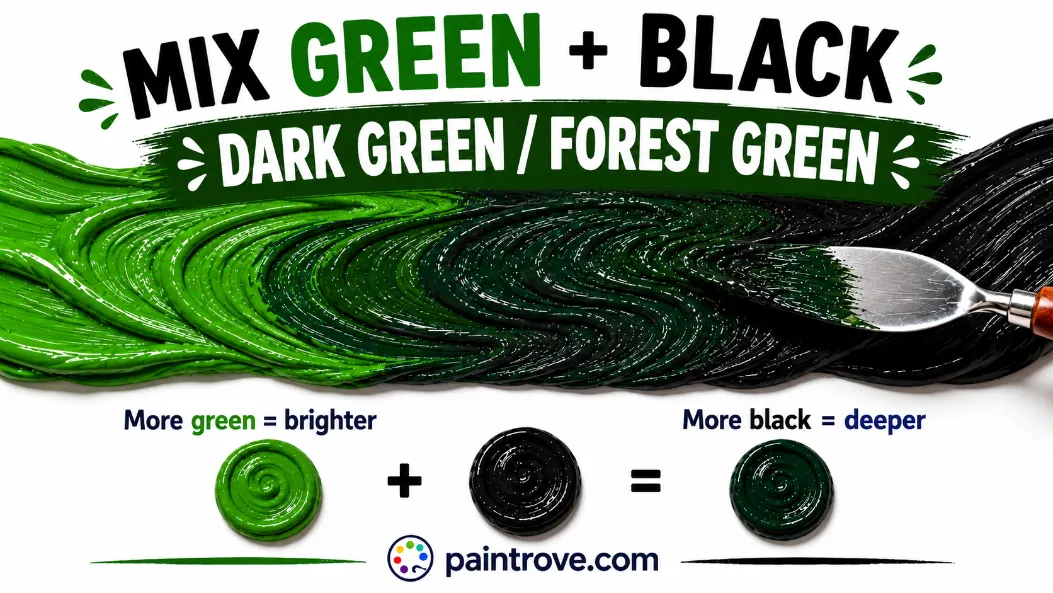
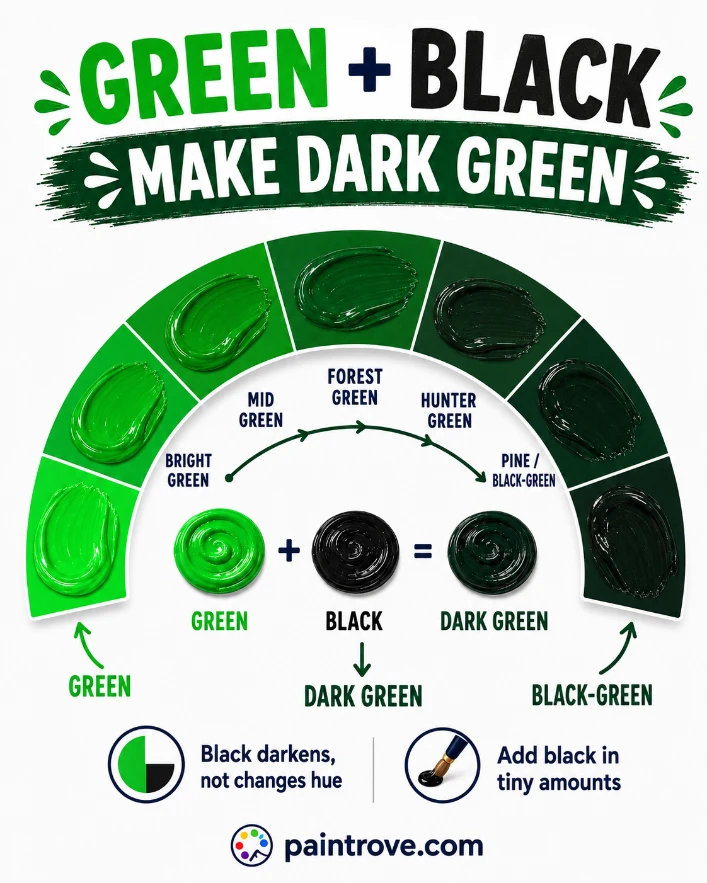
What Color Do Green and Black Make? Mix green and black together and you get a dark green, most often a deep forest or pine green. A little black turns a bright green into rich forest green at hex #228B22, and more black pushes it toward the near-black darkness of pine and hunter green. Black does not change green into a new color; it simply deepens and slightly cools whatever green you start with.
That is the simple answer, and it is mostly correct. But there is a catch worth knowing: black is the trickiest way to darken green, because it can quietly drain the life out of the color and leave it flat or grayish.
This guide covers exactly what black and green make, the ratios and hex codes for every dark green, why black behaves the way it does, and the pro techniques for mixing deep greens that stay vivid instead of going dead.
Why Green and Black Make Dark Green
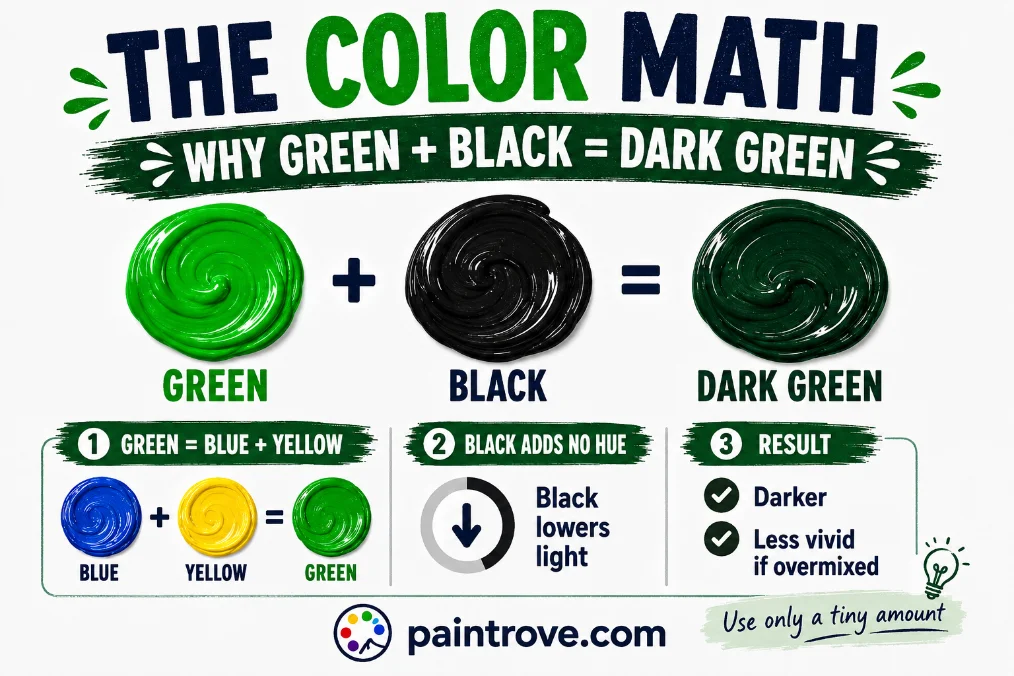
Black is not a color in the usual sense. It is the absence of reflected light, and in mixing it works by absorbing light rather than adding a hue. So when you add black to green, you are not introducing any new color information. You are just lowering how much light the mix reflects, which the eye reads as a darker version of the same green.
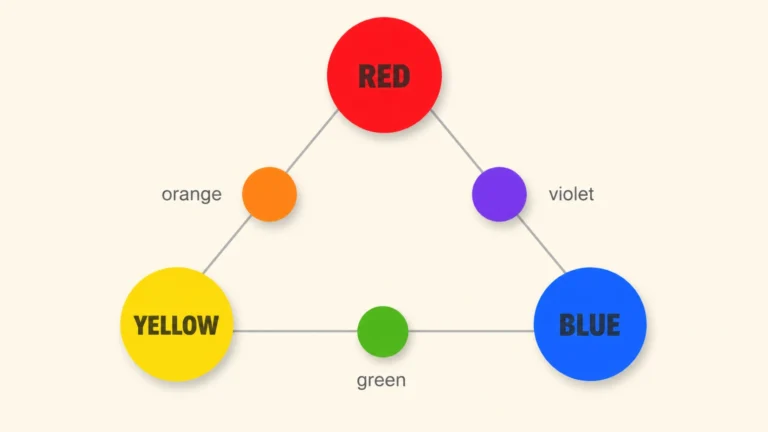
Green itself is a secondary color, made from blue and yellow, as covered in what blue and yellow make. Black does not care about that internal recipe; it darkens the whole thing uniformly. Whatever green you begin with, from a yellow-leaning lime to a blue-leaning teal, black takes it down toward its darkest version. For the full range of the parent color, see what colors make green.
There is one subtle shift, though. Most black pigments are not perfectly neutral; they lean slightly cool or slightly warm. The most common black, ivory black, is actually a touch warm and brownish, while mars black and lamp black are cooler. That slight bias means black can nudge your green a little warmer or cooler as it darkens it, which matters when you are chasing a specific forest tone.
Green and Black Combination Ratios and Hex Codes
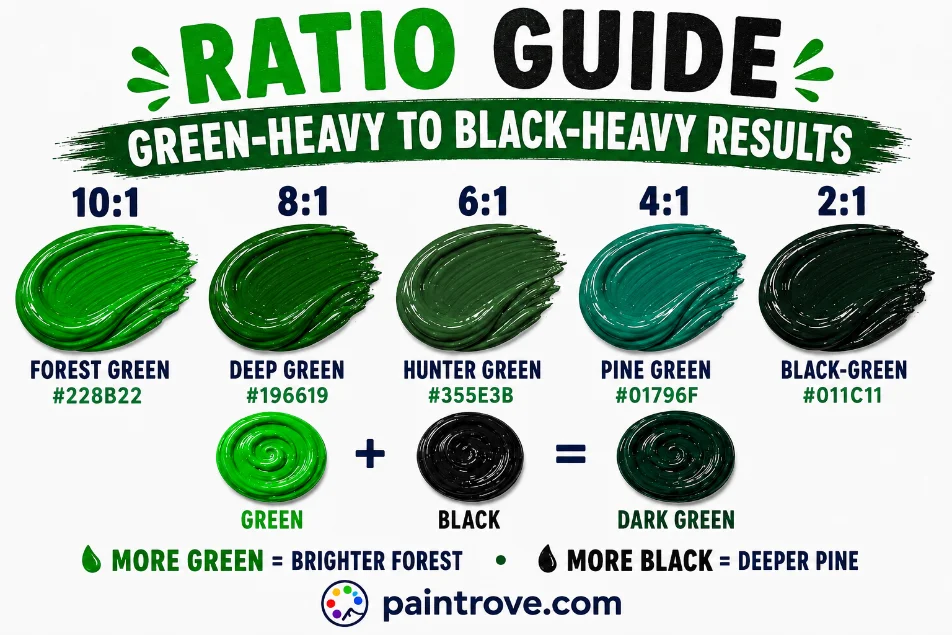
A little black goes a very long way. Black is one of the strongest pigments on any palette, so the ratios here are heavily weighted toward green:
| Ratio (Green : Black) | Resulting shade | Hex code |
|---|---|---|
| 10 : 1 | Rich forest green | Hex #228B22 |
| 8 : 1 | Deep green | Hex #196619 |
| 6 : 1 | Hunter green | Hex #355E3B |
| 4 : 1 | Pine green | Hex #01796F |
| 3 : 1 | Dark forest green | Hex #013220 |
| 2 : 1 | Near-black green | Hex #011C11 |
| 10 : 1 plus white | Muted deep sage | Hex #5F7161 |
Practical notes:
- Add black to green, never green to black, and add it in tiny amounts. A brush-tip of black shifts a whole pile of green. It is far easier to add more than to rescue a mix that went too dark.
- Mix thoroughly before judging. Half-mixed black leaves streaks that look darker than the finished blend.
- Test on white paper and let it dry. Dark greens are hard to read in a pile, and acrylics dry darker still.
Every Dark Green You Can Make
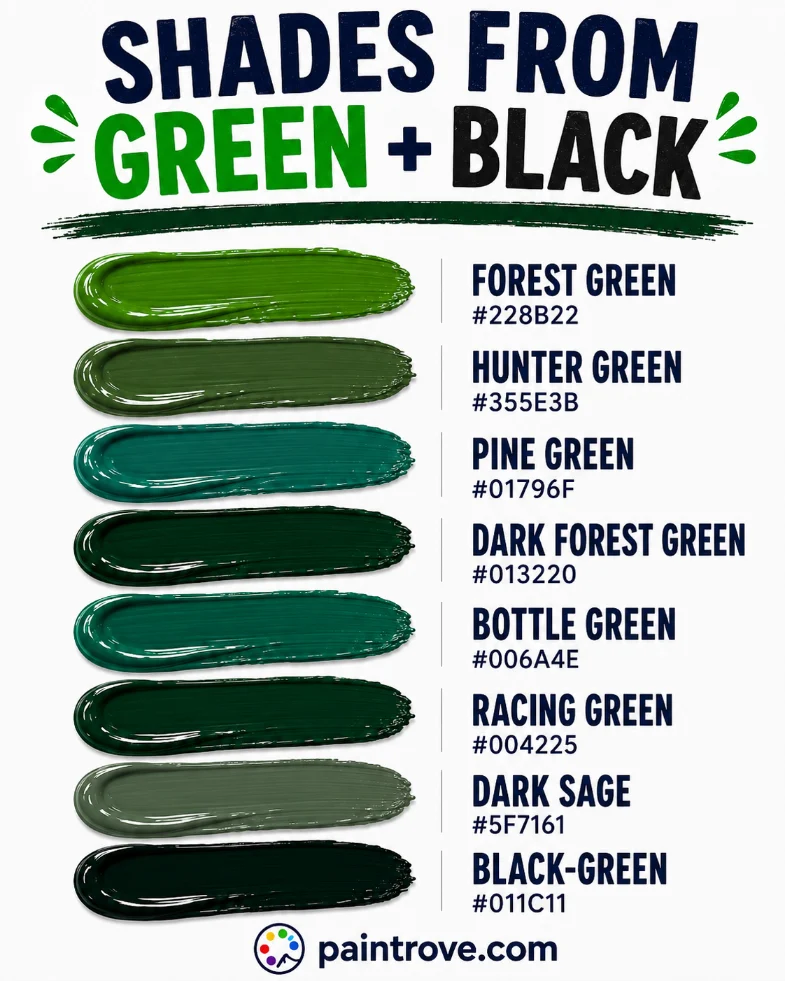
Starting green and a touch of black together cover the full range of deep greens. The reference table, with hex codes in plain text:
| Shade | Hex code | How to mix it |
|---|---|---|
| Forest green | Hex #228B22 | Green plus a small amount of black |
| Hunter green | Hex #355E3B | Green plus black, slightly more |
| Pine green | Hex #01796F | Blue-green plus black |
| Dark forest green | Hex #013220 | Green plus more black |
| Bottle green | Hex #006A4E | Blue-leaning green plus black |
| Racing green | Hex #004225 | Deep green plus black |
| Hunter’s green | Hex #3B5323 | Yellow-leaning green plus black |
| Olive drab | Hex #6B8E23 | Yellow-green plus a touch of black |
| Dark sage | Hex #5F7161 | Muted green plus black plus a little white |
| Emerald (deepened) | Hex #0B6623 | Bright green plus a touch of black |
| Myrtle green | Hex #317873 | Teal-green plus black |
| Black-green | Hex #011C11 | Green plus heavy black |
The Catch: Why Black Can Ruin Your Green
Here is what most quick answers leave out. Black is the fastest way to darken green, but often the worst. It tends to do two things that flatten the color:
It desaturates. Black does not just darken; it also mutes. Push too far and a lively green turns into a dull, grayish dark that reads as muddy rather than rich. The very saturation that made the green appealing is the first thing black takes away.
It deadens. Because black adds no hue of its own, a green darkened only with black can look lifeless next to a green darkened with actual color. Painters describe these as dead darks, and once you learn to spot them, cheap black-darkened greens look obviously flat.
This does not mean never use black. A tiny amount, especially a cooler black like mars black, deepens forest and hunter greens beautifully. The problem is only heavy-handedness. The rule is the same as with every mix: add black last, in the smallest amounts, and stop early.
The Better Ways to Make Dark Green
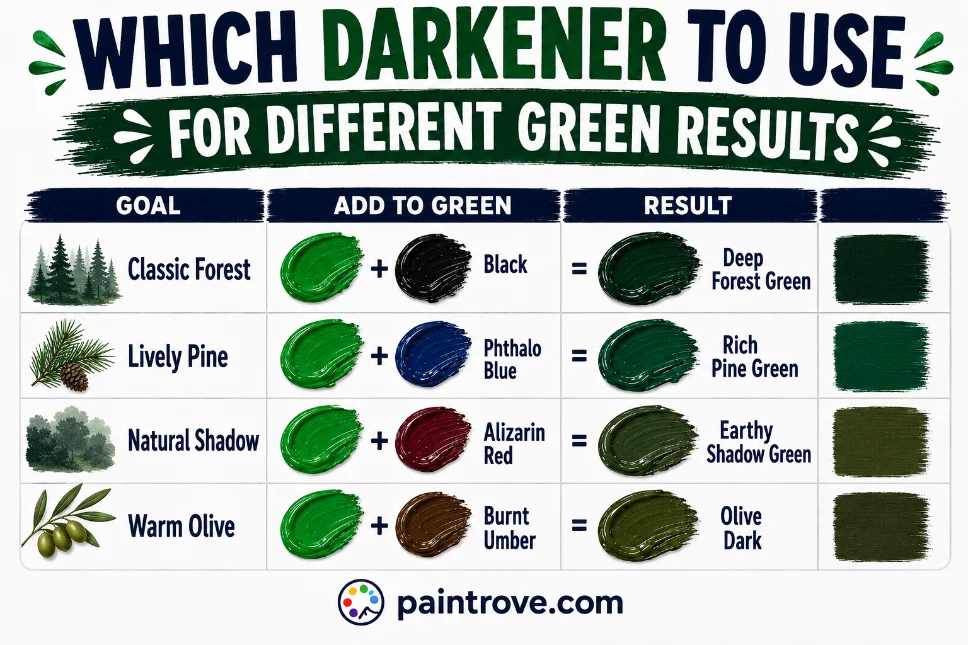
Professional painters usually reach for something other than black to build their deepest greens. Here are the techniques worth knowing:
Darken with more blue. Adding a deep blue like ultramarine or phthalo blue to green deepens it while keeping it chromatic and alive. This is how you get rich bottle and pine greens that still glow. The blue also cools the green naturally, which suits most forest and evergreen subjects, and pushed far enough it slides toward the deep teals of blue and green mixed darkened with blue and black.
Darken with the complement, red. Green’s complement is red, and a small amount of a deep red or alizarin crimson darkens green into a natural, slightly earthy shadow green. This is the classic way to mix believable dark foliage, since real shadows in nature are never pure black. It is the same complementary logic that lets red and green mixed collapse all the way to brown when taken further.
Use burnt umber or dark brown. A touch of burnt umber deepens green toward a warm, earthy dark, ideal for tree trunks meeting leaves, or for olive and moss shadows. It is gentler than black and adds warmth.
Start with a naturally dark green pigment. Some greens, like sap green and phthalo green, are already deep and rich straight from the tube, needing very little darkening at all.
For comparison, adding white instead takes green the other direction entirely, into the mint and pastel tones covered in green and white mixed, and adding gray gives the sage and moss tones of green and gray mixed.
Black and Green Combination in Light and Print
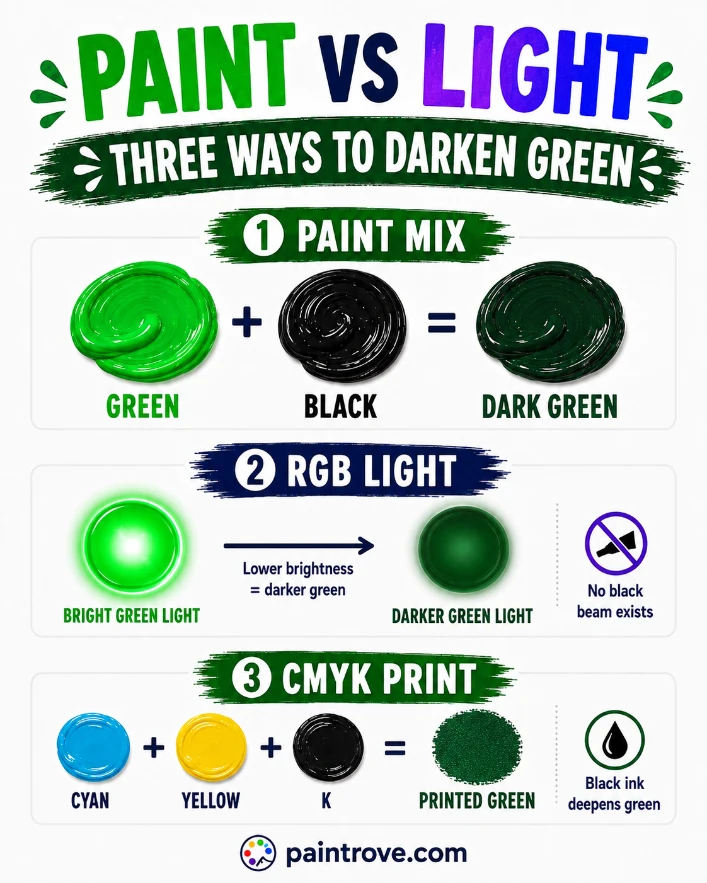
Everything above describes paint. In other systems, black behaves differently, and in one of them it barely exists.
In light, using the RGB model, black is not a color at all. It is what you get when the screen emits no light, all channels at zero. You cannot mix a black light beam, so you cannot “add black” to green light the way you add black paint. On a screen, a darker green is simply green displayed at lower brightness, which produces the same visual result, a deep green, by a completely different mechanism.
In printing, using the CMYK color model, black is very real and very important. The K in CMYK stands for the key black plate. Dark green in print comes from cyan and yellow inks with black added, working much like the paint version, since both are subtractive systems.
| System | How dark green is made | Notes |
|---|---|---|
| RYB (paint) | Green plus a little black, or blue, red, umber | Black works but can dull |
| RGB (light) | Green at low brightness | No black beam exists |
| CMYK (printing) | Cyan and yellow plus black (K) | Black is a base ink |
Troubleshooting Black and Green Combination Mixes
The green went gray and muddy. Too much black, which desaturated it. Rebuild and use far less black, or darken with blue instead to keep the green chromatic.
The dark green looks flat and dead. A classic black-only dark. Add a touch of the original bright green back in, or remix darkening with blue, red, or burnt umber for a living dark.
The green shifted color unexpectedly. Your black has a bias. Ivory black is warm and can push green toward olive; a cool black like mars keeps it truer. Choose your black to match the shift you want.
It looks fine wet but dull dry. Standard acrylic behavior, worse with dark colors. Mix a touch brighter and lighter than your target.
You cannot get it dark enough without killing it. Reach for a naturally deep pigment like phthalo green rather than forcing a light green darker with black.
Dark Green in Art, Fashion, and Design
Deep greens carry a sense of depth, nature, and quiet luxury, and they show up everywhere once you start looking.
In Art
Dark greens are the backbone of landscape painting: the shadowed depths of forests, the far side of foliage, the cool darks under a tree canopy. Skilled painters almost never reach for black to mix these, precisely because natural darks contain color; a forest shadow mixed from green and deep blue, or green and its red complement, reads as alive in a way a black-darkened green never does. Learning to build living darks is one of the marks of an experienced painter, and green is where that lesson is often first learned.
In Fashion
Dark green has quietly become one of fashion’s most sophisticated colors. Forest, hunter, and bottle greens read as rich and understated, a warmer and more interesting alternative to black or navy for tailoring, coats, and eveningwear. British racing green carries a heritage, sporting association, while emerald and deep pine anchor autumn and winter palettes. Dark green pairs beautifully with camel, cream, burgundy, and gold, which is why it reads as expensive.
In Interiors and Branding
Deep green has led the way in interiors in recent years, from forest-green kitchen cabinets to hunter-green feature walls, prized for feeling both moody and natural. It pairs with brass, wood, and dark blues for a rich, grounded look. In branding, dark green signals luxury, heritage, sustainability, and trust at once, which is why it appears across premium, financial, and eco-conscious identities that want depth without the coldness of black.
Quick Reference: Green + Black Cheat Sheet
| Question | Answer |
|---|---|
| Green + black in paint | Dark green (hex #228B22 and deeper) |
| A little black | Forest, hunter green |
| More black | Pine, racing, near-black green |
| The risk | Black desaturates and can deaden green |
| Better dark-green routes | Add blue, red, or burnt umber instead |
| Green + black in light | Green at low brightness (no black beam) |
| Green + black in print | Cyan and yellow plus black key ink |
| Best black for true darks | Cool black like mars black |
| To lighten instead | Add white for mint and pastel green |
FAQs: What Color Do Green and Black Make When Mixed
What color do green and black make when mixed?
A dark green, such as forest, hunter, or pine green. Black does not create a new color; it deepens and slightly cools whatever green you start with, taking it toward its darkest version.
Why does my green turn muddy when I add black?
Black desaturates as it darkens. Too much of it drains the green’s vividness and leaves a dull, grayish dark. Use only a tiny amount, or darken with blue, red, or burnt umber instead to keep the green rich.
What is the best way to make dark green without black?
Add a deep blue like ultramarine or phthalo blue to keep the green chromatic and alive, or add a small amount of red, green’s complement, for a natural shadow green. Burnt umber gives a warmer earthy dark. All three beat black for living darks.
How do you make forest green?
Start with a medium green and add a small amount of black or, better, a touch of deep blue, until you reach a rich deep green around hex #228B22. A blue-leaning green darkened slightly gives the most convincing forest tone.
Does green and black make a different color or just darker green?
Just a darker green. Because black has no hue of its own, it only lowers the brightness and saturation of the green. To actually shift the color, you need to add another hue.
What black should I use to darken green?
A cool black like mars black or lamp black keeps the green truest. Ivory black is slightly warm and can nudge green toward olive, which is useful if that is the tone you want but a surprise if it is not.
Do green and black make dark green in all color systems?
In paint and print, yes, since both are subtractive. In light (RGB), there is no black beam to add, so a dark green on screen is simply green shown at low brightness, the same result reached a different way.
Black and green make dark green, from forest to near-black pine. Black is the quickest route there, but rarely the best; for deep greens that stay alive, reach for blue, red, or burnt umber instead, and save black for the smallest final adjustments.
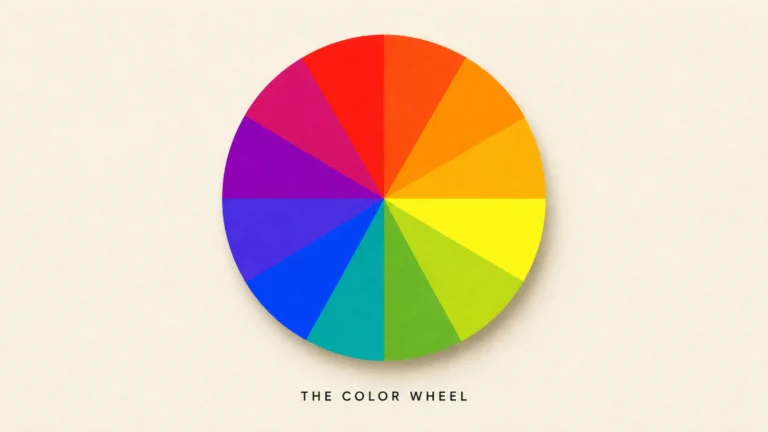
To explore the rest of the family, see our guide to what colors make green, compare the lightening route at green and white mixed, or step back to the color wheel.