What Colors Make White? (Light vs Paint Explained)
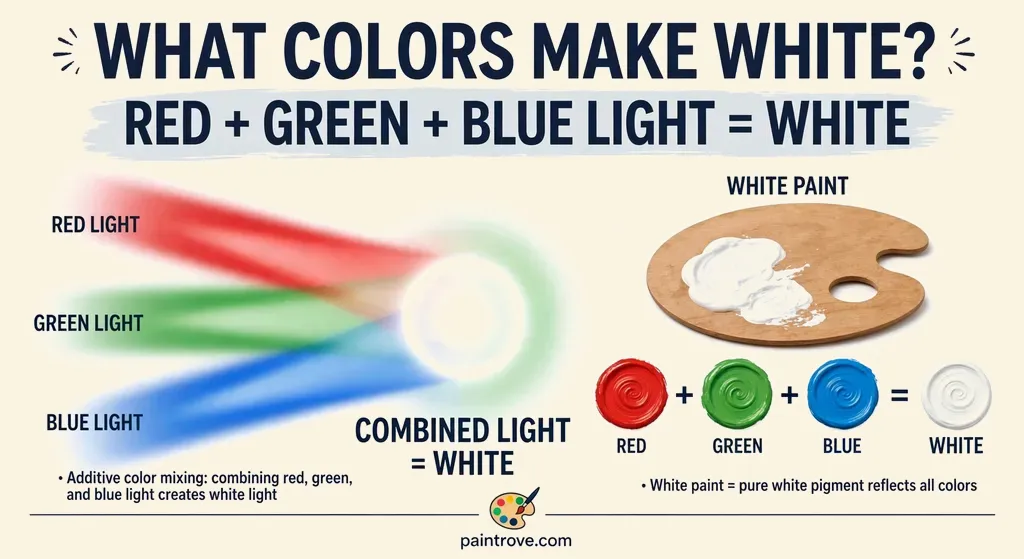
In light, red, green and blue make white. Combine all three at full intensity and the result is white, which is RGB 255, 255, 255 or the white rgb code Hex #FFFFFF.
In paint, no colors make white. White is the opposite of a mixed colour. Every pigment you add absorbs more light, so mixing paints always moves toward darkness, never toward white. White has to come from a pigment that reflects nearly everything: titanium dioxide, zinc oxide or lead carbonate.
Those two answers are the entire subject. What colors make white depends on whether you are adding light or subtracting it, and the confusion between the two is why this question gets contradictory answers everywhere. This guide covers both systems, every white rgb value worth knowing, the different white pigments, and how to mix off-whites that actually look right.
What colors make white in light?
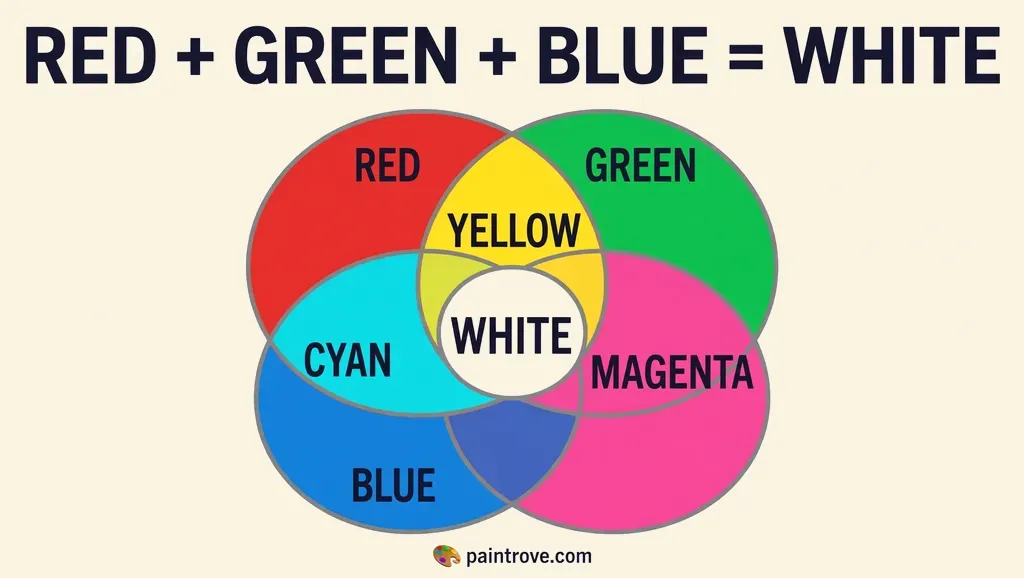
Red, green and blue, at full strength. These are the three additive primaries, and together they produce white because between them they cover the whole visible spectrum.
This is how every screen you own works. A white pixel is not displaying a white substance. It is firing a red, a green and a blue subpixel all at maximum, and your eye combines them into white. Look closely enough at a white area on a monitor with a magnifying glass and you will see the three separate colours.
The same principle works with stage lighting, torches and any other light source. Shine a red, a green and a blue spotlight onto the same patch of a white wall and the overlap reads as white. The University of Wisconsin–Madison Ingersoll Physics Museum demonstrates exactly this.
What colours make white besides those three? Two complements also make white in light. Red and cyan, green and magenta, or blue and yellow light will each combine to white, because each pair covers the full spectrum between them. This is the mirror image of what happens in paint, where complements cancel toward black instead.
So in additive colour, white is the sum of everything and black is the absence of everything. In subtractive colour it is the reverse.
Why no colors make white in paint
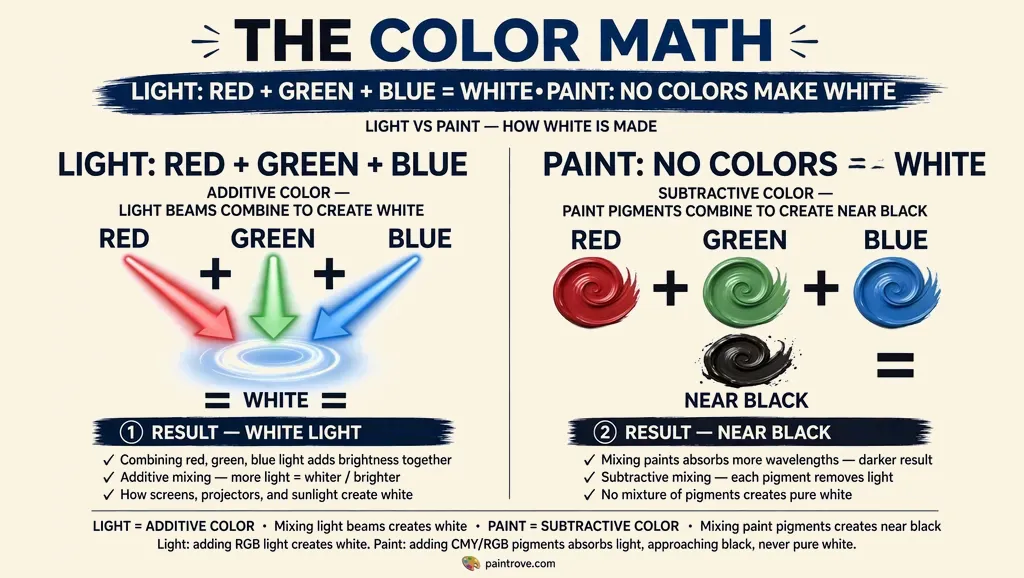
Mixing pigment works by subtraction. Each pigment absorbs certain wavelengths and reflects the rest. Add a second pigment and only the wavelengths both of them reflect survive, so the mixture is always darker than either ingredient.
Follow that logic to its end and you reach black, which is why complements mixed in paint land on the near-blacks covered in what colors make black. There is no route in the other direction. Nothing you add can make a mixture reflect more light than its brightest component already did.
What makes white in pigment is therefore not a mixture at all but a single highly reflective substance:
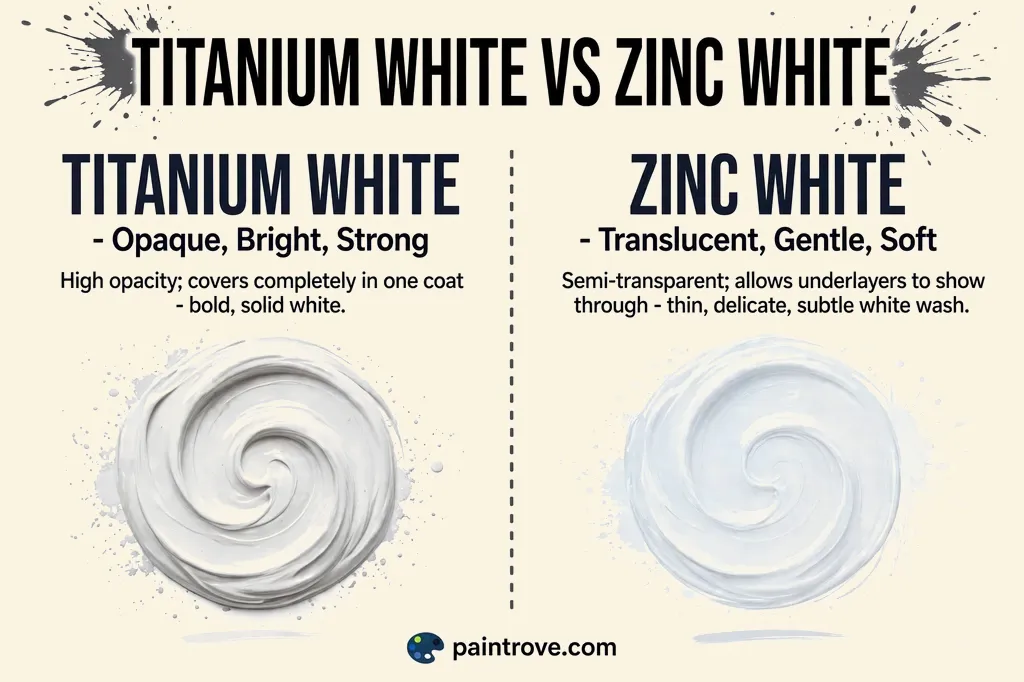
- Titanium white (PW6). Titanium dioxide. The brightest, most opaque white available and the standard choice since the 1920s. It covers almost anything.
- Zinc white (PW4). Zinc oxide. Translucent, much weaker, cooler in tone. Used for gentle tints and glazes where titanium would flatten the result.
- Lead white (PW1). Also called flake or Cremnitz white. Warm, flexible, with a distinctive buttery handling quality. Toxic, and now restricted in many places, but prized by oil painters for centuries.
- Chinese white. A zinc white formulated for watercolour.
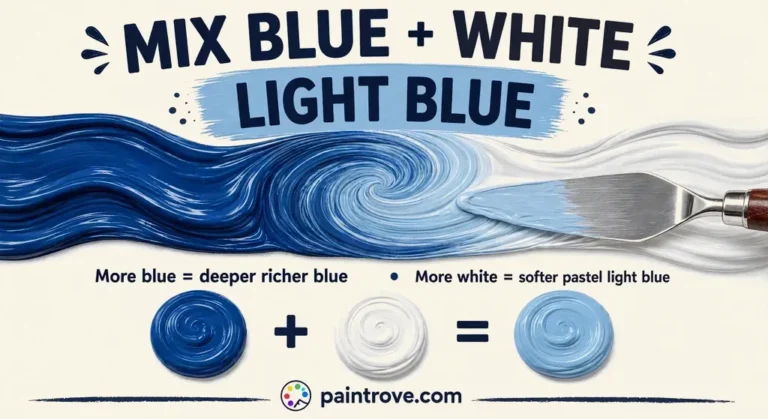
Each behaves differently in a mixture, which matters more than most beginners expect. Titanium white tints powerfully and flattens; zinc white tints gently and preserves luminosity. The difference shows up clearly in any pale mix, including blue and white mixed and yellow and white mixed.
How to make white in practice
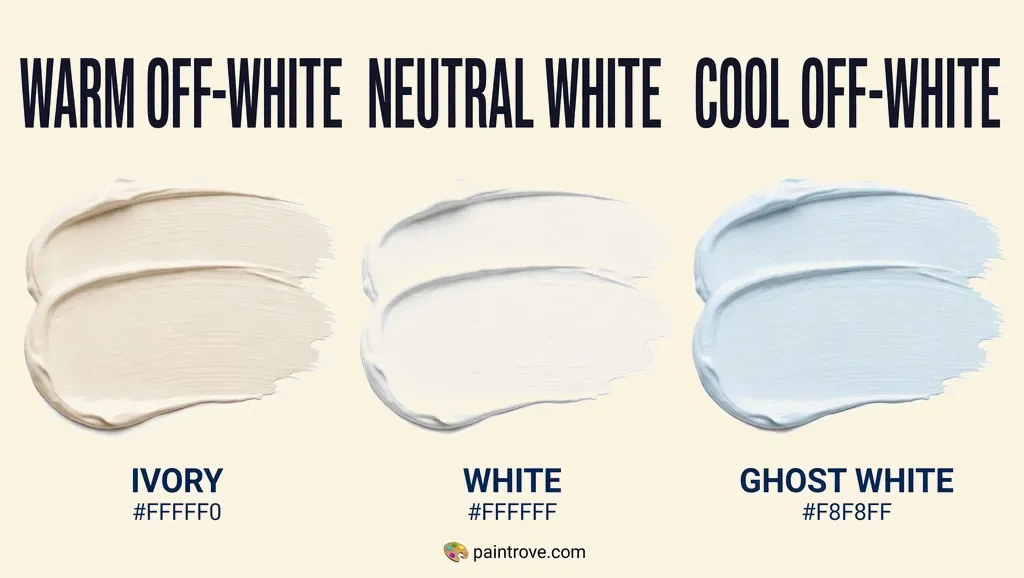
There is no single answer to what color makes white, because no colour does. The honest answer to how to make white is: you cannot mix it, so you buy it or you leave it.
The second half of that is the part people forget. In transparent media, white is not applied at all:
- Watercolour. The white of the paper is the white of the painting. Areas are reserved rather than painted, using masking fluid or careful brushwork. Many watercolourists own no white paint at all.
- Transparent inks and glazes. Same principle. The ground supplies the light.
- Printing. There is usually no white ink. White is simply the paper showing through where no ink is laid.
In opaque media you need a pigment, but you often do not want it pure, and how to make white color read convincingly is a separate question from where the pigment comes from:
A pure titanium white straight from the tube is rarely the right white for a painting. It reads as a flat, glaring hole in the surface, because nothing in nature is that bright or that neutral. Experienced painters almost always break it slightly:
| Target white | How to mix it |
|---|---|
| Warm white | Titanium white with the smallest trace of yellow ochre |
| Cool white | Titanium white with a trace of ultramarine or black |
| Creamy white | White with a touch of Naples yellow or raw sienna |
| Pink-warm white | White with a trace of burnt sienna |
| Greyish white | White with a trace of a neutral grey |
| Snow or cloud white | White tinted toward blue in shadow, toward yellow in light |
How to make white colour behave in a painting, in one rule: tint it a fraction toward the light source and a fraction toward the shadow, and never leave large areas of it untouched from the tube.
White rgb and hex codes
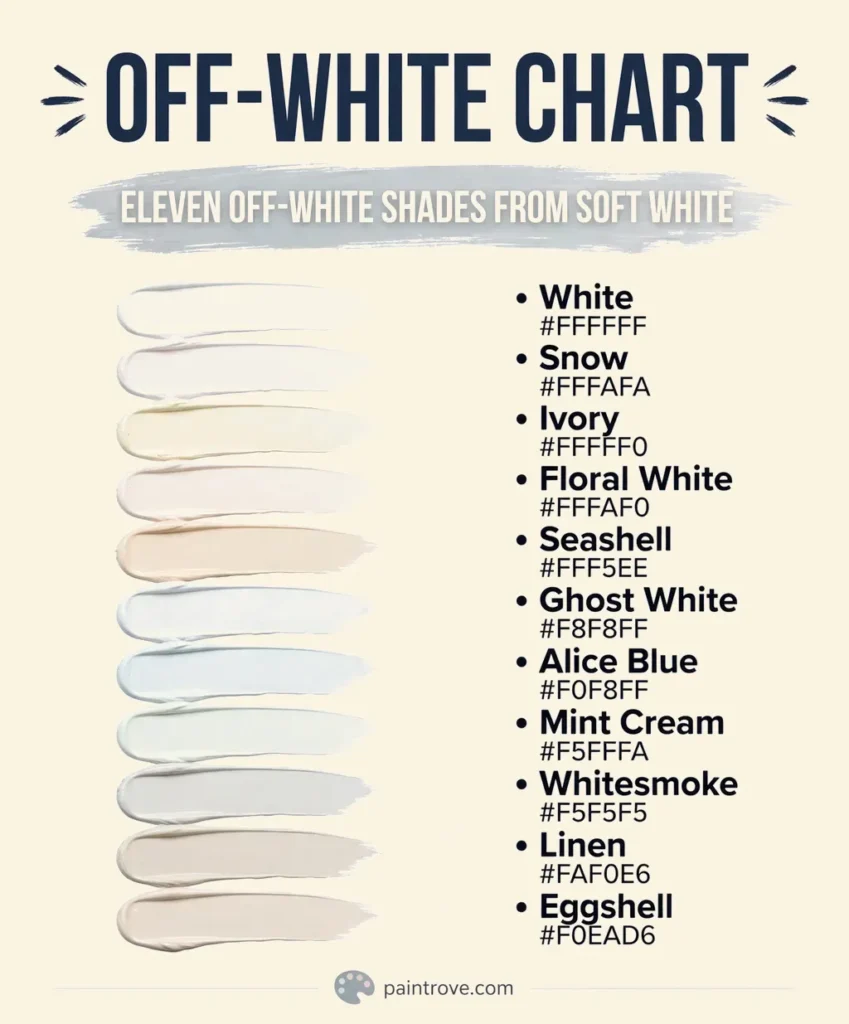
The white rgb code is 255, 255, 255, which is Hex #FFFFFF. All three channels at maximum, so rgb white is the brightest value a screen can display.
| Name | Hex | RGB | Character |
|---|---|---|---|
| White | #FFFFFF | 255, 255, 255 | Pure, maximum on all channels |
| Snow | #FFFAFA | 255, 250, 250 | Very slightly pink |
| Ivory | #FFFFF0 | 255, 255, 240 | Slightly yellow |
| Floral white | #FFFAF0 | 255, 250, 240 | Soft warm white |
| Seashell | #FFF5EE | 255, 245, 238 | Warm, slightly peach |
| Ghost white | #F8F8FF | 248, 248, 255 | Very slightly blue |
| Alice blue | #F0F8FF | 240, 248, 255 | Cool, clearly blue-leaning |
| Mint cream | #F5FFFA | 245, 255, 250 | Very slightly green |
| Whitesmoke | #F5F5F5 | 245, 245, 245 | Neutral off-white |
| Linen | #FAF0E6 | 250, 240, 230 | Warm, natural |
| Eggshell | #F0EAD6 | 240, 234, 214 | Muted, slightly grey-yellow |
The pattern in that table is the whole logic of off-whites. Whenever all three channels are equal, the result is neutral. Lower them together and you get grey. Lift one or two slightly above the others and you get a tinted white: more red and green gives a warm ivory, more blue gives a cool ghost white.
That logic holds for rgb white at every level of tinting. In print, rgb for white does not translate. There is normally no white ink, so white is 0, 0, 0, 0 in CMYK, meaning no ink at all. Where white must appear on coloured or transparent stock, a dedicated spot white ink is used as a fifth plate.
Why white looks different under different light
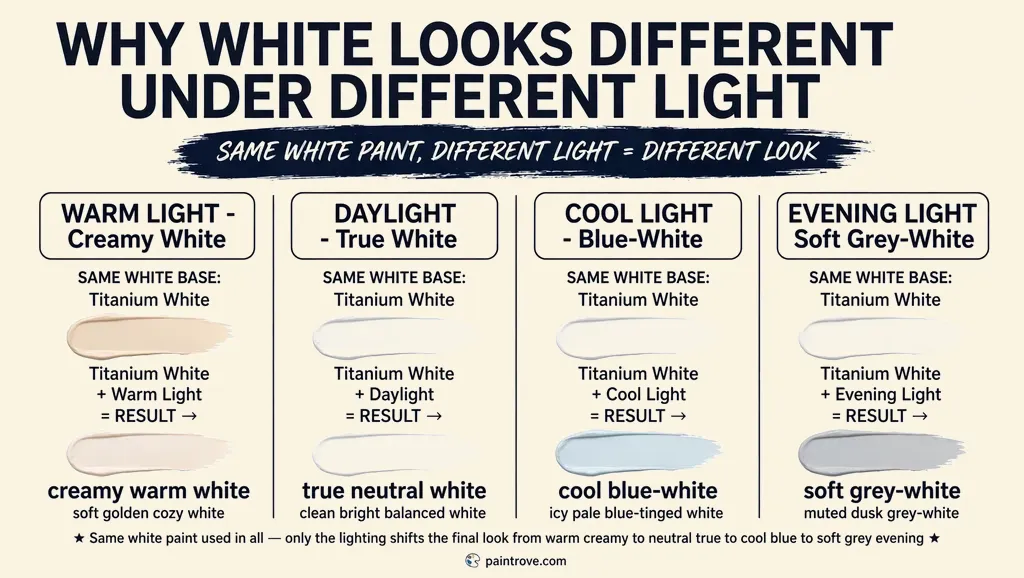
What makes white look like one colour indoors and another outdoors is the light itself. White is the most context-dependent colour there is, which is why choosing white paint for a room is so much harder than it sounds.
A white surface reflects whatever light falls on it. Under warm incandescent light it reads creamy. Under cool north-facing daylight it reads blue-grey. Under fluorescent light it can look slightly green. The paint has not changed at all; the light reaching your eye has.
This is also why off-whites dominate interior paint ranges. A pure brilliant white reads as cold and clinical in most rooms, so nearly every white on a paint chart is tinted a fraction toward yellow, red, grey or green. The yellowish ones are the most common, which is the family covered in brown and white mixed at its palest end.
Three practical rules:
- Test on the actual wall, in large patches, at several times of day.
- Match the white to the room’s light. Warm whites suit north-facing rooms that get cool light; cool whites suit south-facing rooms that get warm light.
- Check it against your trim and ceiling. Two whites side by side reveal undertones that neither shows alone.
White as a tinting colour
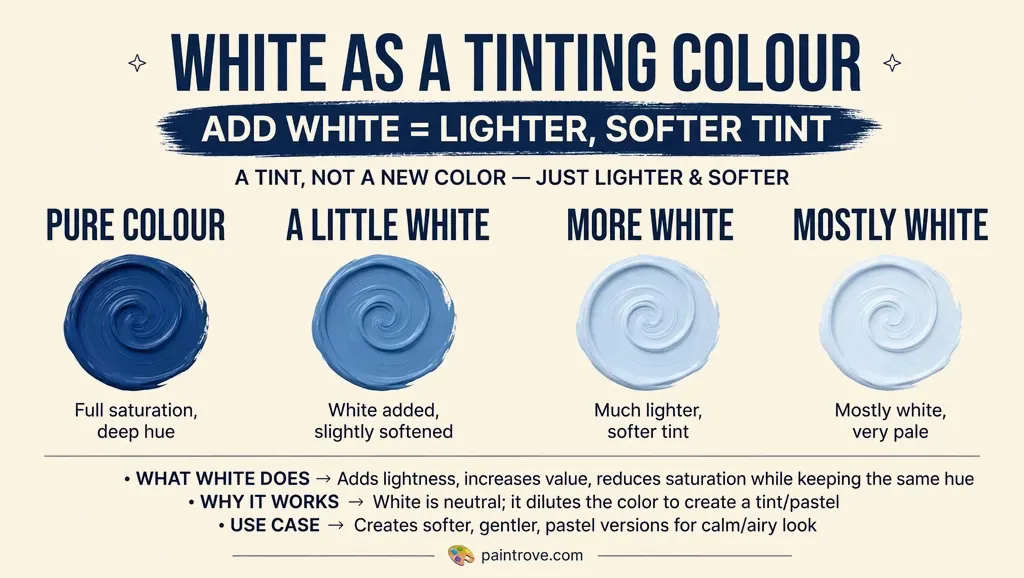
White’s main job in painting is not covering surfaces but making tints. Adding white to any hue produces a tint: the hue stays, the value rises, the saturation falls.
| Hue plus white | Result |
|---|---|
| Red | Pink, as in red and white mixed |
| Blue | Sky blue and baby blue |
| Green | Pastel and mint green, as in green and white mixed |
| Purple | Lavender, as in purple and white mixed |
| Yellow | Cream, with very little change in value |
| Black | Grey |
Two things are worth knowing before you reach for it.
White lowers saturation as well as raising value. A heavily tinted colour always looks chalkier and weaker than the pure hue. If you want a pale colour that still glows, dilute it or glaze it over white rather than mixing white into it.
Yellow is the exception that proves the rule. Because yellow already sits at the highest value of any hue, white has almost nowhere to raise it and mostly just removes colour. That is why pale yellows go milky so readily.
Frequently asked questions
What colors make white?
In light, red, green and blue at full intensity make white, which is why screens display white by firing all three subpixels at maximum. In paint, no colours make white. Mixing pigment always darkens, so white must come from a reflective pigment such as titanium dioxide or zinc oxide.
What color makes white when mixed with another?
None, in paint. Two complements mixed in pigment move toward black, not white. In light the opposite is true: red and cyan, green and magenta, or blue and yellow light each combine to white, because every pair covers the full visible spectrum between them.
How to make white paint from other colours?
You cannot. Every pigment added to a mixture absorbs more light, so the result is always darker than the brightest ingredient. White paint is a single highly reflective pigment rather than a mixture. Titanium dioxide is the standard, with zinc oxide used for gentler tints.
How to make white color look natural rather than flat?
Tint it slightly off neutral. Pure white reflects everything evenly, which no real surface does, so an untinted white reads as a gap in the painting. A trace of yellow ochre, ultramarine or grey is usually enough to make it sit in the scene.
What is the white rgb code?
255, 255, 255, which is Hex #FFFFFF. All three channels sit at maximum, meaning full red, green and blue light. Any value where the three channels are equal is neutral: lower them together and you get grey, lift one or two slightly and you get a tinted off-white.
What is rgb for white in printing?
RGB does not apply in print. White is normally 0, 0, 0, 0 in CMYK, meaning no ink at all, with the paper supplying the white. Where white must print on coloured or clear stock, a dedicated spot white ink is run as an extra plate.
How to make white colour look right in a painting?
Tint it slightly rather than using it straight from the tube. Pure titanium white reads as a flat, glaring hole because nothing in nature is that bright or neutral. Add a trace of yellow ochre for warmth, or ultramarine for coolness, and shift it toward the light source.
What colours make white in additive colour?
Red, green and blue, the three additive primaries. Combined at full intensity they cover the whole visible spectrum and the eye reads the result as white. This is the basis of every screen, projector and stage lighting rig, and it is the exact reverse of how pigment behaves.
What two colors make white?
No two pigments make white in paint. In light, any complementary pair does: red with cyan, green with magenta, or blue with yellow. Each pair covers the full spectrum between them, so the combined light reads as white even though neither colour alone is close.
Why are there so many different whites?
Because a pure neutral white reads as cold and clinical in most settings, so nearly every commercial white is tinted slightly toward yellow, red, grey or green. White also reflects whatever light falls on it, so the same paint looks creamy under warm light and blue-grey under daylight.
What is the difference between titanium and zinc white?
Titanium white is highly opaque and strong, giving flat, solid covering power and powerful tints. Zinc white is translucent and much weaker, lightening gently and preserving luminosity. Use titanium for coverage and opaque pastels, zinc for soft tints, glazes and anything that needs to glow.
Does white count as a colour?
In pigment, yes: it is a physical paint with its own pigment codes. In light, it is all colours combined rather than one of them. In colour theory it is achromatic, having value but no hue or saturation, which is why it sits off the colour wheel alongside black and grey.
How do watercolourists make white?
Mostly by leaving the paper untouched. The white of the paper is the white of the painting, reserved with masking fluid or careful brushwork. Opaque white paint exists for watercolour but is used sparingly, since it flattens the transparency the medium depends on.
White at a glance
| If you want | Do this |
|---|---|
| White in light | Red, green and blue at full intensity |
| White on a screen | Hex #FFFFFF, RGB 255, 255, 255 |
| White in paint | Buy it; it cannot be mixed |
| White in watercolour | Leave the paper untouched |
| White in print | No ink at all, 0, 0, 0, 0 CMYK |
| A warm white | Titanium white plus a trace of yellow ochre |
| A cool white | Titanium white plus a trace of ultramarine |
| A soft tint of another colour | Zinc white rather than titanium |
What colors make white has two correct answers and they point in opposite directions: red, green and blue in light, and nothing at all in paint. Three things are worth remembering: pigment mixing can only ever move toward darkness, white paint is a reflective substance rather than a mixture, and a white straight from the tube almost always needs tinting before it looks convincing.