What Color Do Yellow and Pink Make When Mixed? (Peach)
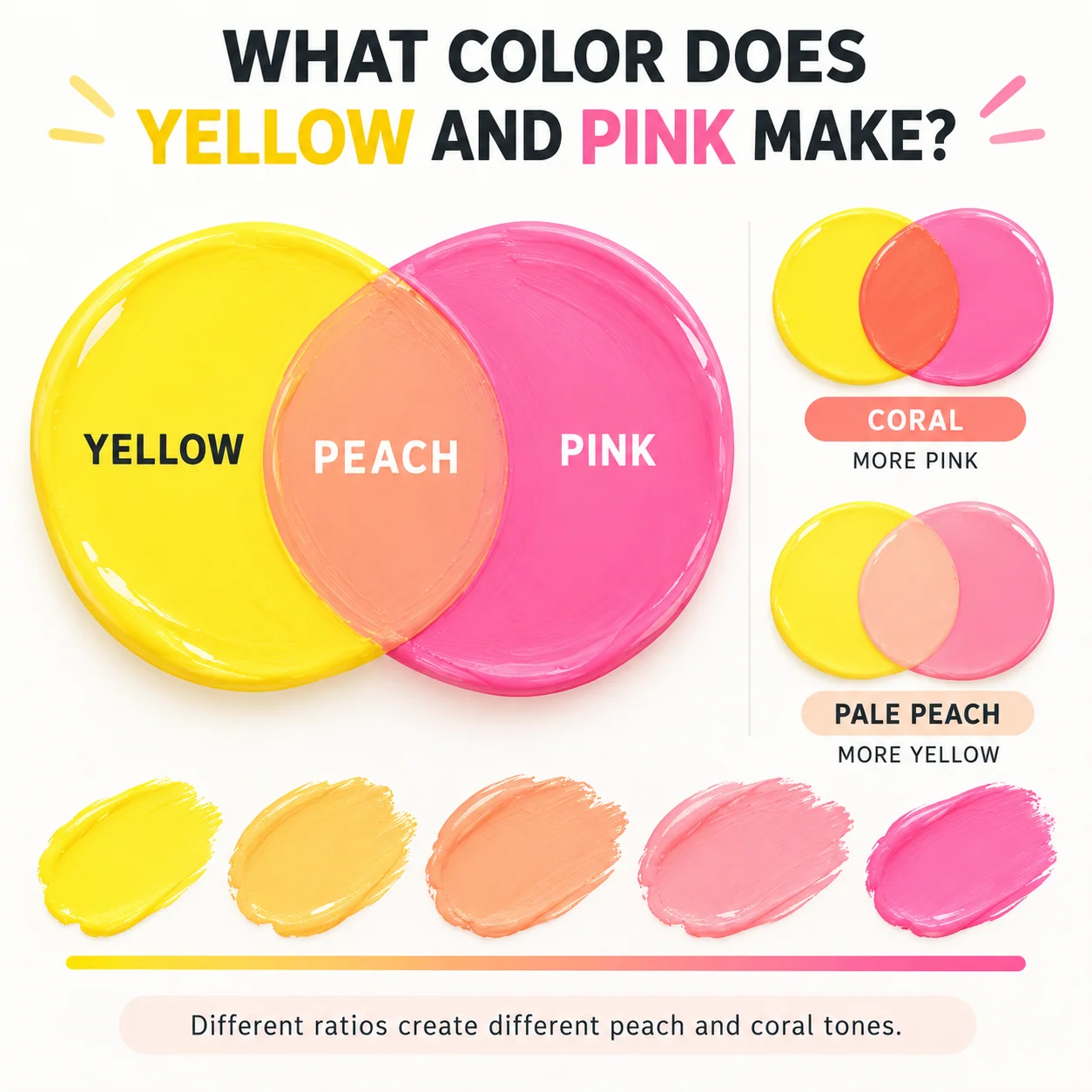
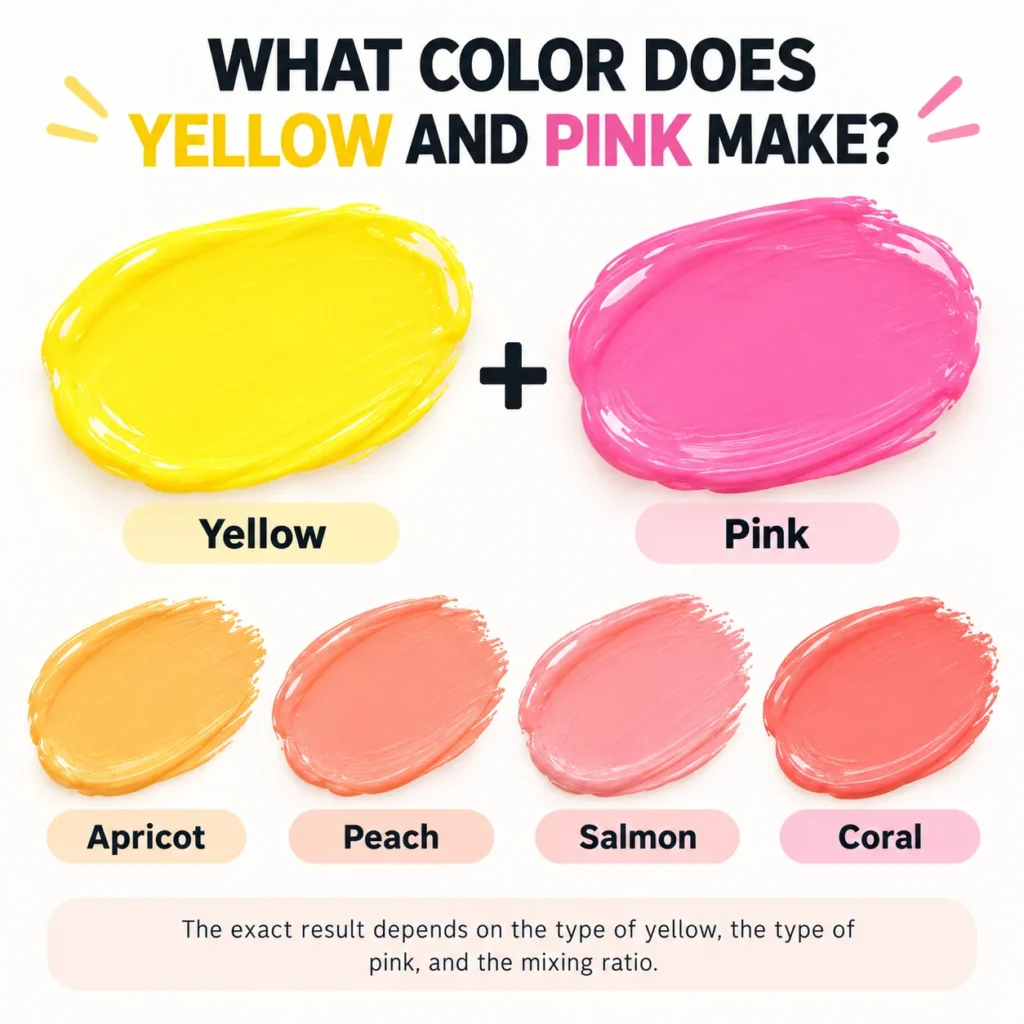
What Color Do Yellow and Pink Make? Yellow and pink make peach, a soft warm hue sitting around Hex #FFE5B4. It is essentially a pale, gentle orange, because pink is red lightened with white and red plus yellow has always made orange.
How pale depends entirely on your ratio and your starting shades. A yellow-heavy mix gives a light golden peach. A pink-heavy mix gives coral or salmon. Soft pastel versions of both colors give the classic pale peach; saturated hot pink with a strong yellow gives something much closer to a bright orange.
The order of the names changes nothing. Pink and yellow make the same peach as yellow and pink, and only the proportion and the specific tubes decide where you land.
What color does pink and yellow make?
Peach. More precisely, a tint of orange, which is what peach actually is.
The logic is short. Pink is not a hue in its own right on the traditional color wheel; it is red with white added, which makes it a tint of red. Yellow is a primary. Red and yellow make orange, one of the three secondary colors. So mixing yellow with a lightened red gives you a lightened orange, and that lightened orange is what we call peach.
Yellow mixed with pink therefore behaves like yellow mixed with a diluted red, which is exactly what it is. If you want the wider picture of how pink itself is built before mixing anything into it, the guide to what colors make pink covers the red and white foundation this mix sits on top of.
This is why the result always looks softer than a true orange. The white already present in the pink is doing two things at once: raising the value and lowering the saturation. You are not just mixing two hues, you are mixing two hues with a whitener already stirred into one of them.
Because pink is a tint rather than a pure hue, the answer moves around more than most mixes. Where your peach lands depends on how much white is in the pink to begin with, which is why two people following the same instructions can end up with visibly different results.
Pink and yellow mixing ratios
Every ratio below is a starting point, not a formula. Pink varies enormously between brands, so add gradually and test on scrap first.
| Approximate ratio (pink : yellow) | Result | Roughly matches |
|---|---|---|
| 1 : 4 | Barely warmed yellow, cream-gold | Near Hex #FFF0C0 |
| 1 : 3 | Pale golden peach | Peach, Hex #FFE5B4 |
| 1 : 2 | Classic soft peach | Peach Puff, Hex #FFDAB9 |
| 1 : 1 | Warm apricot | Apricot, Hex #FBCEB1 |
| 2 : 1 | Deeper, pinker peach | Light salmon, Hex #FFA07A |
| 3 : 1 | Coral | Coral, Hex #FF7F50 |
| 4 : 1 | Pink with a warm cast | Salmon, Hex #FA8072 |
Add pink into yellow, not the other way round. Pink carries red, and red has far more tinting strength than yellow even when diluted with white. Starting from a pool of yellow and touching pink into it gives fine control. Working the other way means using a great deal of yellow before the mixture visibly shifts.
Yellow plus pink at roughly two or three parts yellow to one part pink is what most people picture when they imagine peach. Pink mixed with yellow at equal parts is already noticeably deeper than that, and pink and yellow mixed beyond that ratio leaves peach territory entirely for coral.
How to make peach color: three methods
Peach is one of the most requested mixes in painting, and there are three reliable routes to it. Which one answers how to make peach color best for you depends on what is already on your palette.
Method 1: pink plus yellow. The simplest. Mix pink and yellow by starting with a light warm yellow, adding pink in small touches until the color turns soft and warm, then adjusting. Best when you already have a pale pink and want speed.
Method 2: white, red and yellow. The most controllable. Start with a generous pool of titanium white. Add a touch of a warm red such as Cadmium Red Light and blend fully to a pastel pink. Then introduce yellow gradually until it warms into peach. Building the pink yourself means you know exactly how much white is in it, which removes the main source of variation.
Method 3: orange plus white. The fastest if you already have orange. Mix orange to your liking, then fold it into white rather than adding white to the orange. Working white-first keeps the result opaque and creamy instead of thin and streaky. Add a touch of extra red if it reads too yellow.
Method 2 is worth the extra step for anything where you need to reproduce the color later, such as skin tones across multiple sessions. Methods 1 and 3 are fine for one-off work.
Whichever route you use, mix a little lighter than your target if you are working in acrylic, since acrylic dries darker. Watercolor behaves in reverse and dries lighter, so mix stronger than looks right.
Peach, coral, salmon and apricot compared
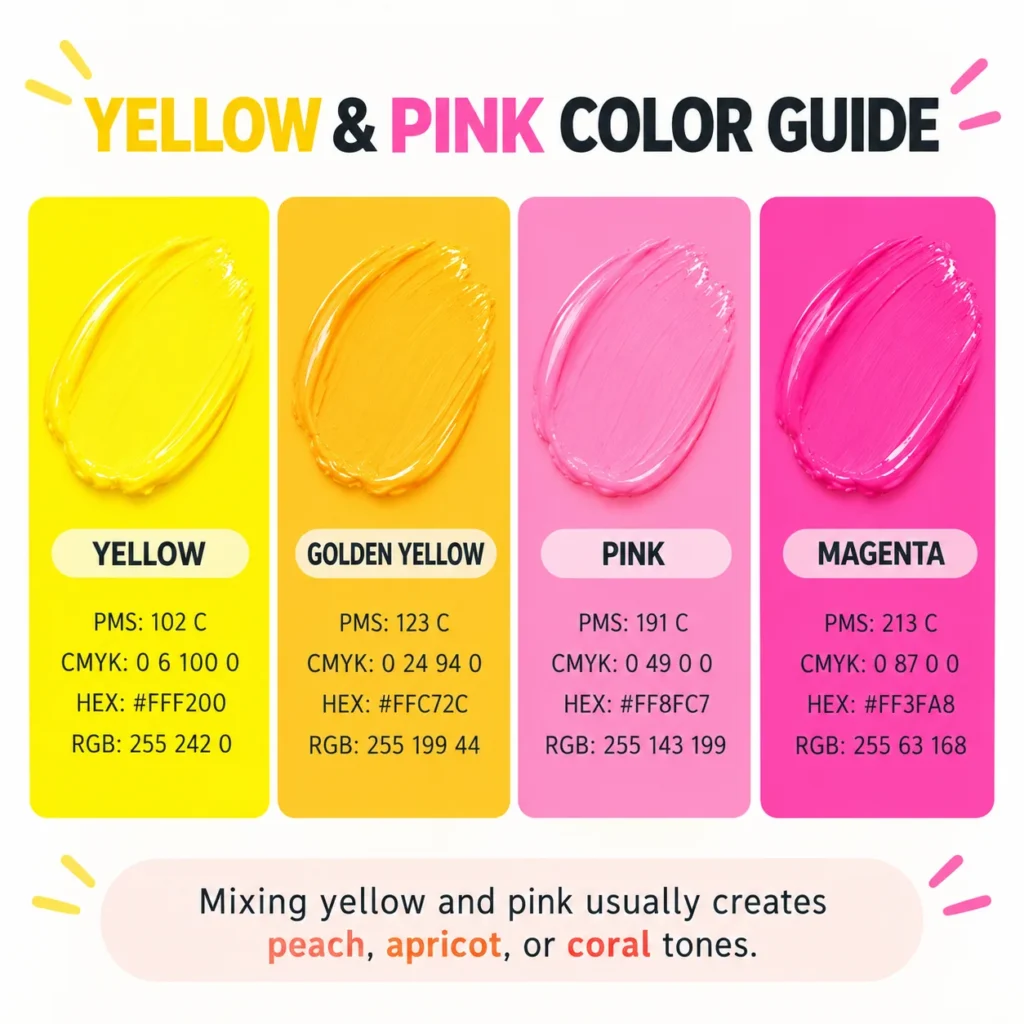
These four names all describe the pink-yellow region and get used interchangeably, which causes a lot of confusion when matching a color.
| Name | Approximate hex | RGB | Character |
|---|---|---|---|
| Peach | #FFE5B4 | 255, 229, 180 | Pale, yellow-leaning, soft |
| Peach Puff | #FFDAB9 | 255, 218, 185 | The web-standard pale peach |
| Apricot | #FBCEB1 | 251, 206, 177 | Slightly deeper and pinker than peach |
| Light salmon | #FFA07A | 255, 160, 122 | Noticeably pink, mid value |
| Salmon | #FA8072 | 250, 128, 114 | Pink-dominant, muted |
| Coral | #FF7F50 | 255, 127, 80 | Brighter and more orange than salmon |
| Melon | #FDBCB4 | 253, 188, 180 | Soft, cool-leaning peach |
| Blush | #DE5D83 | 222, 93, 131 | Pink with only a hint of warmth |
The useful distinction: peach and apricot lean yellow, salmon and blush lean pink, and coral sits between them at higher saturation. If your mix looks right in hue but wrong in name, the fix is almost always a shift in ratio rather than a different pigment.
Can you turn yellow into pink?
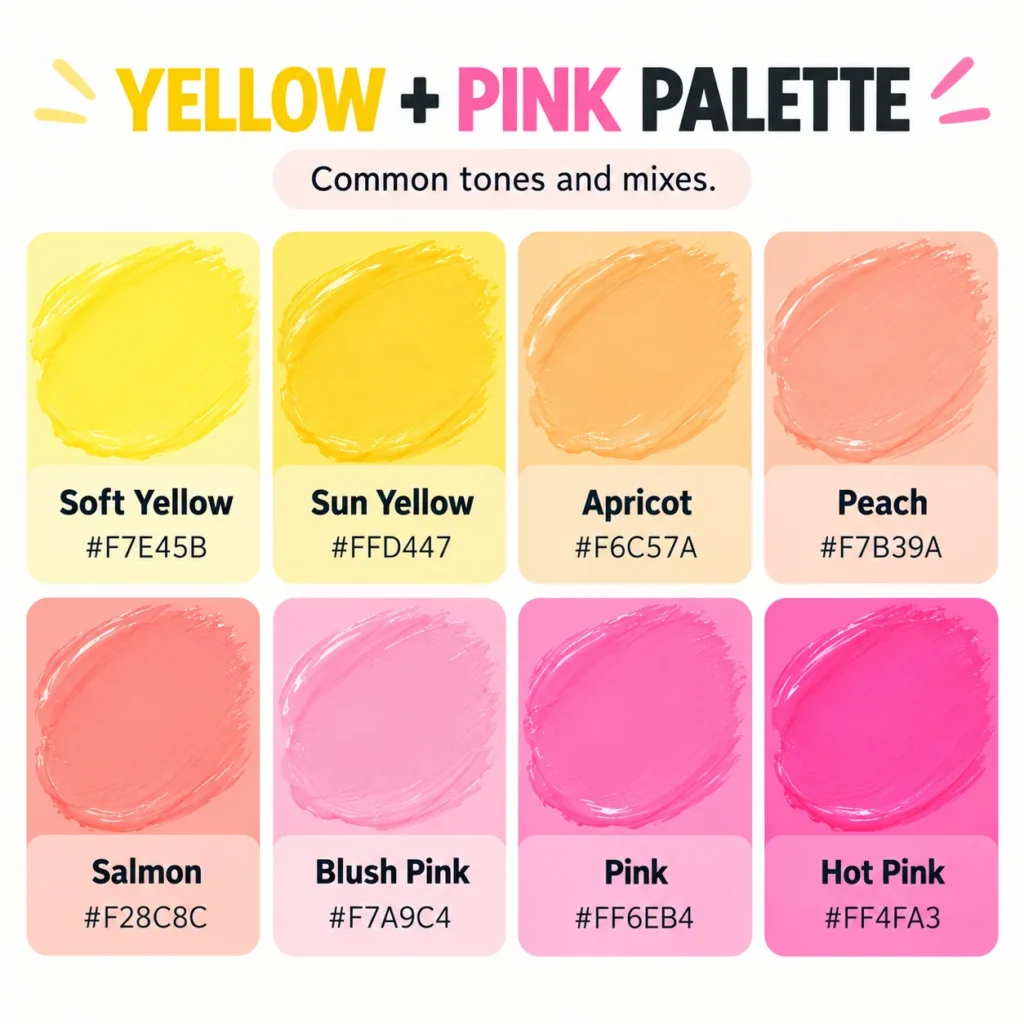
Not by mixing, no. How to turn yellow to pink is a common search and the honest answer is that yellow works against you here.
Adding pink to yellow gives peach. Adding more pink gives coral, then salmon. To reach an actual pink you would have to add so much magenta and white that the yellow is effectively overwhelmed, and even then the residual yellow keeps the result warm, so you get a peachy pink rather than a clean one. There is no proportion at which yellow helps you get to pink.
If pink is the goal, start over. Pink comes from red or magenta lightened with white, with no yellow involved at all. A cool red or a quinacridone magenta plus titanium white gives a clean pink; a warm red gives a warmer, more coral-leaning one.
The one exception is digital color, where you are not mixing pigment at all and can simply change the values. Nothing carries over from a previous color on a screen.
Why your pink and yellow mix looks dull or brown
When pink and yellow mixed together give you something you did not expect, the cause is almost always the specific tubes rather than the ratio.
It went grey or muddy. Your pink is cool. Many pinks are made from a blue-leaning red such as quinacridone magenta or permanent rose, which carries blue bias. Blue plus yellow plus red gives brown or grey, which is exactly what you are seeing. Switch to a pink built on a warm red. The same reaction pushed further is what produces the results covered in the guide to mixing brown.
It went distinctly green-grey. Both your pink and your yellow are cool. A lemon yellow leans green and compounds the problem. Use a warm yellow such as Cadmium Yellow Medium.
It looks chalky rather than glowing. Too much white in the system, either from the pink itself or from added white. Rebuild with a stronger yellow base and less pink.
It looks like plain orange. Your pink is highly saturated. Hot pink and fluorescent pinks carry very little white, so they behave almost like red and produce orange rather than peach. Lighten the pink with white before mixing, or accept the brighter result.
It looks nothing like the pink you started with. Expected. Yellow and pink mix in a way that neutralizes pink’s coolness quickly. If you want to keep more pink character, the complementary relationship at work is the same one explained in what pink and green make, where green cancels pink almost completely.
Pink and yellow in RGB and CMYK
Paint and screens reach peach by different routes, so the two should not be confused.
- Paint (subtractive). Pink and yellow make peach because each pigment absorbs part of the spectrum and only the wavelengths both reflect survive. The University of Wisconsin–Madison Ingersoll Physics Museum demonstrates the principle clearly.
- Screens (additive RGB). Peach is 255, 229, 180. Full red light, high green, moderate blue. That blue content is what makes it read as pale rather than orange; true orange has no blue at all.
- Print (CMYK). Peach comes from a light magenta and yellow overlay, roughly 0, 10, 29, 0.
Worth knowing: pink has no wavelength of its own. Unlike red, yellow or blue, there is no single band of light that produces pink. It exists only as a mixture, which is part of why pink behaves less predictably in paint than the spectral colors do.
Pink and yellow combination in art, fashion and interiors
In painting, the color pink and yellow make does most of its work in skin tones and warm light. It is the standard base for pale complexions, the color of low sun on a white wall, and the transition tone between a lit and shadowed edge on warm surfaces. Because it is naturally desaturated it recedes, which makes it useful for pushing an area back without darkening it.
As a color pairing, the pink and yellow combination reads as fresh and optimistic and has become a staple of spring palettes, wedding stationery and packaging aimed at warmth rather than urgency. The pairing works best when the two sit at different values, a soft blush with a strong lemon, or a hot pink with a pale butter. Matched at equal saturation they compete and the effect flattens.
In interiors, peach is one of the more forgiving warm neutrals. It reads as warmer than beige without being as demanding as terracotta, and it flatters skin under artificial light, which is why it appears in bedrooms and bathrooms far more than in kitchens. It pairs naturally with sage green, warm white, brass and pale wood. Deeper versions in the salmon and coral range work better as accents than as wall colors, since the saturation becomes tiring at scale. If you want to knock a peach back toward something more grounded, the route runs through the muted territory covered in brown and pink mixed.
FAQs
What color do pink and yellow make when mixed?
Peach, a soft tint of orange around Hex #FFE5B4. Pink is red lightened with white, and red plus yellow makes orange, so the mixture is a pale orange. More yellow gives a lighter golden peach, more pink gives coral or salmon.
What color does yellow and pink make?
The same as pink and yellow: peach. Mixing order does not change the hue, only your control. Adding pink into yellow gives finer control, since pink carries red and shifts a yellow base quickly while yellow needs to be added in quantity to move a pink base.
What do yellow and pink make together?
Peach, a pale tint of orange. Because pink is red with white already stirred in, yellow mixed with pink produces a lightened, softened orange rather than a fully saturated one. Paler pinks give paler peaches, and highly saturated pinks push the result toward true orange.
What is the best ratio of pink and yellow?
Roughly one part pink to two or three parts yellow gives a classic soft peach. Equal parts gives a deeper apricot, and three parts pink to one part yellow reaches coral. Because pinks vary widely in how much white they contain, treat any ratio as a starting point and adjust.
How do you make peach color?
Three routes work. Mix pink into yellow, mix white with a warm red then add yellow, or fold orange into white. The white-red-yellow method gives the most control because you decide exactly how much white is in the pink, which makes the color repeatable across sessions.
Do pink and yellow make orange?
They make a tint of orange, which is peach. A saturated hot pink with very little white in it will produce something close to a true orange, because it behaves like red. The paler the pink, the further the result sits from orange and the closer it sits to peach.
Why did my pink and yellow mix turn brown?
Your pink is built on a cool, blue-leaning red such as quinacridone magenta or permanent rose. That introduces blue into a red and yellow mixture, and all three primaries together always neutralize toward brown or grey. Switch to a pink made from a warm red.
How do you turn yellow into pink?
You cannot, by mixing. Adding pink to yellow produces peach, then coral, then salmon, and the residual yellow keeps the result warm no matter how much pink you add. To get a clean pink, start again with red or magenta plus white and leave yellow out entirely.
What color does pink and yellow make in light rather than paint?
On a screen, peach is 255, 229, 180 in RGB. Pink and yellow are not channels in additive color, so the digital route has nothing in common with mixing pigment. Peach on screen is simply full red light with high green and moderate blue.
Is the pink and yellow combination good in design?
Yes, when the two sit at different values rather than matching in saturation. A soft blush with a bright lemon, or a hot pink with a pale butter yellow, reads as deliberate and fresh. Two equally saturated versions compete and flatten each other.
Pink and yellow at a glance
| If you want | Do this |
|---|---|
| Classic soft peach | One part pink to two or three parts yellow |
| Pale golden peach | Increase the yellow |
| Apricot | Equal parts pink and yellow |
| Coral or salmon | Two to three parts pink to one part yellow |
| Repeatable peach for skin tones | White, then warm red, then yellow |
| Peach from orange | Fold orange into white, not white into orange |
| A clean pink | Start over with red or magenta and white, no yellow |
Pink and yellow make peach because pink is a tint of red, and red with yellow has always made orange. That is the whole of what pink and yellow make, whichever way round you ask it. Three things worth remembering: add pink into yellow rather than the reverse, use a pink built on a warm red if you want the result to stay clean, and mix a little lighter than your target in acrylic because it dries darker.