What Color Do Orange and Pink Make When Mixed? (Coral / Peach)
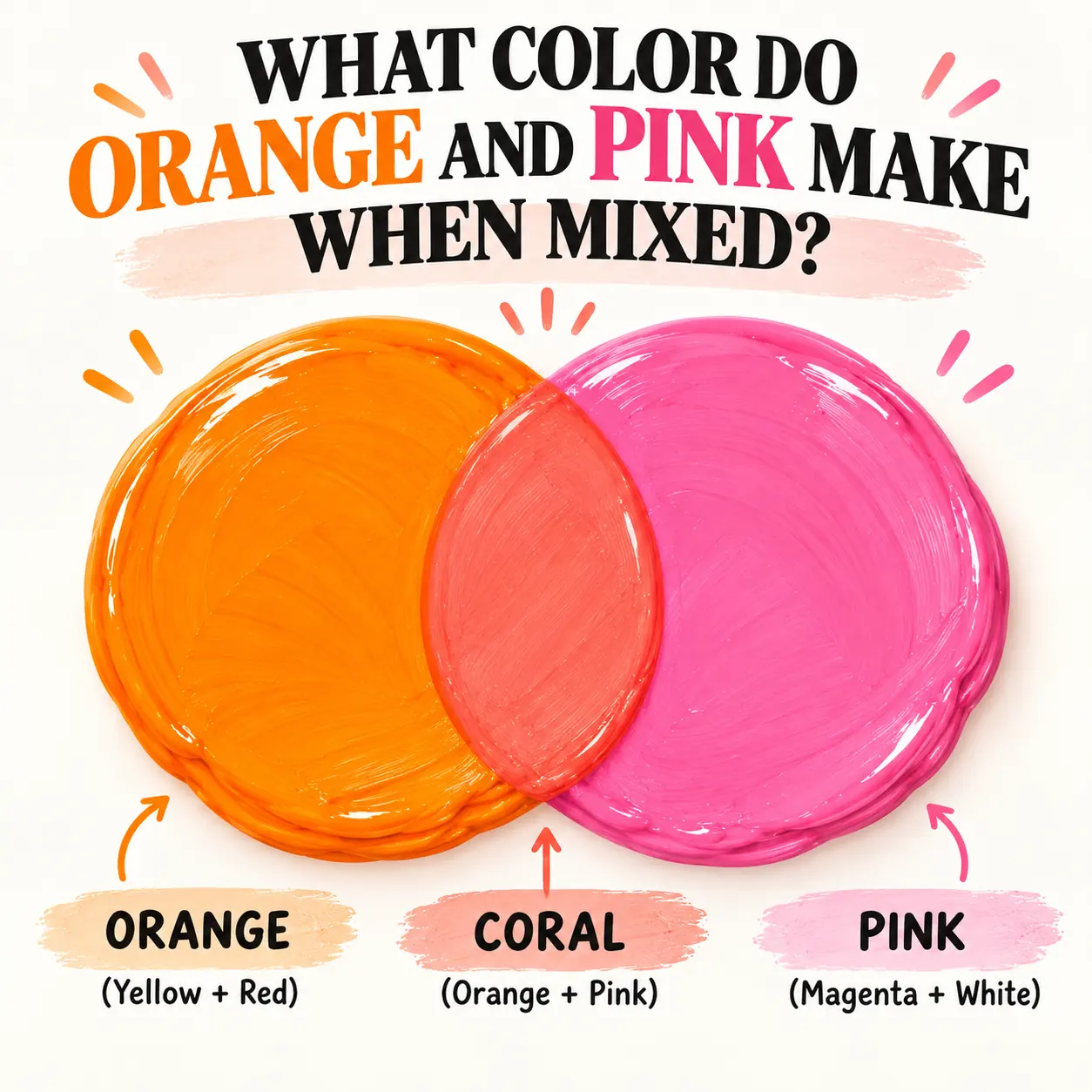
What Color Do Orange and Pink Make? Pink and orange make coral, a warm pinkish orange sitting around Hex #FF7F50. Depending on your ratio and starting shades it can land anywhere from pale peach to bright melon.
The reason is that both colors already share a red base. Orange is red plus yellow. Pink is red plus white. Mixing them concentrates the red and yellow while the white inside the pink keeps the value light, so the result reads as a soft, sun-warmed orange rather than a new hue.
More pink gives a softer rose-coral. More orange gives a saturated melon. Equal parts lands on classic coral. Add white and the whole range shifts toward peach. The order of the names changes nothing: orange and pink make the same coral as pink and orange.
What color does pink and orange make?
Coral, in the general case. More precisely, a family of warm pinkish orange shades covering coral, salmon, peach and melon.
Nothing here is a true tertiary color in the color-theory sense, because pink is not a hue. Pink is a tint of red, meaning red lightened with white. So when you mix pink and orange you are really combining:
- Red and yellow, from the orange
- Red and white, from the pink
The red content stacks up while the white dilutes it. That is why the mix never turns muddy and never turns into a fully saturated red. It sits permanently in the light, warm band between the two parent colors on the color wheel.
This also means the result is unusually sensitive to which pink you use. A pale baby pink carries a lot of white and pushes the mix straight to peach. A hot pink carries almost none and gives a vivid coral or watermelon instead.
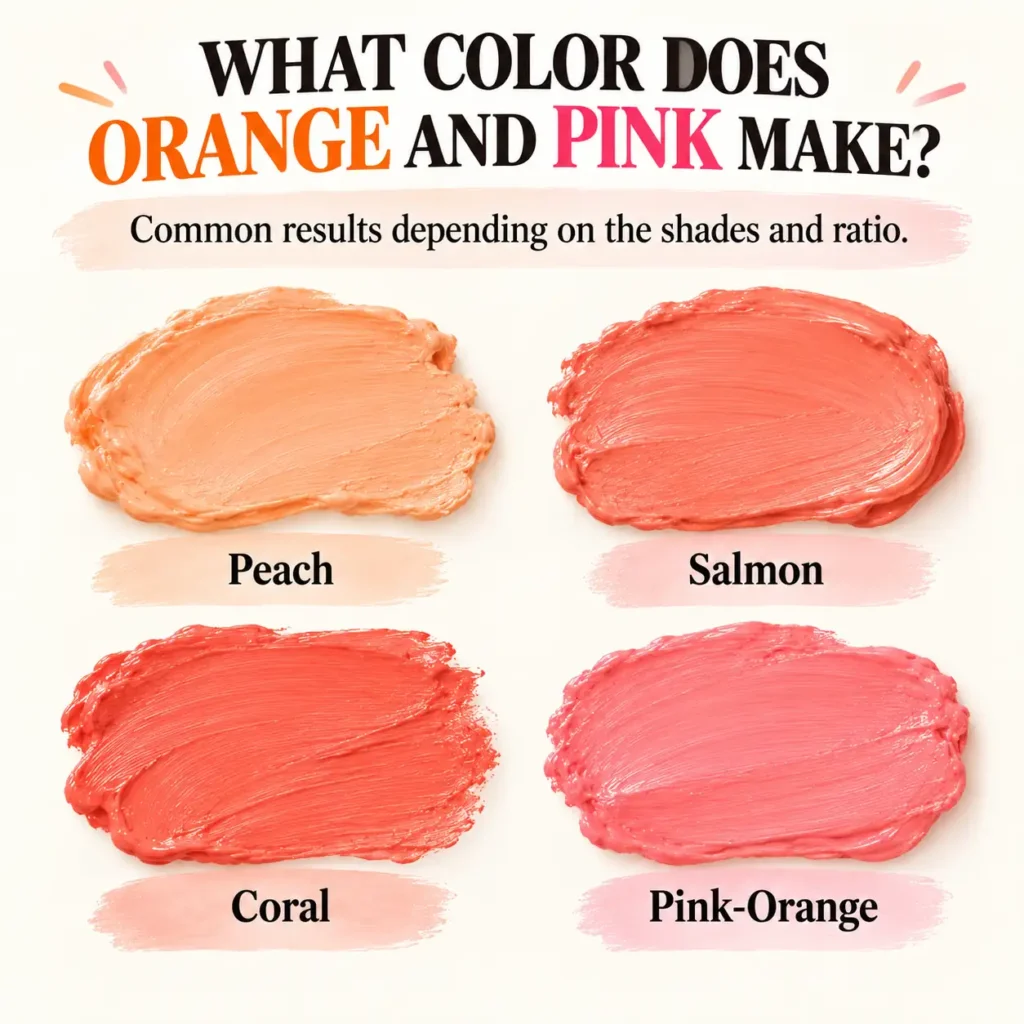
Pink and orange mixing ratios
Every ratio below is a starting point, not a formula. Pinks vary enormously in how much white they contain, so add gradually and test before committing.
| Approximate ratio (pink : orange) | Result | Roughly matches |
|---|---|---|
| 1 : 4 | Orange with a soft pink cast | Vivid tangerine, Hex #FFA089 |
| 1 : 3 | Warm melon | Melon, Hex #FDBCB4 |
| 1 : 2 | Bright coral, orange-leaning | Atomic tangerine, Hex #FF9966 |
| 1 : 1 | Classic coral | Coral, Hex #FF7F50 |
| 2 : 1 | Soft rose-coral | Light salmon, Hex #FFA07A |
| 3 : 1 | Pink-dominant, muted | Salmon, Hex #FA8072 |
| Any ratio plus white | Pale, chalky version | Peach, Hex #FFE5B4 |
Add pink into orange rather than the reverse. Orange is the stronger, more saturated of the two and will hold its character while pink is introduced. Working the other way means the white in the pink flattens the mixture before the hue has shifted much.
Orange plus pink at equal parts is what most people picture as coral. Pink plus orange at three to one has already left coral and become salmon.
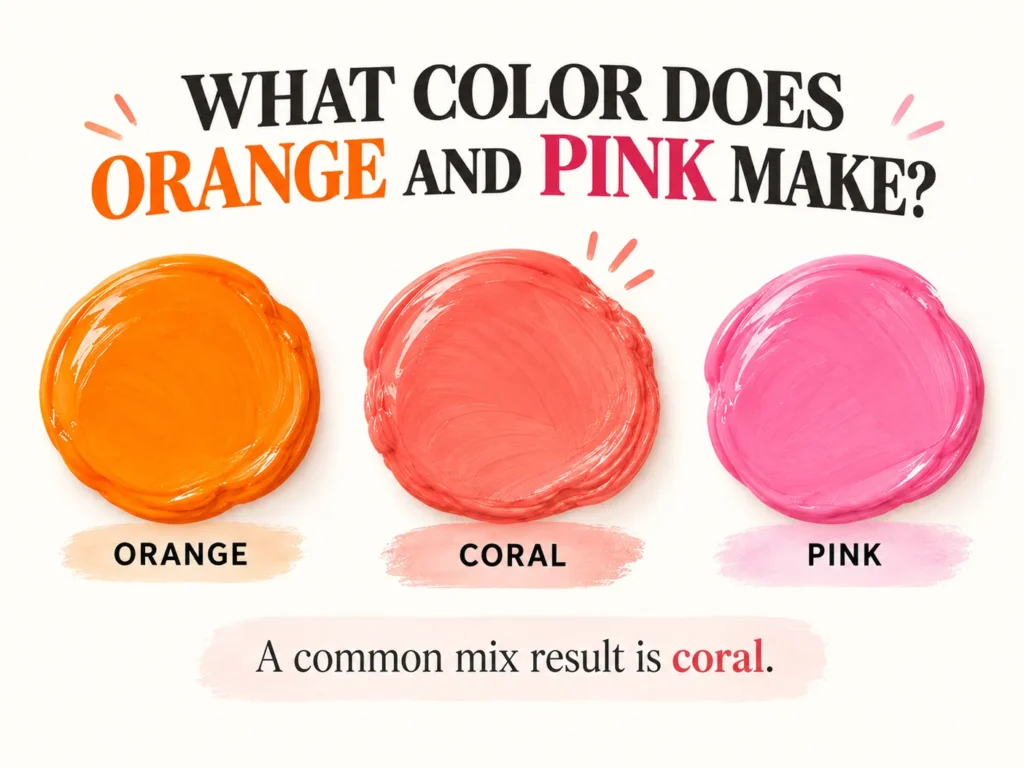
What is the name of the color between pink and orange?
This is the question underneath a lot of searches for orangish pink and pinkish orange. The color between orange and pink has more than one name depending on where exactly you land.
| Name | Approximate hex | RGB | Where it sits |
|---|---|---|---|
| Peach | #FFE5B4 | 255, 229, 180 | Palest, yellow-leaning |
| Apricot | #FBCEB1 | 251, 206, 177 | Pale, slightly pinker than peach |
| Melon | #FDBCB4 | 253, 188, 180 | Soft, balanced pinkish orange |
| Atomic tangerine | #FF9966 | 255, 153, 102 | Bright, orange-dominant |
| Coral | #FF7F50 | 255, 127, 80 | The classic midpoint |
| Light salmon | #FFA07A | 255, 160, 122 | Mid value, pink-leaning |
| Salmon | #FA8072 | 250, 128, 114 | Muted, pink-dominant |
| Coral pink | #F88379 | 248, 131, 121 | Softer, clearly pink-leaning |
| Watermelon | #FC6C85 | 252, 108, 133 | Bright, strongly pink |
| Tomato | #FF6347 | 255, 99, 71 | Deeper, red-leaning |
The useful rule for naming: peach and apricot lean yellow, coral sits in the middle, and salmon and watermelon lean pink. If you have mixed something and cannot name it, compare it against coral at Hex #FF7F50. Warmer and paler is peach. Cooler and pinker is salmon.
This is the answer most people are looking for when they search for an orange pink color name, partly because it is a named web color and appears in design tools, and partly because it genuinely sits at the midpoint of the range.
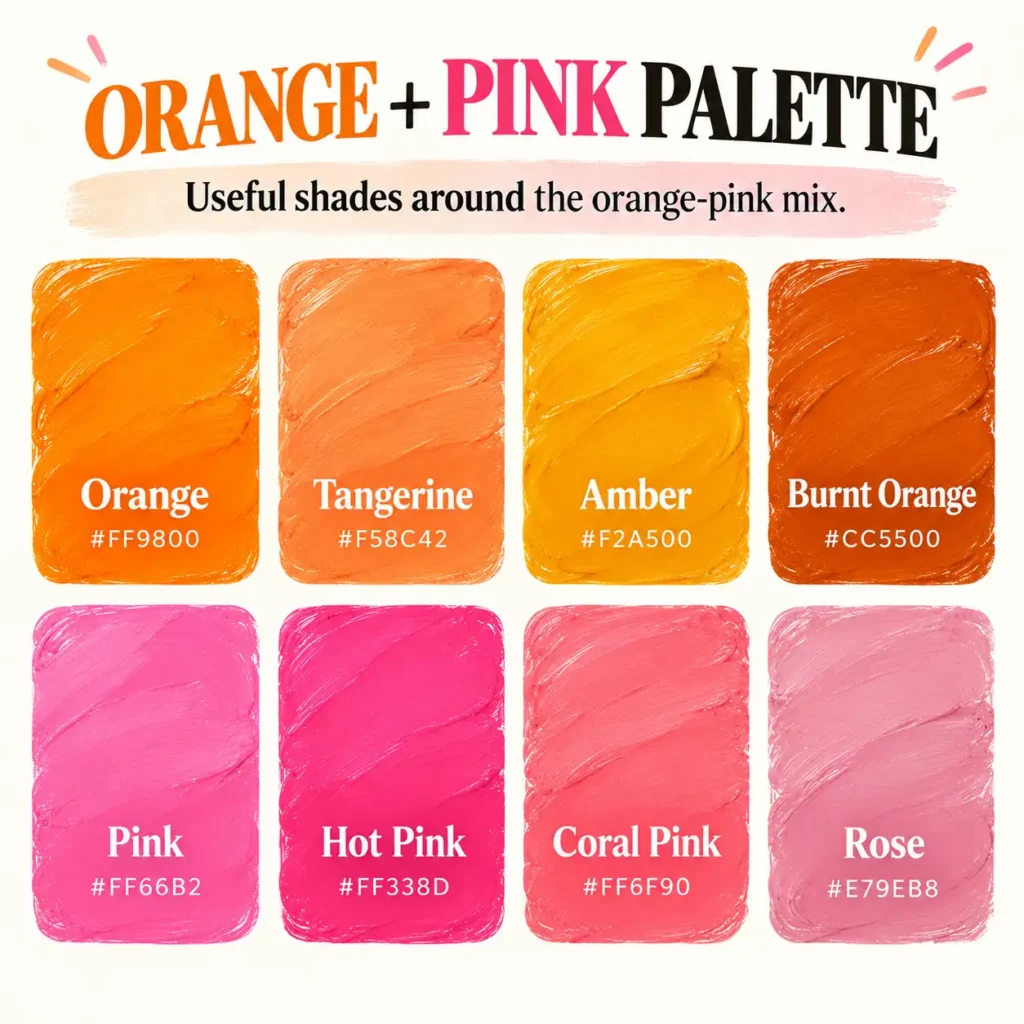
Is peach orange or pink?
Peach is orange. Specifically it is a tint of orange, meaning orange lightened with white, in exactly the way pink is a tint of red.
This causes confusion because peach reads as soft and warm in a way people associate with pink, and because pink is one of the routes to mixing it. But structurally, peach sits in the orange family. Its hue angle is closer to orange than to red, and it contains yellow, which no true pink does.
The distinction that matters in practice:
- Peach color is orange plus white. It has yellow in it and reads golden.
- Coral is orange plus pink. It has both yellow and extra red, and reads warm but distinctly pinker than peach.
- Salmon is coral pushed further toward pink. The yellow is still present but the red dominates.
So peach is a shade of orange, coral is genuinely between the two, and salmon leans pink. If you mix orange and pink and get something you would call peach color, you probably used a very pale pink or added white, which diluted the extra red back out.
Does pink and orange make red?
No. This comes up often and the answer is a clear no in both directions.
Red is a fully saturated primary. Pink is red that has already been lightened with white, and that white cannot be removed by adding anything. Orange contains yellow, which pushes away from red rather than toward it. Combining a lightened red with a yellowed red gives you a lightened, yellowed red, which is coral.
To get red you need red pigment. The closest this mix comes is tomato at Hex #FF6347, and only if you use a highly saturated hot pink with very little white in it and a red-leaning orange. Even then it reads as a soft red-orange rather than a true red.
If you want to move a coral mixture toward red, add red itself. Adding more pink will lighten it and adding more orange will push it toward yellow.
Hot pink and orange, and magenta and orange
The pink you start with changes the answer more than anything else, and the vivid pinks behave differently from pale ones.
Hot pink and orange make a bright, saturated coral closer to watermelon than to peach. Hot pink at Hex #FF69B4 carries very little white, so it contributes intensity rather than lightness. The result is punchy and reads as a deliberate, modern color rather than a soft natural one.
Magenta and orange make a hot coral or a warm red-pink, depending on ratio. Magenta is not a tint at all, it is a pure pigment sitting between red and purple, so it contributes no white whatsoever. Magenta-heavy mixes drift toward a vivid rose-red; orange-heavy mixes give the most saturated coral you can reach by mixing. If you need coral to be bright rather than soft, this is the route.
Pale pinks and orange make peach, because the white does most of the work.
If you want the fuller picture of which pink you are actually holding, the guide to what colors make pink covers the difference between red-based and magenta-based pinks and why it matters so much in mixtures.
How to mix coral specifically
This is the target for most people asking about this combination, and there are two reliable routes.
From pink and orange. Mix orange to your liking, then introduce pink in small amounts until the color warms and softens. What color does pink and orange make at this stage depends entirely on when you stop. Add a touch of white only if it needs to be paler. This is the fastest route if both colors are already on your palette.
From primaries. Start with white. Add a warm red such as Cadmium Red Light to build a pastel pink, then introduce yellow gradually until the mix warms into coral. Building it this way gives far more control over the final value, and makes the color repeatable across sessions, which matters if you are mixing coral for a large area.
Either way, mix a little lighter than your target in acrylic, which dries darker, and a little stronger in watercolor, which dries lighter. It is one of the colors most commonly mixed slightly wrong for exactly this reason.
Because both parent colors are already warm, this mixture stays clean rather than turning muddy. That happens because pigments work by subtraction, absorbing some wavelengths and reflecting the rest, and here there is nothing in either color absorbing what the other reflects. The University of Wisconsin–Madison Ingersoll Physics Museum demonstrates the underlying principle clearly.
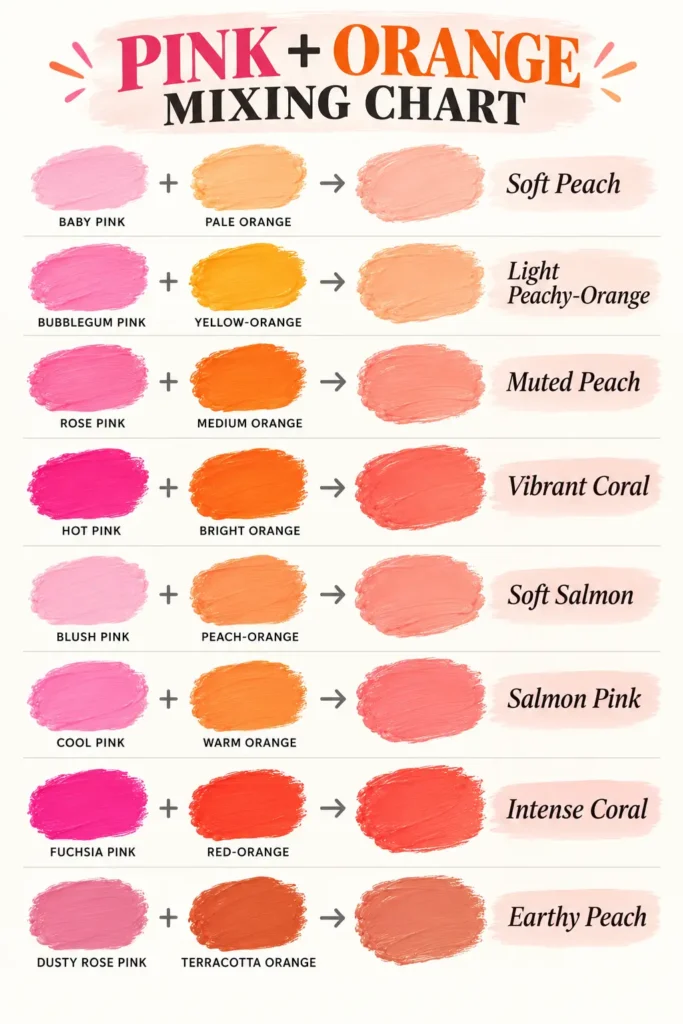
Why your pink and orange mix looks wrong
When pink and orange mixed together give you something unexpected, the cause is almost always the specific pink rather than the ratio.
It looks chalky and washed out. Your pink carries a lot of titanium white, which is opaque and flattening. Use a more saturated pink, or build the color from primaries instead.
It looks dull or slightly grey. Your pink is built on a cool, blue-leaning red such as quinacridone magenta or permanent rose. Blue plus orange neutralizes, which is the reaction shown in what blue and orange make. Switch to a pink built on a warm red.
It just looks like orange. Not enough pink, or the pink is too pale to register. Add a more saturated pink rather than more of the same one.
It looks flat and pink rather than coral. Too much pink. Orange needs to stay dominant or at least equal for the warm hue to hold.
It went muted and dusty. Something green has entered the mix, which cancels pink almost completely. The same mechanism is visible in what pink and green make. If you want that muted effect deliberately, brown and pink mixed covers the dusty rose range properly.
Pink and orange in RGB and hex
Paint and screens reach coral by different routes, so the two should not be confused.
- Paint (subtractive). Pink and orange make coral by combining pigments that each absorb part of the spectrum.
- Screens (additive RGB). The value is 255, 127, 80. Full red light, mid green, low blue. That small blue value is what separates it from orange, which has no blue at all.
- Print (CMYK). Roughly 0, 50, 69, 0.
Averaging the hex codes of pink at Hex #FFC0CB and orange at Hex #FFA500 lands close to the coral value, which is a neat coincidence rather than a rule. Digital averaging and pigment mixing follow completely different mathematics, and they agree here only because both parent colors are already warm. Do not expect that trick to work for other pairs.
A screen can also display versions more saturated than any pigment reaches, so treat a hex code as a target rather than something your paint will match exactly.
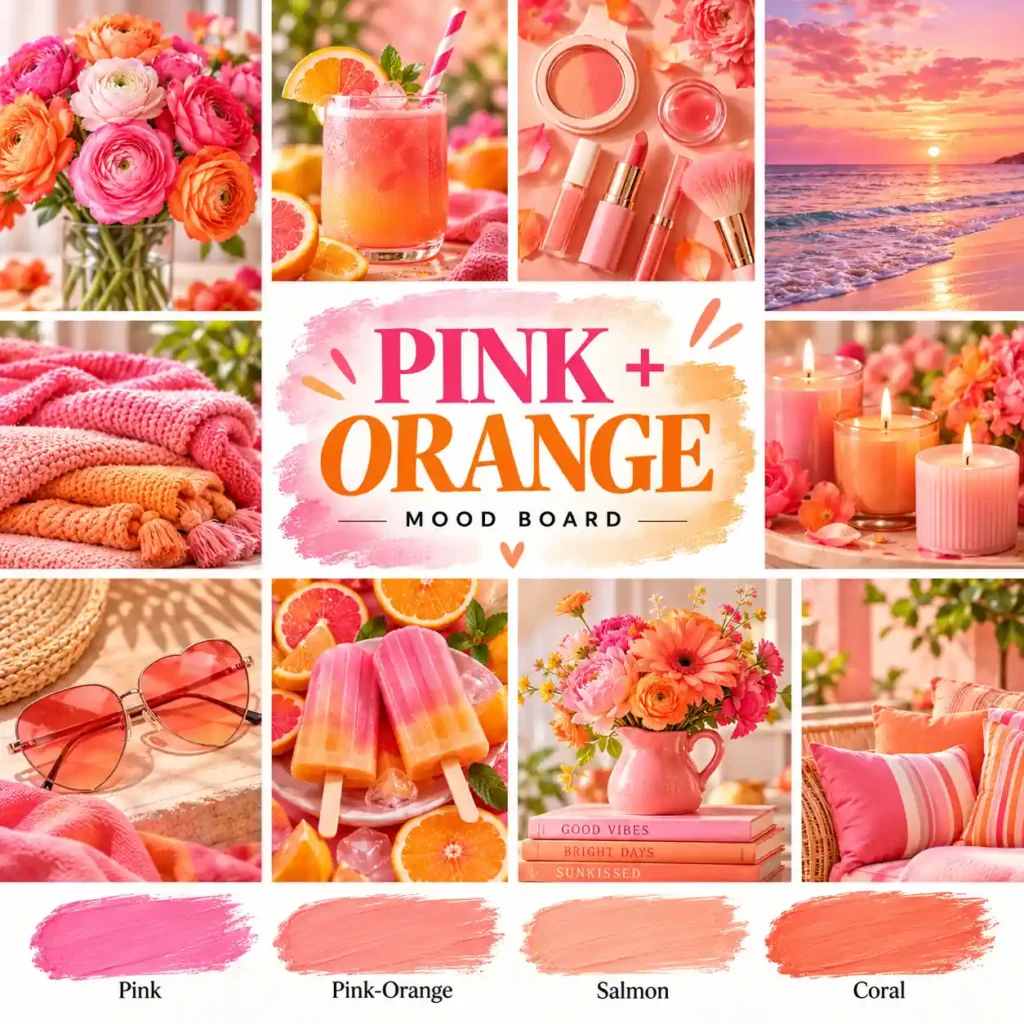
Do pink and orange go together?
Yes, and it is one of the most confident pairings in warm color. Pink and orange together were treated as a clash for decades and are now a design staple, which is worth knowing if you are working from older advice.
The reason it works is that both colors are secondary or tinted versions of the same warm family, so they sit close on the wheel and read as analogous rather than competing. Analogous pairings are naturally harmonious.
Three things make the pairing work in practice:
- Separate the values. A hot pink with a pale peach, or a soft blush with a strong tangerine. Two colors at identical saturation compete and the effect flattens.
- Give them a neutral. Cream, warm white, sand or charcoal lets the pair breathe. Without a neutral the combination can feel relentless at scale.
- Add a cool accent if it needs grounding. Teal, navy or sage sits opposite the warm range and stops it becoming overwhelming.
In interiors, the mixed shade works as a full wall color where pure orange or hot pink would not, because the mixture is naturally softer than either parent. In fashion and branding, orange and pink together read as energetic, contemporary and warm, which is why the pairing dominates summer palettes, beauty packaging and travel branding.
FAQs
What color do pink and orange make when mixed?
Coral, a warm pinkish orange near Hex #FF7F50. Because both colors share a red base, the mix stays warm and light rather than turning muddy. More orange gives melon, more pink gives salmon, and adding white gives peach.
What color does orange and pink make?
The same as pink and orange: coral. Mixing order does not change the hue, only your control. Adding pink into orange works better, since orange is the more saturated of the two and holds its character while the pink is introduced.
What is the color between pink and orange called?
Coral is the standard name, and it is a named web color at Hex #FF7F50. Nearby names cover the rest of the range: peach and apricot lean yellow, melon sits in the middle, and salmon and watermelon lean pink. Coral is the most widely recognised name for an orangish pink.
Is peach orange or pink?
Peach is orange. It is a tint of orange, meaning orange lightened with white, and it contains yellow, which no true pink does. It reads soft and warm in a way people associate with pink, but structurally it belongs to the orange family. Coral is the color genuinely between the two.
Does pink and orange make red?
No. Pink is red that has already been lightened with white, and orange contains yellow that pulls away from red. Combining them gives a lightened, yellowed red, which is coral. The closest the mix reaches is tomato at Hex #FF6347, using a saturated hot pink and a red-leaning orange.
What do hot pink and orange make?
A bright, saturated coral close to watermelon. Hot pink carries very little white, so it adds intensity rather than lightness, and the result is punchier than a mix made with pale pink. Magenta and orange give an even more vivid coral, since magenta contains no white at all.
How do you make coral color?
Mix orange with pink in roughly equal parts, adding pink gradually until the color softens. For more control, build it from primaries instead: start with white, add a warm red to make a pastel pink, then add yellow until it warms into coral. The primaries route is more repeatable.
Why did my pink and orange mix turn dull?
Your pink is built on a cool, blue-leaning red such as permanent rose or quinacridone magenta. Any blue content neutralizes orange and drags the mixture toward grey. Switch to a pink made from a warm red, and check your brush and water for stray pigment.
Do pink and orange go together in design?
Yes. They sit close together on the color wheel as analogous warm colors, which makes the pairing naturally harmonious. It works best when the two sit at different values rather than matching in saturation, and when a neutral such as cream or charcoal is included to give them room.
Pink and orange at a glance
| If you want | Do this |
|---|---|
| Classic coral | Equal parts pink and orange |
| Melon or bright coral | Two to three parts orange to one part pink |
| Salmon | Two to three parts pink to one part orange |
| Peach | Any ratio plus a generous amount of white |
| Vivid, modern coral | Use hot pink or magenta instead of pale pink |
| Repeatable coral | Build from white, warm red and yellow |
| Something closer to red | Add red; pink and orange will not get you there |
Pink and orange make coral because both already contain red, and the white inside the pink keeps the result light. Three things worth remembering: add pink into orange rather than the reverse, choose a pink built on a warm red so the mixture stays clean, and remember that the pink you use decides whether you land on peach, coral or watermelon.