What Color Do Yellow and Green Make When Mixed?
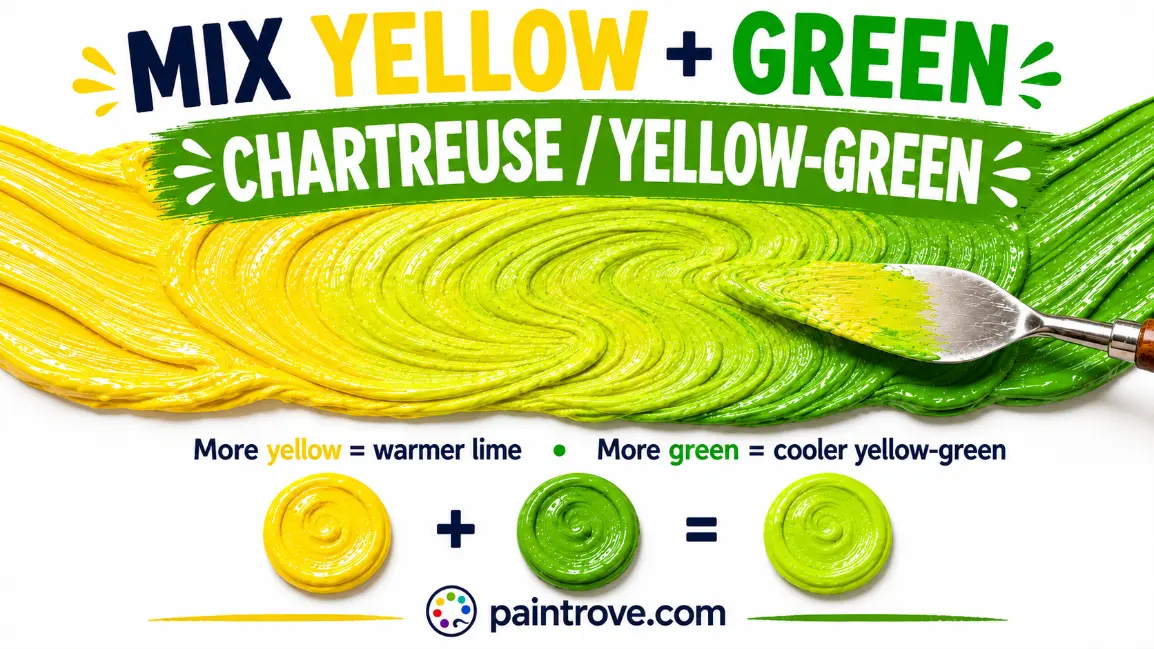
What Color Do Yellow and Green Make? Mix yellow and green together and you get yellow-green, most often called chartreuse or lime green. It sits at hex #7FFF00 at its brightest and #DFFF00 when yellow dominates. Add more yellow for a warm, electric lime; add more green for a cooler, deeper yellow-green; and shift your yellow toward orange to slide into muted olive.
Yellow and green are neighbors on the color wheel, so this is one of the safest, cleanest mixes you can make. Nothing turns to mud. The only real decisions are how bright, how warm, and how deep you want the result.
This guide covers the exact ratios with hex codes, the pigments that give the most electric chartreuse, the full range from lime to olive, and what changes when you mix yellow and green as light instead of paint.
Why Yellow and Green Make Chartreuse
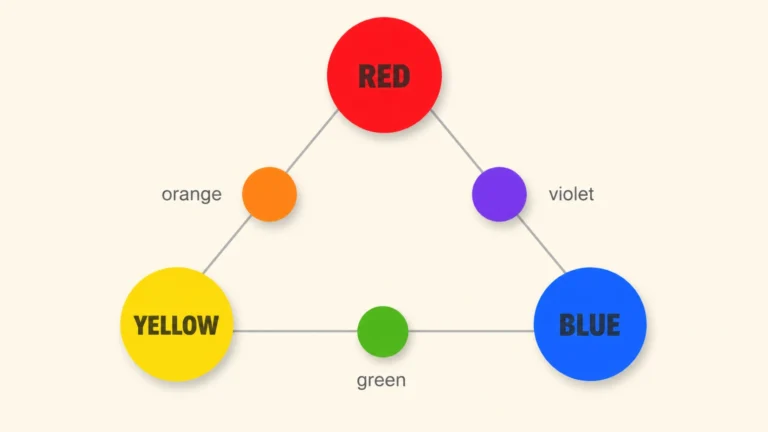
On the color wheel, green sits directly beside yellow. Colors that neighbor each other are called analogous, and mixing them produces harmony rather than contrast. The result simply lands between its two parents, in this case on yellow-green.
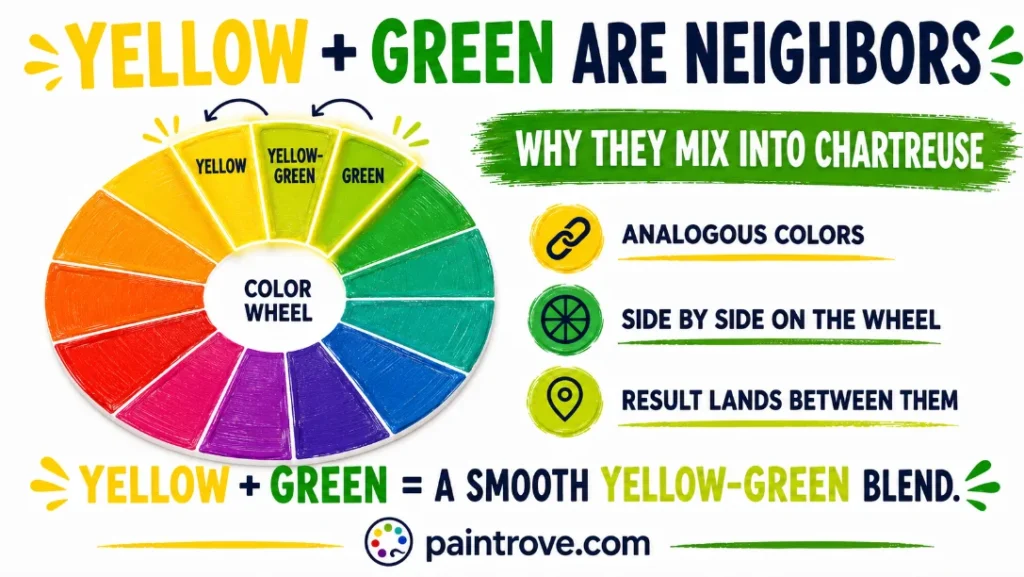
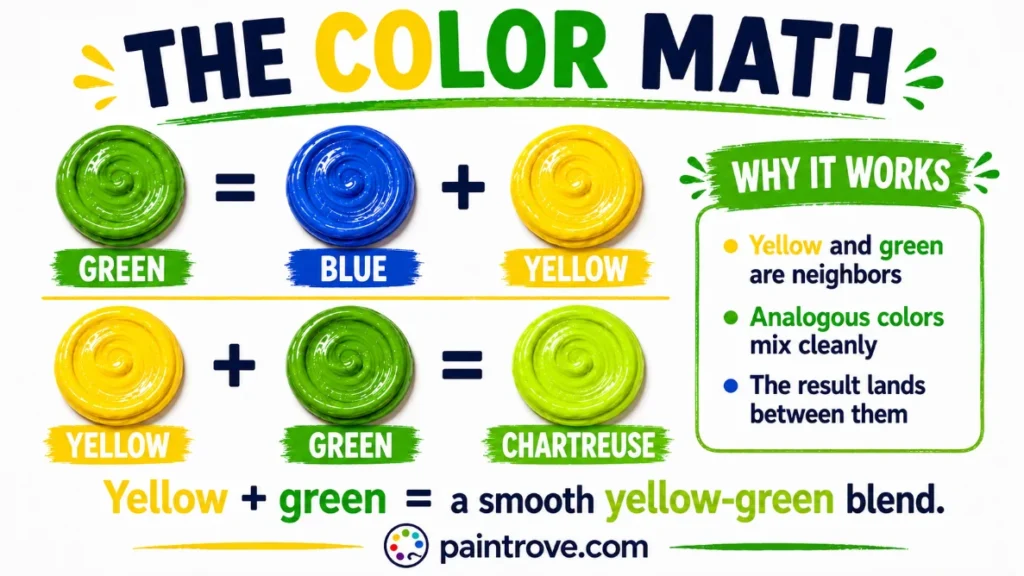
There is family logic underneath, too. Green is not a primary color. It is a secondary color, made by mixing blue and yellow, as covered in what blue and yellow make. So when you add yellow to green, you are strengthening the yellow half of a blue-yellow mix. The blue content gets diluted, the yellow rises, and the color slides from green toward yellow, stopping at yellow-green.
That makes chartreuse an intermediate color (sometimes loosely called tertiary): a primary, yellow, mixed with its neighboring secondary, green. It is one of six such colors on the wheel, alongside blue-green, blue-violet, red-violet, red-orange, and yellow-orange. Its cool-side twin is what you get from blue and green mixed: teal, the blue-green on the opposite shoulder of green. For the parent color’s full story, see our guide to what colors make green.
Chartreuse, Lime, Olive, Mint: What Is the Difference?
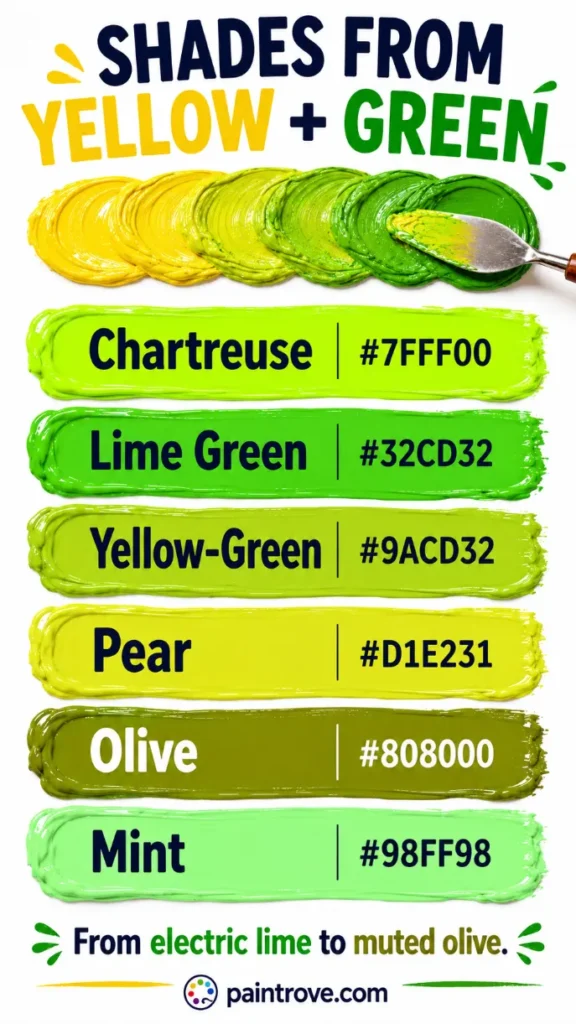
Yellow-green collects a surprising number of names, and they describe genuinely different colors. Here is how they separate:
| Color | Hex code | Character |
|---|---|---|
| Chartreuse | Hex #7FFF00 | Bright, balanced yellow-green, electric |
| Lime green | Hex #32CD32 | Slightly greener, punchy |
| Yellow-green | Hex #9ACD32 | Softer, more natural mid-tone |
| Olive | Hex #808000 | Muted, dark, yellow-dominant |
| Mint | Hex #98FF98 | Pale, whitened, cool |
| Pear | Hex #D1E231 | Yellow-heavy, soft |
| Apple green | Hex #8DB600 | Rich mid yellow-green |
| Wasabi | Hex #A3A847 | Muted grayish yellow-green |
The names worth keeping straight:
Chartreuse is named after a French liqueur made by Carthusian monks since the 1700s, one of the few colors named after a drink rather than the other way around. It is the bright, balanced yellow-green.
Lime leans a touch greener and reads as slightly more saturated.
Olive is the odd one out. It is what happens when your yellow carries orange, or when you mute a yellow-green with its complement. Olive is really a darkened, dulled yellow-green, which is why it feels earthy where chartreuse feels electric.
Mint is a whitened, cooler version, closer to the blue-green side, and also reachable through green and white mixed.
Mixing Ratios: From Electric Lime to Deep Green
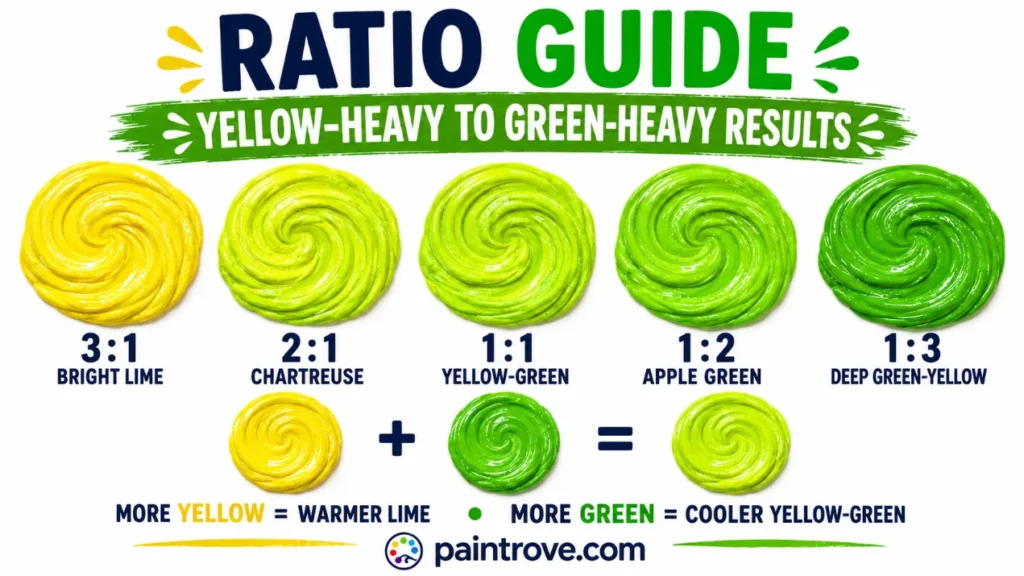
The yellow-to-green ratio decides where you land. Here is the working chart with hex targets in plain text:
| Ratio (Yellow : Green) | Resulting shade | Hex code |
|---|---|---|
| 3 : 1 | Bright lime / warm chartreuse | Hex #CCFF00 |
| 2 : 1 | Chartreuse | Hex #9ACD32 |
| 1 : 1 | Yellow-green | Hex #7FBF00 |
| 1 : 2 | Deep green-yellow | Hex #5A9E1F |
| 1 : 3 | Green with a yellow cast | Hex #4C9A2A |
| 2 : 1 plus white | Pale spring green | Hex #B5E550 |
| 2 : 1 plus a touch of black | Olive | Hex #808000 |
| 2 : 1 with orange-yellow | Muted olive-gold | Hex #9A8420 |
Practical notes:
- Start with green and add yellow gradually. Yellow is bright but green pigments are usually stronger, so it takes more yellow than you expect to shift the mix.
- These two colors are close in value and can swallow each other. Add in small steps and mix fully before judging.
- Test on white paper. Yellow-greens look far more saturated in a pile than they do spread thin.
Which Yellow and Which Green to Use
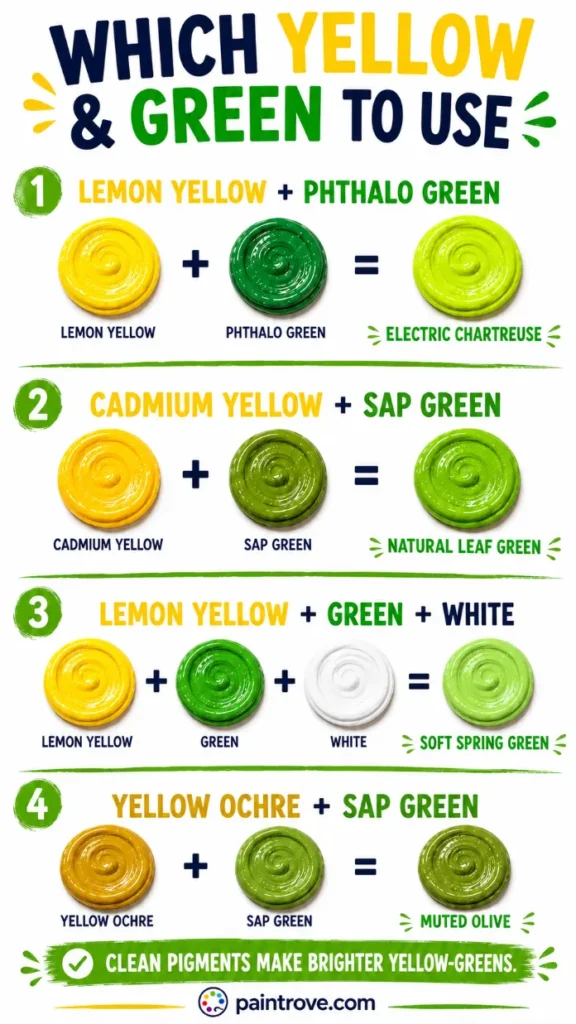
Pigment choice decides whether your chartreuse glows or goes dull:
| Goal | Yellow to use | Green to use | Result |
|---|---|---|---|
| Electric chartreuse | Lemon yellow | Phthalo green | Intense, near-fluorescent lime |
| Natural leaf green | Cadmium yellow | Sap green | Warm, botanical yellow-green |
| Soft spring green | Lemon yellow | Green plus white | Fresh pale yellow-green |
| Muted olive | Yellow ochre | Sap green | Earthy, dusty olive |
The key: cool, green-leaning yellows make the brightest chartreuse. Lemon yellow has a slight green bias, so it merges into green cleanly and keeps the mix electric. Warm yellows like cadmium and especially yellow ochre carry orange, and since orange leans toward green’s opposite side, they mute the result into olive and gold territory. When you want a chartreuse that almost hums, reach for lemon yellow and phthalo green, and add the phthalo sparingly because it overpowers fast.
Every Shade You Can Make from Yellow and Green
Between ratio, pigment choice, and additions of white, black, or gray, yellow and green cover a wide band of the wheel. The reference table:
| Shade | Hex code | How to mix it |
|---|---|---|
| Chartreuse | Hex #7FFF00 | Two parts yellow, one part green |
| Lime green | Hex #32CD32 | Equal mix leaning green |
| Yellow-green | Hex #9ACD32 | Balanced yellow-green |
| Spring green | Hex #B5E550 | Yellow-green plus white |
| Pear | Hex #D1E231 | Yellow-heavy mix, touch of white |
| Apple green | Hex #8DB600 | Slightly green-heavy mix |
| Olive | Hex #808000 | Yellow-green plus a touch of black |
| Olive drab | Hex #6B8E23 | Green-heavy mix plus black |
| Moss green | Hex #8A9A5B | Yellow-green plus gray |
| Wasabi | Hex #A3A847 | Yellow-green plus gray and a touch of black |
| Avocado | Hex #568203 | Green-heavy mix plus a touch of yellow ochre |
| Mint | Hex #98FF98 | Yellow-green plus generous white, slight blue |
| Fern | Hex #4F7942 | Deep green plus a little yellow |
Lighter Versions (Tints)
White lifts yellow-green into spring green and pale lime, the fresh colors of new growth. Because neither parent carries any red, these tints stay clean and cheerful rather than chalky. Add a whisper of extra yellow if a whitened mix starts to feel washed out. The related route through green and white mixed reaches similar pale greens from the other side.
Darker Versions (Shades)
A touch of black turns chartreuse into olive and olive drab, the backbone colors of military and heritage palettes. Black works better here than on most mixes because a little darkening is exactly what creates olive. Go slowly all the same. For a livelier dark yellow-green, deepen with more green or a trace of the complement instead of black, as shown in green and black mixed.
Muted Versions (Tones)
Gray softens yellow-green into moss, sage, and wasabi tones, the quiet naturals used across interiors and knitwear. See green and gray mixed for that branch. A tiny amount of red or purple, the complements of yellow-green, mutes it even more naturally than gray and pulls it toward sophisticated olive.
Yellow and Green in Light: The Lime Answer
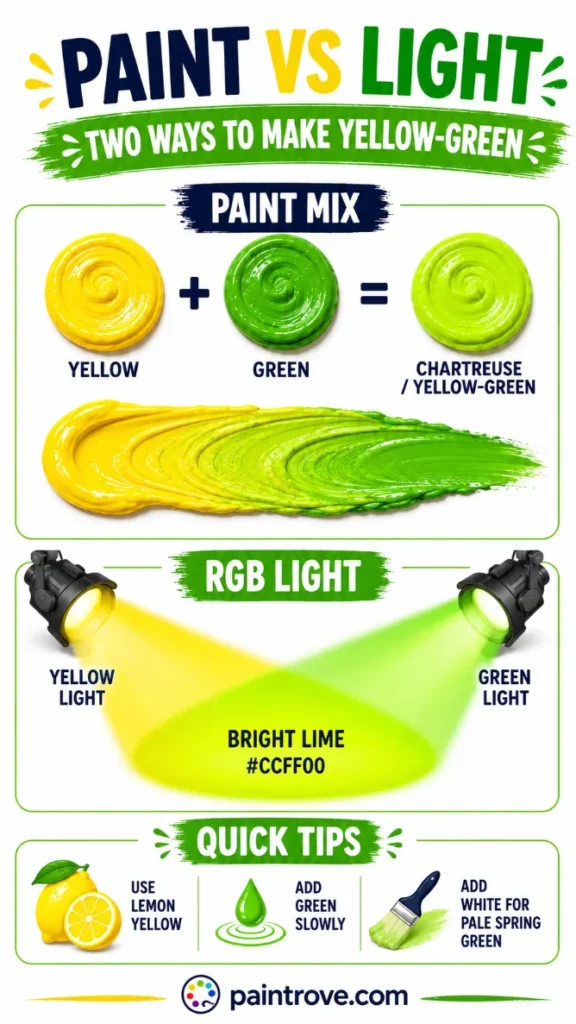
Everything above describes paint. Mix yellow and green as light and the result is a brilliant lime, brighter than any pigment can manage.
Screens use the RGB model, where green is a primary color and colors combine by addition. Here is the interesting part: on a screen, yellow light is itself made from red and green light. So yellow-green light is really red, plus a double helping of green, which the eye reads as an intense, glowing lime around hex #CCFF00. This is the electric yellow-green of highlighter pens and safety vests, colors engineered to be maximally visible.
| System | Type | Yellow + Green makes | Hex code |
|---|---|---|---|
| RYB (paint) | Subtractive | Chartreuse / yellow-green | Hex #9ACD32 |
| RGB (light and screens) | Additive | Bright lime | Hex #CCFF00 |
| CMYK (printing) | Subtractive | Yellow-green from yellow + cyan | Varies |
In printing, covered in our guide to the CMYK color model, yellow-green is built from yellow ink plus a small amount of cyan, since cyan is the printing stand-in for blue. Three systems, three routes to roughly the same family.
Troubleshooting Yellow-Green Mixes
The mix looks dull or olive when you wanted bright. Your yellow carries orange. Cadmium yellow and yellow ochre both mute yellow-green toward olive. Switch to lemon yellow for brightness.
The mix is barely different from plain green. Not enough yellow, or your green is very strong. Phthalo and sap greens dominate; keep adding yellow past the point that feels reasonable.
The mix looks flat and dark. Too much black, or a muddy green to begin with. Rebuild with a clean green and darken with green itself rather than black.
You want neon and cannot get there in paint. Pigment cannot match emitted light, so true highlighter lime only exists on screens or in fluorescent paints. The closest standard mix is lemon yellow plus phthalo green, kept thin.
It dries slightly darker. Normal acrylic behavior. Mix a step brighter than your target.
Yellow-Green in Art, Fashion, and Design
Yellow-green is one of the most polarizing colors on the wheel. People tend to love it or find it unsettling, and designers use both reactions on purpose.
In Art
Chartreuse is the color of new spring growth, and botanical and landscape painters lean on it for the fresh green of early leaves and sunlit grass, where a warm yellow-green catches light in a way that flat green cannot. It also has a long association with the strange and the sickly. Because a slightly off yellow-green can suggest illness or decay, artists and filmmakers use it deliberately to unsettle: the green tint of horror lighting is a yellow-green cousin. That double life, freshness and unease, makes it one of the most expressive colors available.
In Fashion
Yellow-green swings between high fashion and near-taboo. Chartreuse periodically storms the runway as a bold statement color, hard to wear and therefore attention-grabbing. Olive, its muted sibling, is one of fashion’s most enduring neutrals, the backbone of military-inspired and utility styles that never fully leave. Lime green owns sportswear and streetwear, where visibility and energy are the point. Few color families cover this much ground, from combat jacket to couture gown.
In Interiors and Branding
Soft yellow-greens and sages bring the freshness of the outdoors inside, which is why they anchor so many nature-led interior schemes paired with wood and cream. Brighter chartreuse works as a jolt of accent color, energizing an otherwise neutral room. In branding, yellow-green signals growth, health, and freshness, which is why it dominates organic food, eco products, and wellness identities. It is the color that says natural and alive without a single word.
Quick Reference: Yellow + Green Cheat Sheet
| Question | Answer |
|---|---|
| Yellow + green in paint | Chartreuse / yellow-green (hex #9ACD32) |
| Yellow + green in light | Bright lime (hex #CCFF00) |
| More yellow | Lime, warm chartreuse |
| More green | Deep green-yellow, apple green |
| Plus white | Spring green, pale lime |
| Plus black | Olive, olive drab |
| Plus gray | Moss, sage, wasabi |
| With orange-leaning yellow | Muted olive |
| Best pigments for bright | Lemon yellow + phthalo green |
| Color type | Intermediate (primary + secondary) |
FAQs
What color do yellow and green make when mixed?
Yellow-green, most often called chartreuse or lime green. The exact result depends on the ratio and pigments: more yellow gives a warm electric lime, more green gives a cooler deep yellow-green, and an orange-leaning yellow gives muted olive.
Do yellow and green make lime green?
Yes. A yellow-heavy mix of a clean lemon yellow and a bright green lands on lime, around hex #32CD32. Leaning the mix even more toward yellow, or mixing as light, produces the electric near-neon lime of screens.
How do you make olive green from yellow and green?
Add a touch of black to a yellow-green mix, or use a warm, orange-leaning yellow like yellow ochre. Both darken and mute the mix into olive at around hex #808000. A tiny amount of red or purple deepens it further.
What is the difference between chartreuse and lime?
Chartreuse is the balanced yellow-green at hex #7FFF00, sitting exactly between yellow and green. Lime leans slightly greener and reads as a touch more saturated. In everyday use the names overlap.
Why is my yellow and green mix dull?
Your yellow probably carries orange. Cadmium yellow and yellow ochre mute yellow-green toward olive. For a bright, clean chartreuse, use a cool lemon yellow and a clean green.
Is yellow-green warm or cool?
It sits on the border. Yellow-heavy versions read warm and sunny, while green-heavy versions read cooler and more natural. This warm-cool flexibility is what makes it so useful for both highlights and shadows in nature painting.
What two colors make chartreuse?
Yellow and green, with yellow dominant, roughly two parts yellow to one part green. Since green is itself blue plus yellow, you can also build chartreuse directly from a large amount of yellow with just a little blue.
Yellow and green mixed give you chartreuse and lime at their brightest, olive and moss at their most muted, and one of the most forgiving mixing experiences on the wheel. Two warm-leaning neighbors, no mud in sight.
To go deeper into this color family, see our full guides to what colors make green and what colors make yellow, or step back to the system behind it with the color wheel.