What Colors Make Black? Mixing the Deepest Blacks
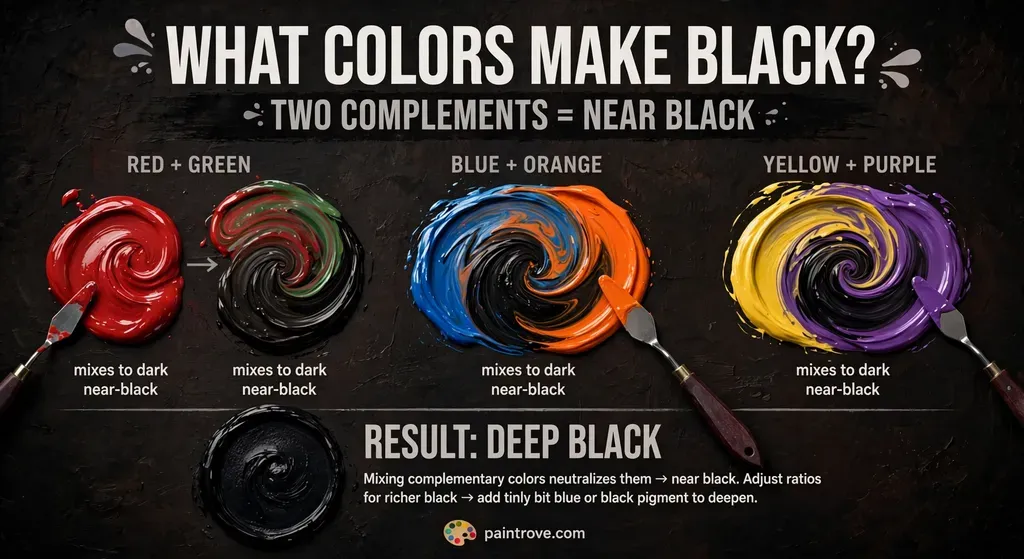
No two colors make a true black in paint. The closest you get is mixing two complementary colors, which cancel each other out and land on a very dark near-black. The classic pairing is ultramarine blue with burnt sienna or burnt umber.
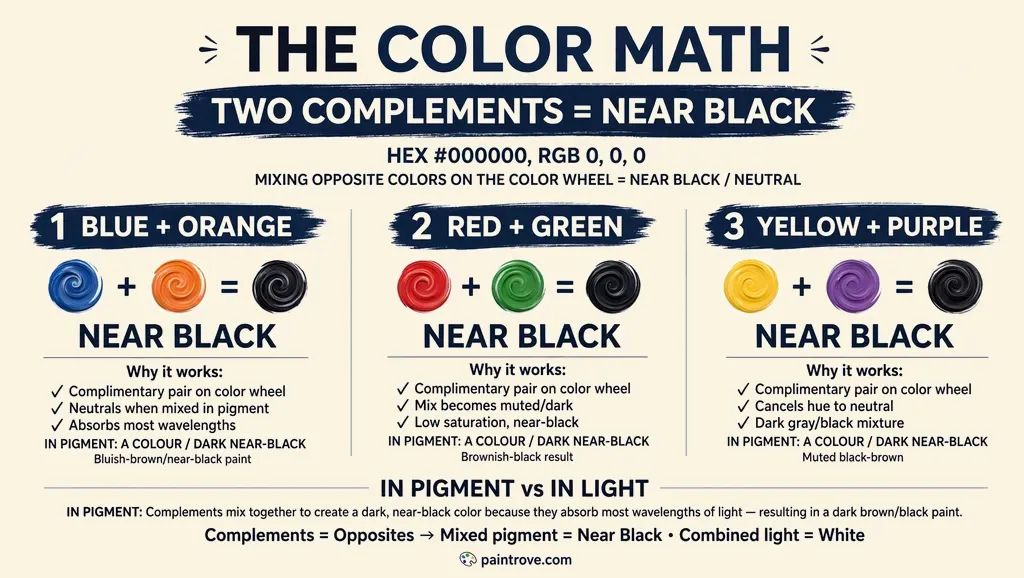
In light, nothing makes black, because black is the absence of light rather than a colour of it. On a screen, black is simply all three channels switched off: RGB 0, 0, 0, or the black color code Hex #000000.
What colors make black in practice, then, is a question about pigments rather than about hues. Mixed blacks are often better than tube black. They can be warmed or cooled to suit the painting, they stay alive where a tube black goes flat, and they sit more naturally beside other colours. This guide covers the best recipes, how to make black lean warm or cool, every black colour code worth knowing, and whether black counts as a colour at all.
What colors make black?
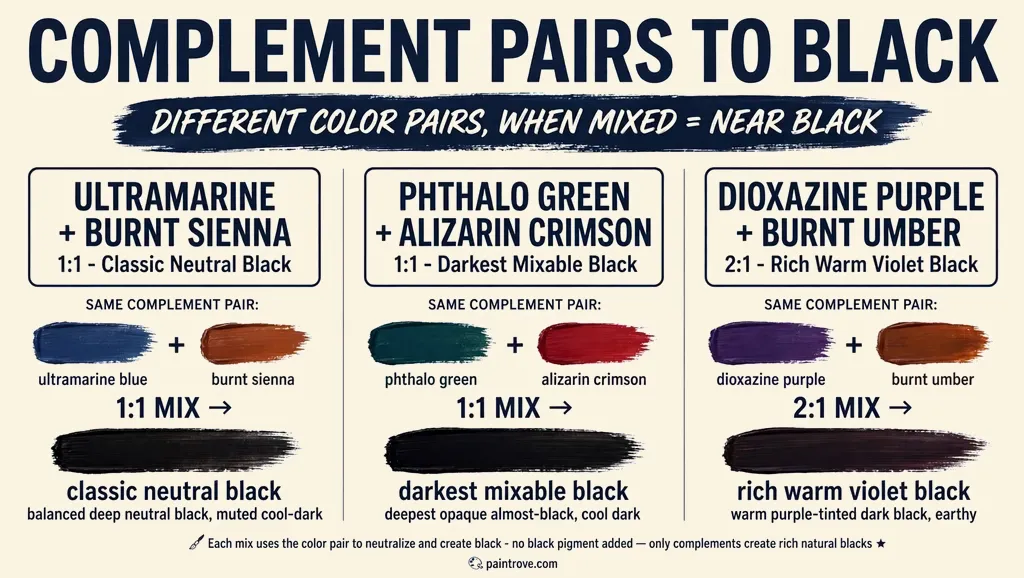
Two complements, or all three primaries together. Neither gives a perfect black, and the honest answer is that what makes black in pigment is subtraction rather than addition.
Here is the mechanism. Every pigment absorbs some wavelengths and reflects the rest. Mix two pigments and only the wavelengths both of them reflect survive. Mix colours from opposite sides of the color wheel and between them they absorb nearly everything, so almost no light comes back. That is what you perceive as black.
The practical result is a chromatic black: very dark, but carrying a faint bias one way or the other. Held against a tube black it will read slightly warm, slightly cool or slightly green. In isolation it reads as black, and in a painting it usually reads better than a true neutral.
Three routes, in order of reliability:
- Two complements. The standard approach. Blue with orange, red with green, or yellow with purple. The relationship is explained in the guide to complementary colors.
- All three primaries. Red, yellow and blue together in roughly equal strength. This works but is harder to control, since the balance tips into brown easily. The same reaction at a weaker ratio is what produces the results in how to make brown.
- A tube black. Fast and consistent, but flatter.
What two colors make black most effectively comes down to picking a complement pair where both pigments are already dark. A pale yellow and a pale purple will neutralize each other but land on grey, not black, because neither had much darkness to contribute.
The best black mixing recipes
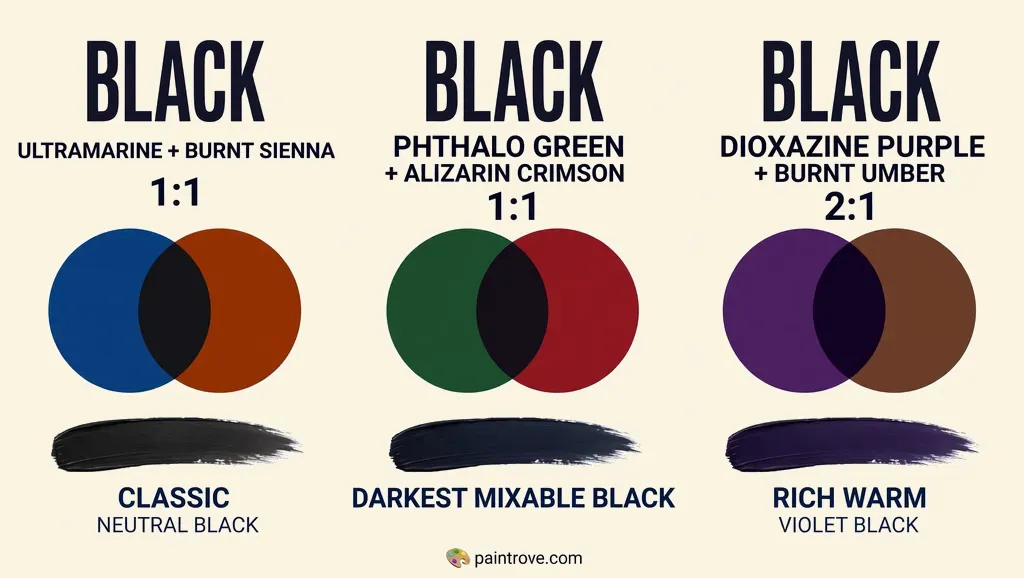
What two colors make black best is answered differently by each pairing below. Every ratio is an approximate starting point, since pigment strengths vary enormously, so add gradually and test on scrap.
| Recipe | Approximate ratio | Result |
|---|---|---|
| Ultramarine + Burnt Sienna | 1 : 1 | The classic. Neutral to slightly warm, very versatile |
| Ultramarine + Burnt Umber | 1 : 1 | Deeper and cooler than burnt sienna, excellent for shadows |
| Phthalo Green + Alizarin Crimson | 1 : 1 | The darkest mixable black, slightly cool |
| Phthalo Blue + Quinacridone Red + Hansa Yellow | roughly equal | A true three-primary black, hard to balance |
| Dioxazine Purple + Burnt Umber | 2 : 1 | Rich, warm, slightly violet black |
| Prussian Blue + Burnt Sienna | 1 : 1 | Very dark with a green undertone |
Ultramarine with burnt sienna is the one to learn first. Both pigments are widely available, the ratio is forgiving, and shifting it slightly gives you an entire range: more ultramarine for a cool blue-black, more burnt sienna for a warm brown-black. That controllability is the whole argument for mixing rather than squeezing.
Phthalo green with alizarin crimson produces the deepest black you can mix, darker than most tube blacks. Both pigments are intensely staining, so handle the ratio carefully and expect it to be difficult to lighten afterwards.
How to make black from a complement pair, step by step:
- Put out roughly equal amounts of both pigments.
- Mix them fully and look at the result against white paper.
- If it leans blue, add a little of the warm colour. If it leans brown or orange, add a little of the cool one.
- Keep adjusting until neither colour dominates.
- Test a swatch and let it dry, since acrylic dries darker and watercolour dries lighter.
Why mixed black beats tube black
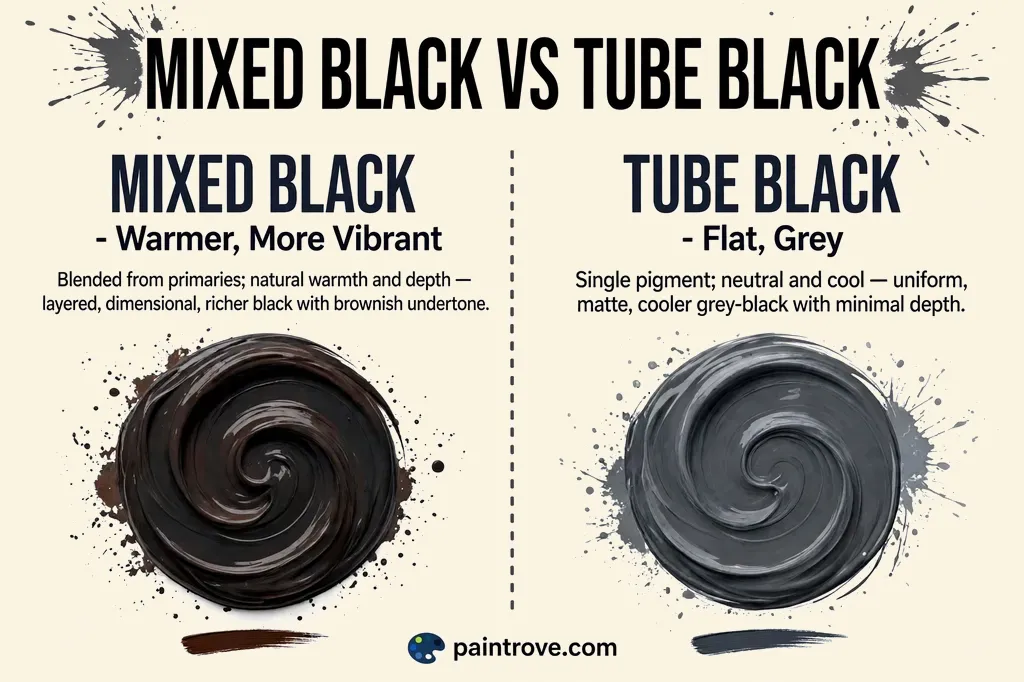
Knowing how to make black colour yourself changes how you paint. Four reasons painters avoid black straight from the tube:
Tube black is flat. It has no hue content at all, so it sits dead beside saturated colours and can make a painting look lifeless.
Tube black kills other colours. Adding it to any hue drops the saturation sharply and often shifts the hue unexpectedly. Black added to yellow gives olive rather than dark yellow, as covered in the yellow family, and black added to warm colours frequently dulls them into mud, which is why orange and black mixed lands on a burnt, dirty brown.
Tube blacks have undertones anyway. Lamp black and carbon black lean cool and blue. Ivory black leans warm and slightly brown. Mars black is the most neutral but also the strongest. None of them is the neutral most people assume.
A mixed black can be tuned. You can make it warm for firelight and skin shadows, cool for night and metal, or green-leaning for foliage shadows. A tube cannot do that.
Where tube black genuinely wins: large flat areas, underpainting, consistency across sessions, and any situation where mixing time matters more than subtlety.
Warm, cool and neutral blacks
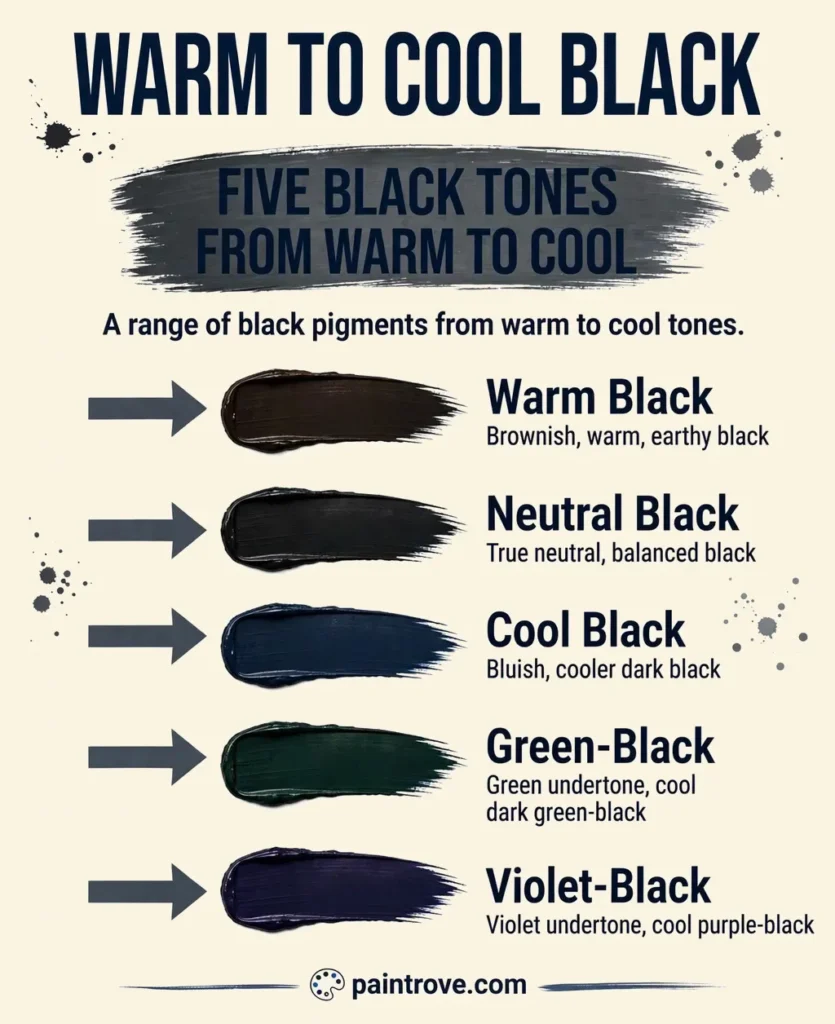
| Target | How to mix it | Use it for |
|---|---|---|
| Warm black | More burnt sienna or burnt umber than blue | Skin shadows, firelight, wood, fur |
| Cool black | More ultramarine or phthalo than brown | Night scenes, metal, glass, snow shadows |
| Neutral black | Balanced complement pair, adjusted carefully | General darks, text, flat areas |
| Green-black | Phthalo green with a little alizarin | Foliage shadows, deep water |
| Violet-black | Dioxazine purple with burnt umber | Fabric, dramatic shadow, velvet |
What colours make black of each temperature is a matter of which pigment you let dominate. The test for which you have: lay a swatch beside a tube black. Whatever direction yours leans will become obvious immediately, and that is the information you need to adjust it.
Is black a color? What color is black?
This question comes up constantly and the answer genuinely depends on which system you mean.
In pigment, black is a colour. It is a physical substance with a pigment index number, it behaves like other paints, and it mixes predictably. Mars black is PBk11, ivory black is PBk9. These are colours in every practical sense.
In light, black is not a colour. It is the absence of light entirely. There is no wavelength that produces black and no such thing as a black light source. A screen displays black by emitting nothing at all.
In colour theory, black is achromatic. It has no hue and no saturation, only value, which is why it does not appear on the colour wheel alongside red, yellow and blue. It sits with white and grey as a neutral.
So what color is black? It is a colour in the everyday and pigment sense, and not a colour in the physics sense. Both answers are correct within their own system, which is why the argument never resolves. The University of Wisconsin–Madison Ingersoll Physics Museum demonstrates the additive side clearly: switch off every light source and you have black, because there is nothing left to see.
Black color code: hex, RGB and CMYK
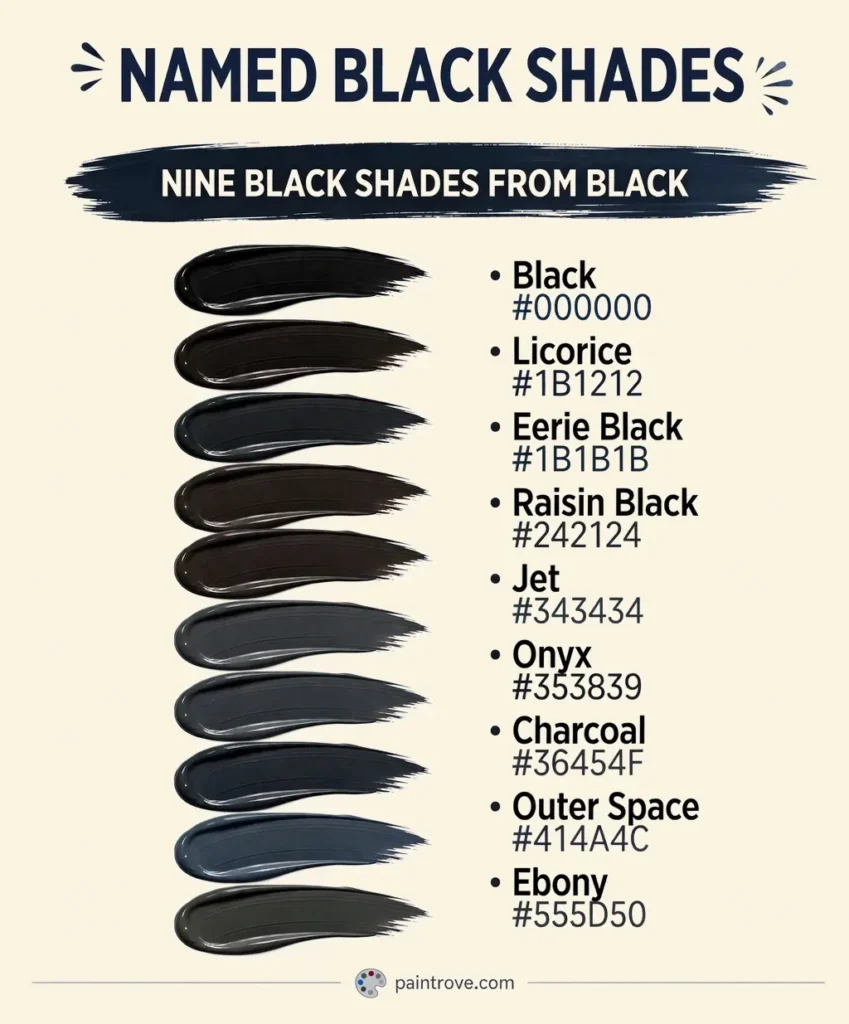
The black color code most people need is Hex #000000, which is RGB 0, 0, 0. All three channels at zero, no light emitted.
| Name | Hex | RGB | Character |
|---|---|---|---|
| Black | #000000 | 0, 0, 0 | Pure, absolute black |
| Licorice | #1B1212 | 27, 18, 18 | Very slightly warm |
| Eerie black | #1B1B1B | 27, 27, 27 | Neutral soft black |
| Raisin black | #242124 | 36, 33, 36 | Slightly violet |
| Jet | #343434 | 52, 52, 52 | Neutral, clearly lighter than pure |
| Onyx | #353839 | 53, 56, 57 | Slightly cool |
| Charcoal | #36454F | 54, 69, 79 | Distinctly blue-grey |
| Outer space | #414A4C | 65, 74, 76 | Cool, greyish |
| Ebony | #555D50 | 85, 93, 80 | Green-leaning, softest |
Those values are approximate for the named shades, since most have no formal standard. Only #000000 is fixed.
In print, black rgb values do not translate directly, and this matters. The black rgb triplet has no direct CMYK equivalent, so printers work with two separate options. CMYK offers two options:
- Plain black is 0, 0, 0, 100: black ink alone. On large areas it looks thin and washed out, closer to dark grey.
- Rich black adds the colour inks underneath, commonly around 60, 40, 40, 100. This produces a genuinely deep black on press.
Use plain black for small text, since rich black on fine type causes registration problems. Use rich black for large solid areas. This single distinction is the most common cause of disappointing printed blacks.
Why your mixed black is not dark enough
It came out brown. Your warm pigment is dominating. Add more of the cool one. Brown is the halfway house between a balanced complement mix and a failed one.
It came out navy or grey-blue. The opposite problem. Add more burnt sienna or burnt umber.
It came out grey rather than black. One or both of your pigments is too light in value. A pale yellow with a pale purple neutralizes correctly but has no darkness to give. Use dark pigments on both sides, or switch to phthalo green with alizarin crimson.
It looks dark but flat. You may have used too much tube black, or your mix has gone fully neutral. A small deliberate bias one way reads better than a perfect neutral.
It lightened as it dried. Watercolour does this noticeably. Mix stronger than looks right and judge from a dried swatch.
I cannot get it dark enough in watercolour. Build it in layers rather than trying to reach full strength in one pass, letting each layer dry completely.
How black behaves when added to other colours
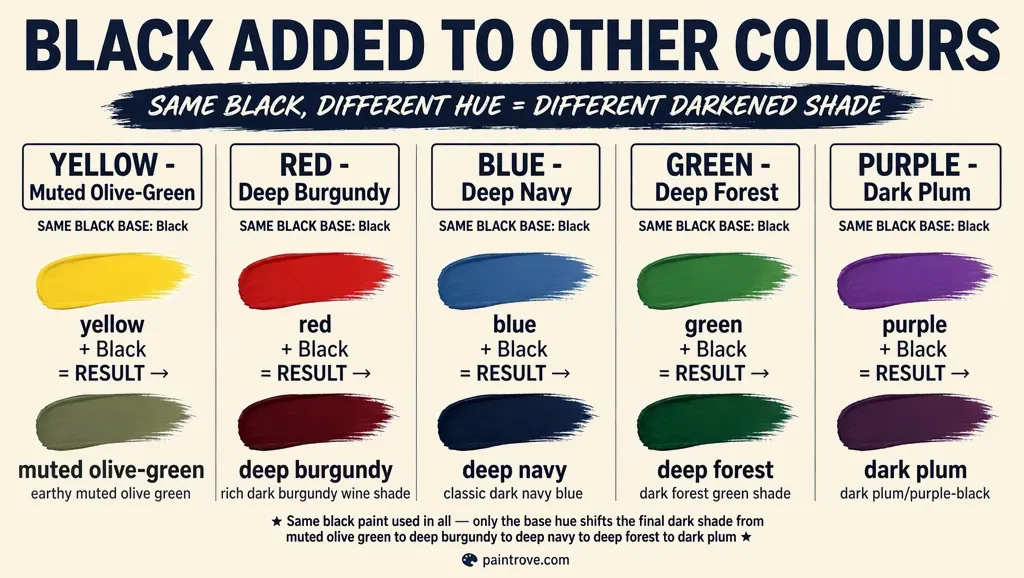
Adding black to a hue produces a shade, which is the opposite of a tint. The results are not always what people expect:
| Hue plus black | Result |
|---|---|
| Red | Maroon, then oxblood |
| Blue | Navy, then midnight blue |
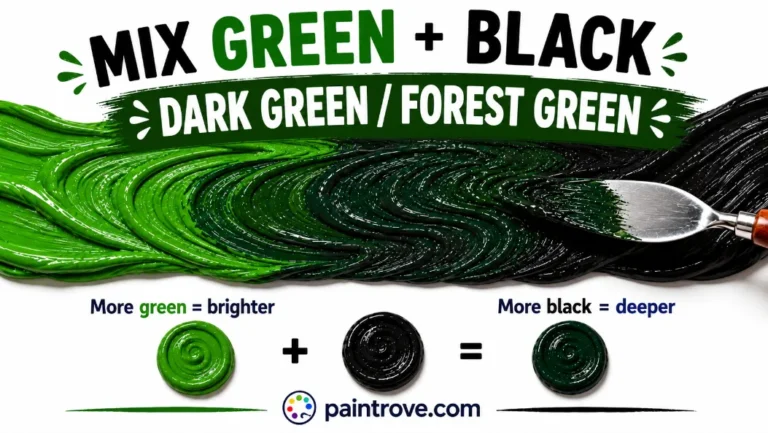
| Green | Dark forest green, as in green and black mixed |
| Yellow | Olive, not dark yellow |
| Orange | Dark burnt brown |
| Purple | Dark plum, as in purple and black mixed |
Yellow is the surprise on that list. Because most blacks carry a cool blue undertone, and blue plus yellow makes green, black turns yellow olive almost immediately rather than darkening it cleanly. The same neutralizing reaction in reverse is what drives purple and yellow mixed toward muddy brown.
What colors make black?
Two complementary colours mixed together, or all three primaries in roughly equal strength. Ultramarine blue with burnt sienna is the most reliable pairing. No two colours produce a perfect neutral black in paint; the result is always a very dark chromatic black with a slight warm or cool bias.
What two colors make black?
Any complementary pair where both pigments are dark. Ultramarine with burnt sienna or burnt umber is the standard. Phthalo green with alizarin crimson produces the deepest mixable black. Blue with orange, red with green and yellow with purple all work in principle, but pale pigments give grey rather than black.
How to make black paint from scratch?
Mix equal amounts of a dark blue and a dark brown, such as ultramarine and burnt umber, then adjust. If the result leans blue, add more brown. If it leans brown, add more blue. Keep going until neither dominates. Test on white paper, since dark mixes are hard to judge on a palette.
What makes black in printing?
Either black ink alone at 0, 0, 0, 100, called plain black, or black ink over the colour inks at around 60, 40, 40, 100, called rich black. Plain black looks thin across large areas, while rich black is genuinely deep. Use plain black for small text and rich black for solid blocks.
What is the black color code?
Pure black is Hex #000000, which is RGB 0, 0, 0 with all three channels off. Softer blacks include eerie black at Hex #1B1B1B, jet at Hex #343434 and charcoal at Hex #36454F. Only #000000 is a fixed standard; the named shades vary between sources.
What is black rgb?
0, 0, 0. All three channels at zero, meaning no red, green or blue light is emitted. Black on a screen is not a colour being displayed but the absence of any light at all, which is why true black requires a display that can switch pixels off entirely.
What color is black, and is it a color at all?
In pigment, yes: black is a physical paint with its own pigment codes, and it mixes like any other. In light, no: black is the absence of light and has no wavelength. In colour theory it is achromatic, having value but no hue or saturation, which is why it sits off the colour wheel with white and grey.
How to make black colour darker than tube black?
Mix phthalo green with alizarin crimson. Both are intensely staining pigments and the combination produces a black deeper than most commercial tube blacks. Build it in layers for maximum depth in watercolour, letting each pass dry fully before adding the next.
What colours make black without blue?
Red with green, or yellow with purple. Both are complementary pairs and both neutralize toward black, though the red-green route tends toward brown and the yellow-purple route tends toward grey unless both pigments are dark. Blue-based mixes are generally more reliable.
What 2 colors make black that is warm rather than cool?
Ultramarine with a higher proportion of burnt sienna or burnt umber. The brown pushes the mix warm while the blue supplies the darkness. Warm blacks suit skin shadows, firelight and wood, where a cool black would look out of place.
Why does my black look brown?
The warm pigment is dominating the mix. Brown is literally the midpoint between a neutral complement mix and an unbalanced one, so a brownish result means you need more of the cool colour. Add blue or green in small increments until the brown cast disappears.
Should I use tube black or mix my own?
Mix your own when the black appears beside other colours, since a mixed black can be tuned warm or cool and stays alive in a painting. Use tube black for large flat areas, underpainting, text, and anywhere consistency across sessions matters more than subtlety.
Black at a glance
| If you want | Do this |
|---|---|
| A reliable mixed black | Ultramarine plus burnt sienna, roughly 1 to 1 |
| The deepest mixable black | Phthalo green plus alizarin crimson |
| A warm black | Increase the burnt sienna or burnt umber |
| A cool black | Increase the ultramarine or phthalo |
| Black on a screen | Hex #000000, RGB 0, 0, 0 |
| Black in print, small text | Plain black, 0, 0, 0, 100 |
| Black in print, large areas | Rich black, around 60, 40, 40, 100 |
| To avoid killing other colours | Darken with a complement, not with black |
What colors make black comes down to one principle: two colours that between them absorb the whole spectrum. Three things are worth remembering: no mix gives a perfectly neutral black and that is usually an advantage, a brown result means you need more of the cool pigment, and black added to yellow gives olive rather than dark yellow.