What Color Do Red and Yellow Make When Mixed? (Orange)
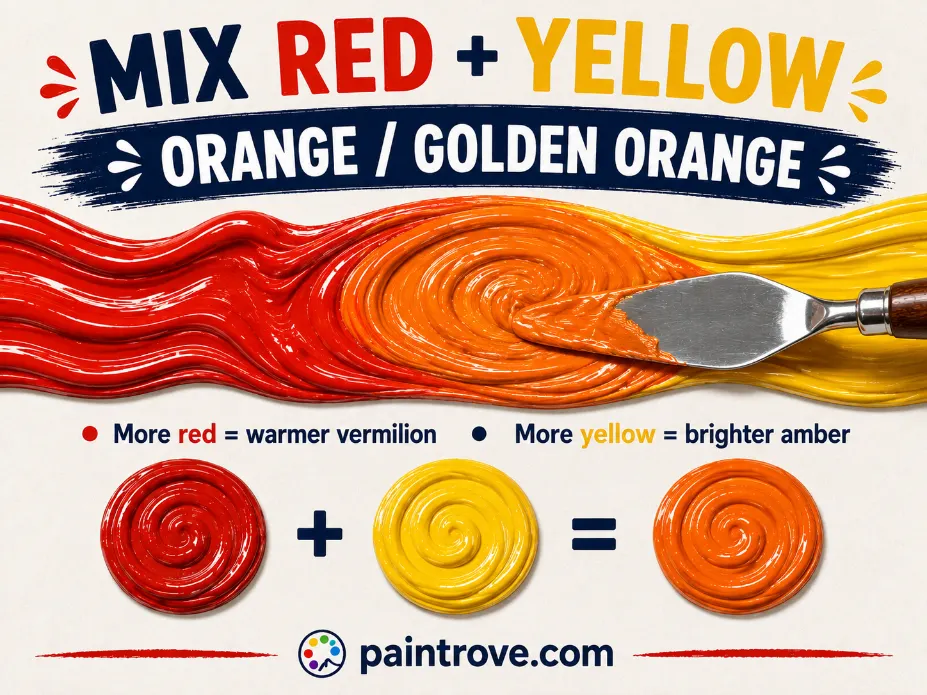
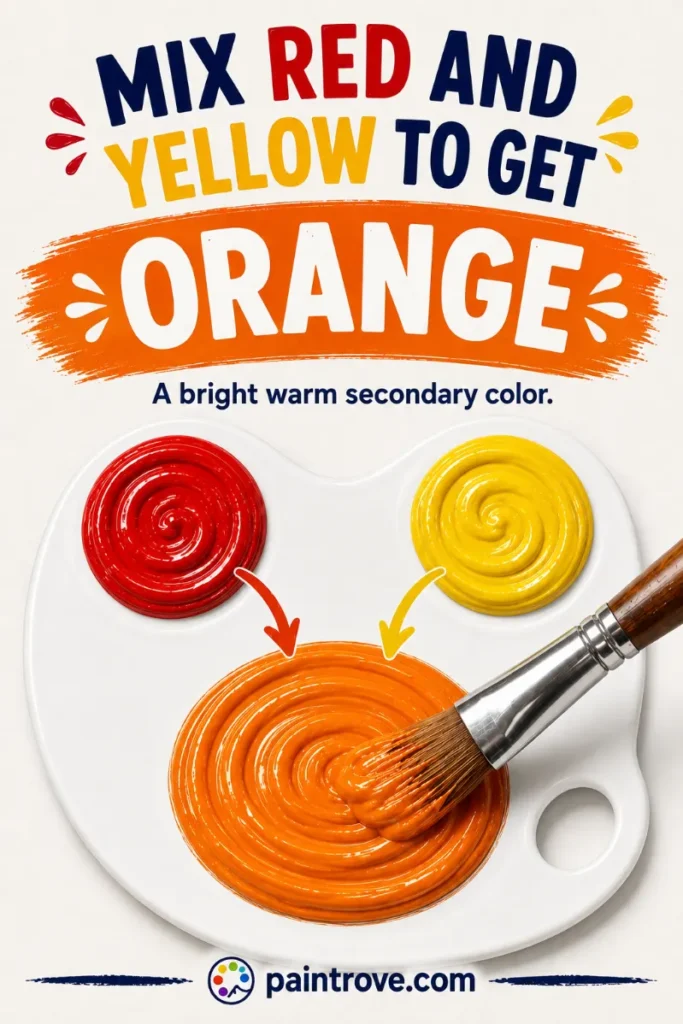
What Color Do Red and Yellow Make? Quick answer: Red and yellow make orange, at hex #FFA500. Equal parts of red and yellow produce a bright, true orange. More red gives a warm red-orange or vermilion; more yellow gives a bright yellow-orange or amber. Remarkably, red and yellow make orange in paint, ink, and light alike, one of the very few mixes that stays consistent across every color system.
Red and yellow making orange is one of the first color-mixing facts most of us learn, and it is refreshingly reliable. Unlike many mixes that behave differently in paint versus light, this one gives you orange everywhere. But mixing the exact orange you want, a glowing tangerine versus a dull brownish one, still takes knowing which red and yellow to use.
This guide covers why the mix works, the exact ratios with hex codes, the best pigments, the full shade range, and why this mix is so uniquely consistent.
Why Do Red and Yellow Make Orange?
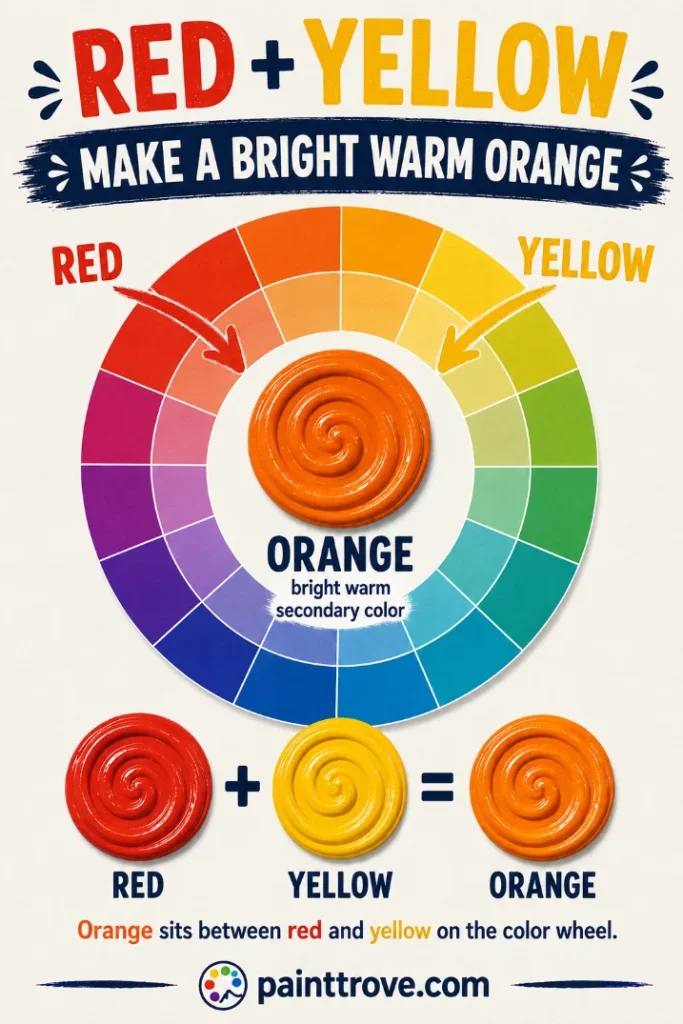
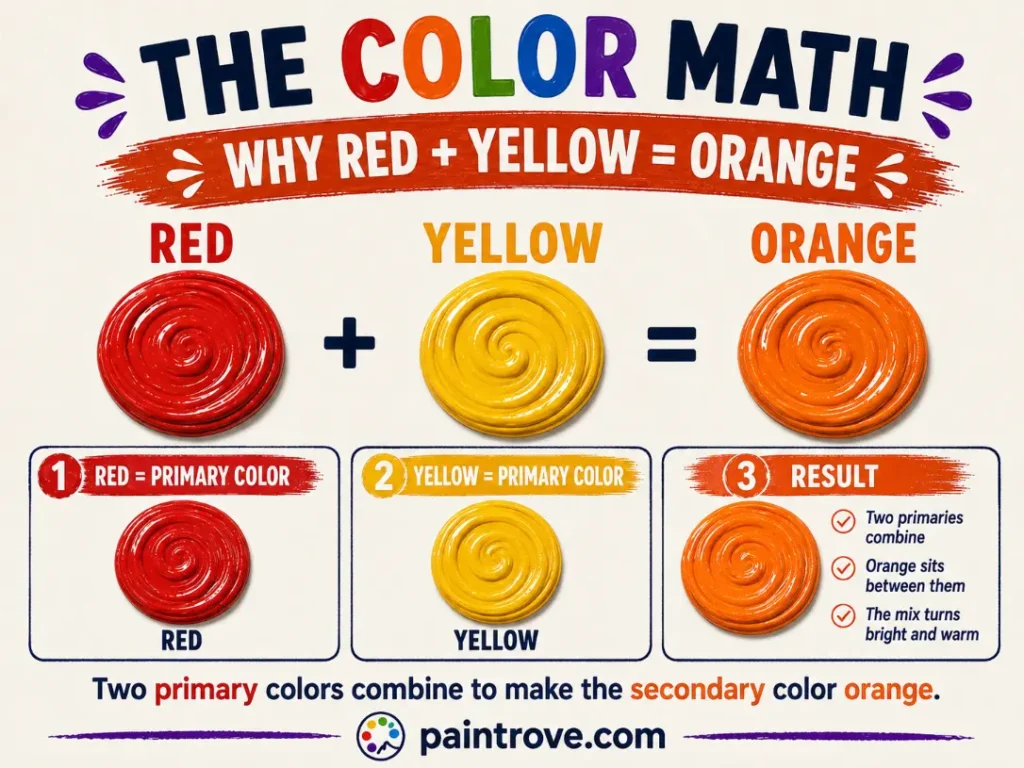
Red and yellow make orange because they are two of the three primary colors, and mixing any two primaries produces a secondary color.
Red and yellow are both primary colors in the traditional RYB paint model, alongside blue. Primary colors cannot be created by mixing other colors, but combining any two of them makes a secondary color:
- Red + Yellow = Orange
- Blue + Yellow = Green
- Red + Blue = Purple
On the color wheel, orange sits directly between red and yellow, exactly where their mix lands. Both parents are warm colors, which makes orange the warmest, most energetic color on the wheel, the color of fire, sunsets, and autumn. This mix is the core recipe behind the whole orange family, covered in full in our guide to what colors make orange.
The One Mix That Works Everywhere: Paint, Ink, and Light
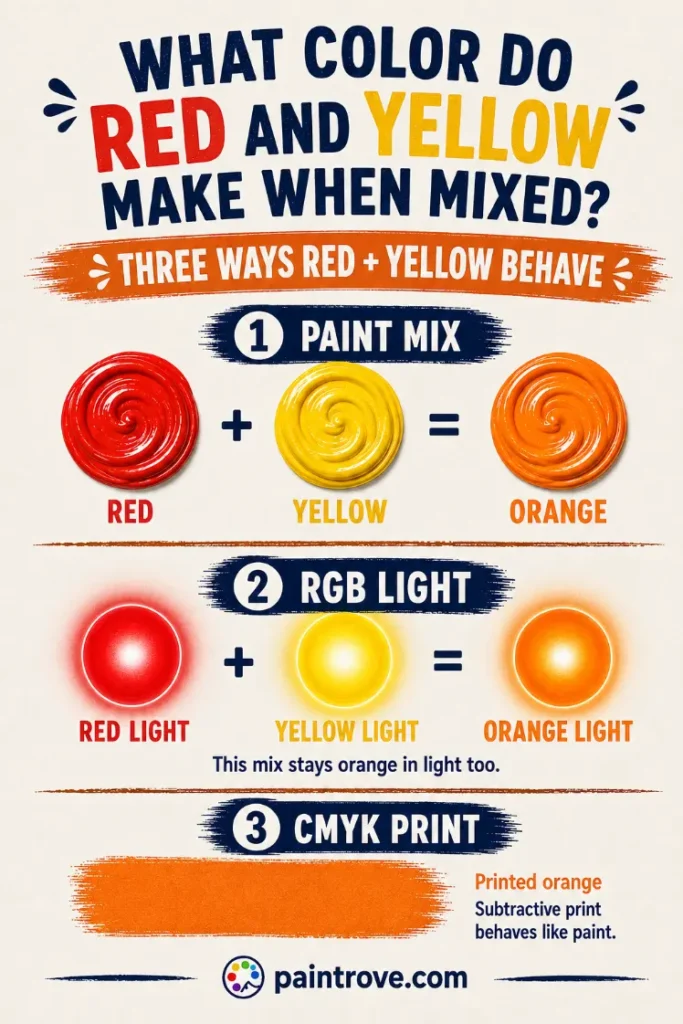
Here is what makes red and yellow special. Most color mixes give different results in paint versus light. Red and green, for example, make brown in paint but yellow in light. Red and yellow, though, make orange in every color system.
In paint (RYB, subtractive), red and yellow pigments absorb light and reflect orange wavelengths. In light (the RGB model, additive), red light plus yellow light, where yellow is itself red plus green, effectively combines red, red, and green, which the eye reads as orange. In print (the CMYK model, subtractive), magenta and yellow inks combine to make orange. All three land on orange.
| System | Type | Red + Yellow makes | Hex code |
|---|---|---|---|
| RYB (paint) | Subtractive | Orange | Hex #FFA500 |
| RGB (light and screens) | Additive | Orange | Hex #FFA500 |
| CMYK (printing) | Subtractive | Orange (via magenta + yellow) | Hex #FFA500 |
This consistency is rare and makes red and yellow one of the most dependable mixes in all of color theory. Whatever your medium, red and yellow will give you orange.
Which Red and Yellow Make the Brightest Orange?
The reds and yellows you choose decide how vivid or muddy your orange turns out. Every red and yellow leans slightly toward a neighboring color, and that bias matters.
The rule: use a warm red and a warm yellow, both leaning toward orange. A red that leans orange (cadmium red, scarlet) and a yellow that leans orange (cadmium yellow) share no hidden blue, so they mix into a clean, vivid orange. If either leans toward blue, and blue is orange’s complement, that hidden blue mutes the orange toward brown.
| Red used | Yellow used | Resulting orange |
|---|---|---|
| Cadmium red (warm) | Cadmium yellow (warm) | Bright, vivid classic orange |
| Cadmium red | Lemon yellow (cool) | Slightly muted, softer orange |
| Alizarin crimson (cool) | Cadmium yellow | Muted, earthy orange |
| Alizarin crimson | Lemon yellow | Dull, brownish orange |
| Scarlet | Cadmium yellow | Bright red-orange |
The takeaway: for a glowing orange, reach for cadmium red and cadmium yellow. This is why a 50/50 mix of two cool colors can surprisingly give a brown-orange instead of a bright one, the hidden blue is muting it. Cool pigments are useful for autumn tones but not for brightness.
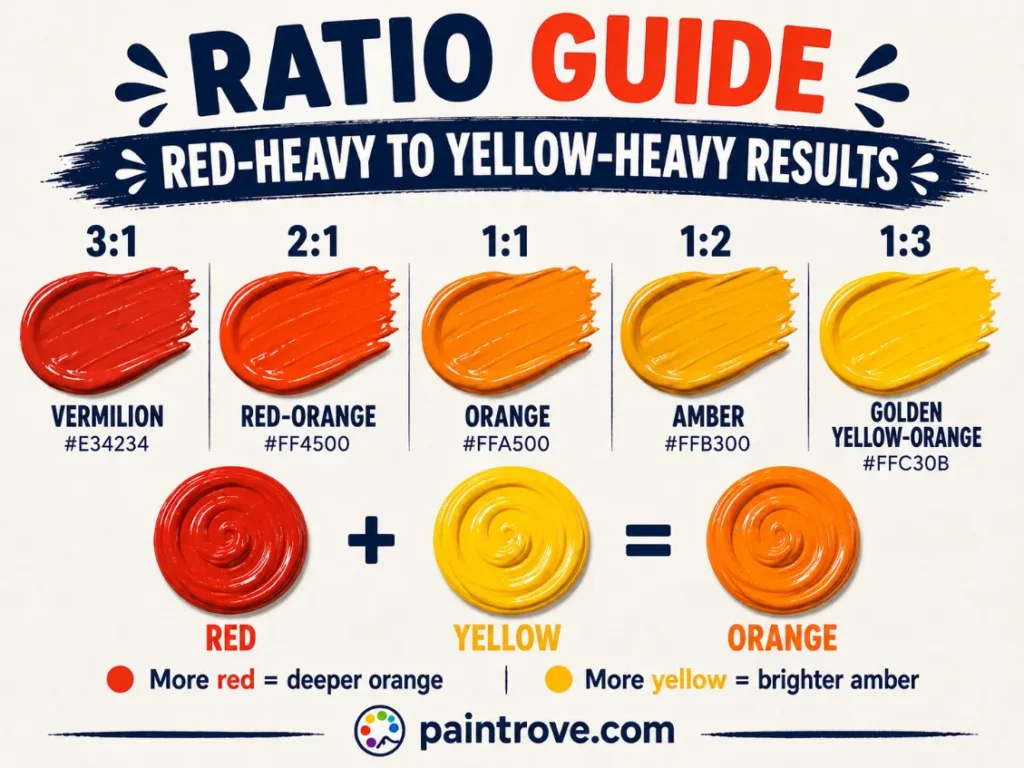
Red and Yellow Mixing Ratios and Hex Codes
The ratio of red to yellow decides the exact hue. Here is the working chart with hex targets in plain text:
| Ratio (Red : Yellow) | Resulting shade | Hex code |
|---|---|---|
| 1 : 1 | True orange | Hex #FFA500 |
| 2 : 1 | Red-orange | Hex #FF4500 |
| 3 : 1 | Deep vermilion | Hex #E34234 |
| 1 : 2 | Yellow-orange / amber | Hex #FFB300 |
| 1 : 3 | Golden yellow-orange | Hex #FFC30B |
| 1 : 1 plus white | Peach | Hex #FFCBA4 |
| 1 : 1 plus black | Burnt orange | Hex #CC5500 |
| 1 : 1 plus a touch of blue | Muted terracotta | Hex #E2725B |
Practical notes:
- Start with yellow and add red gradually. Red is stronger and darker, so a little goes a long way. It is easier to redden a yellow than to lighten a red.
- Mix thoroughly before judging. A half-mixed blend looks streaky.
- Test on white paper and let it dry. Acrylics dry slightly darker.
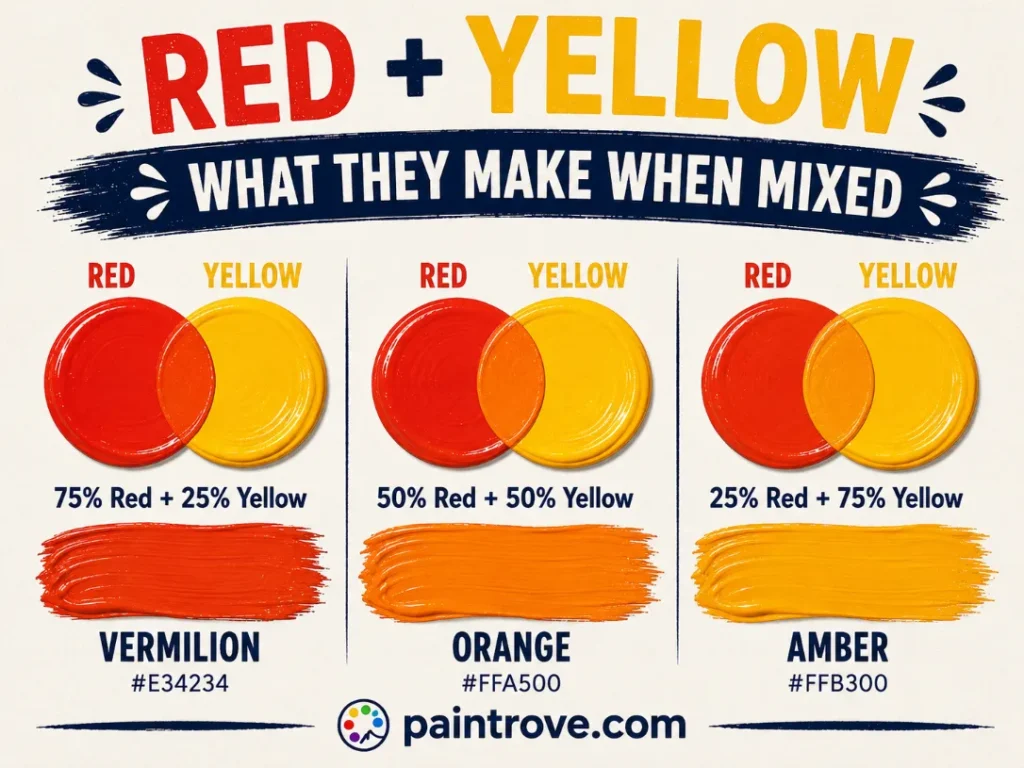
Every Shade You Can Make from Red and Yellow
Between ratio, pigment choice, and additions of white, black, or blue, red and yellow cover the entire orange family. The reference table:
| Shade | Hex code | How to mix it |
|---|---|---|
| True orange | Hex #FFA500 | Equal parts red and yellow |
| Red-orange | Hex #FF4500 | More red than yellow |
| Vermilion | Hex #E34234 | Red-heavy mix |
| Yellow-orange / amber | Hex #FFB300 | More yellow than red |
| Tangerine | Hex #F28500 | Balanced mix, warm pigments |
| Peach | Hex #FFCBA4 | Orange plus generous white |
| Apricot | Hex #FBCEB1 | Yellow-orange plus white |
| Coral | Hex #FF7F50 | Orange plus white and a touch of pink |
| Burnt orange | Hex #CC5500 | Orange plus a little black or brown |
| Rust | Hex #B7410E | Orange plus brown, deep |
| Pumpkin | Hex #FF7518 | Red-orange, slightly deep |
| Terracotta | Hex #E2725B | Orange muted with blue |
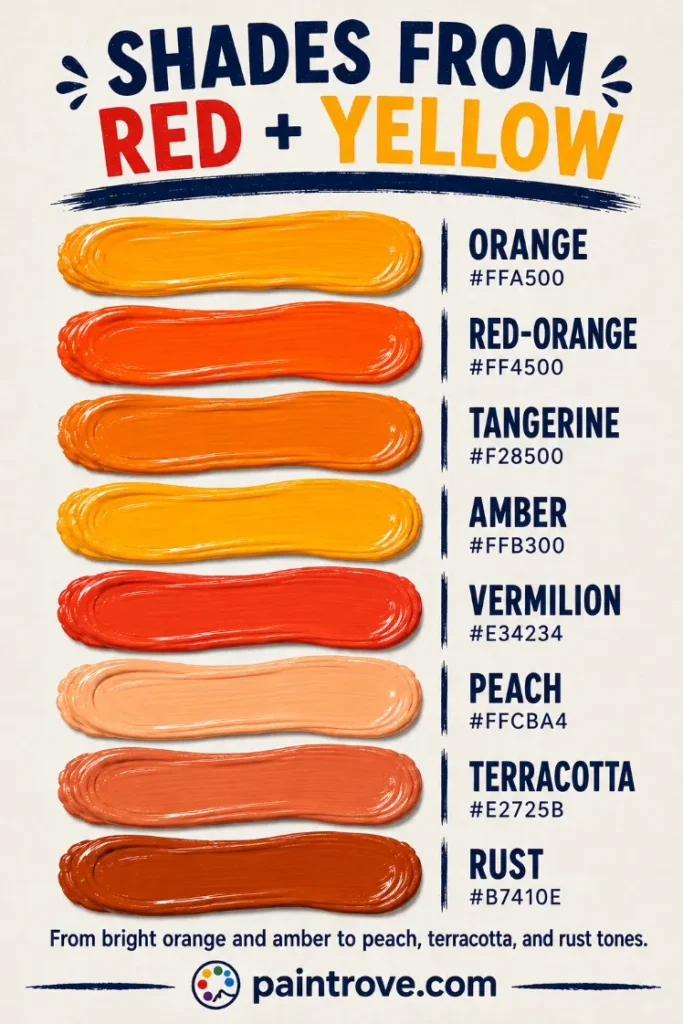
How Do You Make Red-Orange or Yellow-Orange?
For red-orange, use roughly two parts red to one part yellow, landing on a warm vermilion. This is covered in detail at red and orange mixed. For yellow-orange, use more yellow, giving a bright amber, covered at orange and yellow mixed. These are the two tertiary oranges on either side of true orange.
How Do You Make Light Orange or Peach?
Add white to lighten orange into peach and apricot. For coral, add a touch of pink along with the white. These soft oranges connect to the guides at orange and pink mixed and yellow and pink mixed.
How Do You Make Dark or Burnt Orange?
Add a small amount of black or brown to deepen orange into burnt orange and rust. Deepening with brown or a touch of blue keeps the color richer than black alone, which can dull it. These earthy tones connect to orange and black mixed and how to make brown.
Troubleshooting Red and Yellow Mixes
The orange came out brown or muddy. One of your colors leans blue. Alizarin crimson and lemon yellow both carry cool bias. Switch to cadmium red and cadmium yellow for a clean orange. This is the most common surprise with this mix.
The orange is too red. Too much red, which dominates. Add more yellow to brighten and warm it.
The orange is dull, not vivid. Cool or muted pigments. Use warm cadmium colors for maximum vibrancy.
The dark orange looks flat. Too much black. Deepen with brown or a touch of blue instead.
It dried darker. Standard acrylic behavior. Mix a step brighter and lighter than your target.
what does red and yellow make in Different Mediums
Red and yellow make orange in every medium, but the character shifts slightly.
Acrylics and oils give the most vivid orange from warm cadmium pigments. Acrylics dry slightly darker, so mix a touch brighter. Oils blend smoothly and stay workable, ideal for the graded oranges of a sunset.
Watercolor produces luminous, glowing oranges, since light passes through the transparent layers. Let red and yellow washes meet on wet paper for a natural graded orange, a favorite for autumn leaves and sunsets.
Food coloring and icing follow the same rule: red and yellow gel colors make orange, though red is concentrated, so add it a drop at a time to a yellow base.
Digital and print both reliably produce orange, since red and yellow combine to orange in RGB light and via magenta and yellow in CMYK print. This cross-medium consistency, covered above, is what makes orange so dependable for designers working across screen and paper.
Whichever medium you use, the same principle holds as in every secondary mix: warm, clean parent colors give the brightest result, as detailed in what colors make orange.
Orange in Art, Fashion, and Design
The orange that red and yellow make is the warmest, most energetic color on the wheel, with a long history across art and design.
In Art
Orange has been used in art for millennia, though the word is young. Ancient Egyptians used the mineral realgar, and Romans used orpiment, for orange tones. For most of history the color was called “yellow-red,” until the word orange entered English in the 1500s, named after the fruit. In painting, the red-yellow orange is essential for sunlight, warmth, autumn, and skin tones, and it makes its complement blue sing by contrast, a favorite pairing of the Impressionists.
In Fashion
Orange is a bold, confident color in fashion, used for statement pieces, while its softer and deeper versions, coral, peach, terracotta, and rust, are wardrobe staples across seasons. Red and yellow worn together, unmixed, is a high-energy, cheerful pairing associated with warmth and summer. Orange flatters warm skin tones and pairs strikingly with navy.
In Interiors and Branding
Orange brings warmth and energy to interiors as accents and earthy terracotta schemes. In branding, red and yellow together, and the orange they make, signal excitement, youthfulness, positivity, and appetite, which is why they dominate food and fast-food logos and playful, energetic identities.
Quick Reference: Red + Yellow = What Color Cheat Sheet
| Question | Answer |
|---|---|
| Red + yellow in paint | Orange (hex #FFA500) |
| Red + yellow in light | Orange |
| Red + yellow in print | Orange |
| More red | Red-orange, vermilion |
| More yellow | Yellow-orange, amber |
| Plus white | Peach, apricot |
| Plus black or brown | Burnt orange, rust |
| Plus a touch of blue | Terracotta |
| Best pigments | Cadmium red + cadmium yellow |
| Why it goes muddy | Blue bias in the red or yellow |
| Color type | Secondary color |
FAQs: yellow and red make what color
What color do red and yellow make when mixed?
Red and yellow make orange, a secondary color, at hex #FFA500. Equal parts give a bright true orange. More red gives red-orange; more yellow gives yellow-orange. Uniquely, red and yellow make orange in paint, ink, and light alike.
Do red and yellow make orange in light too?
Yes. Red and yellow make orange in every color system, paint, ink, and light. This is unusual, since most mixes differ between paint and light. Red and yellow is one of the few that stays consistent everywhere.
Why did my red and yellow make brown instead of orange?
One of your colors has a blue bias. Blue is orange’s complement, so any hidden blue mutes the mix toward brown. Alizarin crimson and lemon yellow are common culprits. Use warm cadmium red and cadmium yellow for a clean, bright orange.
What is the ratio of red to yellow for orange?
Equal parts, 1:1, give a true orange. For red-orange, use about two parts red to one part yellow. For yellow-orange, use two parts yellow to one part red. Start with yellow and add red gradually, since red is stronger.
How do you make orange brighter?
Use warm, pure pigments, cadmium red and cadmium yellow, and avoid cool colors and black. To brighten a dull orange, add more warm yellow, and mix on a clean palette to avoid muddiness.
How do you make orange darker?
Add a small amount of black or brown for burnt orange and rust. Deepening with brown or a touch of blue keeps the orange richer than black, which can flatten it.
Are red and yellow warm or cool colors?
Both are warm colors, and so is the orange they make. Red, orange, and yellow occupy the warm half of the color wheel, associated with fire, sun, and energy.
Is orange a primary or secondary color?
Orange is a secondary color, made by mixing the two primaries red and yellow. In the RGB light model it is also not primary, being a mix of red and green light.
Red and yellow make orange, reliably, in paint, ink, and light alike. Use warm cadmium pigments for a vivid result, adjust the ratio for red-orange or yellow-orange, and add white, black, or blue to reach the whole family from peach to rust.
For the full orange family, see what colors make orange, explore the tertiary mixes at orange and yellow and red and orange, or step back to the color wheel and primary colors.