What Color Do Red and Black Make When Mixed? (Maroon / Dark Red)
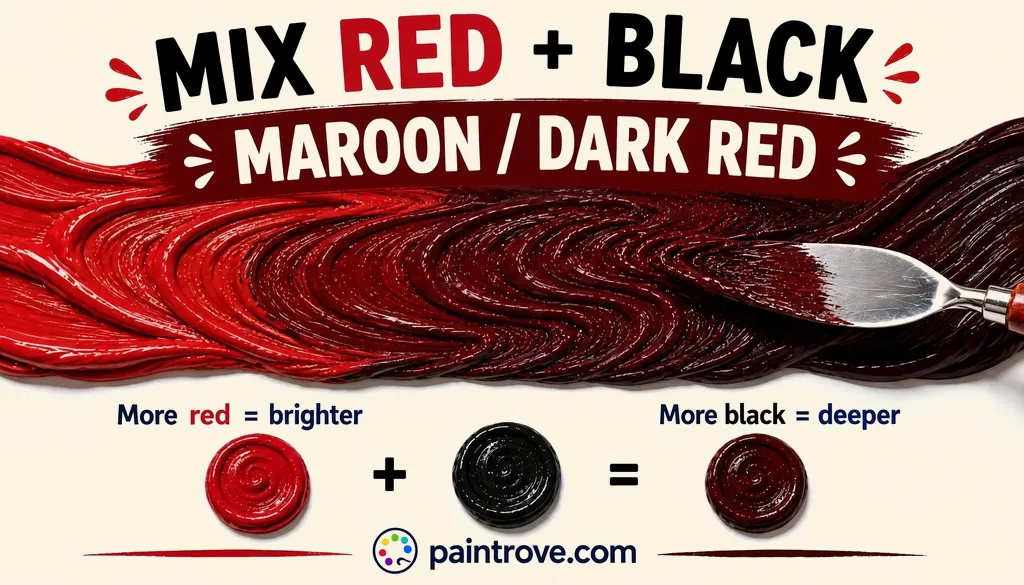
Red and black make maroon, deepening through burgundy and oxblood to a near-black red as more black goes in. A small amount of black gives a rich dark red around Hex #8B0000. More gives maroon near Hex #800000. Past that the red disappears into the black almost entirely.
Black carries no hue of its own, so it cannot turn red into another colour. What does red and black make at any ratio is still red, just darker and considerably less vivid.
That loss of vividness is the catch, and it is why experienced painters rarely use black to darken red. Red is unusually sensitive to it: a mixture that should read as deep crimson often comes out looking muddy, flat or faintly brown instead. This guide covers the ratios, why that happens, the better routes to a rich dark red, and how the red and black combination works in design.
What does red and black make?
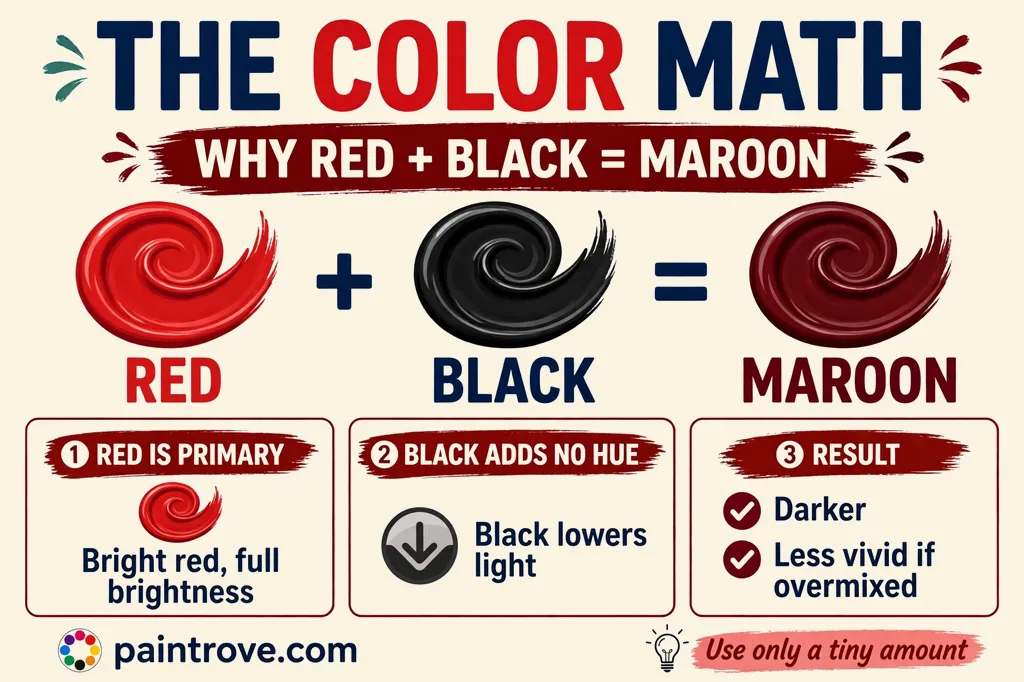
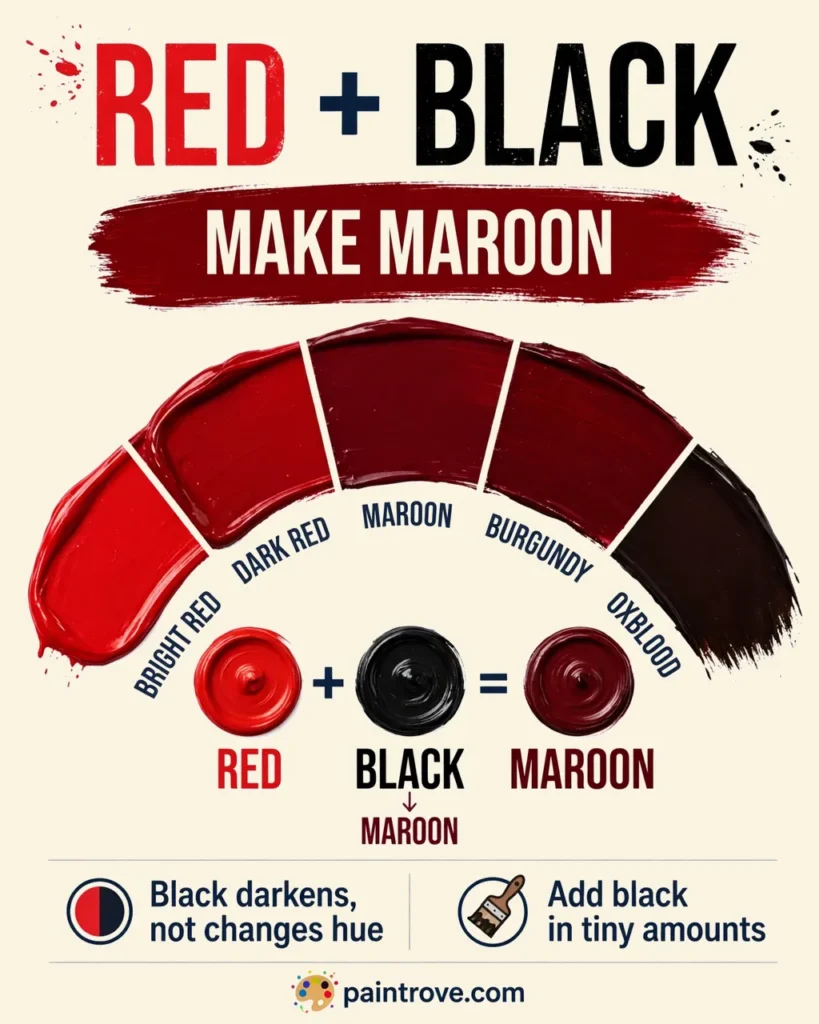
A shade of red. That is the technical term and it sets up the whole result.
Colour theory has three ways of modifying a hue. A tint is a hue plus white, so red plus white gives pink. A tone is a hue plus grey, so red plus grey gives the muted brick and marsala covered in red and grey mixed. A shade is a hue plus black, and that is what we have here.
Because black absorbs across the whole visible spectrum, adding it to red reduces the light the mixture reflects without favouring any wavelength. The hue stays put. The value drops. Saturation drops with it, which is the part that catches people out.
Black and red make what color sits progressively further down that value scale, and the useful range is shorter than most people expect. Red is already a mid-to-dark value hue, so there is far less room to darken it than there is with yellow, and black and red make what color is effectively black surprisingly quickly.
Red and black mixing ratios
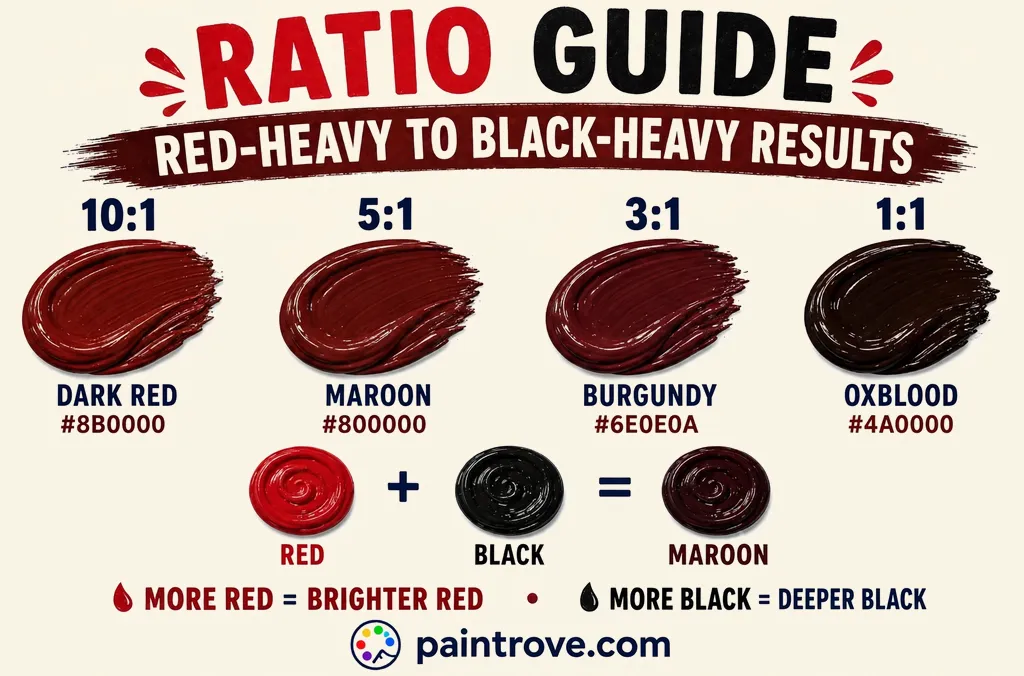
What does red and black make at each step down the scale is set out below. Every ratio is an approximate starting point rather than a formula, since reds vary enormously in strength and blacks vary in undertone, so add gradually and test before committing.
| Approximate ratio (red : black) | Result | Roughly matches |
|---|---|---|
| 20 : 1 | Slightly deepened red | Still clearly red, less shrill |
| 10 : 1 | Rich dark red | Dark red, Hex #8B0000 |
| 6 : 1 | Maroon | Maroon, Hex #800000 |
| 4 : 1 | Deep burgundy | Burgundy, Hex #6E0E0A |
| 2 : 1 | Oxblood | Oxblood, Hex #4A0000 |
| 1 : 1 | Near-black with a red cast | Barely readable as red |
| 1 : 2 | Black for practical purposes | Indistinguishable from black |
Add black into red, never red into black. Black has enormous tinting strength and red is already fairly dark, so the window between “nicely deepened” and “ruined” is narrow. Work from the red and introduce black a brushtip at a time.
A workable sequence:
- Put out the red you want to darken.
- Pick up the smallest trace of black your brush will carry.
- Blend fully before judging. Streaky dark paint always reads darker than it will once mixed.
- Check the swatch against a scrap of the pure red so you can see how much chroma has gone.
- Stop one step before you think you should, then test and let it dry.
Overshooting here is effectively unrecoverable. Adding red back to an over-blackened mixture needs a very large quantity before the hue returns, and the result stays dull because the black is still in there.
Why black makes red look muddy
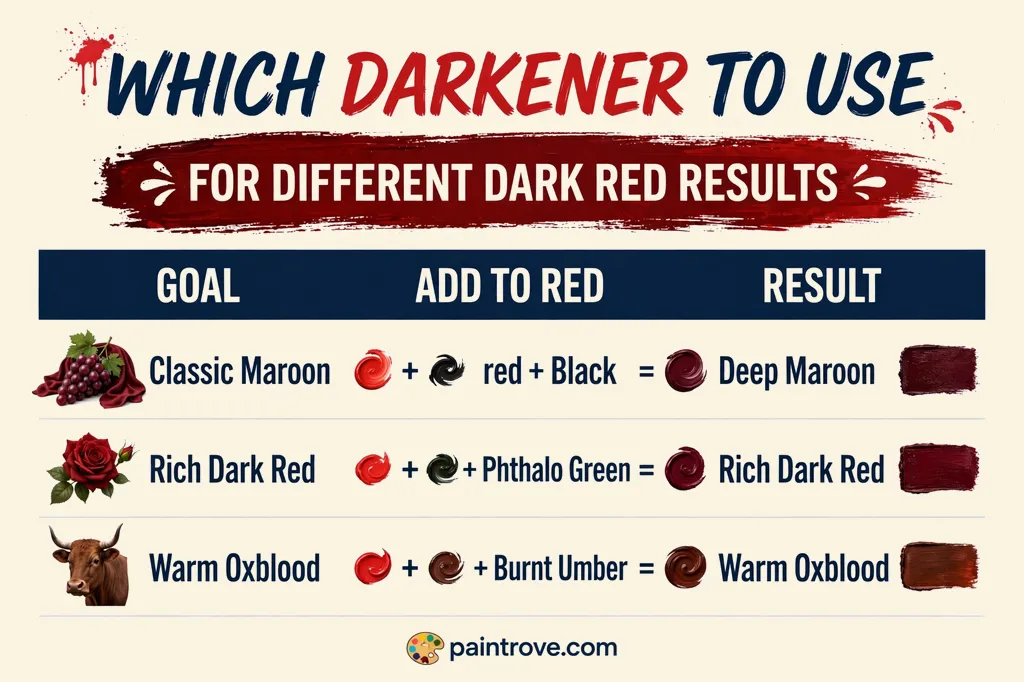
What color does red and black make when it goes wrong? Mud. This is the problem every painter runs into with this mix, and red suffers from it more than most hues.
Black removes chroma along with light. Saturation and value fall together, so you cannot darken without also dulling. A deep red that still looks rich has to get its darkness from something other than black.
Most blacks are not neutral. Lamp black and carbon black lean cool and blue. Blue is on the opposite side of the wheel from orange, and red sits close enough to orange that a blue-leaning black starts neutralizing it rather than simply darkening it. Ivory black leans warm and slightly brown, which pushes red toward a dull brick instead. Mars black is the most neutral but also the strongest, so it overwhelms quickly.
Red has nowhere to hide. Unlike blue, which stays recognisable at very low values, red loses its identity fast. A red at 20 percent value reads as brown or black rather than as dark red, which is why so many attempts at burgundy come out looking like mud.
The alternatives painters actually use:
| Method | What to add | Result |
|---|---|---|
| Complementary darkening | Phthalo green or viridian | Deep, rich, luminous dark red |
| Blue darkening | Ultramarine or dioxazine purple | Cool burgundy and wine tones |
| Brown darkening | Burnt umber | Warm oxblood and mahogany |
| Pre-mixed dark red | Alizarin crimson, perylene maroon | Naturally deep straight from the tube |
Alizarin crimson with a touch of phthalo green is the classic route to a rich burgundy. Green is red’s direct complement, so it darkens by neutralizing rather than by greying, and the result keeps a depth that black cannot produce. Use very little green: it is intensely staining and will take the mixture to near-black fast. The mechanism is the same one shown in what red and green make, and the relationship is explained in the guide to complementary colors.
Burnt umber is the gentler option and gives the warm, slightly earthy dark reds covered in red and brown mixed.
Which red you start with
What color does black and red make depends on the tube as much as the ratio. The bias of your starting red survives into the mixture and decides whether you land on burgundy or on brick.
| Red | Bias | Dark red it produces |
|---|---|---|
| Alizarin Crimson | Cool, leans purple | Deep wine burgundy, the classic choice |
| Quinacridone Magenta | Very cool | Rich, slightly violet dark red |
| Cadmium Red Medium | Warm, leans orange | Dull brick or brown-red; black hurts it most |
| Pyrrole Red | Fairly neutral | Clean, strong maroon |
| Vermilion / Scarlet | Very warm | Goes brown quickly with black |
| Perylene Maroon | Already dark | Needs almost no black at all |
The practical rule: cool reds take black better than warm reds do. A warm red already leans toward orange, and orange plus a blue-leaning black neutralizes fast, which is why cadmium red mixed with black so often looks like dirty brown. Alizarin crimson, being cool, has further to fall before it loses its identity.
Maroon, burgundy, oxblood and wine
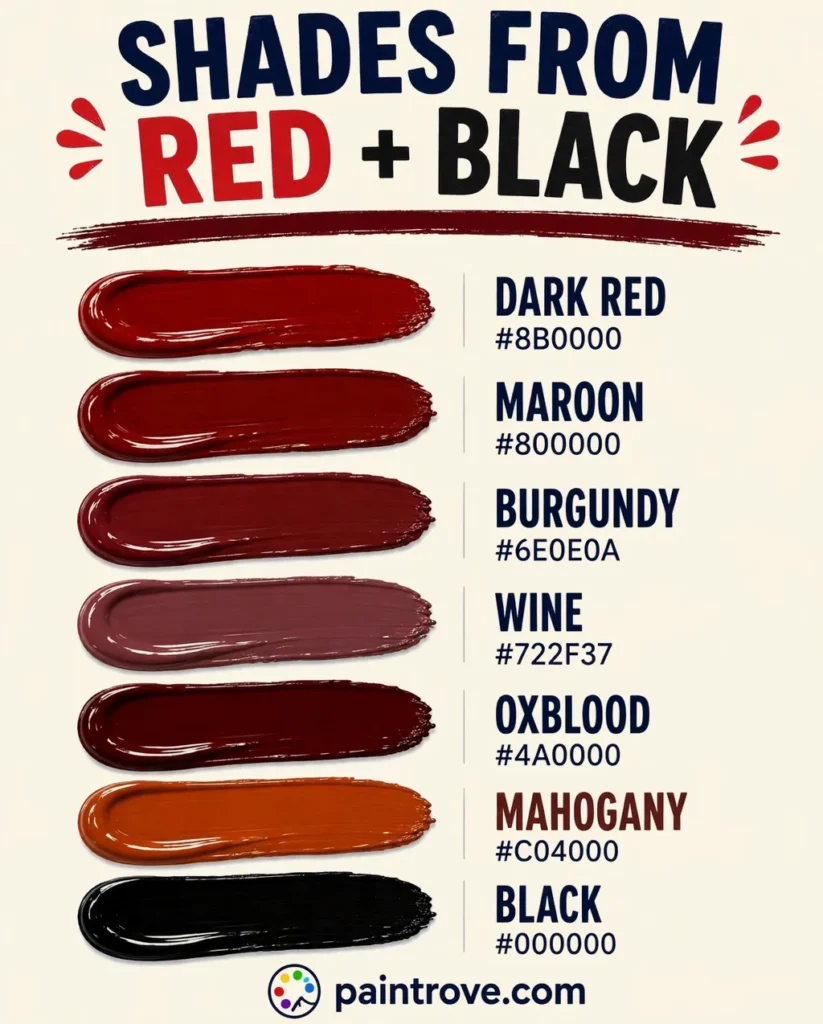
Red and black make what color each of these names describes, though they get used interchangeably and are not quite the same.
| Name | Hex | RGB | Character |
|---|---|---|---|
| Red | #FF0000 | 255, 0, 0 | The pure hue |
| Dark red | #8B0000 | 139, 0, 0 | Deepened but clearly red |
| Maroon | #800000 | 128, 0, 0 | The web standard, red at half intensity |
| Burgundy | #6E0E0A | 110, 14, 10 | Slightly browner and softer |
| Wine | #722F37 | 114, 47, 55 | Muted, greyer, more sophisticated |
| Oxblood | #4A0000 | 74, 0, 0 | Very deep, almost black |
| Mahogany | #C04000 | 192, 64, 0 | Warm, orange-leaning |
| Black | #000000 | 0, 0, 0 | No hue at all |
Notice what maroon actually is. At RGB 128, 0, 0 it is pure red at exactly half intensity, which is precisely what adding black does: it scales the channel down while keeping green and blue at zero. Burgundy and wine instead have small amounts of green and blue lifted, which is why they read as softer and less saturated than a true maroon.
Red and black in RGB and on screens
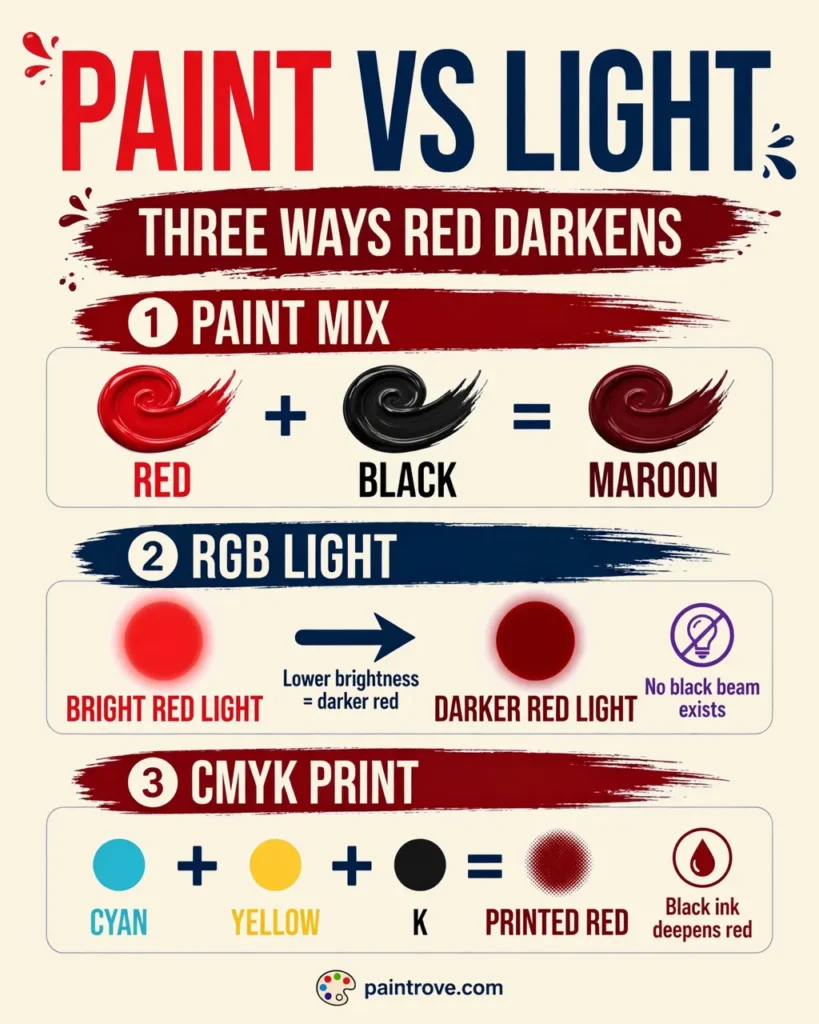
- Paint (subtractive). Red plus black pigment gives a shade: the hue stays and both value and saturation drop.
- Screens (additive RGB). There is no black to add, because black on a screen is the absence of light. Darkening red means lowering its value: 255, 0, 0 is pure red, 128, 0, 0 is maroon, 74, 0, 0 is oxblood.
- Print (CMYK). Maroon comes from magenta and yellow with a heavy percentage of black, typically around 0, 100, 100, 50.
The same logic applies whenever black meets a hue. Adding black to green gives dark forest green, as in green and black mixed, and adding it to orange gives the burnt brown in orange and black mixed. In every case the hue survives and the value falls.
The red and black combination in design
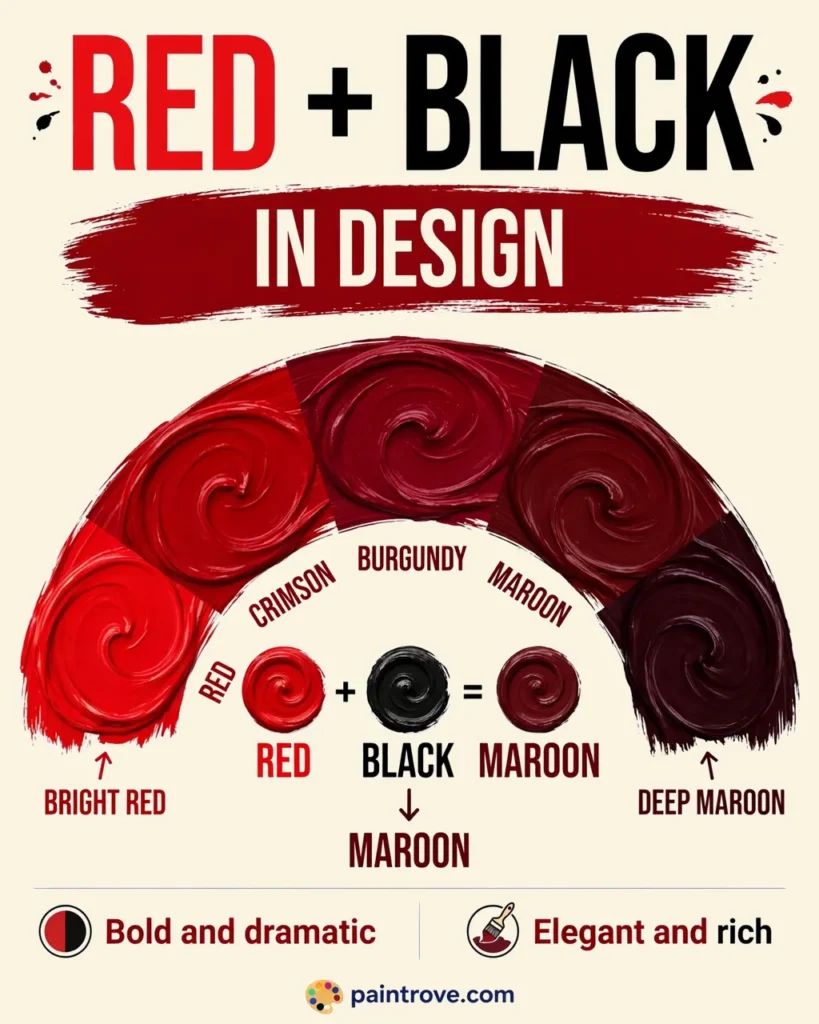
Worth treating separately, because the red and black combination draws as much interest as the mixing does.
Red and black is one of the highest-impact pairings in design, and it carries a strong, unmistakable character. The contrast is extreme: a saturated red against black has maximum value separation and no hue conflict, since black has no hue to compete with. The eye goes straight to the red.
That impact is also the limitation. The red and black combination reads as bold, urgent and slightly aggressive, which makes it excellent for some contexts and wrong for others. It dominates sports branding, automotive, gaming, energy drinks and horror or thriller design, and it appears constantly in formal evening wear. It is a poor choice for anything meant to feel calm, soft or approachable.
What makes it work:
- Let black dominate. Roughly 80 percent black to 20 percent red. Equal amounts of both feel relentless.
- Add a neutral. White, cream or grey gives the eye somewhere to rest and stops the pairing feeling heavy. Red, black and white together is the classic three-colour version.
- Choose the red deliberately. A warm scarlet against black reads as energetic. A deep crimson or burgundy against black reads as formal and expensive.
- Mind the legibility. Pure red text on a black background vibrates badly and is hard to read at small sizes. Use red as an accent rather than for body text.
Why your mix came out wrong
What does black and red make when the result disappoints? Almost always a pigment problem rather than a ratio one.
It looks brown rather than dark red. Your red is warm, your black leans warm, or both. Cadmium red with ivory black is the usual culprit. Switch to a cooler red such as alizarin crimson.
It looks dull and flat. This is black doing what black does. Switch to phthalo green or burnt umber for darkening instead.
It looks purple or plum. Your red is cool and your black leans blue. Reduce the black or switch to a more neutral one such as Mars black.
It went black almost immediately. Expected. Red is already a mid-to-dark hue, so the usable range is short. Measure the black in brushtips, not in parts.
It dried darker than the wet mix. Normal in acrylic. Mix one step lighter than your target and confirm from a dried swatch.
I cannot get a clean burgundy. Burgundy is easier to reach from alizarin crimson with a touch of green or burnt umber than from any red plus black. The black route tends to land on muddy maroon instead.
Frequently Asked Questions
What does red and black make when mixed?
Maroon, deepening to burgundy and then oxblood as more black is added. Black carries no hue, so it only lowers the value and saturation of the red. A small amount gives a dark red near Hex #8B0000, and roughly equal parts gives a near-black with only a red cast.
Red + black = what color exactly?
A shade of red, with the exact result set by the ratio. Ten parts red to one part black gives dark red, six to one gives maroon near Hex #800000, and two to one gives oxblood. The hue stays red throughout; only the value and vividness change.
Black + red = what color if you keep adding black?
Progressively darker reds, moving through maroon and burgundy to oxblood and finally to something indistinguishable from pure black. Red is already a mid-to-dark hue, so the usable range is short and the mixture reaches effective black far faster than with lighter colours.
Red and black make what color of maroon in practice?
A maroon that is darker but noticeably duller than one mixed another way. Black removes chroma along with light, so the result lacks the richness of a burgundy built from alizarin crimson with a touch of phthalo green. Use black when flatness is acceptable and a complement when it is not.
What color does red and black make if the red is warm?
A dull brick or brown-red rather than a clean maroon. Warm reds such as cadmium red and vermilion lean toward orange, and most blacks lean cool, so the two partly neutralize each other. Cool reds such as alizarin crimson take black far better.
What does black and red make that is different from red and grey?
Black gives a shade, meaning a darker and less saturated red. Grey gives a tone, meaning a muted red that can sit at any value depending on the grey. Grey offers more control, because you choose the value before you start, and it is the route to brick and marsala rather than maroon.
What color does black and red make in RGB?
There is no black to add in RGB, since black on a screen is the absence of light. Darkening red means lowering its value: pure red is 255, 0, 0, maroon is 128, 0, 0, and oxblood is 74, 0, 0. Maroon is literally red at half intensity.
Red plus black makes what color of burgundy?
Not a very good one, in truth. Burgundy at around Hex #6E0E0A has a slight brown softness that black cannot supply, since black only darkens. A cleaner burgundy comes from alizarin crimson with a trace of phthalo green or burnt umber.
How do you make a dark red without black?
Add a small amount of phthalo green or viridian, which is red’s complement, or burnt umber for a warmer result. Green darkens by neutralizing rather than greying, so the mixture keeps depth and luminosity. Use very little, since phthalo green is intensely staining.
Red plus black: why does mine look muddy?
Because black removes saturation as well as value, and red loses its identity faster than most hues as it darkens. A warm red with a cool black compounds the problem, since the two partially cancel. Switch to a cool red, use far less black, or darken with a complement instead.
What is the red and black combination best used for?
High-impact contexts: sports and automotive branding, gaming, energy drinks, thriller and horror design, and formal evening wear. It reads as bold and urgent, which makes it a poor choice for anything meant to feel calm or approachable. Let black dominate and add white as a third colour.
Is maroon the same as burgundy?
Not quite. Maroon at Hex #800000 is pure red at half intensity and reads as a clean dark red. Burgundy at around Hex #6E0E0A is slightly browner and softer, and wine at Hex #722F37 is greyer still. All three sit in the same family at different levels of neutralization.
Red and black at a glance
| If you want | Do this |
|---|---|
| A slightly deepened red | 20 parts red to 1 part black |
| Dark red | Roughly 10 parts red to 1 part black |
| Maroon | Roughly 6 parts red to 1 part black |
| Oxblood | Roughly 2 parts red to 1 part black |
| A rich burgundy | Alizarin crimson plus a trace of phthalo green |
| A warm oxblood | Red plus burnt umber rather than black |
| A dark red that stays vivid | Darken with a complement, not with black |
| The pairing to work in design | Let black dominate and add white as a third colour |
What does red and black make, in one line: a shade of red running from dark red through maroon to near-black, with the hue intact and the richness reduced. Three things are worth remembering: measure the black in brushtips rather than parts, use a cool red because warm reds go brown, and reach for phthalo green or burnt umber when the dark red needs to stay alive.