What Does Black and Yellow Make When Mixed? (Olive / Dark Yellow)
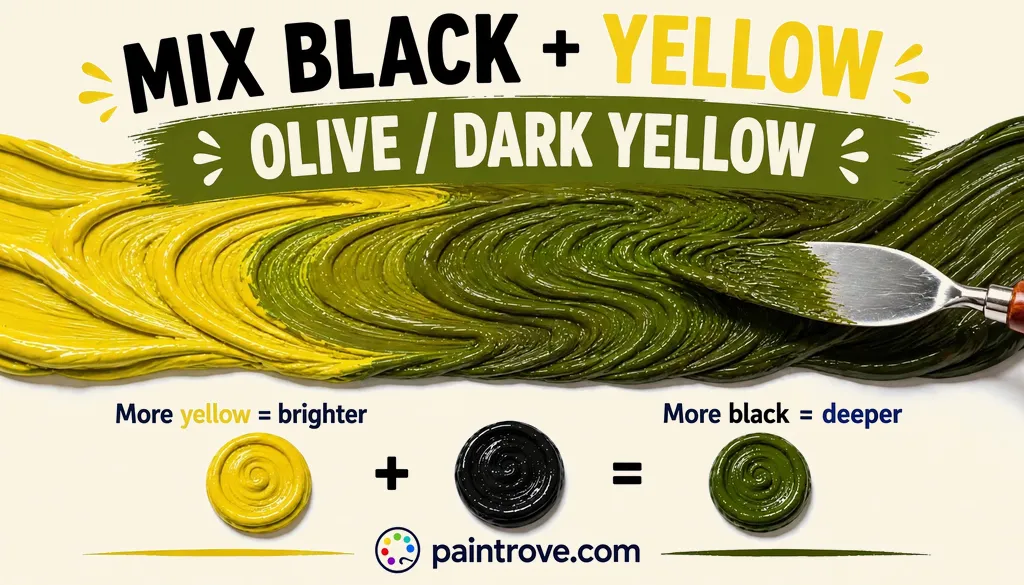
Black and yellow make olive, not dark yellow. Even a trace of black turns yellow green, and the result deepens through olive drab into a dark brownish green as more black goes in. A small amount gives something near Hex #BDB76B. More gives olive at Hex #808000.
This surprises almost everyone, because black should only lower the value. It has no hue of its own, so in theory what does black and yellow make ought to be a darker version of the same yellow.
It is not, and the reason is specific and fixable. Most black pigments carry a cool, slightly blue undertone, and blue plus yellow makes green. You are not mixing two colours; you are mixing three without realising it. This guide covers the ratios, why the green appears, how to get a genuinely dark yellow instead, and how the black and yellow combination works in design.
What does black and yellow make?
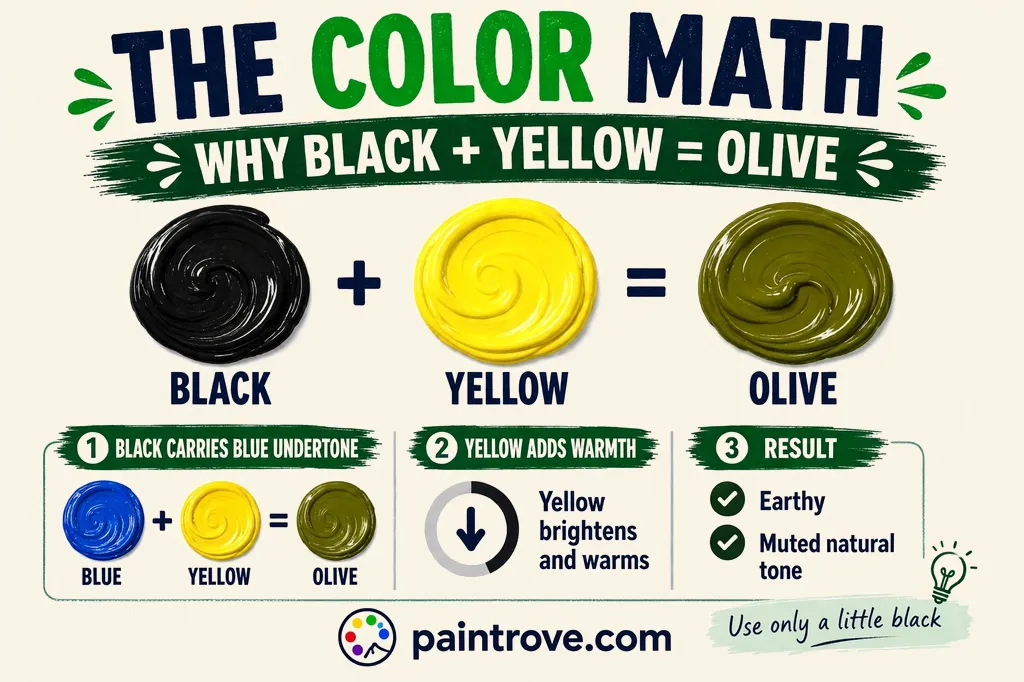
Technically a shade of yellow. In practice, olive.
Colour theory says a shade is a hue plus black, and that adding black should lower value and saturation while leaving the hue alone. That holds reasonably well for red, blue and green. It fails for yellow, and yellow is the clearest example of where the theory and the palette disagree.
Two properties make yellow the exception:
Yellow sits at the highest value of any hue. Pure yellow is nearly as light as a pale tint of any other colour. There is a very long way down and almost no way up, so every addition of black has an outsized effect on the value.
Yellow has the weakest tinting strength of the three primaries. It cannot defend itself in a mixture. Whatever else is present will show, and black pigments are among the strongest paints on any palette. A brushtip of black against a generous pool of yellow will still dominate.
Put those together and the blue hiding inside most blacks does not stay hidden. Yellow and black make what color that blue dictates, and that colour is green. Black and yellow make what color sits between olive and dark khaki at almost every usable ratio.
Which black you use decides how green it goes
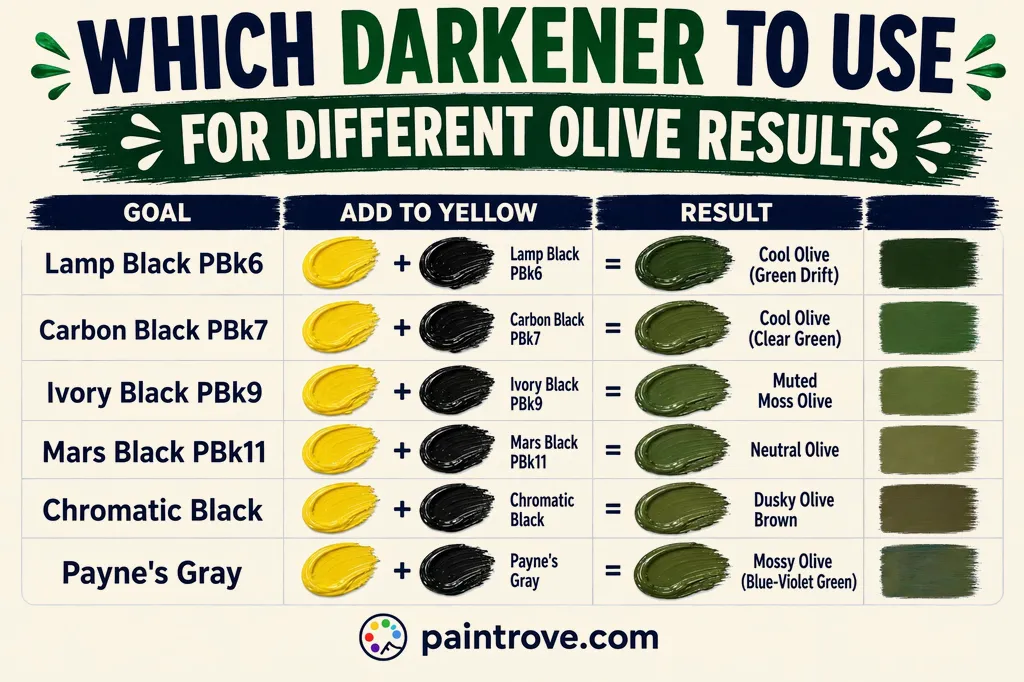
What color does black and yellow make is decided here more than by the ratio. This is the controllable part, and the single most useful thing on this page.
| Black pigment | Undertone | Result with yellow |
|---|---|---|
| Lamp black (PBk6) | Distinctly cool and blue | Strong green drift, olive very fast |
| Carbon black (PBk7) | Cool | Clear green cast |
| Ivory black (PBk9) | Warm in mass, often cool in tint | Mixed results; usually still greenish |
| Mars black (PBk11) | The most neutral available | The least green, but very strong |
| Payne’s gray | Blue-violet, not a black at all | Heavy green shift, closer to moss |
Mars black is the best choice if you insist on using black with yellow, since it is the most neutral of the common blacks. It is also the strongest, so use less of it than you would of lamp black.
Payne’s gray is worth a specific warning. It is not a black; it is a premixed blue-violet grey, usually ultramarine with a red or a black. Mixed with yellow it produces a distinctly green, mossy result rather than anything resembling dark yellow.
Black and yellow mixing ratios
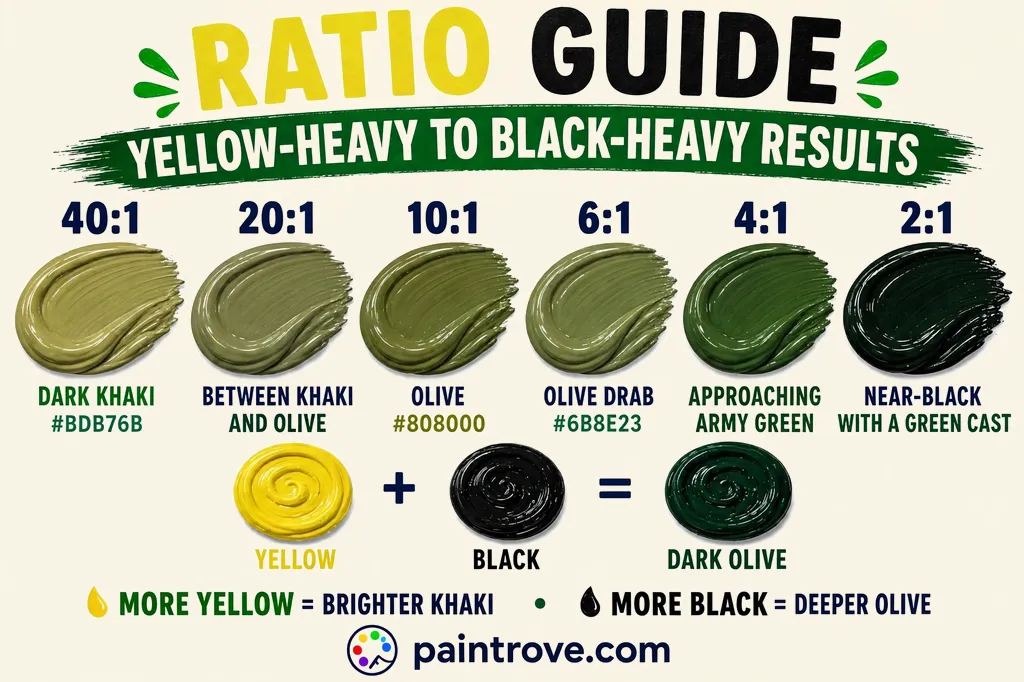
Every ratio below is an approximate starting point rather than a formula. Blacks vary enormously in strength and undertone, so add gradually and test before committing.
| Approximate ratio (yellow : black) | Result | Roughly matches |
|---|---|---|
| 40 : 1 | Slightly deepened, already greenish | Dark khaki, Hex #BDB76B |
| 20 : 1 | Clearly olive | Between khaki and olive |
| 10 : 1 | Olive | Olive, Hex #808000 |
| 6 : 1 | Deep olive drab | Olive drab, Hex #6B8E23 |
| 4 : 1 | Dark brownish green | Approaching army green |
| 2 : 1 | Very dark, barely yellow | Near-black with a green cast |
What does yellow and black make at each of these ratios is further from dark yellow than most people expect, and notice how extreme the numbers are. Forty parts yellow to one part black already shows a visible shift, which is nothing like the ratios needed to darken red or blue. That is the tinting strength imbalance in action.
A workable sequence:
- Put out a generous pool of yellow.
- Pick up the absolute minimum of black your brush will carry, then wipe most of it off.
- Blend fully before judging. Streaky mixes read darker and greener than they will once mixed.
- Check the swatch against pure yellow so you can see how far it has moved.
- Stop well before you think you should.
Overshooting is effectively unrecoverable. Adding yellow back to an over-blackened mixture takes an enormous quantity, and the green stays.
How to make a genuinely dark yellow
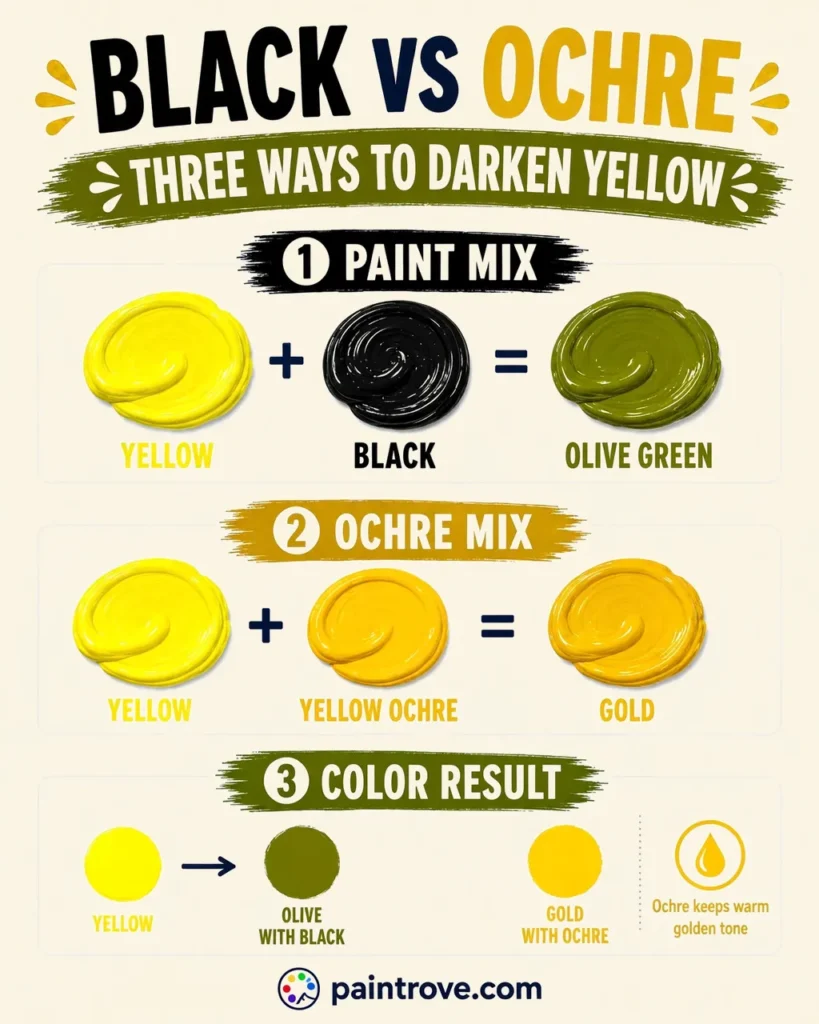
Yellow and black make what color you will struggle to use if you wanted gold. If olive is not what you wanted, the answer is to stop using black. Four routes, each with a different character:
Yellow ochre or raw sienna. The most reliable. These are naturally darker yellow earth pigments, so they deepen the colour while keeping it firmly in the yellow family. No blue is introduced at any point.
Raw umber or burnt umber. Darkens toward bronze and deep gold. Raw umber is cooler, burnt umber warmer. Both avoid the green problem entirely.
A touch of orange or red. This darkens by increasing warmth rather than by removing light, producing gold, amber and saffron. The result stays vivid in a way no black mixture can.
Brown. The standard route to mustard and golden tan, covered in brown and yellow mixed.
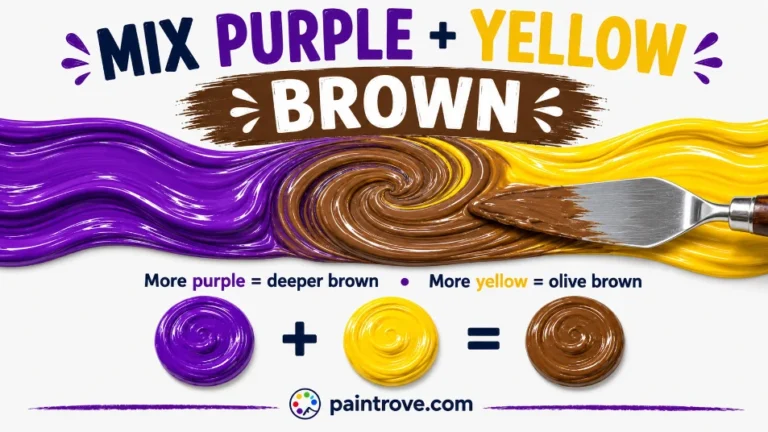
A trace of purple. Purple is yellow’s complement, so it darkens and neutralizes simultaneously. Very easy to overdo, and the result goes brown quickly, as shown in purple and yellow mixed. The relationship is explained in the guide to complementary colors.
| Dark yellow target | How to mix it |
|---|---|
| Gold | Yellow plus a touch of orange or ochre |
| Amber | Yellow plus more orange |
| Mustard | Yellow plus brown, or a trace of purple |
| Bronze | Yellow plus burnt umber |
| Deep gold | Yellow ochre plus a little raw sienna |
| Olive | Yellow plus black, if that is what you actually want |
That last row matters. If you want olive, black is the correct and fastest tool. The green drift is only a problem when it is unintended. Olive drab exists as a military colour precisely because muted yellow-greens disappear against landscape, and black plus yellow gets there in one step.
When the green is what you want
Black and yellow make what color a great many painters actually need. Olive is genuinely useful, and this mixture is the shortest route to it.
- Landscape and foliage. Olive and olive drab are the colours of dry grass, old leaves and distant trees. Pure greens rarely read as natural; muted yellow-greens do.
- Camouflage and utility. The entire military palette lives here.
- Fashion and interiors. Olive has been a staple for a century because it is desaturated enough to function almost as a neutral.
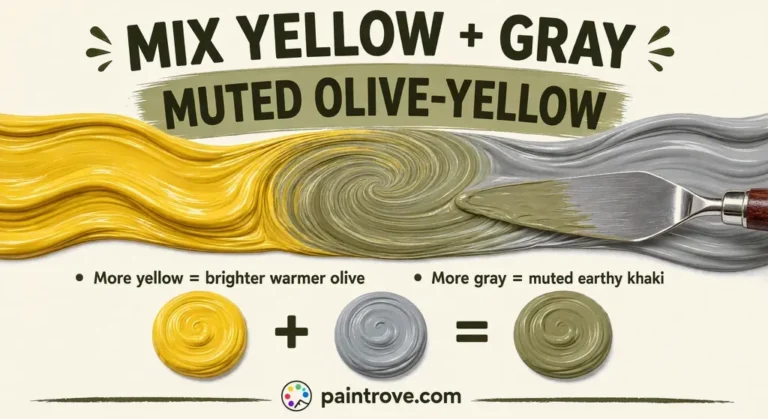
For a lighter, more controlled version of the same family, grey rather than black gives the muted range covered in yellow and gray mixed, which lands on khaki and sand before it reaches olive. Push further toward green proper and you are in the territory of yellow and green mixed.
Olive and dark yellow hex codes
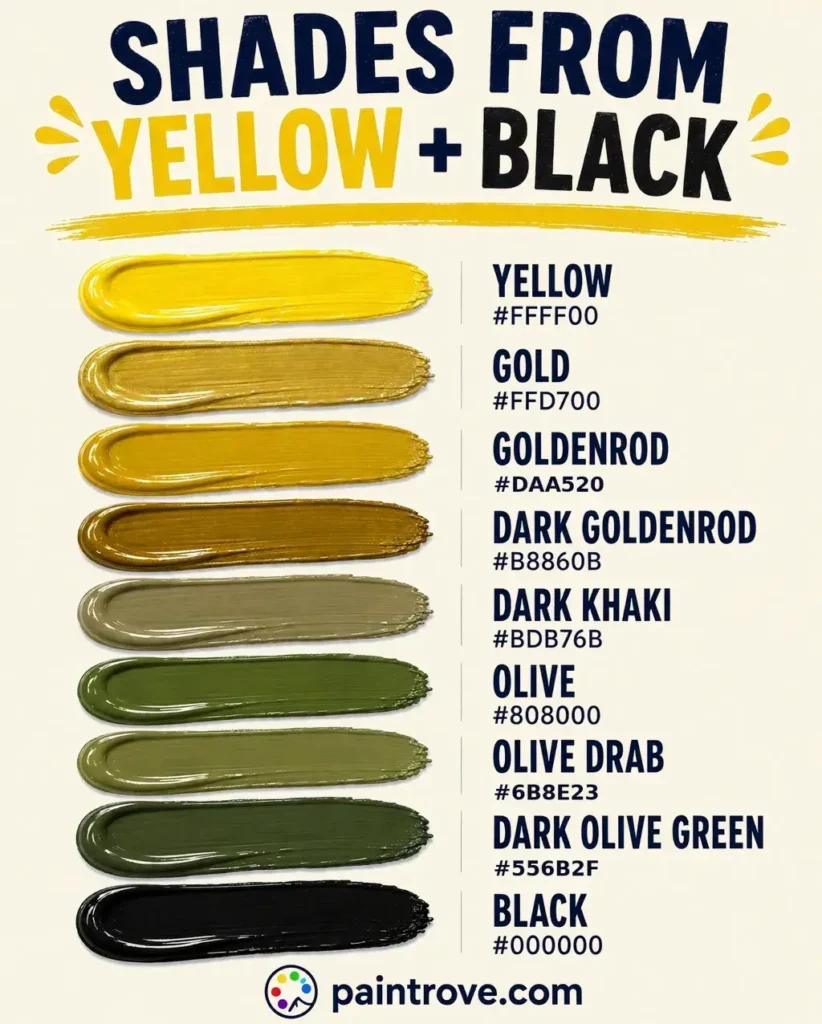
| Name | Hex | RGB | Character |
|---|---|---|---|
| Yellow | #FFFF00 | 255, 255, 0 | The pure hue |
| Gold | #FFD700 | 255, 215, 0 | Warm, deepened without green |
| Goldenrod | #DAA520 | 218, 165, 32 | Earthy dark yellow |
| Dark goldenrod | #B8860B | 184, 134, 11 | Deeper, browner |
| Dark khaki | #BDB76B | 189, 183, 107 | The first stop on the olive road |
| Olive | #808000 | 128, 128, 0 | Yellow at half intensity |
| Olive drab | #6B8E23 | 107, 142, 35 | Clearly green |
| Dark olive green | #556B2F | 85, 107, 47 | Deep, mossy |
| Black | #000000 | 0, 0, 0 | No hue at all |
What color does yellow and black make in numbers rather than pigment? The RGB values tell the story cleanly. Pure yellow is 255, 255, 0. Olive at 128, 128, 0 is simply yellow at half intensity, which is exactly what lowering the value does. But olive drab at 107, 142, 35 has green lifted above red and blue introduced, which is the pigment-mixing result rather than the mathematical one. The gap between those two values is the whole subject of this page.
Black and yellow in RGB and on screens
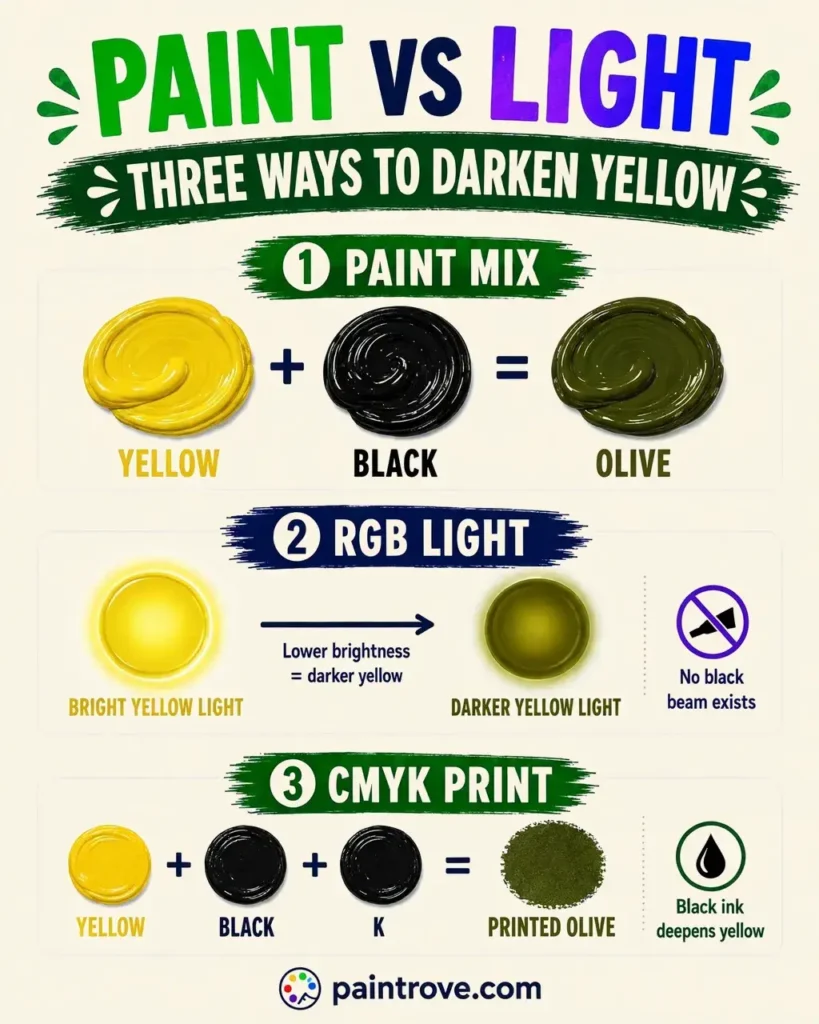
- Paint (subtractive). Yellow plus black pigment gives olive, because the blue undertone in the black turns the mixture green.
- Screens (additive RGB). There is no black to add, since black on a screen is the absence of light. Darkening yellow means scaling red and green down together: 255, 255, 0 becomes 128, 128, 0, which is olive. The digital route produces a clean dark yellow with no green drift.
- Print (CMYK). A dark yellow comes from yellow ink with a percentage of black, and the same green cast can appear depending on the black used.
This is a rare case where the digital result is cleaner than the physical one. Scaling the channels gives you the dark yellow that pigment refuses to produce.
The same shading logic applies to other hues without the complication. Black with green gives dark forest green, as in green and black mixed, and black with orange gives the burnt brown in orange and black mixed.
The black and yellow combination in design
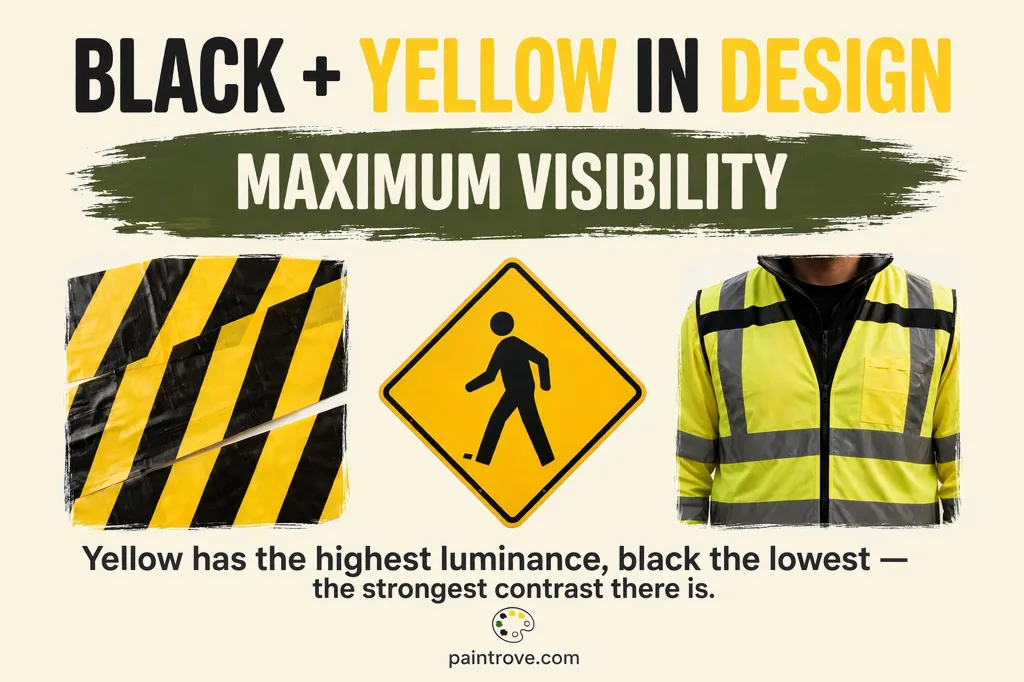
Worth treating separately, because the pairing has a function that no other colour combination matches.
Black and yellow is the highest-visibility colour combination available to human vision. Yellow has the greatest luminance of any hue and black has the least, so the pair produces maximum contrast. The eye detects it faster and at greater distance than any other pairing, including red and white.
That is why it is used for hazard tape, road signs, construction equipment, wet floor signs and high-visibility clothing. It is also why wasps, hornets and many venomous animals wear it: the pattern is called aposematic colouration, and it works because the contrast is unmissable.
The design consequences:
- It will always read as a warning, whatever you intend. A black and yellow combination carries that association so strongly that it is almost impossible to use neutrally.
- Use it when you want attention, not when you want calm. It suits construction, safety, sport, energy and anything taxi-related.
- Diagonal stripes amplify it further, which is why hazard tape uses them.
- Soften it by changing the yellow. Mustard or gold with black reads as far more sophisticated than pure yellow with black, and loses most of the hazard association.
- Legibility is excellent. Black text on yellow is one of the most readable combinations there is, which is why it is used on road signage.
Why your mix came out wrong
It went green and I wanted dark yellow. Your black has a cool blue undertone. This is normal and expected. Switch to Mars black, or stop using black and darken with yellow ochre or raw umber instead.
It went green even with Mars black. Mars black is the most neutral option but not perfectly neutral, and yellow’s weak tinting strength means even slight bias shows. For a true dark yellow, black is simply the wrong tool.
It went very dark very fast. Expected. Yellow has the weakest tinting strength of the primaries and black has among the strongest. Measure the black in wiped brushtips, not in parts.
It looks brown rather than olive. Your black is warm, carrying brown, or you have gone far enough that all three primaries are effectively present.
It dried darker. Normal in acrylic, and more noticeable with yellow than any other hue because it starts so light. Always judge from a dried swatch.
Frequently asked questions
What does black and yellow make when mixed?
Olive, not dark yellow. Most black pigments carry a cool blue undertone, and blue plus yellow makes green, so the mixture drifts green almost immediately. A small amount of black gives dark khaki near Hex #BDB76B, and more gives olive near Hex #808000.
What color does black and yellow make in paint specifically?
A muted yellow-green ranging from dark khaki to olive drab. Yellow has the weakest tinting strength of the primaries while black is among the strongest, so even forty parts yellow to one part black shows a visible shift. The green is caused by the black’s undertone, not by your technique.
What does yellow and black make if the black is neutral?
Still somewhat green, but less so. Mars black is the most neutral common black and gives the cleanest result, though it is also the strongest so you need less of it. For a genuinely dark yellow with no green at all, use yellow ochre, raw umber or a touch of orange instead.
Yellow and black make what color at a very small ratio?
Even forty parts yellow to one part black produces a visible greenish shift toward dark khaki. That is far more sensitive than red or blue, both of which can take considerably more black before the hue changes character. Yellow’s weak tinting strength is the reason.
Black and yellow make what color if you keep adding black?
Progressively darker yellow-greens, moving through olive and olive drab to a dark brownish green, then to something indistinguishable from black. The hue shifts green early and stays green throughout, which is why the mixture never passes through a stage that reads as dark yellow.
What color does yellow and black make for olive specifically?
Roughly ten parts yellow to one part black lands on olive near Hex #808000. Using a cool black such as lamp black gets there faster and more decisively. If olive is what you want, black is the correct and quickest tool, since the green drift works in your favour.
Black + yellow = what color in RGB?
There is no black to add in RGB, since black on a screen is the absence of light. Darkening yellow means scaling red and green down together, so 255, 255, 0 becomes olive at 128, 128, 0. The digital route gives a cleaner dark yellow than pigment does, with no green drift.
Yellow + black = what color that is not olive?
There is no reliable ratio that gives a clean dark yellow from black. Use yellow ochre or raw sienna to deepen within the yellow family, raw umber for bronze, or a touch of orange for gold and amber. All three avoid introducing the blue that causes the green.
What is the black and yellow combination used for?
Maximum visibility. Yellow has the highest luminance of any hue and black the lowest, so the pair gives greater contrast than any other, including red and white. It is used for hazard tape, road signs, construction equipment and high-visibility clothing, and appears in nature as warning colouration on wasps and venomous animals.
Yellow plus black makes what color that still looks like yellow?
None, in practice. If the result must still read as yellow, darken with yellow ochre, raw sienna or a small amount of orange rather than black. Black removes saturation as well as value, and yellow has very little saturation to spare before it stops reading as yellow at all.
Why is black and yellow so easy to see?
Because the two sit at opposite ends of the luminance scale. Yellow reflects more light than any other hue and black reflects almost none, so the contrast between them is the largest the eye can register. Diagonal stripes increase the effect further, which is why hazard tape uses them.
Can I use black and yellow without it looking like a warning sign?
Soften the yellow. Mustard, gold or ochre with black reads as warm and sophisticated rather than as a hazard, because the reduced saturation breaks the association. Pure yellow with black will always carry the warning signal, however it is arranged.
Black and yellow at a glance
| If you want | Do this |
|---|---|
| Olive | 10 parts yellow to 1 part black |
| Dark khaki | 40 parts yellow to 1 part black |
| Olive drab | 6 parts yellow to 1 part black, cool black |
| The least green result | Use Mars black, and very little of it |
| A genuine dark yellow | Yellow ochre or raw sienna, not black |
| Gold or amber | Add orange rather than black |
| Mustard | Add brown, or a trace of purple |
| Maximum visibility in design | Pure yellow with black, diagonal stripes |
What does black and yellow make, in one line: olive, because the blue hiding in most blacks turns yellow green long before it turns it dark. Three things are worth remembering: measure black in wiped brushtips because yellow is the weakest primary, use Mars black if you must use black at all, and reach for yellow ochre or raw umber when you actually want a dark yellow.