what color does brown and blue make When Mixed?
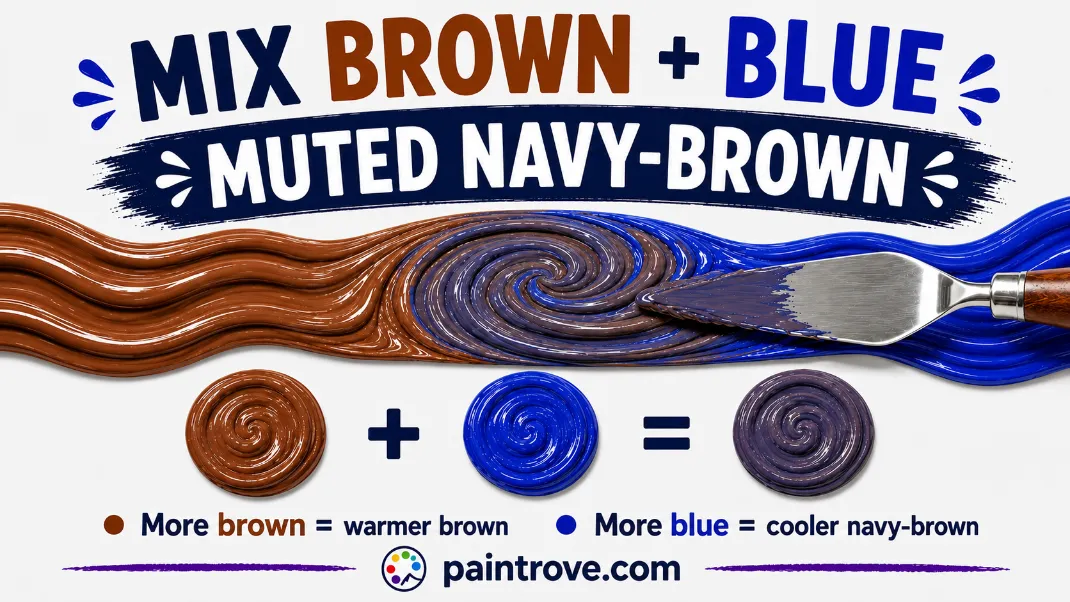
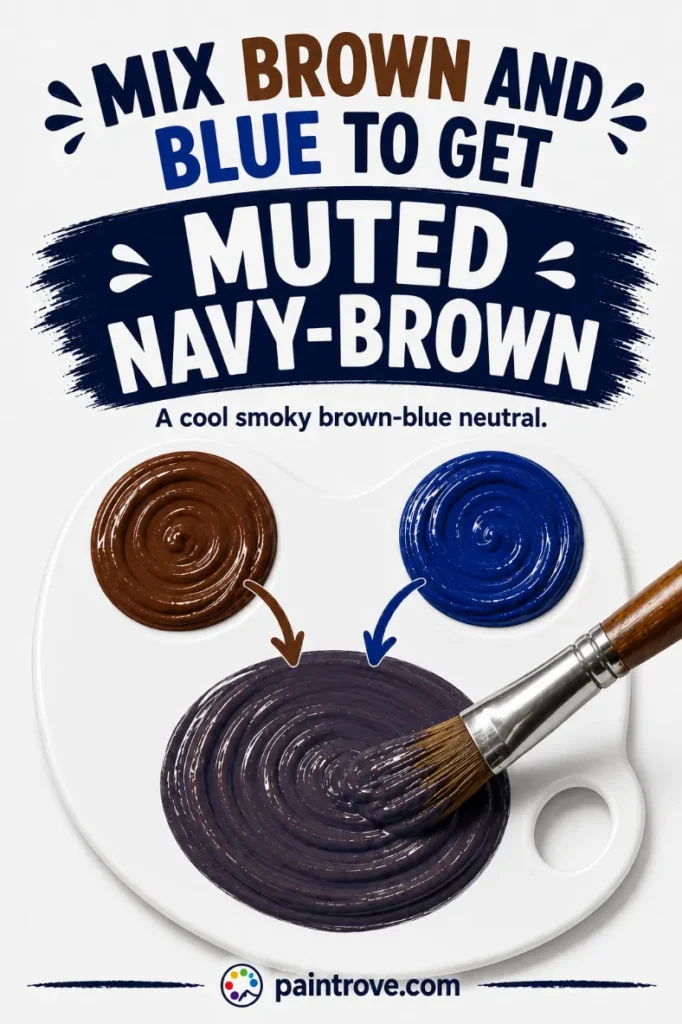
what color does brown and blue make? Quick answer: Brown and blue make a muted, cool navy-brown or slate, at around hex #3B4252. Adding blue to brown deepens and cools it, because brown already contains blue as one of its ingredients. Leaning the mix toward blue gives a dark, dusty blue or teal; leaning toward brown gives a cooler, grayer taupe-brown.
Brown and blue is one of the trickier mixes to predict, and the search results disagree about it for a good reason: the outcome genuinely shifts with the ratio and the exact shades you use. You can land anywhere from a deep muddy navy to a slate gray, a dusty teal, or a cool taupe.
This guide sorts out the confusion, explains the color theory behind why it happens, and gives exact ratios with hex codes, pigment recommendations, the full shade range, and what happens in light.
Why Do Brown and Blue Make a Muted Navy-Brown?
Brown and blue make a muted navy-brown because brown already contains blue, so adding more blue mainly deepens and cools the mix rather than creating a new hue.
Here is the color theory. Brown contains all three primary colors, red, yellow, and blue, and is essentially a dark, desaturated orange, as explained in how to make brown. Blue is a primary color. So the mix looks like this:
Brown + Blue = (Red + Yellow + Blue) + Blue = Red + Yellow + Blue + Blue
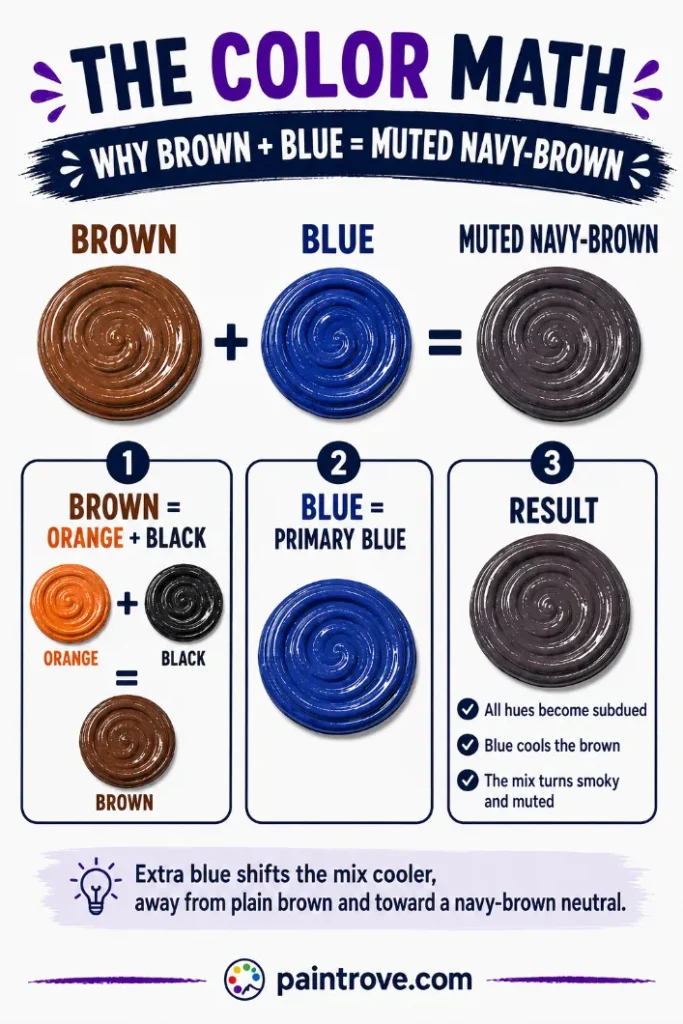
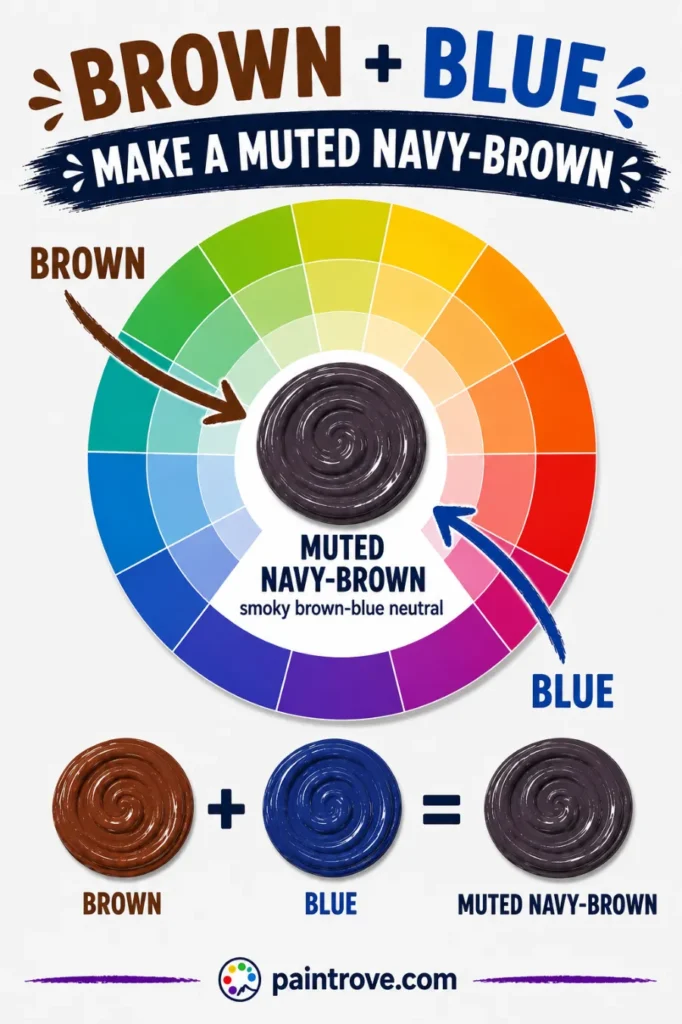
The extra blue tips the balance of the brown toward its blue component, cooling and darkening it. There is also a second effect at work. Brown is a form of orange, and orange sits directly opposite blue on the color wheel, which makes them complementary colors.
Complementary colors neutralize each other, so the blue you add both cools the brown and mutes it, draining some of its warmth and saturation. The combined result is a dark, muted, cool color: navy-brown, slate, or dusty teal, depending on the balance.
This is exactly why the mix is so variable. You are doing two things at once, cooling the brown and neutralizing it, and small changes in ratio tip the result between a brownish blue and a bluish brown.
what does blue and brown make Actually? Sorting the Confusion
Search results give different answers, dark blue, muted purple, slate, teal, muddy brown, because all of them are correct depending on the pigments and ratio. Here is the honest breakdown:
| Your brown and blue | Resulting color | Hex code |
|---|---|---|
| Equal brown + blue | Deep navy-brown slate | Hex #3B4252 |
| More blue than brown | Dark dusty blue, muted navy | Hex #2A3052 |
| More brown than blue | Cool taupe-brown | Hex #5C554B |
| Warm brown + blue | Muted brown with violet undertone | Hex #4A4053 |
| Green-brown + blue | Dark teal, blue-green | Hex #2E4A4A |
| Light brown + light blue | Dusty gray-blue | Hex #7C8494 |
The pattern real-world mixing confirms: more blue pushes toward dark navy and dusty blue, more brown pushes toward cool taupe and gray-brown, a warm red-leaning brown can add a violet tint, and a green-leaning brown pushes toward teal.
What you almost never get is a bright color, because the complementary relationship mutes everything. Every result lands in the deep, muted, sophisticated part of the palette.
Brown and Blue Mixing Ratios and Hex Codes
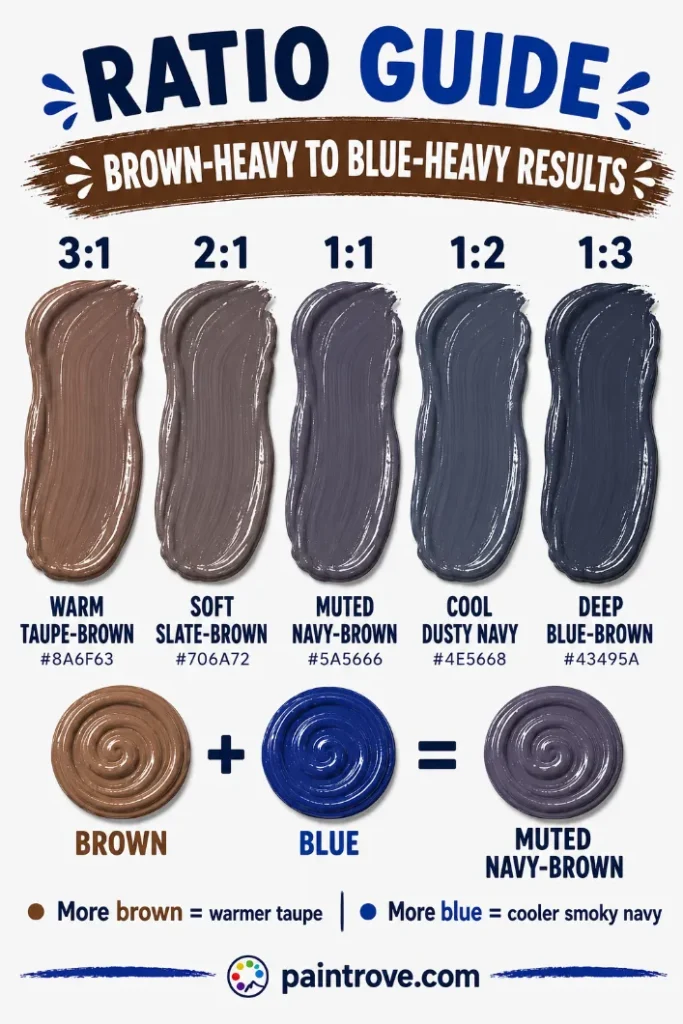
The ratio is the main control. Here is the working chart with hex targets in plain text:
| Ratio (Brown : Blue) | Resulting shade | Hex code |
|---|---|---|
| 3 : 1 | Cool taupe-brown | Hex #5C554B |
| 2 : 1 | Muted brown-slate | Hex #4B4A4A |
| 1 : 1 | Navy-brown slate | Hex #3B4252 |
| 1 : 2 | Dark dusty blue | Hex #2A3052 |
| 1 : 3 | Deep muted navy | Hex #23293F |
| 1 : 1 plus white | Dusty gray-blue | Hex #7C8494 |
| 1 : 1 plus black | Near-black slate | Hex #22242B |
| 1 : 1 with green-brown | Dark teal | Hex #2E4A4A |
Practical notes:
- Both colors are dark and strong, so this mix goes deep fast. Add blue to brown gradually and keep some of each in reserve.
- Mix thoroughly before judging. A half-mixed blend looks streaky and darker than the finished color.
- Add white to a small test amount to reveal the true undertone, since these dark, muted colors are hard to read otherwise. Acrylics dry darker still.
Which Brown and Blue Pigments Should You Use?
The undertones of your brown and blue steer the result more than almost any other mix:
| Brown used | Blue used | Resulting color |
|---|---|---|
| Burnt umber | Ultramarine | Classic deep navy-brown, slightly violet |
| Raw umber | Ultramarine | Cool, neutral slate |
| Warm red-brown | Ultramarine | Muted brown with a purple tint |
| Green-brown (raw umber) | Phthalo blue | Dark teal, blue-green |
| Any brown | Phthalo blue | Very dark, cool, strong result |
The most useful pairing to know is burnt umber and ultramarine blue. This combination is a studio favorite for mixing rich, natural darks, and it produces a deep, slightly warm navy-brown that many painters use instead of black.
Because the two are near-complementary, adjusting their balance lets you mix an entire range of dark neutrals from one pair, warmer or cooler, browner or bluer, simply by shifting the ratio. Phthalo blue, being very strong and green-leaning, pushes the mix toward dark teal and should be used sparingly.
Every Shade You Can Make from brown and blue combination
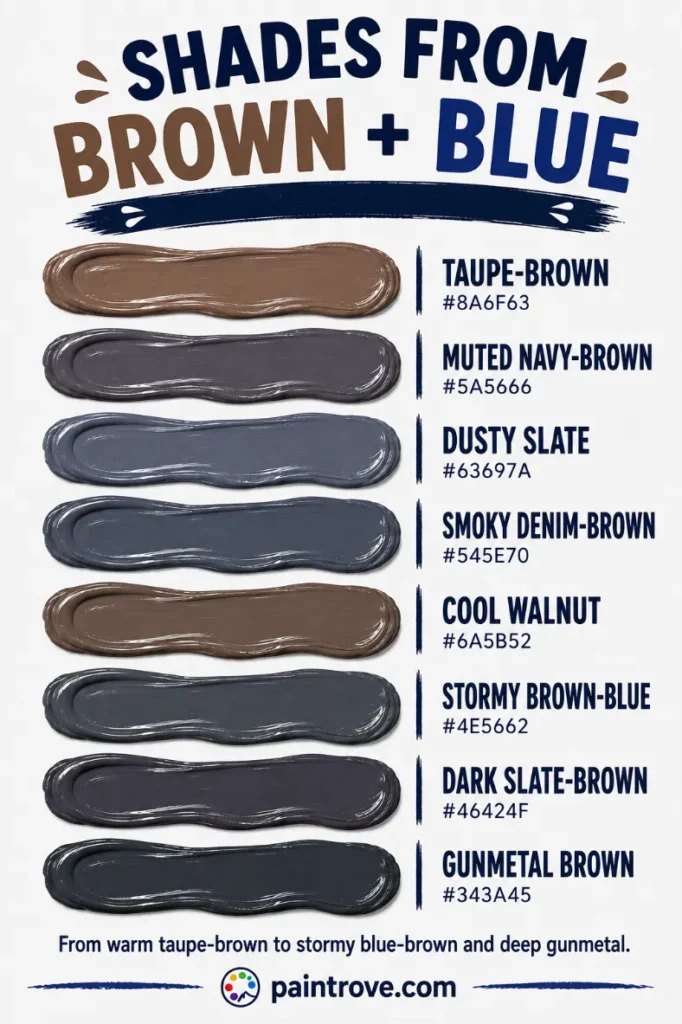
Between ratio, pigment choice, and additions of white or black, brown and blue cover a rich band of dark, muted, cool colors. The reference table:
| Shade | Hex code | How to mix it |
|---|---|---|
| Navy-brown slate | Hex #3B4252 | Equal parts brown and blue |
| Dark dusty blue | Hex #2A3052 | Blue-heavy mix |
| Deep navy | Hex #23293F | Very blue-heavy mix |
| Cool taupe-brown | Hex #5C554B | Brown-heavy mix |
| Muted violet-brown | Hex #4A4053 | Warm brown plus blue |
| Dark teal | Hex #2E4A4A | Green-brown plus blue |
| Slate gray | Hex #708090 | Equal mix plus white |
| Dusty blue | Hex #7C8494 | Equal mix plus generous white |
| Payne’s gray | Hex #536878 | Blue-heavy mix, deep |
| Charcoal slate | Hex #2F3439 | Equal mix plus black |
| Storm blue | Hex #4E5A6B | Blue-heavy mix plus a little white |
| Gunmetal | Hex #2A3439 | Green-brown plus blue plus black |
How Do You Make a Dark Navy or Slate from Brown and Blue?
Use a blue-heavy mix, ideally ultramarine with a small amount of burnt umber, to reach deep navy and slate tones. This is a favorite alternative to black, since the resulting dark carries subtle color and reads far richer than a flat black would. Adjust with more umber for warmth or more blue for depth. This connects to the darks covered in blue and black mixed.
How Do You Make a Cool Taupe from Brown and Blue?
Use a brown-heavy mix with just a touch of blue, then add white. The small amount of blue cools and mutes the brown into a sophisticated gray-taupe, one of the most popular neutrals in interior design. This overlaps with the taupe tones from brown and white mixed and the greige family.
How Do You Make Dark Teal from Brown and Blue?
Use a green-leaning brown like raw umber with a blue, especially phthalo blue. The green content in the brown combines with the blue to produce a deep, muted teal, related to the blue-greens of blue and green mixed.
What Do Brown and Blue Make in Light?
Brown and blue cannot be mixed in light, because brown light does not exist. This is a genuine quirk of how color works.
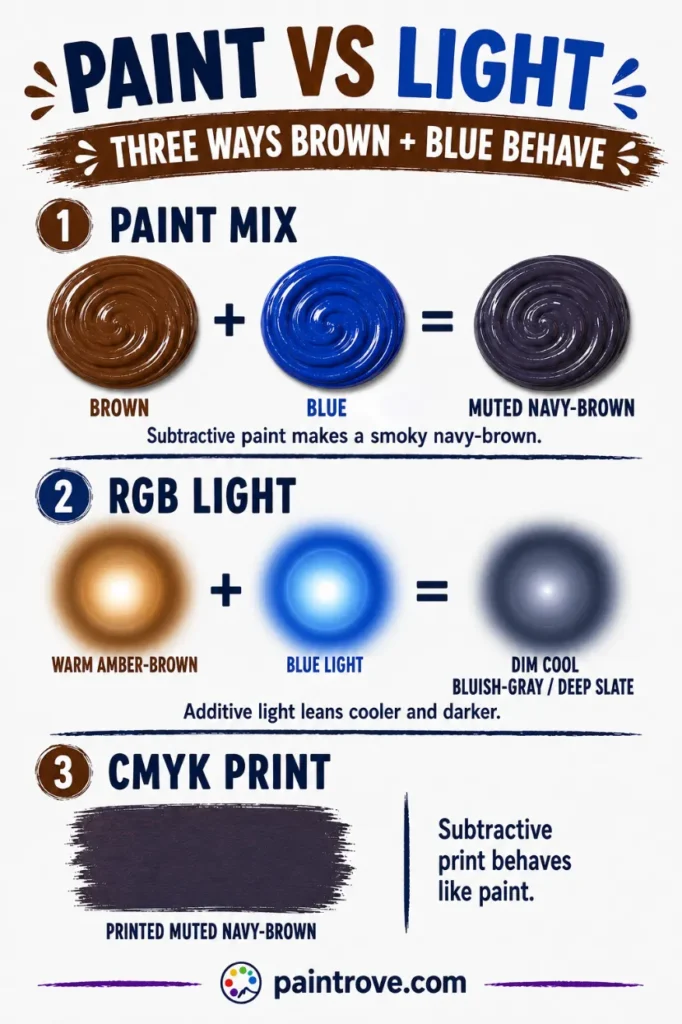
Screens and lights use the RGB model, where colors add together and only get brighter. Brown exists only as a dark, dull orange seen in context, and since light can never be dark or dull, there is no brown on the visible light spectrum and no brown light to mix. If you combine brown and blue values in RGB, you get a darker or duller blue rather than a true brown-blue blend.
| System | Type | Brown + Blue makes | Result |
|---|---|---|---|
| RYB (paint) | Subtractive | Muted navy-brown, slate | Hex #3B4252 |
| RGB (light and screens) | Additive | Darker blue (no true brown) | Varies |
| CMYK (printing) | Subtractive | Muted navy-brown | Varies |
Printing, covered in our guide to the CMYK color model, behaves like paint since it is subtractive, producing muted navy-browns from combined inks.
Troubleshooting Brown and Blue Mixes
The mix is almost black. Two dark, strong colors in equal parts absorb nearly all light. Add white to a test amount to reveal the true hue, then adjust, or use lighter versions of both.
The mix is a flat, dead gray. The complementary neutralizing went too far. Add a little more brown for warmth or a little more blue for a cooler blue-slate, to give the color direction.
The mix is muddier than you wanted. That is the nature of this near-complementary pair. Embrace the muted result, or if you want a cleaner dark blue, use mostly blue with only a whisper of brown.
It leans too purple. Your brown is warm and red-leaning. Switch to a neutral or green-leaning brown like raw umber for a cooler slate.
It dried darker and duller. Standard acrylic behavior, pronounced with dark colors. Mix a step lighter and add white to judge.
Navy-Brown and Slate in Art, Fashion, and Design
The dark, muted colors from brown and blue are among the most sophisticated and useful in any palette, and the pairing is a design classic both mixed and side by side.
In Art
The burnt umber and ultramarine combination is one of the most important dark-mixing recipes in all of painting. It gives artists a deep, adjustable near-black that carries subtle color, ideal for rich shadows, night scenes, and atmospheric darks that a flat black could never provide.
Because the pair is near-complementary, painters use it to mix an entire range of natural grays and slates, warming or cooling as needed, which is why many landscape and portrait painters rely on it as their primary dark. The muted navy-browns also capture stormy skies, deep water, and twilight beautifully.
In Fashion
Brown and blue together, especially navy and tan, is a timeless, sophisticated pairing, a staple of tailoring and classic menswear that reads as refined and understated. The mixed colors, slate, dusty blue, and navy-brown, are versatile deep neutrals that work as alternatives to plain navy or black. They flatter most skin tones and pair naturally with cream, camel, and warm metals.
In Interiors and Branding
Slate blue, navy-brown, and dusty blue are cornerstone interior colors for calm, grounded, sophisticated schemes, working beautifully with wood, brass, and warm neutrals. Navy paired with brown leather is a design classic. In branding, these deep, muted colors signal trust, stability, and premium quality, appearing across finance, heritage, and lifestyle identities that want to feel dependable and refined.
Quick Reference: blue and brown combination Cheat Sheet
| Question | Answer |
|---|---|
| Brown + blue in paint | Muted navy-brown or slate (hex #3B4252) |
| Brown + blue in light | Darker blue; brown light does not exist |
| Why muted | Brown contains blue, and orange is blue’s complement |
| More blue | Dark navy, dusty blue |
| More brown | Cool taupe-brown |
| Green-leaning brown | Dark teal |
| Warm brown | Violet-tinted brown |
| Plus white | Slate gray, dusty blue |
| Best pigments | Burnt umber + ultramarine |
| Color type | Dark muted neutral, near-complementary |
FAQs:
what color does brown and blue make when mixed?
Brown and blue make a muted, cool navy-brown or slate, at around hex #3B4252. Because brown already contains blue, adding more blue deepens and cools it. The exact result ranges from dark navy to slate gray, dusty teal, or cool taupe depending on the ratio and shades used.
Do brown and blue make navy?
Yes, with a blue-heavy mix. Ultramarine blue with a small amount of burnt umber produces a rich, deep navy that carries subtle warmth, which many painters prefer to a flat navy or black.
Do brown and blue make purple?
They can make a violet-tinted brown, especially if your brown is warm and red-leaning. The red in the brown combines with the blue to produce a subtle purple undertone, but the result is a muted brown-purple, not a bright purple.
What is the best brown and blue combination for mixing darks?
Burnt umber and ultramarine blue is the classic pairing. It produces a deep, adjustable near-black that reads richer than pure black, and shifting the ratio lets you mix a whole range of warm and cool dark neutrals from one pair.
Can you mix brown and blue in light?
No. Brown light does not exist, because brown is a dark, dull orange and light only adds brightness. Combining brown and blue values in RGB gives a darker blue rather than a true brown-blue mix.
How do you make slate blue from brown and blue?
Mix roughly equal parts brown and blue for a navy-brown slate, then add white to lift it into a soft slate blue around hex #708090. Using a neutral brown like raw umber keeps the slate cool rather than warm.
Are brown and blue a good color combination?
Side by side, brown and blue, especially navy and tan, is a timeless, sophisticated pairing in fashion and interiors. Mixed, they produce versatile deep slates and navy-browns. Both uses come from their near-complementary relationship on the color wheel.
Brown and blue make a muted navy-brown, slate, or dusty teal, the exact shade depending on your ratio and pigments. It is one of the most useful dark-mixing pairs on the palette, and burnt umber with ultramarine gives painters a living dark far richer than black.