What Color Do Yellow and Gray Make When Mixed? (Muted Olive-Yellow)
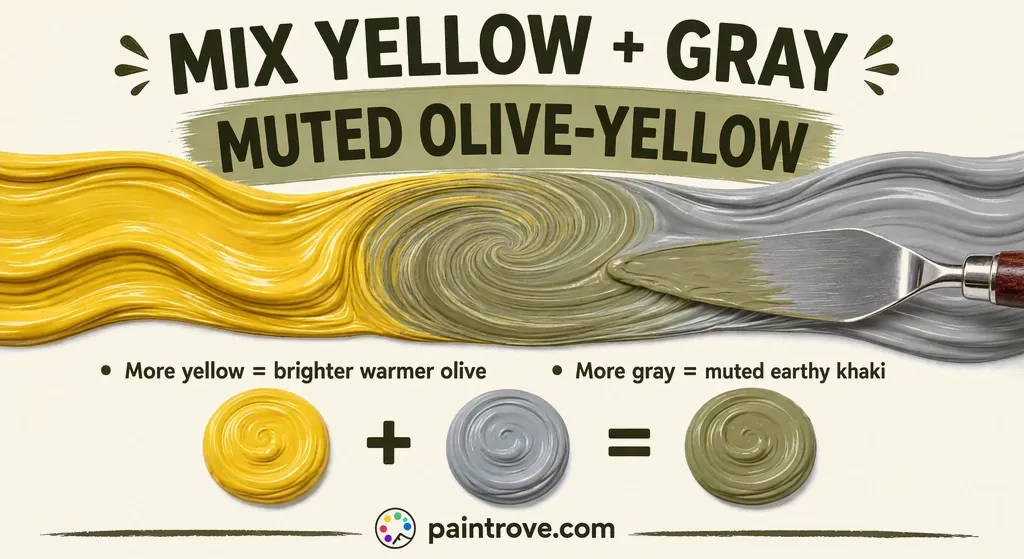
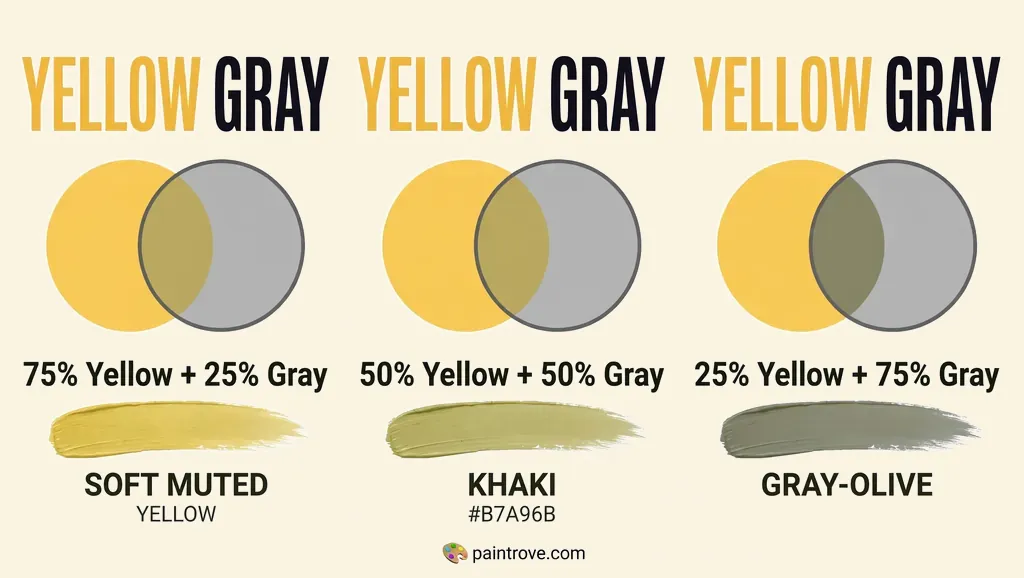
Yellow and gray make a muted, greyish yellow that drifts toward olive as you add more gray. A light gray gives a soft sand or beige-yellow. A mid gray gives khaki, around Hex #F0E68C. A dark gray gives olive, around Hex #808000.
Gray carries no hue of its own, so in theory it should only drain yellow’s intensity. In practice something else happens, and it is the reason this mix surprises people: grayed yellow almost always goes green.
That drift is not a mistake in your technique. It is a predictable consequence of what gray is made of, and once you know why, it is easy to control or avoid. This guide covers the ratios, why the green appears, how to mute yellow without it, and where greyish yellow sits as a named colour.
What color does yellow and gray make?
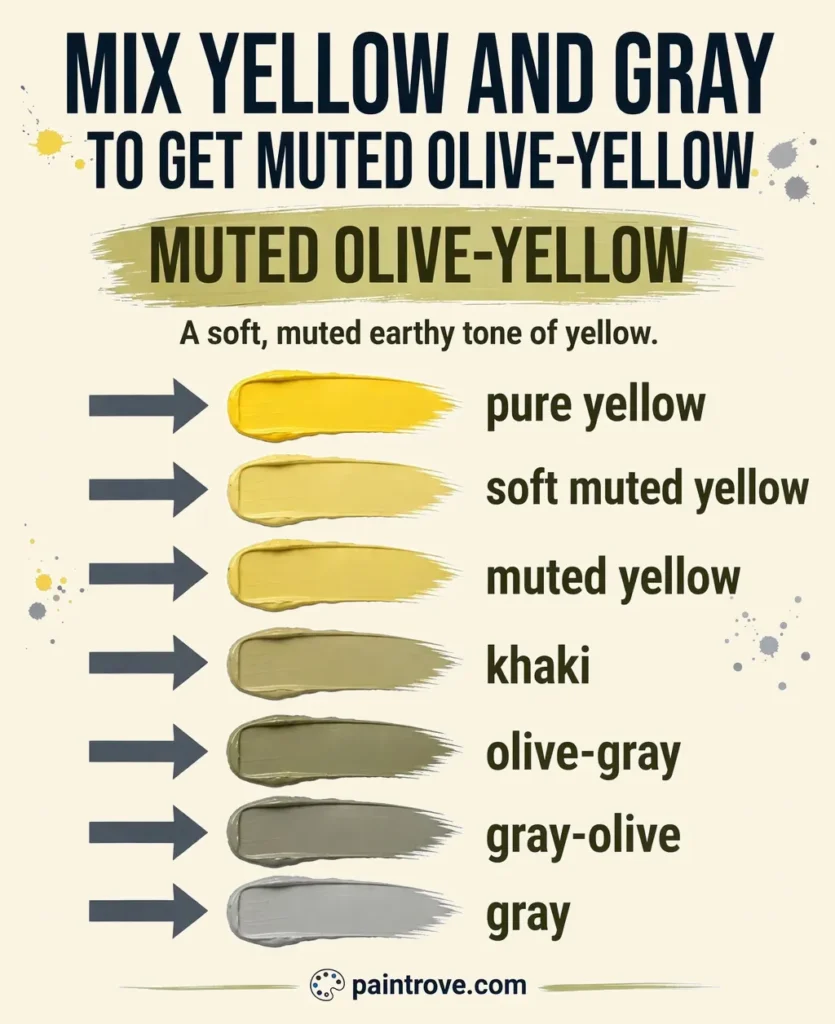
A tone of yellow. That is the technical term and it sets up everything else.
Color theory has three ways of modifying a hue, and the distinction matters here more than in most mixes:
- A tint is a hue plus white. Yellow plus white gives a pale, chalky cream.
- A shade is a hue plus black. Yellow plus black gives olive, not dark yellow.
- A tone is a hue plus gray. Yellow plus gray gives a muted, greyish yellow.
Gray sits between black and white, so a tone lands between a tint and a shade. The value can go either way depending on how light your gray is, but the saturation always falls. As Wikipedia’s summary of tint, shade and tone notes, mixing any neutral into a hue reduces chroma while the perceived hue shifts only slightly.
“Only slightly” is doing a lot of work in that sentence where yellow is concerned, which brings us to the main problem.
Why grayed yellow drifts green
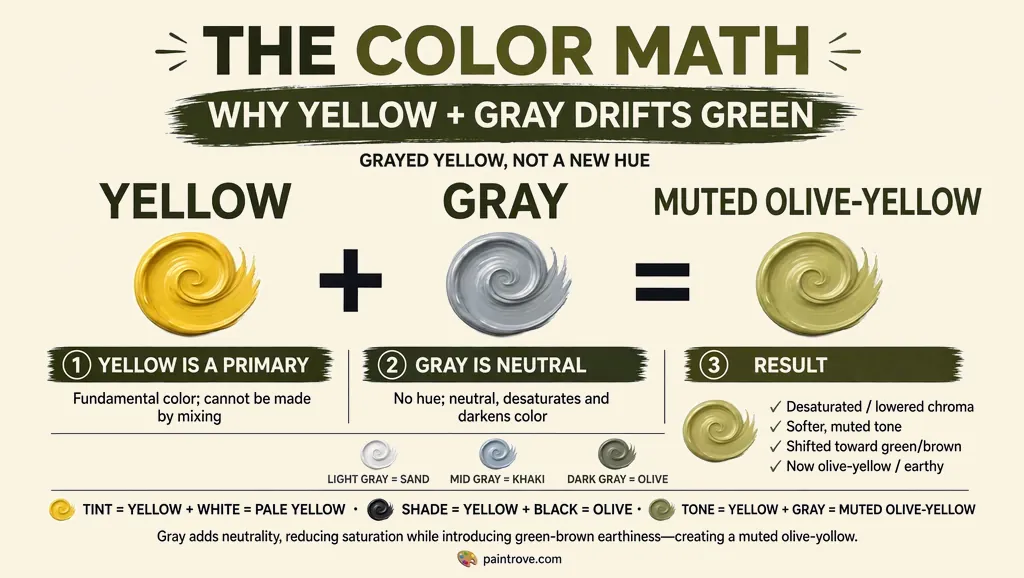
Here is the mechanism, and no competing page explains it clearly.
Gray is made from black and white, and most black pigments carry a cool, slightly blue undertone. Lamp black and carbon black lean distinctly blue. Even ivory black, which is warm in mass tone, often tints toward a cool blue-grey.
Blue plus yellow makes green. So when you add a gray built on a cool black to yellow, you are quietly introducing blue into the mixture, and the result slides toward olive. The same relationship that produces a clean green in blue and yellow mixed is working against you here in small, invisible amounts.
Yellow is unusually vulnerable to this for two reasons:
It sits at the highest value of any hue. There is very little room above it and a great deal below, so any darkening agent has an outsized effect.
It has the weakest tinting strength of the primaries. Yellow cannot defend itself in a mixture. A trace of almost anything shows immediately, which is why a brush holding leftover blue will turn a pool of yellow green in one stroke.
The practical upshot: what color does gray and yellow make depends heavily on the undertone of the black inside your gray. A truly neutral gray gives a clean greyish yellow. A cool gray gives olive. A warm gray gives something closer to sand or khaki.
Yellow and gray mixing ratios
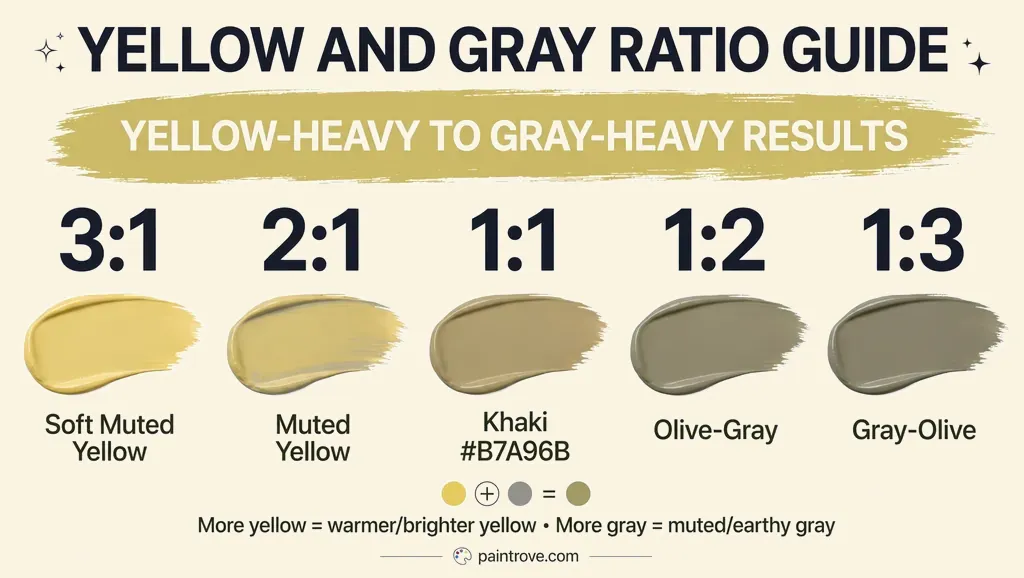
What color does yellow and gray make at each proportion is set out below. Every ratio is an approximate starting point rather than a formula. Grays vary in value and undertone, and yellows vary in strength, so add gradually and test before committing.
| Approximate ratio (yellow : gray) | Result | Roughly matches |
|---|---|---|
| 10 : 1 | Slightly softened yellow | Still clearly yellow, less acidic |
| 6 : 1 | Soft buttery yellow | Flax, Hex #EEDC82 |
| 4 : 1 | Muted sand-yellow | Pale goldenrod, Hex #EEE8AA |
| 2 : 1 | Greyish yellow | Khaki, Hex #F0E68C |
| 1 : 1 | Clearly olive-leaning | Dark khaki, Hex #BDB76B |
| 1 : 2 | Deep muted olive | Approaching olive, Hex #808000 |
| 1 : 4 | Gray with a yellow cast | Greige, barely yellow |
Add gray into yellow, not yellow into gray. Gray is already a weakened, middle-value mixture, so it has less tinting power than either black or white alone. Starting from yellow gives you fine control over how much chroma you give up. Yellow and grey make what color you stop at, and stopping early is almost always right.
A workable sequence:
- Put out the yellow you want to mute.
- Check your gray’s undertone first by tinting a little of it with white on the side. If the swatch looks blue, expect a green drift.
- Add the gray a little at a time, blending fully before judging.
- Stop one step before you think you should.
- Test on your actual surface and let it dry, since acrylic dries darker and watercolor dries lighter.
The value of your gray changes the result completely
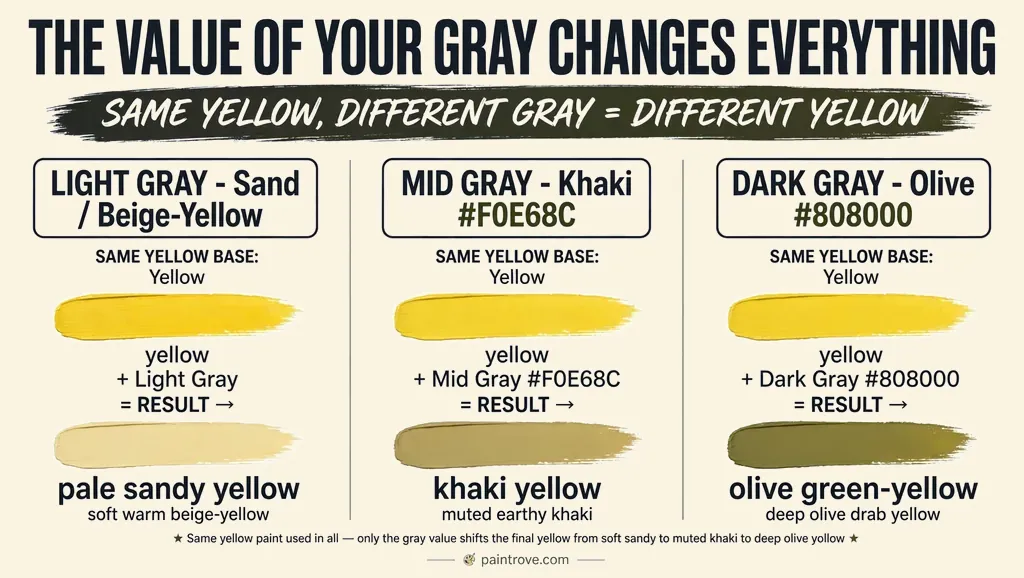
What color does yellow and gray make is decided here more than anywhere else. This is the biggest variable in the mix, bigger than the ratio.
Gray runs the whole range from near-white to near-black, and each point produces a visibly different colour from the same yellow.
| Gray used | Result | Roughly matches |
|---|---|---|
| Light gray (Hex #D3D3D3) | Soft, pale, slightly dusty yellow | Beige, ecru, sand |
| Mid gray (Hex #808080) | Balanced greyish yellow | Khaki, flax |
| Dark gray (Hex #404040) | Deep olive-yellow | Dark khaki, olive drab |
| Warm gray (greige) | Earthy, sandy yellow | Ecru, Hex #C2B280 |
| Cool gray (slate) | Distinctly green olive | Olive, moss |
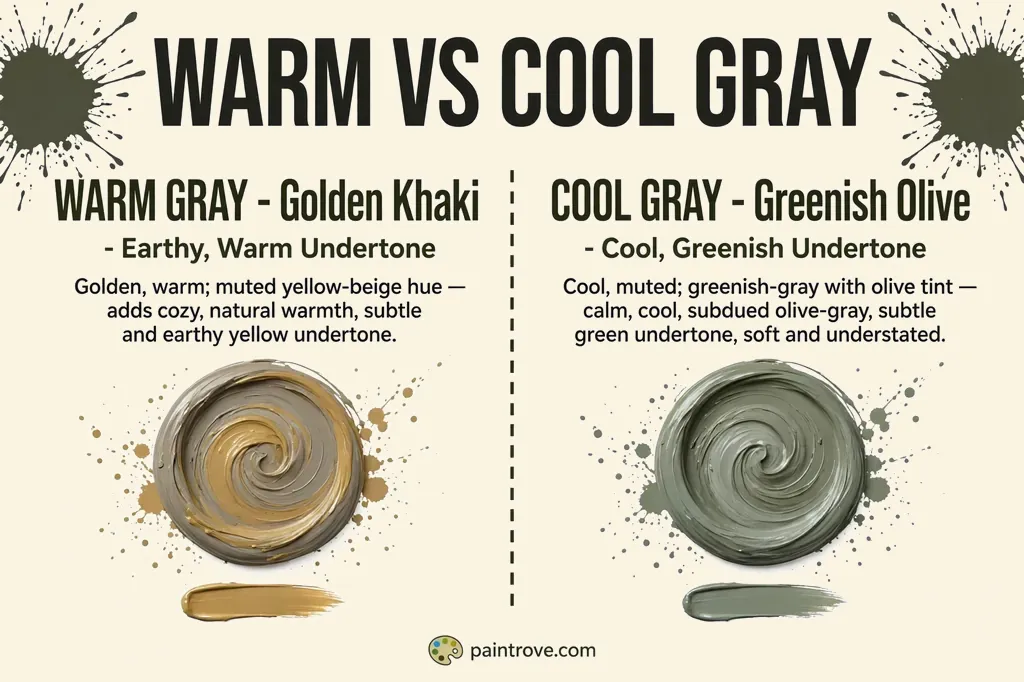
The last two are where most of the control lives. A warm gray carrying a trace of ochre or brown keeps the mixture in sandy, khaki territory. A cool gray carrying a trace of blue pushes it straight into olive. Grey and yellow make what color their shared undertone allows, so if you want khaki and keep getting army green, your gray is the reason.
Greyish yellow as a named colour
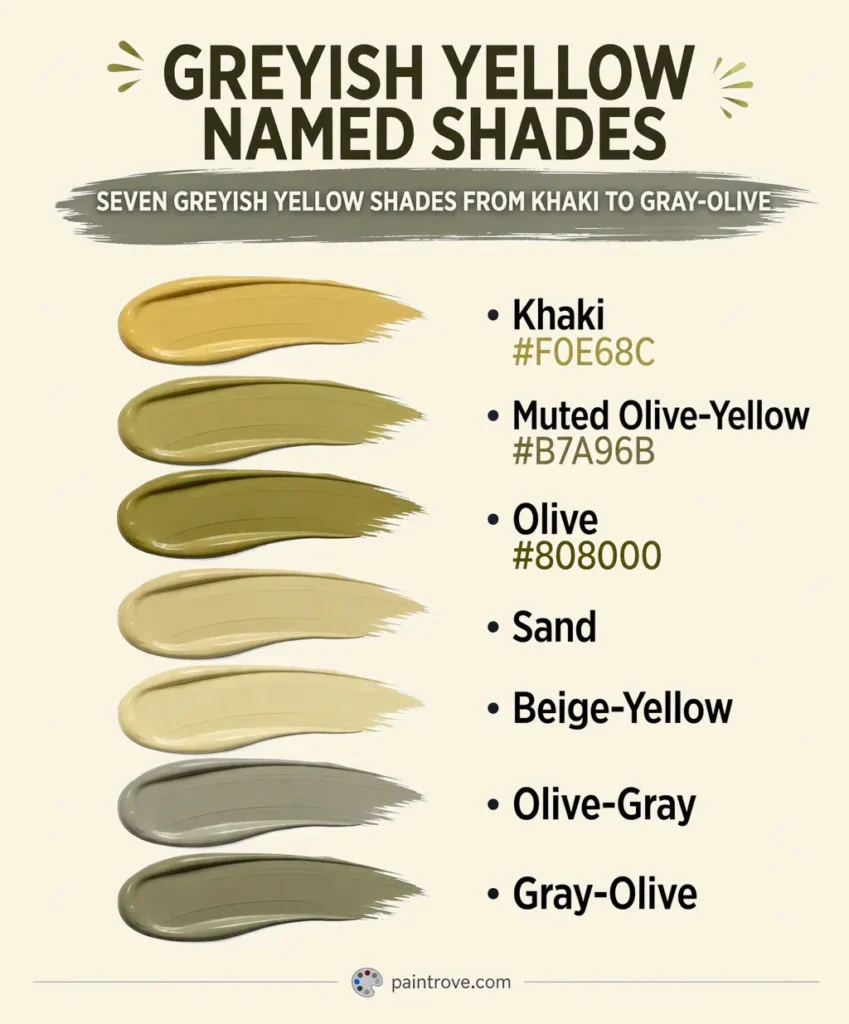
This is a real colour family rather than a single value, and it has no standardised hex code. It sits in the band between khaki and dark khaki, roughly Hex #F0E68C to #BDB76B, depending on how much gray is present and how warm it is.
The greyish yellow colour most people picture is closer to the lighter end: a soft, dusty, slightly dirty yellow that reads as natural rather than bright. It appears constantly in natural materials such as dry grass, raw linen, aged paper and unbleached wool, which is why it feels familiar even though it has no fixed name in common use.
Named points along the band:
| Name | Approximate hex | Character |
|---|---|---|
| Beige | #F5F5DC | Palest, barely yellow |
| Ecru | #C2B280 | Warm, sandy, unbleached |
| Pale goldenrod | #EEE8AA | Soft, slightly green |
| Flax | #EEDC82 | Warm, buttery, muted |
| Khaki | #F0E68C | The classic greyish yellow |
| Dark khaki | #BDB76B | Deeper, clearly olive-leaning |
| Olive | #808000 | The dark end of the family |
| Olive drab | #6B8E23 | Fully green, past yellow |
Notice that the band ends in green. That is not an error in the list. Push the mixture far enough and it stops being a yellow at all, which is the same progression described in yellow and green mixed.
How to mute yellow without turning it green
What does gray and yellow make when you actually want a clean result? Not always what you hoped, and gray is not always the best tool. Four alternatives, each with a different character:
A trace of purple. Purple is yellow’s complement, so it neutralizes directly and quickly. The result is warmer and more interesting than a grey-muted yellow, though very easy to overdo. The full behaviour is covered in what purple and yellow make, which lands on muddy brown when pushed too far. The underlying relationship is explained in the guide to complementary colors.
Raw umber. The most reliable route to a natural, dusty yellow. It mutes and slightly darkens without introducing blue, which keeps the result in the khaki and sand range rather than the olive one.
Yellow ochre or Naples yellow. Not a mixture at all. These pigments are naturally muted yellows, and starting with one of them avoids the problem entirely.
Brown. Produces mustard and golden tan rather than greyish yellow, which is a different target but often the one people actually want. Covered in brown and yellow mixed.
A warm gray. If you do want to use gray, mix your own from a warm black and white, or add the smallest trace of yellow ochre to a commercial gray before introducing it. This cancels the blue bias before it can act.
Yellow and gray in RGB and on screens
- Paint (subtractive). Yellow plus gray pigment gives a tone: the hue stays yellow, the chroma drops, and the value moves toward the gray’s level.
- Screens (additive RGB). There is no gray to add. A muted yellow is produced by raising the blue channel while lowering red and green slightly. Khaki at 240, 230, 140 is yellow with blue lifted from 0 to 140, which is exactly what reduces the saturation.
- Print (CMYK). A greyish yellow comes from yellow ink with a percentage of black, and often a little cyan, which is the same mechanism that causes the green drift in paint.
That RGB breakdown is the cleanest way to see the whole family. Pure yellow is 255, 255, 0 with maximum separation between the channels. Khaki at 240, 230, 140 has far less. Olive at 128, 128, 0 keeps the separation but halves the value. The closer all three channels come to equal, the more neutral the result.
For the full picture of how gray itself is built, including the chromatic grays that behave differently in this mix, the guide to what colors make gray covers every method.
Where greyish yellow and olive get used
In painting, what does yellow and gray make is exactly the band that does most of the work pure yellow cannot. Dry grass, sand, stone, weathered wood, aged paper and skin in shadow all sit in this band. Straight yellow from the tube is too acidic for almost any of them, which is why experienced painters reach for yellow ochre and raw umber more often than cadmium yellow.
In interiors and fashion, khaki and olive have been staples for a century precisely because they are desaturated. A greyish yellow reads as grounded and natural where a bright yellow reads as loud. The pairing with grey itself is reliable for the same reason the mixture works: there is no hue conflict, only a difference in warmth.
In military and utility contexts, olive drab exists because muted yellow-greens disappear against natural backgrounds. That is the same green drift described above, used deliberately.
If you want a muted colour that leans green rather than yellow, the sibling mixture in green and gray mixed lands on sage and gray-green, and the two families overlap in the middle.
Why your mix came out wrong
It went green or olive and I wanted khaki. Your gray carries a cool, blue-leaning black. Use a warm gray, add a trace of yellow ochre to neutralize the blue, or mute with raw umber instead.
It went brown. Too much gray, or a gray with a strong warm undertone. All three primaries end up present and the mixture neutralizes past yellow entirely.
It looks dirty rather than muted. There is a difference, and it usually comes from overshooting. Muted means lower chroma with the hue intact; dirty means the hue has gone entirely. Start again and use a fraction of the gray.
It barely changed. Gray has weaker tinting strength than black or white, so you need more than you expect. This is the one mix where the ratio table runs all the way to equal parts and beyond.
It dried darker. Normal in acrylic. Yellow shows value shifts more than any other hue because it starts so light, so always judge from a dried swatch.
What color does yellow and gray make when mixed?
A muted, greyish yellow that moves toward olive as more gray is added. A light gray gives sand or beige tones, a mid gray gives khaki near Hex #F0E68C, and a dark gray gives olive near Hex #808000. The hue stays yellow; the saturation falls.
What color does gray and yellow make if the gray is cool?
Olive. Cool grays are built on blacks with a blue undertone, and blue plus yellow makes green, so the mixture drifts green rather than staying a clean greyish yellow. For khaki rather than olive, use a warm gray or mute the yellow with raw umber instead.
Yellow and grey make what color at equal parts?
A dark khaki with a clear olive lean, near Hex #BDB76B. Equal parts is well past the point where the result still reads as a yellow. For a recognisable greyish yellow you want roughly two parts yellow to one part gray.
Grey and yellow make what color on the light end?
Soft sand, beige and ecru tones. A light gray added to yellow raises the value while draining saturation, giving the dusty, natural yellows found in raw linen, dry grass and unbleached wool. Ecru sits around Hex #C2B280 and is the most useful reference point.
What does gray and yellow make that is different from black and yellow?
Gray gives a tone, meaning a muted yellow that can sit at any value depending on the gray. Black gives a shade, which in yellow’s case means olive almost immediately. Gray offers far more control, because you choose the value of the gray before you start.
What does yellow and gray make in RGB?
A muted yellow, produced by raising the blue channel rather than by adding anything. Pure yellow is 255, 255, 0 and khaki is 240, 230, 140, where the lifted blue is what removes the saturation. Olive at 128, 128, 0 instead halves the red and green while keeping blue at zero.
What is greyish yellow called?
Khaki is the most widely recognised name, sitting around Hex #F0E68C. Nearby names include flax, ecru, pale goldenrod and sand on the lighter side, and dark khaki and olive on the darker side. There is no single standardised hex code for greyish yellow as a term.
What is the greyish yellow colour used for?
Natural and utility contexts, mostly. It appears in dry grass, sand, stone, raw linen and aged paper, which is why it reads as grounded rather than loud. Khaki and olive have been fashion and interiors staples for a century for the same reason, and olive drab exists because muted yellow-greens disappear against landscape.
Why does my yellow go green when I add gray?
Your gray contains a black with a cool, blue-leaning undertone, and blue plus yellow makes green. Lamp black and carbon black both lean blue. Yellow also has the weakest tinting strength of the primaries, so even a trace of blue shows immediately.
How do you mute yellow without it going green?
Use raw umber, a small amount of purple, or a warm gray rather than a cool one. Raw umber is the most reliable, muting and slightly darkening without introducing blue. Purple is yellow’s complement and neutralizes quickly, but it is very easy to overdo.
Can yellow and gray make brown?
Yes, if you add enough gray or if the gray carries a warm brown undertone. Brown appears once the mixture has moved past muted yellow and all three primaries are effectively present. A trace of purple or burnt umber gets there faster and more predictably.
Do yellow and gray go together in design?
Very well. Gray is a neutral with no hue to compete against yellow, so it lets a yellow read as deliberate rather than loud. Mid and charcoal greys suit brighter yellows, while light greys suit muted ones. Keep the proportions uneven, with gray dominating and yellow as the accent.
Yellow and gray at a glance
| If you want | Do this |
|---|---|
| A slightly softened yellow | 10 parts yellow to 1 part gray |
| Khaki or greyish yellow | Roughly 2 parts yellow to 1 part mid gray |
| Sand, beige or ecru | Yellow plus a light, warm gray |
| Olive | Yellow plus a dark or cool gray |
| To avoid the green drift | Use a warm gray, or mute with raw umber |
| A muted yellow with warmth | Add a trace of purple instead of gray |
| Mustard rather than khaki | Add brown instead of gray |
| A naturally muted yellow | Use yellow ochre or Naples yellow, no mixing |
What color does yellow and gray make, in one line: a greyish yellow that runs from sand through khaki to olive, with the hue intact and the vividness reduced. Three things are worth remembering: check your gray’s undertone before blaming the ratio, expect a green drift unless the gray is warm, and reach for raw umber when you want the result to stay a yellow.