How Long Does It Take to Paint a Room?
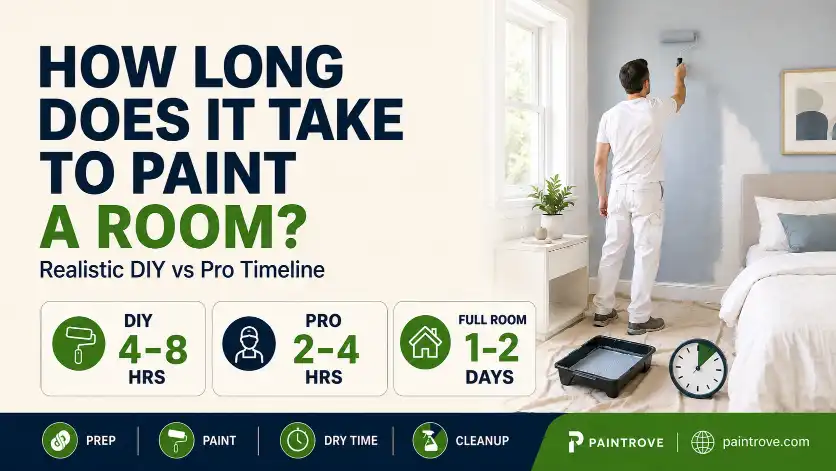
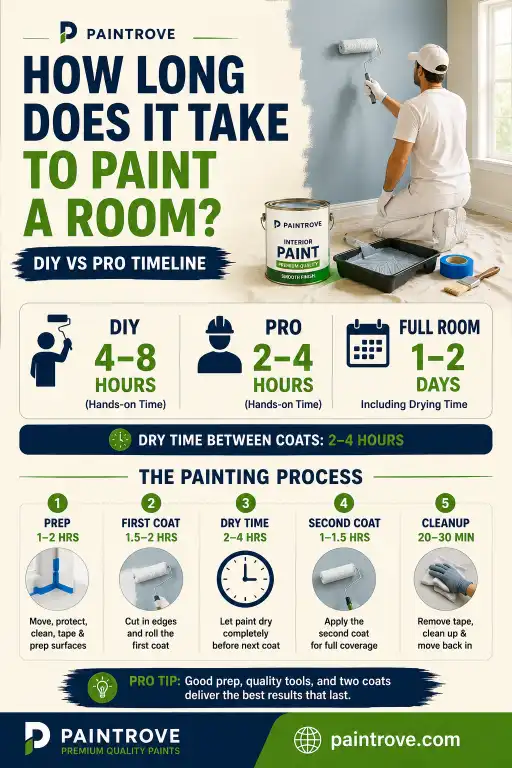
How Long Does It Take to Paint a Room? Painting a room takes 4 to 8 hours for a DIYer and 2 to 4 hours for a professional, not counting drying time between coats.
A standard 12×12 bedroom with two coats of paint on walls only spans a full day from start to finish when you include prep, painting, and drying. Add the ceiling and trim, and you are looking at two days. These are realistic estimates, not the optimistic numbers you will find on most paint can labels. Rushing any stage of the painting process is the fastest way to end up repainting in six months.
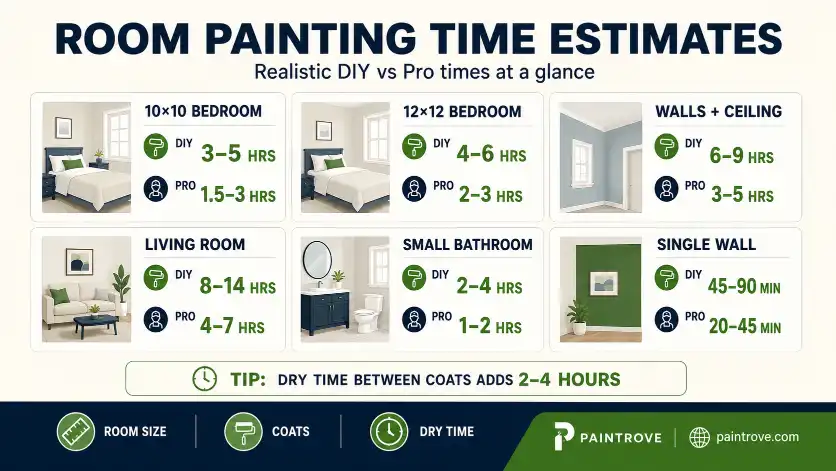
How Long Does It Take to Paint a Room: Time Estimates at a Glance
| Room / Task | DIY Time | Professional Time |
|---|---|---|
| 10×10 bedroom (walls only) | 3–5 hours | 1.5–3 hours |
| 12×12 bedroom (walls only) | 4–6 hours | 2–3 hours |
| 12×12 bedroom (walls + ceiling) | 6–9 hours | 3–5 hours |
| 12×12 bedroom (walls + ceiling + trim) | 8–12 hours | 4–6 hours |
| Living room (250–400 sq ft) | 8–14 hours | 4–7 hours |
| Small bathroom (50–80 sq ft) | 2–4 hours | 1–2 hours |
| Kitchen (100–150 sq ft) | 4–8 hours | 2–4 hours |
| Single wall | 45–90 min | 20–45 min |
| Ceiling only (12×12) | 2–3 hours | 1–1.5 hours |
| Trim and baseboards only (per room) | 1–2 hours | 30–60 min |
These estimates cover two coats of paint with standard prep. They do not include dry time between coats, which adds 2–4 hours of waiting regardless of who is doing the painting.
What Factors Affect How Long It Takes to Paint a Room?
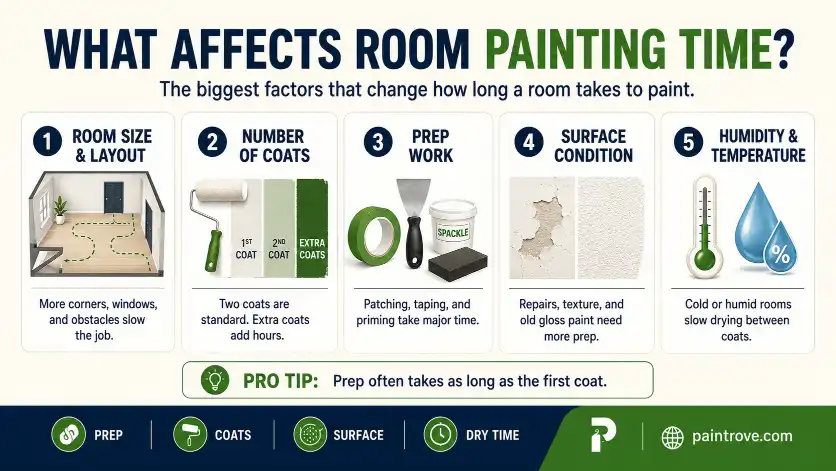
No two rooms take the same amount of time. Here are the variables that stretch or compress every estimate.
Room Size and Layout
Bigger rooms take longer — but not in a straight line. A 20×20 living room does not take twice as long as a 10×10 bedroom. Cutting in the edges and corners takes roughly the same time regardless of how large the flat wall sections are — it is the rolling that scales with square footage.
Awkward layouts add time. A room with two doors, three windows, a fireplace surround, and built-in shelving takes significantly longer to tape and cut in than an open rectangular room of the same square footage. Every obstacle means more tape, more brush work, and more precision.
Number of Coats
One coat of paint: faster, but only appropriate when repainting the same color or a very similar one.
Two coats: standard for most paint jobs. Each coat adds active painting time plus the full dry time before the next coat — a minimum of 2–4 hours for latex paint.
Three coats: sometimes required when covering dark paint with a light color, painting a bold or saturated color, or working with low-quality paint. Three coats can add 4–6 hours to a project across the additional painting and waiting time.
Prep Work
Prep work is the most underestimated time consumer in any paint job. It is also the stage that most DIYers skip or rush — and the reason most DIY paint jobs fail prematurely.
A fully prepared room includes:
- Furniture moved and protected with drop cloths
- Outlet covers and switch plates removed
- Nail holes and wall damage filled with spackle and sanded smooth
- Walls cleaned with a damp cloth or degreaser
- Painter’s tape applied to all trim, baseboards, and ceiling edges
- Primer applied where needed
For a standard 12×12 bedroom, complete prep takes 1 to 2 hours for an experienced DIYer and 2 to 3 hours for a beginner. Rooms with significant wall repairs, heavily greasy surfaces, or wallpaper removal add 2–4 hours before a brush ever touches paint.
DIY vs. Professional
A professional painter works faster for three reasons: experience, efficiency of movement, and the habit of doing the same tasks in the same order hundreds of times. A pro who has cut in hundreds of rooms moves twice as fast as a careful DIYer — and makes fewer mistakes that require correction.
That said, professionals are not simply faster versions of a DIYer. They also bring better equipment (spray rigs, proper ladders, professional-grade brushes and rollers) that reduces setup and cleanup time and produces more consistent results.
For complex rooms — high ceilings, extensive trim work, popcorn ceilings, or multiple colors — the professional time advantage is even more pronounced. A vaulted ceiling or a room with crown molding, chair rail, and detailed window casings that takes a DIYer two days might take a professional crew half a day.
Number of Colors
Single color throughout: fastest. No stopping to switch paint, no additional tape lines, no precision required at color transitions.
Two colors (accent wall or ceiling contrast): adds 30–90 minutes for the tape work at the transition and the careful cutting in at the border.
Multiple colors or patterns: adds time proportionally. Each color change requires clean brushes and rollers, new tape, and additional dry time before applying the adjacent color.
Surface Condition
A freshly primed, smooth wall is the easiest surface to paint. It takes paint evenly, requires fewer coats, and shows fewer application marks.
Old walls with patches, repairs, different sheen levels from previous touch-ups, or previously painted gloss surfaces require additional prep and often additional coats. Heavily textured walls (orange peel, knockdown, skip trowel) take longer to roll because the roller needs to work paint into all the low points of the texture.
Popcorn ceilings take significantly longer to paint than flat ceilings. The texture absorbs paint and requires slow, light roller passes — no fast rolling on popcorn.
Environmental Conditions
High humidity slows drying time, which extends the total project duration. If you need to wait 4 hours between coats instead of 2 because the humidity is above 70%, your one-day project becomes a two-day project.
Cold temperatures below 60°F also extend dry time. Painting in an unheated room in winter or early spring — common when painting before moving into a home — adds significant waiting time between coats and between primer and paint.
How Long Does It Take to Paint a 12×12 Room?
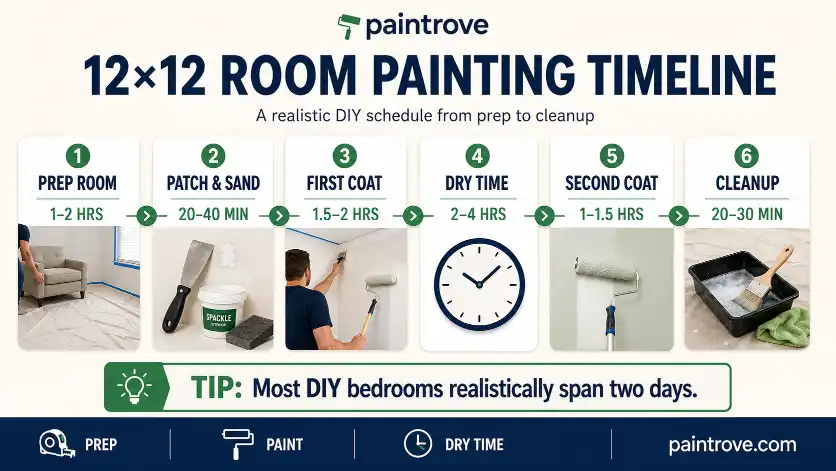
A standard 12×12 bedroom with 8-foot ceilings has approximately 360 square feet of wall surface (accounting for a standard door and two windows). Here is a realistic breakdown for a DIYer doing walls only with two coats:
| Stage | Time |
|---|---|
| Move furniture, lay drop cloths | 20–30 min |
| Remove outlet covers, tape edges | 30–45 min |
| Patch and sand nail holes | 20–40 min |
| Apply primer (if needed) | 45 min + 1 hour dry |
| First coat — cut in | 45–60 min |
| First coat — roll walls | 45–60 min |
| Dry time between coats | 2–4 hours |
| Second coat — cut in | 30–45 min |
| Second coat — roll walls | 30–45 min |
| Remove tape, touch up | 20–30 min |
| Clean up | 20–30 min |
| Total hands-on time | 5–7 hours |
| Total elapsed time (with drying) | 8–12 hours |
This is why most 12×12 room painting projects realistically span two days — one for prep and the first coat, one for the second coat and cleanup. Trying to compress everything into a single day is possible with an early start and fast-drying latex paint, but it is tight.
How Long Does It Take to Paint a Room and Ceiling?
Add a ceiling to the 12×12 example above and the hands-on time increases by 1.5 to 2.5 hours:
- Ceiling cut in: 30–45 minutes
- Ceiling roll (two coats with dry time included in the schedule): 45–60 minutes per coat
The ceiling must be painted before the walls — so it goes first in the sequence, adding time at the start of the project. Total hands-on time for walls and ceiling: 7 to 10 hours. Total elapsed time including all drying: 10 to 16 hours — realistically two days.
How Long Does It Take to Paint Trim in a Room?
Trim — baseboards, window frames, door casings, and crown molding — is slower per linear foot than rolling walls because it requires precision brush work rather than fast rolling.
For a standard 12×12 bedroom with typical trim (one door, two windows, baseboard around the perimeter):
- Painter’s tape application: 20–30 minutes
- Trim cut in and paint (one coat): 45–75 minutes
- Drying and second coat: 30–45 minutes active time
- Total trim time: 1.5–2.5 hours
Rooms with ornate crown molding, chair rails, wainscoting, or board and batten take significantly longer. Intricate crown molding in a large room can add 2–4 hours of careful brush work.
How Long Does It Take to Paint a Small Bathroom?
A small bathroom (50–80 square feet) has less wall surface than a bedroom — but it has more obstacles per square foot: toilet, vanity, mirror, towel bars, light fixtures, and tile transitions. All of those fixtures require taping and careful cutting in.
Realistic DIY time for a small bathroom (walls only, two coats):
| Stage | Time |
|---|---|
| Prep (tape fixtures, remove hardware) | 30–45 min |
| First coat (cut in + roll or brush) | 45–60 min |
| Dry time | 2–4 hours |
| Second coat | 30–45 min |
| Cleanup | 20–30 min |
| Total hands-on time | 2–3 hours |
| Total elapsed time | 4–7 hours |
A bathroom is a good first painting project for beginners — the small size limits how much can go wrong, and the enclosed space makes mistakes easier to spot and fix before the paint dries.
How Long Does It Take to Paint a Living Room?
A living room (250–400 square feet of wall surface) is significantly larger than a bedroom and typically has more architectural features — large windows, possibly a fireplace, wider trim, higher ceilings. Expect:
- DIY, walls only, two coats: 8–12 hours hands-on, 12–18 hours elapsed
- DIY, walls and ceiling, two coats: 10–16 hours hands-on, 14–22 hours elapsed
- Professional, walls only: 4–6 hours
- Professional, walls and ceiling: 5–8 hours
Most DIYers spread a living room paint job across two full days — one for prep and first coat, one for second coat and cleanup.
How Long Does It Take to Paint a Room By Yourself vs. With 2 People?
Adding a second painter does not cut the time in half — but it reduces it significantly.
Two people painting a 12×12 bedroom:
- One person cuts in while the other rolls: the most efficient split
- First coat time drops from 90 minutes to 45–60 minutes
- Total active painting time roughly 30–40% shorter than solo
- Prep and cleanup time mostly unchanged — these tasks do not parallelize as well
Two people vs. solo for a full room (walls + ceiling): Solo: 7–10 hours hands-on / 10–16 hours elapsed Two people: 5–7 hours hands-on / 8–13 hours elapsed
The clearest benefit of two painters is maintaining a wet edge. One person cuts in while the other rolls immediately behind — the cut-in edges never have a chance to dry before the roller reaches them, which produces a cleaner, more seamless finish.
Three people: Marginal additional benefit in a standard room — most rooms do not have enough simultaneous work for three painters. A third person helps most in very large rooms or multi-room projects where one person can be prepping the next room while two paint the current one.
How Long Does It Take to Paint a Room with a Roller?
Using a paint roller is the standard method for painting walls and ceilings — and by far the fastest way to cover large flat surfaces. For a 12×12 room (walls only), rolling two coats takes approximately:
- First coat rolling: 30–45 minutes
- Second coat rolling: 25–35 minutes
The cutting in (brush work at edges and corners) takes longer than the rolling — approximately 45–60 minutes per coat. This is why having two people — one cutting in, one rolling — is so effective.
A 9-inch roller covers approximately 50 square feet per minute when loaded correctly and rolled at a steady pace. On 360 square feet of wall, expect the physical rolling to take 7–10 minutes per coat — the rest of the time is loading the roller, repositioning, and backrolling for a smooth finish.
How Long Does It Take to Paint a Room with a Paint Sprayer?
A paint sprayer is the fastest application method — but the fastest tool is not always the fastest overall approach in a typical room.
Sprayer application speed: A quality airless sprayer covers a 12×12 room’s walls in 10 to 20 minutes of spray time. This is dramatically faster than rolling.
Masking and prep time: Everything that is not being painted must be completely masked — walls if you are painting ceiling only, ceiling and floors if you are spraying walls, all fixtures, outlets, trim, windows, doors, and flooring. Thorough indoor masking for a 12×12 room takes 1 to 2 hours before spraying begins.
Net time: The spray time savings are largely offset by masking time in a furnished or partially furnished room. Sprayers make the most sense for empty rooms, new construction, or spaces where everything is already protected.
| Method | Active paint time | Total time (incl. setup, cleanup) |
|---|---|---|
| Brush and roller (solo) | 2–3 hours / coat | 5–8 hours (2 coats) |
| Brush and roller (2 people) | 1.5–2 hours / coat | 4–6 hours (2 coats) |
| Paint sprayer (empty room) | 10–20 min / coat | 3–5 hours (2 coats, incl. masking) |
| Paint sprayer (furnished room) | 10–20 min / coat | 5–8 hours (2 coats, incl. masking) |
How Long Does It Take for Paint to Dry When Painting a Room?
Drying time is the part of the project you cannot control or speed up significantly — it is built into the schedule whether you want it there or not.
Latex paint dry time:
- Touch dry: 30–60 minutes
- Ready for second coat (re-coat time): 2–4 hours
- Fully cured: 14–30 days
Oil-based paint dry time:
- Touch dry: 6–8 hours
- Ready for second coat: 24 hours
- Fully cured: 7 days
For a two-coat latex paint job, the dry time between coats is the longest single waiting period in the whole project. In ideal conditions (70°F, humidity below 50%), latex paint is re-coat-ready in 2 hours. In humid or cold conditions, add at least 50% more waiting time.
Can you paint two coats in one day? Yes — with latex paint in good conditions. Apply the first coat in the morning, let it dry 2–4 hours, apply the second coat in the afternoon. The room is done by evening.
Do not rush the re-coat time. Applying a second coat of latex paint before the first has dried fully causes lifting, wrinkling, and poor adhesion. The second coat traps moisture in the first coat — the paint cannot cure properly and will peel. If you are pressed for time, wait the full re-coat time listed on the paint can. Cutting it short costs more time in repairs than it saves.
Realistic Paint Room Timeline: Start to Finish
Here is the honest, full-project timeline for a DIYer painting a standard 12×12 bedroom (walls, ceiling, and trim) with two coats and no wallpaper or major repairs.
Day 1:
- Move furniture, lay drop cloths: 30 min
- Remove outlet covers, hardware: 15 min
- Patch nail holes, sand: 30 min
- Tape edges: 30–45 min
- Apply primer to patched areas: 20 min + 1 hour dry
- Paint ceiling — first coat: 45–60 min
- Dry time: 2 hours
- Paint ceiling — second coat: 30–45 min
- Day 1 total hands-on: 4–5 hours
Day 2:
- Paint trim — first coat: 45–60 min
- Dry time: 2 hours
- Paint walls — first coat (cut in + roll): 1.5–2 hours
- Dry time: 2–4 hours
- Paint walls — second coat: 1–1.5 hours
- Trim — second coat (if needed): 30 min
- Remove tape, touch up: 30 min
- Clean brushes, rollers, cleanup: 30 min
- Day 2 total hands-on: 5–7 hours
Total project: 9–12 hours hands-on over two days
How Long Does It Take to Paint a House Interior?
Scaling up from one room to a full house:
| House Size | Professional Time | DIY Time |
|---|---|---|
| 1 bedroom apartment | 1–2 days | 3–5 days |
| 2 bedroom apartment | 2–3 days | 5–8 days |
| 3 bedroom house (interior) | 3–5 days | 7–12 days |
| 1,500 sq ft house interior | 4–6 days | 10–15 days |
| Large home (2,500+ sq ft) | 7–14 days | 3–5 weeks |
Professional estimates assume a crew of 2–3 painters. DIY estimates assume a solo painter working full days with appropriate breaks.
How to Paint a Room Faster: 7 Practical Tips
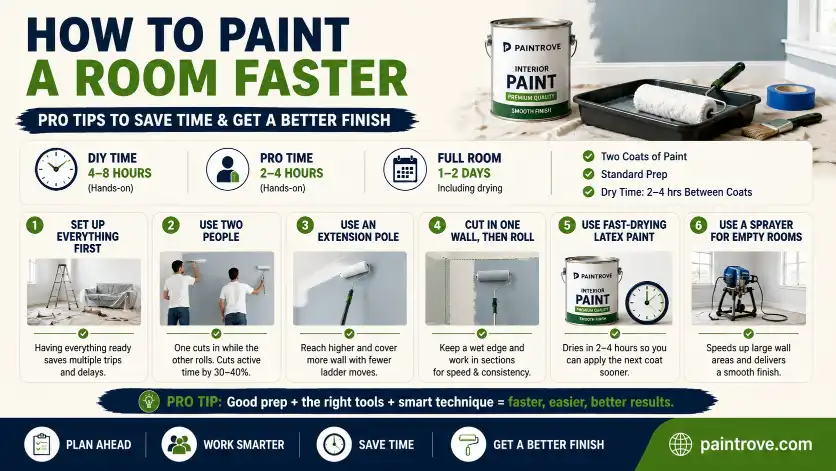
1. Have everything ready before you start. Every minute spent hunting for tape, a brush, or a second roller cover is a minute not painting. Set up your complete workspace before touching paint.
2. Use two people. One cuts in, one rolls. The efficiency gain is significant and the finish is cleaner because the edges never dry before the roller reaches them.
3. Use an extension pole. Rolling from the floor with an extension pole is dramatically faster than climbing a ladder for every pass. It also produces more consistent pressure and a more even finish.
4. Use a paint sprayer for empty rooms. If you can strip the room completely and mask everything, a sprayer cuts active paint time by 80%.
5. Use fast-drying latex paint. Standard latex paint re-coats in 2–4 hours. Some fast-dry formulas (Sherwin-Williams Emerald, Benjamin Moore Advance) are re-coat ready in 1–2 hours. Shorten the wait and the full-day timeline becomes genuinely achievable in a single day.
6. Skip unnecessary tape where possible. If you are painting walls and ceiling the same color, or if the ceiling is being painted before the walls, you do not need tape at the ceiling line. Tape is slow. Use it where it matters; skip it where it does not.
7. Cut in one section, roll immediately. Do not cut in the whole room before rolling. Cut in one wall and roll while those edges are wet — the finish blends seamlessly. The practice does not save time, but it produces a professional result that does not require extra touch-ups.
FAQs
How long does it take to paint a room for beginners?
Expect 6–10 hours of hands-on time for a standard 12×12 bedroom — spread over two days. Beginners move more carefully, make more corrections, and typically cut in more slowly than experienced painters. Budget a full weekend for a bedroom if it is your first time.
How long does it take to paint a room with 2 coats?
Two coats on a 12×12 room’s walls takes 4–6 hours of active painting, plus 2–4 hours of mandatory drying time between coats. Total elapsed time: 7–12 hours. Most DIYers split this across two days.
How long does it take to paint a 10×10 room?
A 10×10 room has approximately 280–300 square feet of paintable wall surface (accounting for a door and window). Expect 3–5 hours of hands-on time for two coats of walls only. Add 1.5–2 hours for the ceiling.
Realistically, how long does it take to paint a room by yourself?
For a standard bedroom — walls only, two coats — realistically plan for 5–7 hours of active work spread over two days to account for drying time. You can complete it in one long day if you start early and conditions are ideal.
How long does it take for paint to dry between coats?
Latex paint: 2–4 hours under ideal conditions (70°F, humidity below 50%). Oil-based paint: 24 hours. In humid or cold conditions, add 50% or more to these estimates. Do not apply a second coat until the first passes the touch test — lightly pressing a knuckle against the paint surface should leave no mark and no stickiness.
How long does it take to paint trim in a room?
1.5–2.5 hours for a standard bedroom with one door, two windows, and perimeter baseboard. More ornate trim with crown molding, chair rail, or detailed window casings takes 3–4 hours.
How long should you wait before putting furniture back in a painted room?
24 hours minimum before moving heavy furniture back against painted walls. 14 days before placing items directly in contact with painted surfaces. Full cure time for latex paint is 30 days — the paint continues hardening throughout that period.
The Bottom Line
Realistically, painting a standard 12×12 bedroom from start to finish takes 5 to 7 hours of active work spread across two days — the drying time between coats makes a single-day job tight but possible with an early start.
The single biggest misconception is that the painting itself is the time-consuming part. It is not. Prep — moving furniture, taping, patching, and priming — takes as long as the first coat of paint. Cutting in the edges takes longer than rolling the walls. Drying time between coats is non-negotiable and cannot be rushed.
Budget your time honestly and the result holds up for years. Compress the schedule and rush the drying time, and you are back to repainting sooner than you expected.
Related Articles:
- How to Paint a Room: 7 Proven Steps to a Perfect Finish
- How Much Does It Cost to Paint a Room? (DIY vs. Professional)
- How Long Does Paint Take to Dry? Every Surface, Every Paint Type
- How to Paint a Ceiling: 4 Steps to a Streak-Free Finish
- How to Clean Paint Brushes: Every Paint Type, Every Situation