Can You Paint Tile? 7 Smart Tips Before You Start
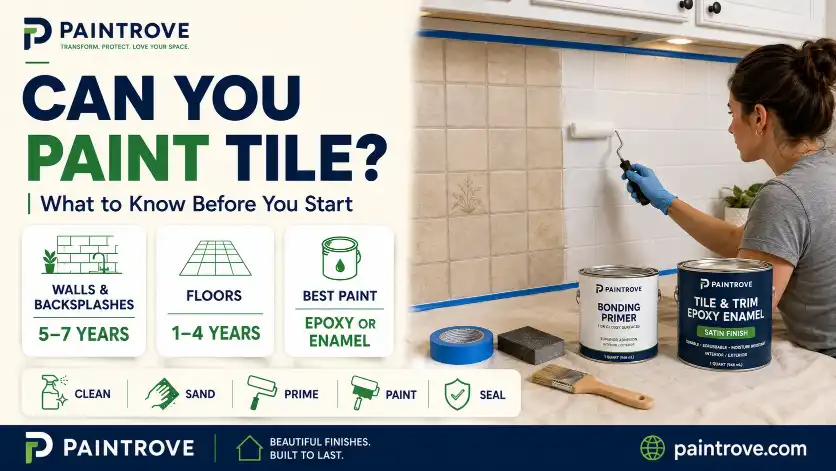
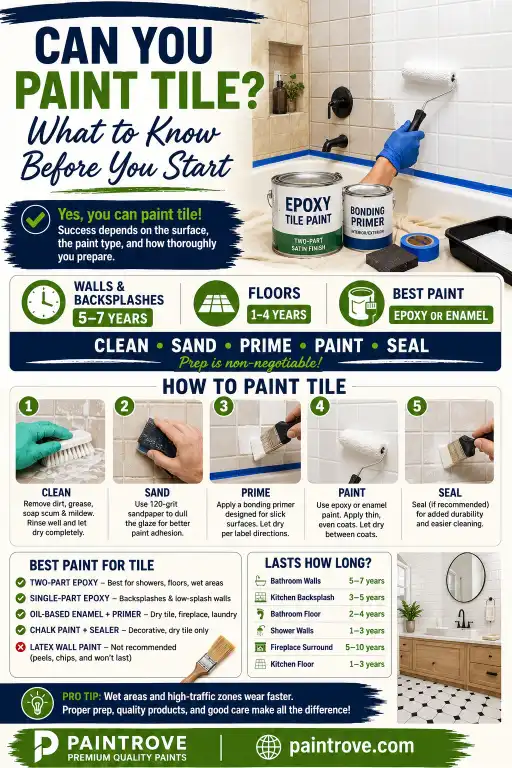
Can You Paint Tile? Yes, you can paint tile — but success depends entirely on the surface, the paint type, and how thoroughly you prepare. Ceramic and porcelain tile can be painted with epoxy paint or a bonding primer plus enamel system. Properly done, painted tile on bathroom walls and backsplashes lasts 5 to 7 years. On shower floors and heavily used surfaces, expect the finish to need refreshing after 1 to 3 years. The prep work is non-negotiable — skip it and the paint peels within weeks.
What Types of Tile Can You Paint?
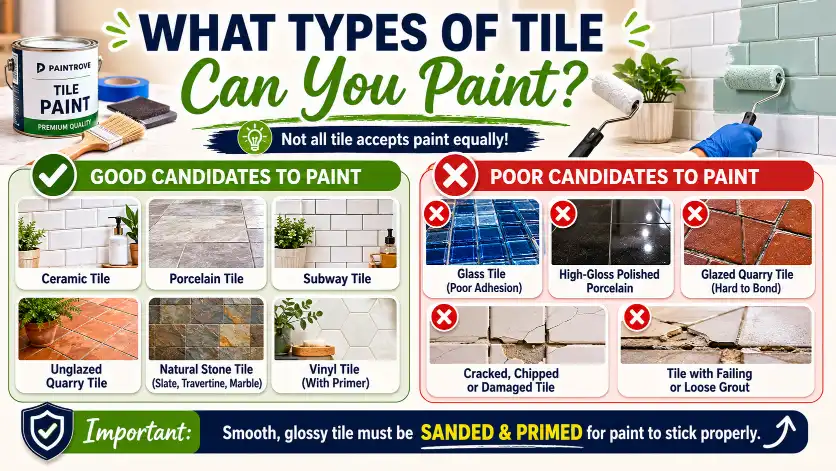
Not all tile accepts paint equally. The smooth, non-porous glaze on ceramic and porcelain tile resists adhesion by design — it repels water, and it repels paint too, unless you create mechanical grip through sanding and chemical grip through a bonding primer.
Good candidates for painting:
- Ceramic tile (wall and floor)
- Porcelain tile (wall and floor)
- Unglazed quarry tile
- Subway tile
- Natural stone tile (slate, travertine, marble — with appropriate sealing afterward)
- Vinyl tile (with a flexible bonding primer)
Poor candidates for painting:
- Glazed quarry tile — the glaze is extremely hard and resists bonding even after sanding
- Glass tile — paint adhesion on glass is very poor; the smooth, non-porous surface cannot be sanded effectively
- Tile with significant cracking, chipping, or grout failure — painting over structural problems masks them temporarily and accelerates the underlying failure
- High-gloss polished porcelain — extremely dense surface with minimal adhesion potential even after prep
What Paint Do You Use on Tile?
Paint choice is the single most important decision in a tile painting project. Standard wall paint will not hold on tile — it is not formulated to bond to non-porous, high-humidity surfaces and will peel within weeks.
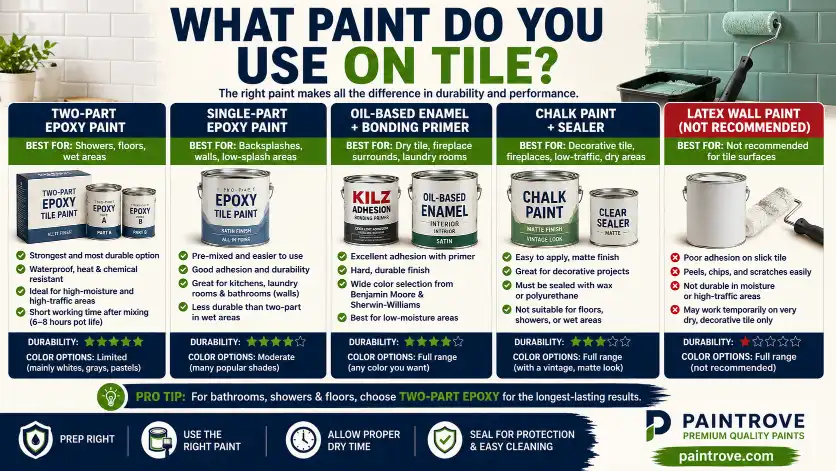
Two-part epoxy paint: The strongest and most durable option for tile. Two-part systems (like Rust-Oleum Tub & Tile Refinishing Kit or EPODEX 2K Tile Paint) consist of a resin and a hardener that you mix just before application. Once cured, the finish is extremely hard, waterproof, and resistant to heat and cleaning products. It is the correct choice for shower walls, bathroom floors, and kitchen backsplashes. The drawback is a short working time after mixing — once the two parts are combined, you need to apply and finish within the pot life (typically 6–8 hours).
Epoxy paint for tile (single-part): Pre-mixed epoxy formulas are easier to work with than two-part systems but are less durable in high-moisture environments. Good for low-splash bathroom walls, laundry rooms, and backsplashes.
Oil-based enamel with bonding primer: Works well on low-moisture tile surfaces like a fireplace surround, laundry room tile, or a kitchen backsplash away from the sink splash zone. Apply over a coat of KILZ or Zinsser bonding primer for adhesion. More color variety than epoxy — oil enamel comes in the full spectrum of paint colors from Benjamin Moore or Sherwin-Williams.
Chalk paint: Annie Sloan Chalk Paint and Fusion Mineral Paint can be used on tile for a matte, vintage finish — primarily on decorative or low-traffic tile like a fireplace surround or a backsplash that does not get wet. Must be sealed with a hard wax or polyurethane topcoat. Not suitable for floors, showers, or anywhere with ongoing moisture exposure.
Regular latex or acrylic wall paint: Not recommended on its own. Latex paint on tile will peel, even with primer, in any area that sees moisture or cleaning. It may hold temporarily on a completely dry, decorative tile surface, but do not use it in bathrooms or kitchens.
Tile Paint Comparison
| Paint Type | Best For | Durability | Color Options |
|---|---|---|---|
| Two-part epoxy | Showers, floors, wet areas | Excellent (3–5+ years) | Limited (pastels/whites) |
| Single-part epoxy | Backsplashes, walls | Good (2–4 years) | Moderate |
| Oil-based enamel + primer | Dry tile, fireplace, laundry | Good (3–5 years) | Full range |
| Chalk paint + sealer | Decorative, fireplace, dry areas | Moderate (2–4 years) | Full range |
| Spray paint (enamel) | Small tile projects, backsplash | Moderate (2–3 years) | Moderate |
| Latex wall paint | Not recommended on tile | Poor | Full range |
How to Paint Tile in 4 Steps
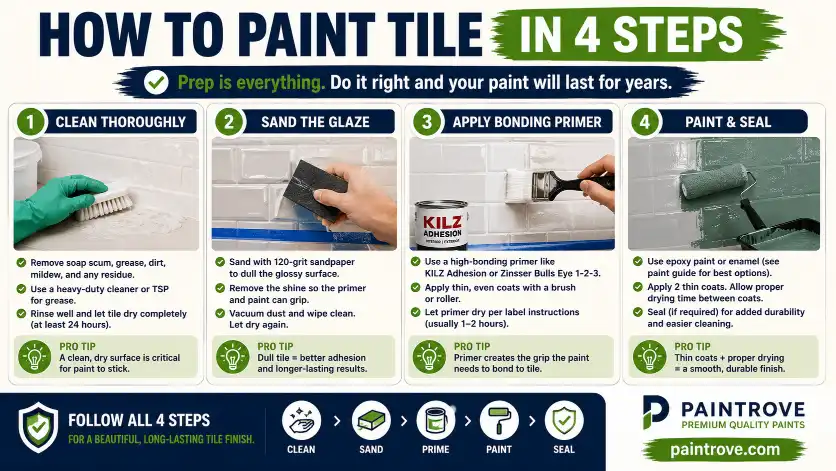
Step 1 — Prep the Tile
Prep is where the project is won or lost. A paint job over improperly prepared tile will fail within months, regardless of paint quality.
Clean thoroughly. Scrub every tile surface with a heavy-duty tile cleaner and a stiff brush. Remove all soap scum, grease, grime, and mildew. For mold or mildew, use a bleach-based cleaner and rinse completely. For kitchen backsplash tile, clean with TSP (trisodium phosphate) to cut through grease — standard dish soap will not remove the thin grease film that accumulates on kitchen tile over time. Rinse twice and let the tile dry completely — at least 24 hours for bathroom tile.
Sand the surface. Use 120-grit sandpaper to remove the glaze from the tile surface. Sand until the shine is gone and the tile surface looks dull and slightly rough. Pay attention to corners and grout lines — fold sandpaper into a crease to get into tight spots. An orbital sander speeds up large floor and wall sections considerably.
After sanding, vacuum all dust and wipe with a damp microfiber cloth. Let dry again before priming.
Repair grout and tile. Fill cracked or missing grout before painting. Once the tile is painted, grout and tile become one uniform color — loose or crumbling grout will show through paint as a depression and will continue crumbling underneath.
Tape and protect. Run painter’s tape along fixtures, trim, bathtub edges, and any surface you do not want painted. Use plastic sheeting on floors when painting tile walls. Remove outlet covers and switch plates.
Step 2 — Prime the Tile
Primer is non-negotiable on tile. Even epoxy paint adheres better over a bonding primer than on bare sanded tile.
Use a dedicated bonding primer — KILZ Adhesion, Zinsser Bulls Eye 1-2-3, or Sherwin-Williams Extreme Block. These primers are specifically formulated to bond to smooth, non-porous surfaces like tile, glass, and laminate.
Apply primer with a small foam roller for large flat sections and a 2-inch angled brush for grout lines and edges. Apply one full coat and let it dry completely — typically 1–2 hours for latex-based bonding primers. Sand very lightly with 220-grit sandpaper between primer and topcoat to remove any texture from the primer surface.
Step 3 — Paint the Tile
Apply the first coat of tile paint using a foam roller (short nap — 1/4 inch) for large flat sections and a brush for grout lines, corners, and edges. Foam rollers leave a smoother finish on tile than fabric rollers and reduce texture buildup.
Apply thin, even coats. Do not try to achieve full coverage in one coat — thick coats on non-porous tile cure unevenly and are prone to dripping and running. Two thin coats always outperform one heavy coat on tile.
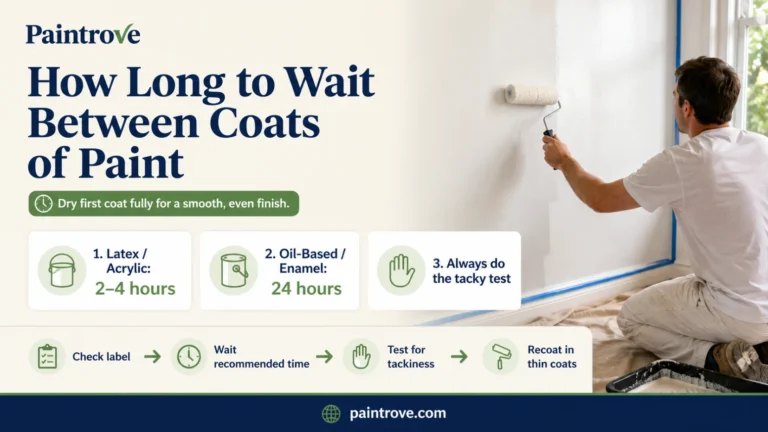
Let the first coat dry for the full time listed on the paint label — typically 2–4 hours for epoxy tile paint — before applying the second coat. Check the manufacturer’s dry time and do not rush it. Applying a second coat over a tacky first coat causes the whole system to lift.
For two-part epoxy: mix exactly according to the manufacturer’s ratio. Use the full mixture within the pot life — do not try to save mixed epoxy. Have all tools ready before mixing.
Painting grout: Paint flows into and covers the grout lines along with the tile surface. This is intentional — painted tile looks best when everything is uniform. If you want to highlight grout lines after painting, use a grout pen in a contrasting color once the topcoat is fully cured.
Step 4 — Seal and Protect
For epoxy paint: two-part epoxy cures to its own hard, sealed finish and may not need an additional topcoat. Check the product label.
For oil-based enamel, chalk paint, or single-part epoxy in wet areas: apply a waterproof topcoat sealer over the cured paint. Polycrylic or polyurethane in a satin or semi-gloss sheen adds moisture resistance and protects the paint film from cleaning product abrasion.
For floor tile: add a non-slip additive to the final sealer coat. Painted tile floors can be slippery — a silica or fine-grit anti-slip powder mixed into the topcoat provides traction without affecting appearance.
Allow the full cure time before using the space — typically 24–72 hours for epoxy. Do not expose newly painted tile to water, steam, or cleaning products until fully cured.
Can You Paint Tile in a Bathroom?
Yes — bathroom tile can be painted, and it is one of the most common applications for this technique. The results vary based on which part of the bathroom the tile is in.
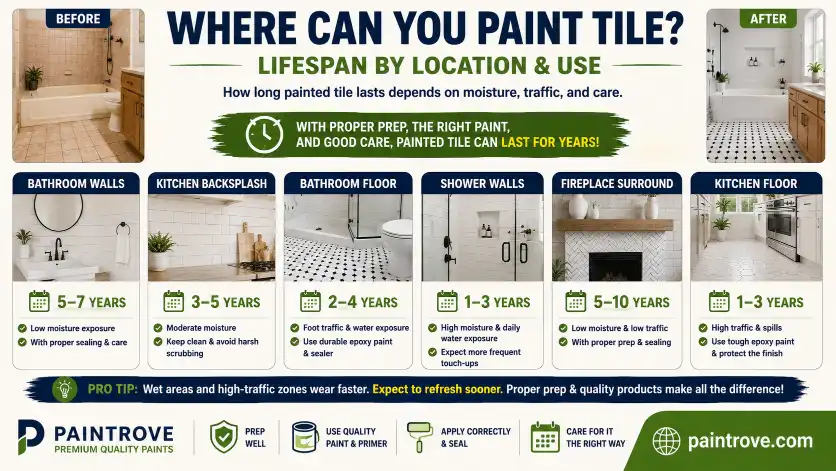
Bathroom walls (away from the shower): Good candidate. Low moisture exposure, minimal physical contact. Epoxy paint or oil-based enamel over bonding primer lasts 5–7 years in these locations.
Bathroom backsplash: Good candidate. Light water exposure from hand washing. Two-part epoxy or single-part epoxy both work well. Expect 3–5 years before the finish needs refreshing.
Bathroom floor: Moderate candidate. Floor tile takes significant foot traffic and physical abrasion — harder on paint than wall surfaces. Use two-part epoxy and add a non-slip topcoat. Expect 2–4 years before the finish wears noticeably. The grout lines in floor tile are especially vulnerable — they take direct foot contact and tend to wear first.
Bathroom floor tile around the toilet and vanity: Better candidate than the shower area. These zones see less water and can hold a painted finish longer.
Can You Paint Tile in a Shower?
Yes, you can paint shower tile — but it is the hardest application and the shortest-lasting result. Shower surfaces face daily water exposure, steam, temperature swings, and cleaning product contact. No paint holds up to this environment as well as factory-glazed tile.
That said, if you use two-part epoxy paint, prepare the surface correctly, and have realistic expectations, a painted shower can last 1 to 3 years before needing to be redone. Some properly done shower paint jobs last longer — the key variables are how often the shower is used, how aggressively it is cleaned, and how thoroughly the tile was prepped.
For shower tile painting:
- Only use two-part epoxy — no other paint type is durable enough
- Prep is everything: clean with bleach, sand all shine off, prime with bonding primer
- Ensure good ventilation — epoxy fumes in an enclosed shower are intense
- Do not use the shower for at least 72 hours after the final coat
- Accept that this is a temporary fix, not a permanent solution
The shower floor is the most vulnerable area — foot traffic plus constant water makes it the first place the finish fails. Painted shower floors typically need refinishing more frequently than painted shower walls.
Can You Paint Tile in a Kitchen?
Yes — kitchen tile is one of the better applications for tile painting. The most common target is the kitchen backsplash, which typically sees light water splashes, grease, and occasional heat near the stove.
Kitchen backsplash: Good candidate for painting. Clean thoroughly with TSP to remove all grease before sanding and priming. Epoxy paint or oil enamel over bonding primer both work well. Avoid painting tiles directly behind and above the stovetop — that area faces direct heat that degrades paint faster than any other kitchen location.
Kitchen floor tile: Moderate candidate. Higher foot traffic than bathroom floors in most homes. Use two-part epoxy and non-slip sealer. Expect 1–3 years of wear before the finish needs attention in high-traffic zones.
Tile countertops: Technically possible but not recommended for active kitchen use. Countertops face cutting, impact, heat from pots and pans, and daily cleaning — painted surfaces cannot match glazed tile for durability in this application. If you choose to paint tile countertops, use two-part epoxy and a hard polyurethane topcoat, and avoid placing hot items directly on the surface.
Can You Paint a Tile Fireplace?
A fireplace surround is one of the best surfaces to paint tile on. The tile receives minimal moisture, no foot traffic, and only moderate heat (on the surround itself, away from the firebox). The result holds well and can be genuinely transformative — painting dated brass or terracotta fireplace tile white or charcoal gives an immediate, high-impact update.
Use oil-based enamel or chalk paint with a hard wax topcoat for the surround. For tiles immediately adjacent to the firebox opening, use a heat-resistant paint — standard epoxy or enamel cannot handle direct heat exposure. Most heat-resistant tile paint is rated to 1,200°F and is available in black, silver, or aluminum colors from Rust-Oleum and similar brands.
Can You Paint Tile Grout?
Yes — grout can be painted with grout paint or grout colorant. This is separate from painting the tile itself and is sometimes done alone when grout has discolored but the tile is in good condition.
Grout paint is a thin, penetrating colorant specifically formulated for cement-based grout. It soaks into the grout surface and permanently changes its color. Rust-Oleum and Behr both make grout paint in a range of colors, including white, gray, and dark neutrals.
When you paint the tile: The paint will cover the grout lines along with the tile. Once the topcoat is cured, you can use a grout pen to add definition or a contrasting color back to the grout lines if preferred.
Grout paint vs. grout replacement: For heavily stained or crumbling grout, replacement is the better long-term solution. Paint and colorant can refresh the appearance but do not restore the structural integrity of failing grout.
Can You Paint Tile Floors?
Floor tile can be painted — it is one of the more challenging applications due to foot traffic and physical wear, but it is doable with the right products and expectations.
The must-haves for painted floor tile:
- Two-part epoxy paint — nothing else is durable enough for floor use
- Non-slip additive in the final sealer coat — painted tile floors are significantly more slippery than unfinished tile
- Full 72-hour cure before walking on the surface
- Furniture pads on all chair and table legs — bare furniture feet will scratch through the paint film quickly
Realistic lifespan: Painted floor tile in a low-traffic area (a guest bathroom, a laundry room) lasts 3 to 5 years with proper prep and two-part epoxy. High-traffic floors — kitchen, main bathroom, entryway — see significantly faster wear and may need refinishing after 1 to 3 years.
Can You Paint Tile a Different Color?
Yes. Tile paint comes in a wide range of colors — and painting tile a different color is the most common motivation for this project. White is the most popular choice (covering dated terracotta, pink, or avocado green tile), followed by gray and charcoal.
One limitation: two-part epoxy tile kits typically come in a narrower color range than standard paint — mostly whites, off-whites, and light neutrals. If you need a specific color, choose an oil-based enamel system with a bonding primer, which gives you access to the full Sherwin-Williams or Benjamin Moore color range.
Painting tile white: Works well on any tile type. One coat of two-part epoxy white is often enough for coverage. Two coats give a harder, more durable finish.
Painting tile black or very dark: Dark paint on tile is striking. Use the same epoxy or enamel system. Dark colors show water spots and mineral deposits more clearly than lighter colors — factor this in for bathroom and kitchen applications.
Painting Tile vs. Replacing Tile: Which Makes More Sense?
| Factor | Paint Tile | Replace Tile |
|---|---|---|
| Cost | $50–$200 DIY | $800–$3,000+ |
| Time | 1–2 days | 1–2 weeks |
| Durability | 1–7 years (location dependent) | 20+ years |
| Mess | Minimal | Significant demolition |
| Result quality | Good (with proper prep) | Best |
| Long-term value | Temporary solution | Permanent improvement |
Paint tile when: You want a fast, affordable update, you are in a rental, you are preparing a home to sell, you cannot afford full replacement right now, or the tile is in good structural condition but dated in color or style.
Replace tile when: The grout is crumbling, tiles are cracked or broken, there is water damage or mold behind the tiles, you want a permanent solution, or you are doing a full bathroom or kitchen renovation.
How Long Does Painted Tile Last?
| Location | Painted Tile Lifespan |
|---|---|
| Bathroom wall (low moisture) | 5–7 years |
| Backsplash (kitchen/bath) | 3–5 years |
| Bathroom floor | 2–4 years |
| Shower walls | 1–3 years |
| Shower floor | 1–2 years |
| Fireplace surround | 5–10 years |
| Kitchen floor | 1–3 years |
These ranges assume correct prep, appropriate paint type, and proper sealing. A painted tile surface in a guest bathroom that sees infrequent use can exceed these estimates significantly. A heavily used main bathroom floor will fall toward the lower end.
FAQs
Should you sand tile before painting?
Yes. Sanding removes the glaze and creates microscopic texture for the primer and paint to grip. Use 120-grit sandpaper and sand until the shine is completely gone. Without sanding, even the best bonding primer will eventually fail on a glazed tile surface.
Do you need to prime tile before painting?
Yes. A dedicated bonding primer — KILZ Adhesion, Zinsser Bulls Eye 1-2-3, or equivalent — is mandatory on tile. Standard paint primer is not enough. Bonding primers contain adhesion-promoting resins specifically designed for smooth, non-porous surfaces.
Can you paint tile with regular wall paint?
No. Standard latex wall paint does not adhere adequately to tile and will peel, especially in humid environments. Use epoxy paint, oil-based enamel over bonding primer, or a dedicated tile paint product.
Can you paint tile with chalk paint?
Yes, on dry, decorative tile surfaces like a fireplace surround or a backsplash away from water. Chalk paint must be sealed with a hard wax or polyurethane topcoat to hold up on tile. It is not suitable for shower tile, bathroom floors, or kitchen floors.
Can you paint tile with spray paint?
Yes — for smaller projects like a backsplash or a fireplace surround, spray enamel gives a smooth, even finish with no brush or roller marks. Use a spray enamel formulated for tile or multi-surface use (Rust-Oleum Universal works on tile). Mask everything in the surrounding area thoroughly before spraying.
Can you paint tile with epoxy?
Yes — two-part epoxy is the best paint for high-moisture tile surfaces. Mix the two parts per the manufacturer’s ratio, apply quickly within the pot life, and allow the full cure time before exposing the surface to water.
Can you paint over tile paint?
Yes — if the existing painted tile finish is sound (not peeling or flaking), you can apply another coat of compatible tile paint over it. Sand lightly with 220-grit, clean, and apply the new topcoat. If the existing paint is failing, scrape or sand it back to a sound surface before repainting.
Can you paint tile grout?
Yes — with a dedicated grout paint or grout colorant. These penetrate cement-based grout and permanently change its color. For tile painting projects, the paint typically covers the grout lines automatically.
The Bottom Line
You can paint tile — and done correctly, it is one of the most cost-effective ways to update a bathroom, kitchen, laundry room, or fireplace surround without demolition. The results are not permanent, but for a fraction of the cost of new tile, a properly painted surface looks clean, fresh, and updated for several years.
The formula for success is consistent: clean thoroughly, sand off the glaze, use a dedicated bonding primer, apply two-part epoxy in wet zones or oil-based enamel in dry areas, and seal with a protective topcoat. Every step skipped shortens the lifespan of the finish proportionally.
Paint tile when you want a fast, affordable update. Replace tile when you want a permanent result.
Related Articles:
- How to Paint a Room: 7 Proven Steps to a Perfect Finish
- How Long Does Paint Take to Dry? Every Surface, Every Paint Type
- Can You Paint Over Wallpaper? Pros, Cons & Step-by-Step Guide
- Best Primers for Every Surface: Oil-Based vs. Water-Based
- How to Fix Chipped Paint on a Wall: A Complete Repair Guide