How Long Does Paint Take to Dry and Cure? Complete Guide
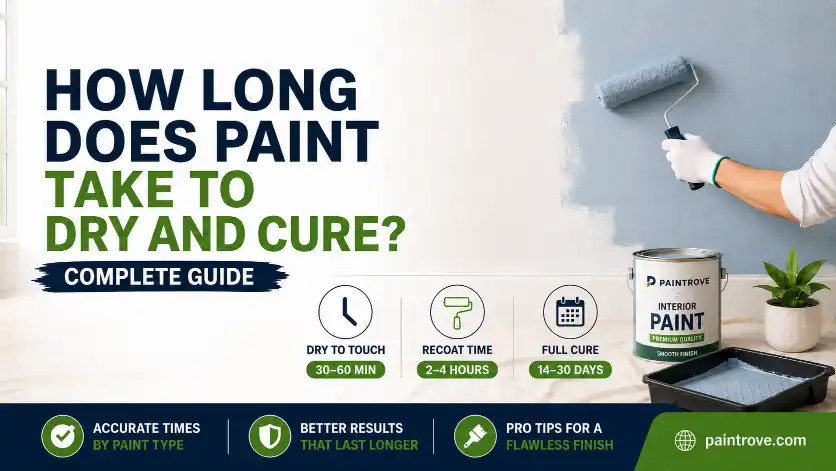
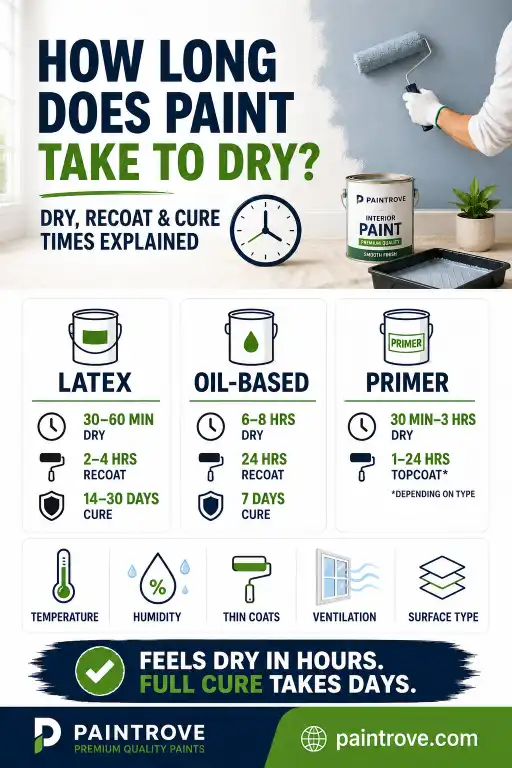
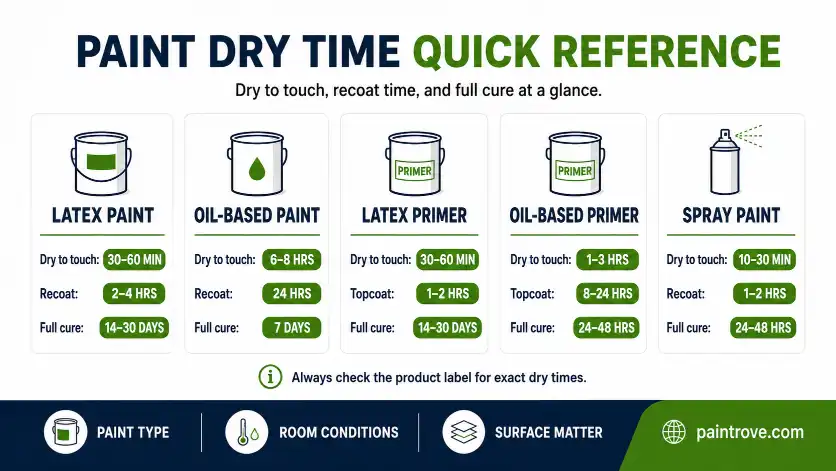
How long does paint take to dry depends on the type of paint, the surface, and the conditions in the room. Latex (water-based) paint is dry to the touch in 30 to 60 minutes and ready for a second coat in 2 to 4 hours. Oil-based paint takes 6 to 8 hours to dry to the touch and 24 hours before recoating. Full cure, the point at which paint reaches maximum hardness, takes 14 to 30 days for latex and 7 days for oil-based paint.
Understanding the difference between dry time, re-coat time, and cure time is the key to a paint job that looks professional and lasts.
Paint Dry and Paint Cure: Two Totally Different Things
Most people treat “dry” and “cured” as the same thing. They are not — and confusing them is one of the most common reasons paint jobs fail, peel, or scratch early.
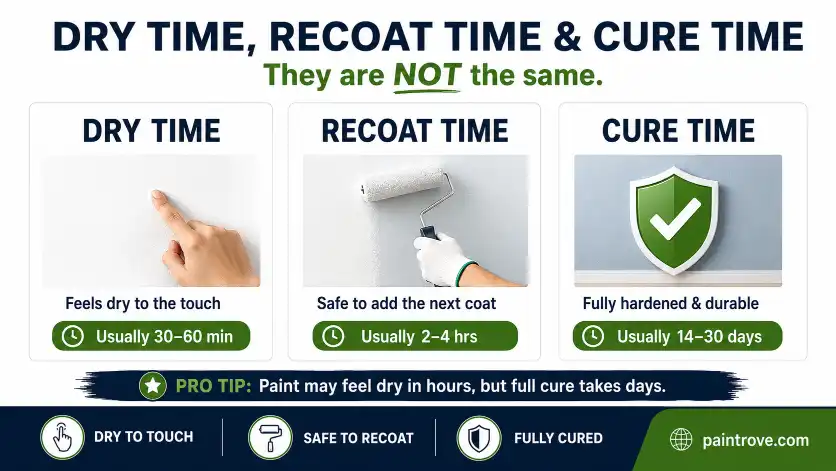
Dry time is when the solvent has evaporated from the surface layer and the paint no longer feels wet to the touch. The wall looks dry. It is not fully dry.
Re-coat time is when enough of the paint film has set to safely accept another coat without lifting, wrinkling, or trapping moisture underneath.
Cure time is when the paint has completely hardened through a chemical cross-linking process and reached its full strength, scratch resistance, and washability. This is the stage that matters for durability.
Here is the practical lesson: paint that feels dry after an hour can still be damaged by furniture, cleaning, or a second coat applied too soon. Rushing any of these three stages is how you end up peeling finishes, roller marks that won’t blend, and walls that scuff the first time something touches them.
A note on patience: Paint dry and paint cure are two totally different things — and a lesson in patience is built into every paint project. The wall may look finished. The chemistry has not finished yet.
How Long Does Paint Take to Dry? Quick Reference Chart
| Paint Type | Dry to Touch | Re-Coat Time | Full Cure |
|---|---|---|---|
| Latex / water-based (flat/matte) | 30–60 min | 2–4 hours | 14–30 days |
| Latex / water-based (eggshell/satin) | 1 hour | 4 hours | 14–30 days |
| Latex / water-based (semi-gloss/gloss) | 1–2 hours | 4–6 hours | 14–30 days |
| Oil-based paint | 6–8 hours | 24 hours | 7 days |
| Latex primer | 30–60 min | 1–2 hours | N/A |
| Oil-based primer | 1–3 hours | 8–24 hours | N/A |
| Acrylic paint | 30–60 min | 2–4 hours | 14–30 days |
| Chalk paint | 1 hour | 2–4 hours | 30 days |
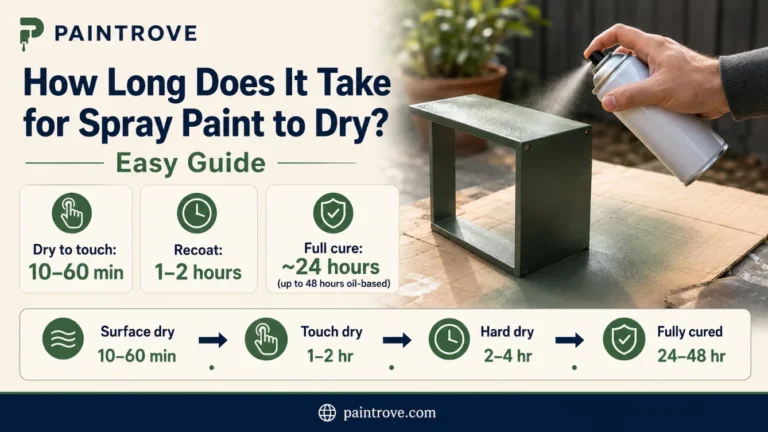
| Spray paint (general) | 10–30 min | 1–2 hours | 24–48 hours |
These are general benchmarks. Always check the label on your specific product — Benjamin Moore, Sherwin-Williams, Behr, Valspar, and Rust-Oleum each publish dry and re-coat times specific to their formulations, which may differ from these general ranges.
What Is the Difference Between Latex and Oil-Based Paint Dry Times?
Latex (water-based) paint dries faster than oil-based paint because its primary carrier is water, which evaporates relatively quickly at room temperature. Oil-based paint uses mineral spirits or other petroleum-based solvents as its carrier — these solvents evaporate far more slowly, which is why oil-based paint requires 24 hours between coats.
Latex paint dry time: Dry to touch in 30–60 minutes; re-coat in 2–4 hours; fully cured in 14–30 days.
Oil-based paint dry time: Dry to touch in 6–8 hours; re-coat in 24 hours; fully cured in 7 days.
There is an important counterintuitive point here: oil-based paint actually cures faster than latex. It reaches full hardness in about 7 days compared to 14–30 days for latex. However, it takes far longer to dry between coats, which is why latex paint has become the dominant choice for interior walls.
What Happens If You Apply a Second Coat of Paint Too Soon?
Applying a second coat too soon is the single most common DIY painting mistake. When you paint over a coat that has not dried sufficiently, you trap moisture in the first coat. This causes the paint film to wrinkle, bubble, or peel. You may also see roller marks, streaking, and color that looks patchy and uneven — all caused by the wet first coat being disturbed by the second.
Glossy or semi-gloss finishes are particularly unforgiving if re-coated too early because their sheen level amplifies every surface imperfection.
The rule: Always wait for the full re-coat time listed on your paint can. If you are working in high humidity or below 60°F, add at least 50% more time to the recommended wait.
What Factors Affect Paint Dry Time?
Paint dry time is not fixed. Every project is slightly different because the drying process is driven by evaporation — and evaporation is controlled by the environment around the wet paint film.
Temperature
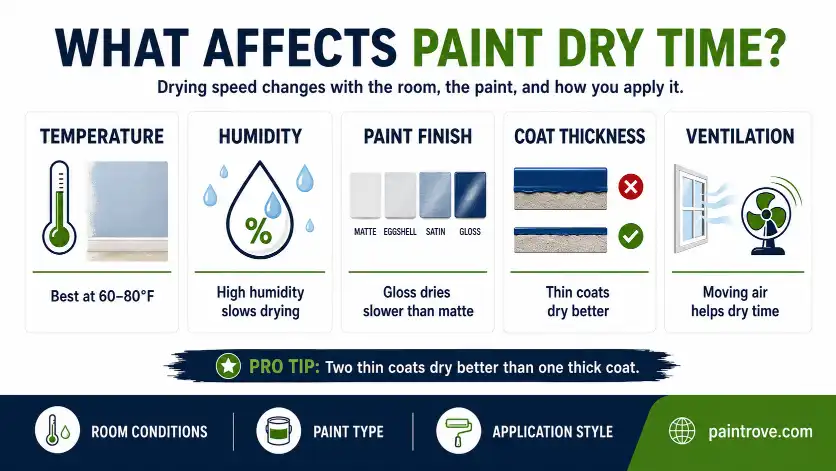
Temperature has the most direct effect on paint dry time. The ideal painting temperature is between 60°F and 80°F (15°C to 27°C). Most paint manufacturers recommend a minimum temperature of 50°F (10°C) for application.
- In 50°F weather: Dry time increases dramatically. Latex paint that normally dries in 1 hour can take 3–4 hours to become touch-dry. Below 50°F, latex paint may not cure properly at all.
- In 60°F weather: Dry time is approximately 50–75% longer than ideal conditions.
- In 70°F weather: Near-ideal. Most label dry times are tested at this temperature.
- In 80°F weather: Fast drying, but very hot days (above 90°F) can cause paint to dry too fast — brush marks become permanent and the surface can crack or blister.
For exterior painting, surface temperature matters as much as air temperature. Wood siding sitting in direct afternoon sun can be 15–20°F hotter than the air temperature around it, causing paint to flash-dry unevenly.
Humidity
Humidity is the factor most DIYers underestimate. The more moisture already in the air, the slower water evaporates from latex paint. Painting in humidity above 70% significantly extends dry time and increases the risk of sheen problems, color variation, and poor adhesion.
Ideal painting humidity is 50% or below. Run a dehumidifier in the room before and during painting if you are working in a humid climate or damp season. Never paint immediately after heavy rain or during a humid stretch of weather — even interior walls are affected by outdoor humidity levels through ventilation.
Paint Finish / Sheen Level
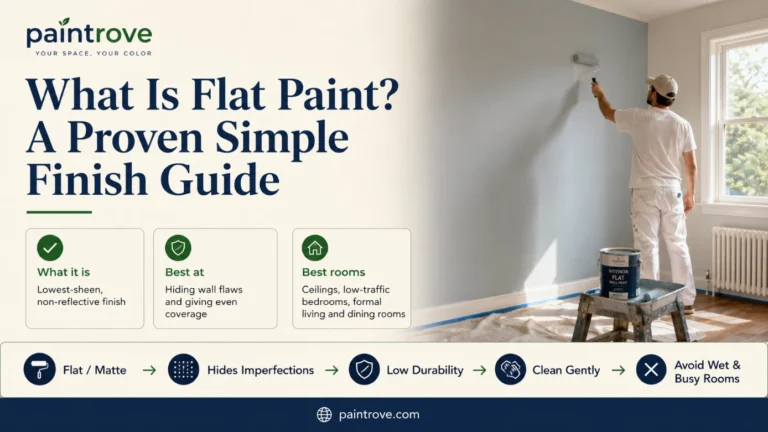
Paint finish directly affects dry time. Lower-sheen paints dry faster; higher-sheen paints dry more slowly. Flat and matte paints have fewer binders and resins, so the film sets quickly. Gloss and semi-gloss paints contain more binding agents that require additional time to harden.
- Flat / matte: Fastest dry time
- Eggshell: Slightly slower
- Satin: Slower than eggshell
- Semi-gloss / gloss: Slowest
Paint Application Thickness
Thick coats of paint trap solvent underneath the surface layer. The top of the film dries while the layers underneath remain wet — creating what is called a “skin.” This skin can wrinkle, sag, or crack as the paint underneath tries to continue drying. Always apply thin, even coats. Two thin coats dry faster and cure harder than one thick coat.
Ventilation
Good air circulation accelerates drying by carrying away evaporated moisture and solvent from the surface. Open windows where possible (not on humid days), run ceiling fans, or set up a box fan to keep air moving across the painted surface. Avoid directing a fan to blow directly onto wet paint — this can cause uneven drying and surface rippling.
Surface Type and Porosity
Porous surfaces like bare drywall and untreated wood absorb paint, which can actually accelerate surface drying. Non-porous surfaces like metal, glass, and plastic retain solvent longer because there is nowhere for it to go — extending dry time significantly. This is why primer is so important on porous surfaces: it seals the substrate and creates a consistent, predictable drying environment for the topcoat.
How Long Does Paint Take to Dry on Walls?
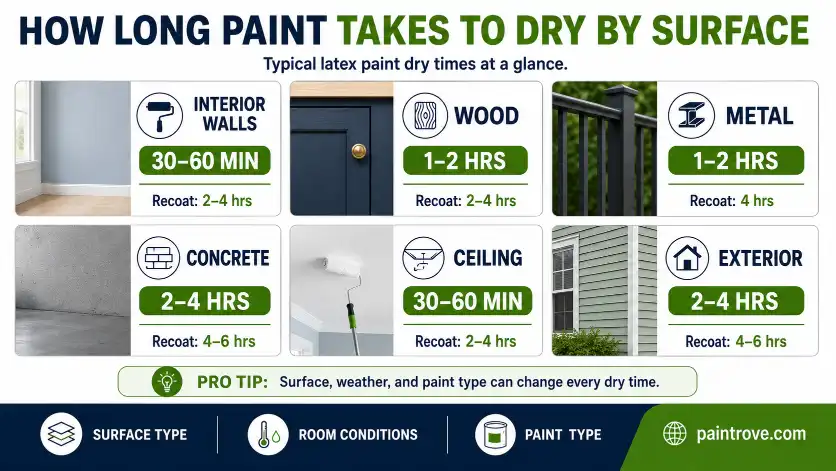
On interior walls (standard drywall), latex paint is dry to the touch in 30 to 60 minutes at ideal temperature (68–72°F) and humidity (below 50%). Re-coat time is 2 to 4 hours. For new plaster — a surface with much higher moisture content — dry time is considerably longer. Fresh plaster must dry completely before painting, which can take 4 to 6 weeks for deep renders. Painting onto wet plaster is a common reason paint peels off in sheets: the moisture vapor migrating out of the plaster breaks the adhesion bond between the wall and the paint film.
Why is my paint peeling off plaster in sheets? Almost always, this is caused by painting onto plaster that had not fully dried. The solution is to strip the affected areas back to bare plaster, allow complete drying, apply a mist coat (heavily diluted latex paint) as a primer, then apply full-strength topcoats.
How Long Does Paint Take to Dry on Wood?
Paint on wood surfaces dries to the touch in 1 to 2 hours for latex paint. Re-coat time is 2 to 4 hours. Because wood is porous, it absorbs paint well — which helps the surface dry relatively quickly. Full cure on painted wood takes 14 to 30 days for latex and approximately 7 days for oil-based paint.
Untreated or bare wood requires a primer coat before painting. Unprimed wood absorbs paint unevenly, creating blotchy color and significantly extending the overall project timeline. Allow primer to dry for 1 to 2 hours before applying your first topcoat.
For furniture or cabinetry where durability matters, do not put the piece back into full use until paint has cured — typically 30 days for latex. Placing objects on a freshly painted wood surface before full cure will leave impressions.
How Long Does Paint Take to Dry on Metal?
Metal is a non-porous surface, so paint cannot absorb into it — instead it must bond to the surface and cure. This makes surface preparation (cleaning and priming) critical for adhesion.
- Spray paint on metal: Dry to touch in 10–30 minutes; fully cured in 24 hours
- Brush-applied latex paint on metal: Dry to touch in 1–2 hours; re-coat in 4 hours; full cure in 14–30 days
- Oil-based paint on metal: Dry to touch in 6–8 hours; re-coat in 24 hours; full cure in 7 days
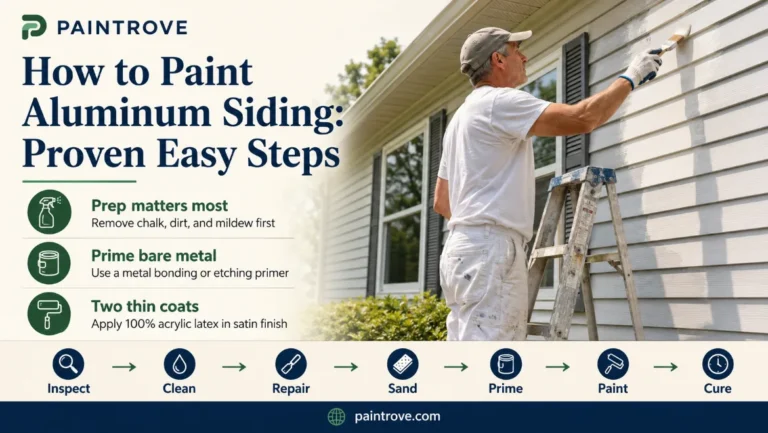
Metal surfaces that are exposed to outdoor conditions should always receive a metal-specific primer before painting. This primer improves adhesion and prevents rust formation beneath the paint film.
How Long Does Paint Take to Dry on Concrete?
Concrete is porous but requires special consideration because it is often damp or alkaline — both of which inhibit paint adhesion and dry time.
- Latex / masonry paint on concrete: Dry to touch in 2 to 4 hours; re-coat in 4 to 6 hours; full cure in 7 days for foot traffic, up to 28 days for full hardness
- Epoxy floor paint on concrete: Dry to touch in 6–8 hours; light foot traffic at 24 hours; full cure at 72 hours to 7 days
- Exterior concrete: Wait at least 24 hours after rain before painting
Concrete must be fully dry before painting — surface moisture causes adhesion failure and bubbling. After heavy rain or power washing, wait 24 to 48 hours minimum before applying paint to exterior concrete.
How Long Does Paint Take to Dry on the Ceiling?
Ceiling paint dries on the same timeline as interior wall paint because it uses the same latex flat formula. Expect dry to touch in 30 to 60 minutes and re-coat time of 2 to 4 hours under ideal conditions.
The ceiling presents one additional challenge: because warm air rises, the area near the ceiling is typically warmer and drier than the rest of the room — which can cause ceiling paint to dry slightly faster and create lap marks if you do not maintain a wet edge while rolling. Work in manageable sections and roll ceiling paint in one continuous session to avoid visible dry lines.
How Long Does Paint Take to Dry Exterior?
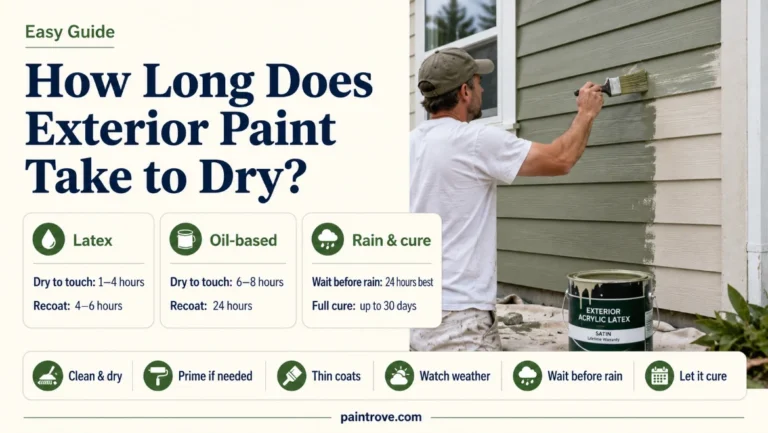
Exterior latex paint dries to touch in 2 to 4 hours and is ready for a second coat in 4 to 6 hours under ideal conditions. Oil-based exterior paint takes 6 to 8 hours to dry and 24 hours before recoating.
Exterior painting is more weather-dependent than interior work. Key rules:
- Do not paint if rain is forecast within 4 hours of application
- Do not paint when temperatures are below 50°F or above 90°F
- Avoid painting in direct afternoon sun on hot days — surface temperature can cause flash drying and uneven adhesion
- After heavy rain, wait at least 24 hours before painting exterior surfaces; wood siding may need 48 hours
For exterior projects, always check both air temperature and surface temperature. A wall in direct afternoon sun can be 20°F hotter than the air, causing paint to dry too fast and crack.
How Long Does Paint Take to Dry in Cold Weather?
Paint takes significantly longer to dry in cold weather, and below certain temperatures it may not cure properly at all.
- 50°F (10°C): The minimum temperature for most latex paints. At 50°F, expect dry times 2–3x longer than label guidance.
- 40°F (4°C): Paint will struggle to dry properly. The film may remain tacky for days.
- Below 35°F (2°C): Most latex paints cannot be applied. The paint may freeze during application or fail to form a continuous film.
During cold snaps, heat the room before and during painting to bring the air and surface temperature above 50°F. For exterior painting, check the forecast for a minimum 24-hour window of temperatures above 50°F.
How Long Does Paint Take to Dry on Different Surfaces? Summary
| Surface | Touch Dry (Latex) | Re-Coat (Latex) | Full Cure |
|---|---|---|---|
| Drywall / interior walls | 30–60 min | 2–4 hours | 14–30 days |
| Fresh plaster | N/A — must dry 4–6 weeks first | N/A | N/A |
| Wood | 1–2 hours | 2–4 hours | 14–30 days |
| Metal | 1–2 hours | 4 hours | 14–30 days |
| Concrete | 2–4 hours | 4–6 hours | 7–28 days |
| Ceiling | 30–60 min | 2–4 hours | 14–30 days |
| Exterior surfaces | 2–4 hours | 4–6 hours | 14–30 days |
| Canvas | 30–60 min | 1–2 hours | 24–72 hours |
| Acrylic on canvas | 30–60 min | 1–2 hours | 24–72 hours |
| Fabric | 2–4 hours | N/A | 24–72 hours |
| Car (automotive) | 1–2 hours | N/A | 30–90 days |
How to Check If Your Paint Is Dry
Do not rely on time alone — always do a physical check before applying the next coat.
Touch test: Lightly press the back of a clean knuckle against the paint in an inconspicuous spot. If it feels even slightly tacky, the paint is not ready. If it feels smooth and firm with no stickiness, it has passed the touch test.
Visual test: Look across the painted surface at a low angle in raking light. Any glossy or wet-looking patches indicate areas where solvent has not yet fully evaporated. Fully dry latex paint will have an even, consistent sheen with no wet-looking spots.
Smell test: Wet paint has a noticeable solvent or latex smell. If the room still smells strongly of paint, the film is still off-gassing — which means it is still drying. A faint smell is acceptable; a strong smell means wait.
How to Check If Your Paint Is Cured
Cured paint is fully hardened and scratch-resistant. To test cure:
Apply firm thumb pressure to the painted surface and twist slightly. If you see any mark, scuff, or transfer of color — the paint is not fully cured. Fully cured paint will show no damage from this test.
Do not clean painted walls with any cleaning products until the paint has cured. Even mild cleaners can damage paint that has not fully hardened. For latex paint, wait a minimum of 30 days before scrubbing. Light dusting with a dry cloth is safe after 2 weeks.
How to Make Paint Dry Faster
You cannot speed up the cure process, but you can optimize conditions to minimize dry time between coats.
Lower the humidity. Run a dehumidifier in the room. Humidity above 70% dramatically slows evaporation. Keeping the room below 50% humidity is the single most effective way to reduce dry time.
Maintain ideal temperature. A room temperature of 70°F (21°C) gives the fastest dry times for latex paint. Cooler rooms dry slower; warmer rooms can dry too fast and cause uneven coverage.
Increase air circulation. Run ceiling fans or place a box fan in the room. Moving air carries evaporated solvent away from the paint surface and speeds up drying. Avoid directing the fan to blow directly on wet paint.
Apply thin coats. Thick layers of paint trap solvent and extend dry time significantly. Apply thinner coats and allow each to dry fully before adding the next.
Can you use a hair dryer? Using a hair dryer on low heat can speed up surface drying slightly on small areas — furniture touch-ups, for example. For full walls, it is impractical and the uneven heat can cause the paint surface to skin over while the layers underneath remain wet.
In direct sunlight (exterior): Direct sunlight speeds up surface evaporation but can cause problems. Avoid painting exterior surfaces in direct afternoon sun during hot weather. The paint can dry so fast it doesn’t level properly, leaving brush marks and an uneven finish.
How Long Should Paint Dry Before Putting Furniture Back?
Wait a minimum of 24 hours before moving furniture back into a painted room. For furniture that will sit directly against walls or make contact with painted surfaces, wait 14 days — the point at which latex paint has hardened enough to resist scuffing.
For full protection before hanging wall art, placing items directly against walls, or cleaning the surface, wait the full 30-day cure period. This is especially important for high-traffic areas, children’s rooms, and kitchens.
Primer Dry Time: How Long Does Primer Take to Dry?
Primer dry times are generally shorter than paint dry times:
- Latex-based primer: Dry to touch in 30 minutes to 1 hour; ready for topcoat in 1 to 2 hours
- Oil-based primer: Dry to touch in 1 to 3 hours; ready for topcoat in 8 to 24 hours
- Stain-blocking shellac primer (Zinsser BIN): Dry to touch in 45 minutes; ready for topcoat in 1 hour
- Bonding primers: Dry to touch in 2 to 4 hours; ready for topcoat in 2 to 4 hours
Always let primer dry completely before applying the first topcoat. Applying paint over tacky primer is a common cause of uneven coverage and lifting.
FAQs
How long does paint take to dry between coats?
Latex paint: wait 2–4 hours between coats. Oil-based paint: wait 24 hours. These are minimum times under ideal conditions (68–72°F, humidity below 50%). In cold or humid conditions, add at least 50% more time.
How long does acrylic paint take to dry on canvas?
Acrylic paint dries to the touch on canvas in 30–60 minutes and is ready for another layer in 1–2 hours. Full cure takes 24–72 hours. Acrylic paint on canvas dries faster than on walls because canvas is absorbent and flexible, allowing moisture to escape quickly.
Does paint dry quicker in heat or cold?
Paint dries faster in warm conditions, up to about 80–85°F. Above that threshold, paint dries too fast — causing brush marks and surface cracking. Cold temperatures slow evaporation significantly. Below 50°F, most latex paints cannot dry or cure properly at all.
What helps paint cure faster?
Nothing speeds up the chemical curing process itself. However, maintaining ideal conditions — 70°F temperature, below 50% humidity, and good air circulation — ensures the cure process begins as quickly as possible. Oil-based paint actually cures faster (7 days) than latex (14–30 days), despite taking longer to dry between coats.
How long does Dulux paint take to dry?
Dulux latex interior paint is typically dry to the touch in 1 hour and ready to re-coat in 2–4 hours — consistent with standard latex paint dry times. Check the specific product label for the exact guidelines, as Dulux’s specialist formulas (bathroom, kitchen, quick-dry) have different specifications.
How long does exterior paint take to dry on fabric or outdoor furniture?
Exterior latex paint on fabric (canvas outdoor furniture) dries to touch in 2–4 hours and reaches full cure in 3–7 days. Use a paint specifically formulated for fabric where possible — standard wall paint on fabric can crack as the material flexes.
How long does paint take to dry on a floor?
Floor paint (latex deck or floor paint) dries to touch in 2–4 hours. Light foot traffic is generally safe at 24 hours. Full cure for floor paint takes 7 days; avoid heavy furniture and rugs for the full 7-day period to prevent impressions in the paint film.
Conclsuion
How long paint takes to dry comes down to three variables: the type of paint, the surface, and the conditions. Latex paint on interior walls is dry to the touch in an hour and ready for a second coat in 2–4 hours — but it will not reach full hardness for 30 days. Oil-based paint takes 24 hours between coats but cures fully in just 7 days.
The most important discipline in any painting project is patience between coats. Apply a second coat of paint too soon and you risk peeling, bubbling, and months of repairs. Get the dry time right and the result holds up for years.