Can You Paint Pressure Treated Wood? Best Steps
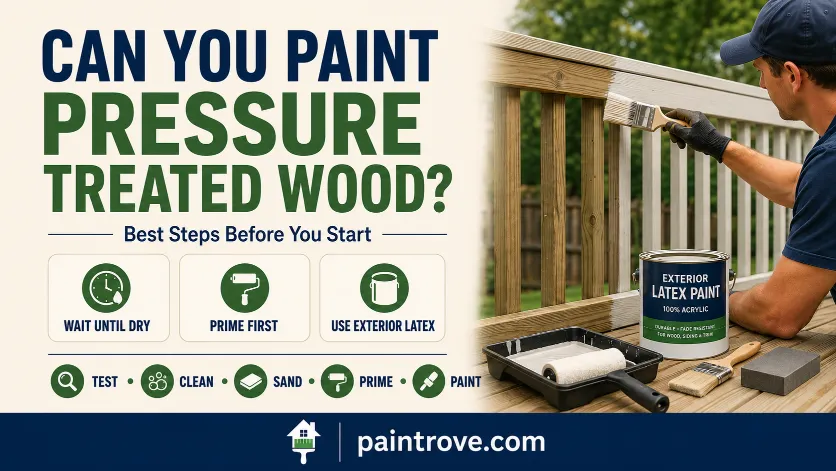
Can You Paint Pressure Treated Wood? Yes, you can paint pressure treated wood — but only if it’s fully dry and properly prepared first. Skip those two steps and the paint will blister, peel, or fail to bond entirely. Get them right and a painted pressure treated deck, fence, or post can hold its finish for years.
This guide covers everything: when the wood is ready, what products to use, how to prep and paint it correctly, and whether stain might be the better choice for your project.
What Is Pressure Treated Wood?
Pressure treated lumber is wood that has been placed inside a large pressurized tank where chemical preservatives are forced deep into the wood fibers. The most common preservative systems used today are Alkaline Copper Quaternary (ACQ) and Micronized Copper Azole (MCA). These chemicals make the wood highly resistant to rot, fungal decay, and insect damage — which is why it’s the standard material for decks, fences, fence posts, pergolas, raised garden beds, and ground-contact applications.
The same process that makes pressure treated wood so durable is also what makes painting it tricky. The chemical treatment saturates the wood with moisture during processing. New pressure treated lumber is often visibly wet and significantly heavier than kiln-dried wood. That moisture needs to fully escape before paint can bond to the surface.
Can You Paint Pressure Treated Wood Right Away?
No. Painting pressure treated wood immediately after purchase is one of the most common and costly mistakes homeowners make. The wood is still saturated with moisture from the treatment process. Applying paint over wet or damp pressure treated lumber results in:
- Paint that won’t fully dry or cure
- Blistering and bubbling as trapped moisture tries to escape
- Peeling within weeks or months
- Warping of the boards as moisture escapes unevenly beneath the paint film
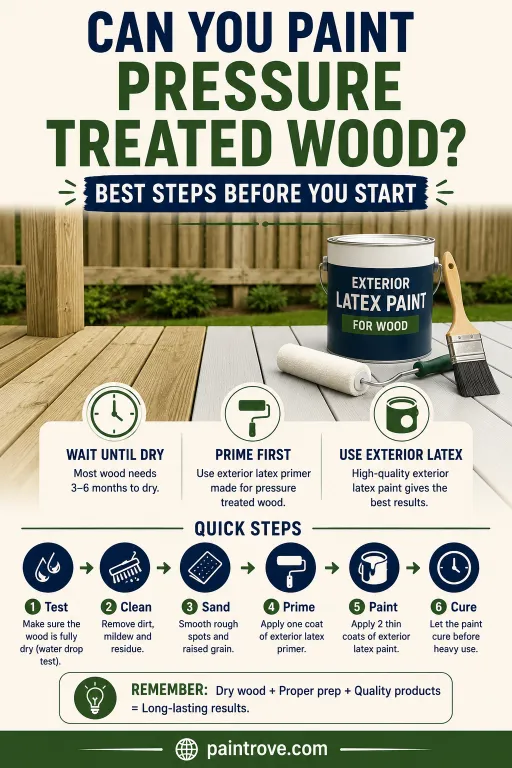
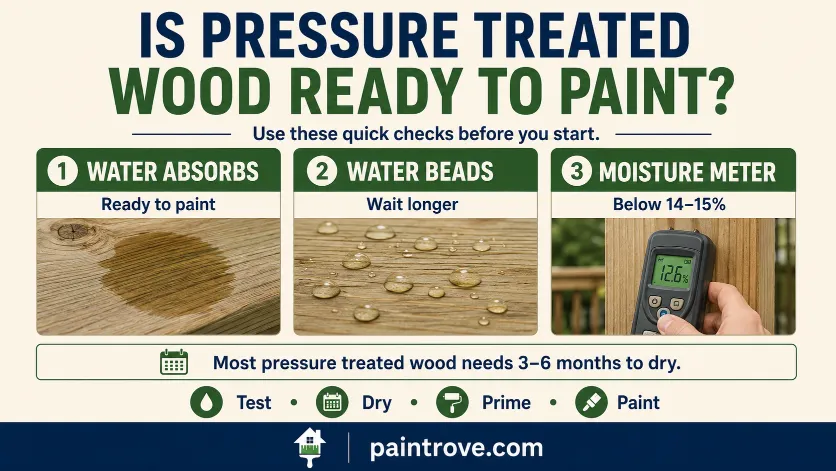
Most standard pressure treated lumber needs 3–6 months to dry sufficiently before painting. The exact timeline depends on the climate, whether the wood is in direct sun or shade, and how it’s stored. Wood in direct sunlight and good airflow dries faster. Lumber stacked flat on the ground with no airflow takes much longer.
The one exception is KDAT lumber — kiln-dried after treatment. If the board is stamped KDAT or ADAT (air-dried after treatment), the moisture has already been removed and you can proceed with priming and painting much sooner. Check the end-tag or ask your supplier.
How to Tell If Pressure Treated Wood Is Dry Enough to Paint
Don’t guess. Use the water drop test:
Sprinkle a few drops of water onto the wood surface. Watch what happens.
- Water absorbs into the wood within a minute or two — the wood is dry enough. You can proceed with preparation and priming.
- Water beads up on the surface — the wood is still too wet. Give it more time.
For a more precise measurement, use a digital wood moisture meter. The moisture content of pressure treated wood must be below 14–15% before painting. Below 19% is the minimum threshold for staining.
What Happens If You Paint Pressure Treated Wood Too Soon?
Painting too early doesn’t just produce a subpar result — it creates a significant amount of rework. Here’s what to expect if moisture content is too high when you apply paint:
The paint forms a surface film but the moisture trapped underneath has nowhere to go. As the wood continues drying, moisture vapor pushes against the paint film from below, causing blistering and bubbling. The paint then cracks and peels, often within the first season. Once this happens, the wood must be stripped back to bare wood, allowed to dry fully, and the entire priming and painting process repeated from scratch.
Waiting the full drying period — or using KDAT lumber — is far more efficient than dealing with paint failure after the fact.
Should You Paint or Stain Pressure Treated Wood?
Both are valid options, and the right choice depends on what you want from the finish.
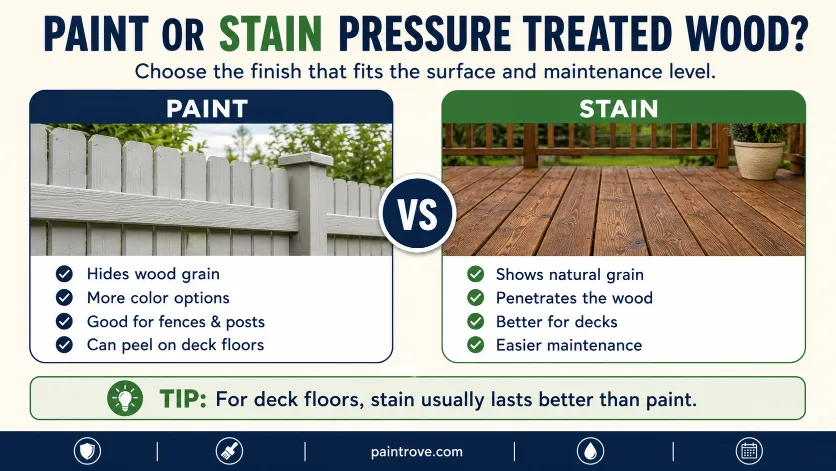
Paint forms a solid opaque film on the surface of the wood. It hides the wood grain and the natural greenish tint of new pressure treated lumber. Paint offers a wider range of color options and creates a robust protective barrier. On vertical surfaces like fences and siding, a quality exterior latex paint can last 3–7 years. The downside is that paint sits on top of the wood rather than penetrating it — making it more prone to peeling on horizontal surfaces like deck floors, where foot traffic, standing water, and wood movement are constant factors.
Stain penetrates into the wood fibers rather than forming a surface film. This means it can’t peel. It preserves the natural grain and texture of the wood, requires less intensive prep between applications, and typically needs refreshing every 2–3 years. Semi-transparent stains in particular work well on pressure treated wood because they allow the wood’s natural character to show through while adding color and UV protection.
The practical guide:
- For deck floors and horizontal surfaces subject to heavy foot traffic: stain outperforms paint for longevity and ease of maintenance.
- For fences, railings, posts, and vertical surfaces: either paint or stain work well; paint gives a cleaner, more opaque look.
- If the wood has visible stains, blemishes, or discoloration you want to hide: paint.
- If you want to preserve wood grain and minimize maintenance: stain.
Primer for Pressure Treated Wood
Primer is not optional when painting pressure treated wood. The chemical preservatives in the wood can interfere with paint adhesion, and the surface often has raised grain and mill glaze that needs to be addressed before topcoating.
Use a high-quality exterior latex (water-based) primer specifically formulated for pressure treated or exterior wood. Latex primer is flexible, allows remaining moisture vapor to pass through without blistering, and bonds well to the treated surface. Kilz Exterior, Zinsser Bulls Eye 1-2-3, and Sherwin-Williams Exterior Latex Primer are all commonly used for this application.
Avoid oil-based primers on pressure treated wood. Oil-based products are less permeable — they trap moisture rather than allowing it to pass through, which increases the risk of adhesion failure and blistering on wood that may still be releasing small amounts of moisture.
Have the primer tinted to a color close to your topcoat. This improves coverage and reduces the number of topcoats needed.
Application: Use a brush to cut in edges, corners, and any narrow or recessed areas first, then use a roller for broad flat surfaces. Allow the primer to dry fully according to the manufacturer’s instructions before applying the topcoat — typically 2–4 hours, or overnight in humid conditions.
How to Paint Pressure Treated Wood: Step-by-Step
Step 1: Confirm the Wood Is Dry
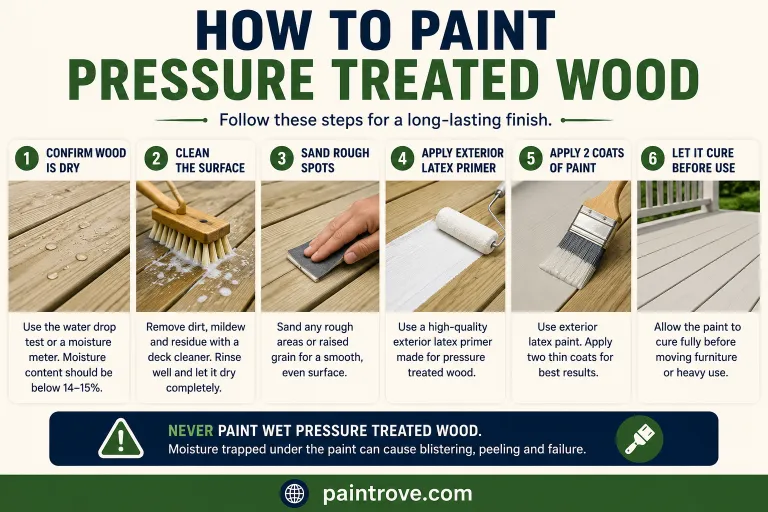
Use the water drop test or a moisture meter to confirm moisture content is below 15% before starting any surface preparation. If the wood fails the test, wait and recheck in a few weeks.
Step 2: Clean the Surface
Even dry pressure treated wood needs to be cleaned before painting. Brush off any loose debris, dirt, or surface contamination with a stiff-bristle brush. For wood that has been outdoors for any length of time, wash with a mild detergent solution and a scrub brush. If there is any mildew or dark staining, treat with a diluted bleach solution (1 part bleach to 3 parts water), scrub thoroughly, and rinse clean.
Do not use a high-pressure power washer on pressure treated wood — the high pressure can damage the wood fibers and the chemical treatment. A low-pressure wash or hand scrubbing is sufficient. After cleaning, allow 1–2 weeks for the wood to dry completely before continuing.
Step 3: Sand Any Rough Spots
Pressure treated lumber often has raised grain and rough patches. Lightly sand any rough areas with 80–100 grit sandpaper. This improves primer adhesion and produces a smoother final finish. Wipe away sanding dust with a tack cloth or damp rag before priming.
You do not need to sand the entire surface — focus on visibly rough, splintered, or fuzzy areas.
Step 4: Apply Primer
Apply a high-quality exterior latex primer across the entire surface. Use a brush for edges and detail areas, and a roller with a 3/8″ to 1/2″ nap for flat surfaces. Work the primer into the wood grain. Apply one full coat and allow to dry completely before topcoating — check the primer’s label for recommended dry time, as this varies by product and conditions.
Step 5: Apply the Topcoat
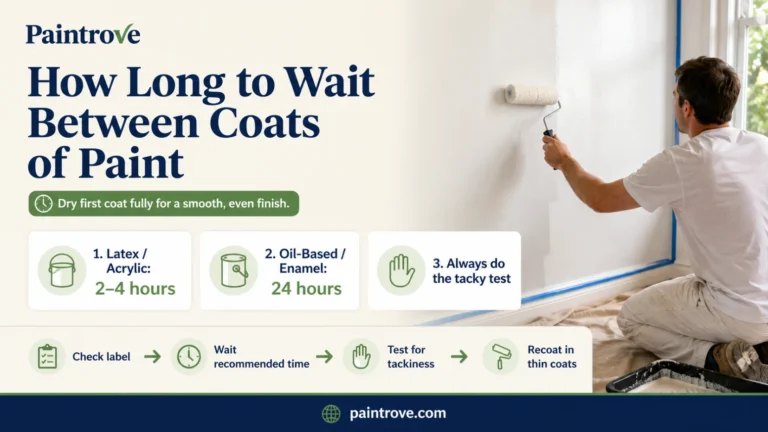
Use a high-quality exterior latex paint. Apply the first coat using a brush or roller, working in the direction of the wood grain. Allow the first coat to dry fully — typically 2–3 hours — before applying the second coat. Two coats over a primed surface is standard for pressure treated wood.
Do not rush between coats. Applying a second coat over an insufficiently dried first coat traps solvent and increases the risk of adhesion problems.
Step 6: Allow Full Cure Before Use
Latex paint is dry to the touch within hours but takes up to 30 days to reach full hardness and cure. Avoid placing furniture or heavy traffic on painted deck surfaces for at least a week, and avoid exposing the freshly painted surface to rain within the first 24–48 hours.
Can You Paint Pressure Treated Wood Without Sanding?
Sanding is not mandatory across the full surface, but it is recommended for rough or splintered areas. Skipping sanding entirely on a new deck with rough boards will result in a textured, uneven finish and slightly weaker primer adhesion. For smooth, planed pressure treated lumber in good condition, a light scuff sand of rough patches is usually sufficient.
Never skip the cleaning step — sanding alone does not remove mildew, oils, or chemical residue that can interfere with primer adhesion.
Can You Paint Pressure Treated Wood Furniture?
Yes. The same principles apply to pressure treated wood furniture as to decks and fences — the wood must be fully dry before painting, and proper priming is essential. For furniture that will be handled frequently, consider a furniture-grade exterior latex paint or a satin/semi-gloss finish, which is more durable and easier to clean than flat or matte paint.
Can You Paint Pressure Treated Wood Deck Boards?
You can, but stain is generally the better long-term choice for deck floors. Deck boards experience constant foot traffic, standing water, UV exposure, and seasonal wood movement — all of which accelerate paint peeling on horizontal surfaces. Semi-solid or solid-color deck stains are specifically formulated for this environment and hold up significantly better than standard exterior paint on deck floors.
If you want to use paint on a deck, use a dedicated deck and floor paint rather than standard exterior wall paint. Products like Behr Premium Solid Color Deck, Patio & Siding Coating or Sherwin-Williams Porch & Floor Enamel are formulated to withstand foot traffic and the specific stresses of horizontal wood surfaces.
Can You Paint Pressure Treated Wood Fences and Posts?
Yes — and fences and fence posts are actually one of the best applications for paint on pressure treated wood. Vertical fence boards don’t accumulate standing water or foot traffic the way decks do, so paint holds up well. Use an exterior latex paint in any sheen from flat to semi-gloss depending on your preference. Apply over a latex primer after confirming the wood is fully dry.
For fence posts set in the ground, painting only the above-ground portion is practical. The below-grade section relies on the pressure treatment itself for rot resistance.
Can You Paint Old Pressure Treated Wood?
Yes — weathered pressure treated wood that has turned gray is actually easier to paint than new lumber because the moisture from treatment has long since evaporated. The main concern with old pressure treated wood is surface condition: clean off dirt, algae, and mildew thoroughly, sand any splintered areas smooth, and apply primer before painting. If the surface has been previously stained or sealed, check whether the old finish is still bonded or needs to be removed before recoating.
Can You Stain Pressure Treated Wood?
Yes, and for many applications stain is the preferred choice over paint. Semi-transparent oil-based exterior stains work well on pressure treated wood, especially when you’re not completely certain of the wood’s moisture content — oil-based semi-transparent stains are more forgiving on slightly damp wood than paint. Solid-color stains behave more like paint and require the same thorough drying before application.
For new pressure treated decks, the water drop test still applies before staining. A good rule of thumb: if the wood passes the water absorption test, it’s ready for either paint or stain.
Does Painting Pressure Treated Wood Extend Its Life?
Paint and stain both add an additional layer of protection against UV degradation and surface moisture — which does extend the useful life of pressure treated lumber. Pressure treated wood is designed to resist rot and insects from the inside out via its chemical preservatives, but the surface is still vulnerable to UV graying, surface cracking (checking), and weathering over time. A quality exterior finish slows that surface deterioration and keeps the wood looking good longer.
FAQs
How long should you wait before painting pressure treated wood?
Standard wet-treated pressure treated lumber needs 3–6 months to dry. KDAT (kiln-dried after treatment) lumber can be painted much sooner — often within a few weeks. Always confirm readiness with the water drop test before proceeding.
What kind of paint can you use on pressure treated wood?
Use a high-quality exterior latex (water-based) paint. Avoid oil-based paint — it doesn’t bond as well with the chemical preservatives in treated wood and is less permeable, which increases the risk of blistering.
Should you prime pressure treated wood before painting?
Yes, always. A latex exterior primer is essential for proper adhesion on pressure treated wood. Skipping primer significantly reduces how long the paint finish will last.
Can you paint pressure treated wood without a primer?
Technically you can apply paint directly, but it will adhere poorly and fail much sooner — especially on new treated lumber where chemical residues are still present on the surface. Primer is strongly recommended.
What happens if you stain treated wood too soon?
The same problems apply as painting too soon — the stain won’t penetrate properly, will sit on the surface, and will peel or flake. The water drop test applies for staining just as it does for painting.
Can you paint pressure treated wood white or black?
Yes — any exterior latex paint color can be used on properly dried and primed pressure treated wood. Darker colors like black absorb more heat, which can accelerate drying between coats and may increase wood movement in extreme climates. This is worth factoring in for deck boards or large flat surfaces in very hot climates.
Can you paint pressure treated wood when it’s wet?
No. Wet pressure treated wood must be allowed to dry below 15% moisture content before any paint or primer is applied. Painting wet wood leads to immediate adhesion failure.
Can you use deck paint on pressure treated wood?
Yes — dedicated deck and floor paints are actually the better choice for horizontal deck surfaces. They’re formulated to withstand foot traffic, standing water, and wood movement better than standard exterior wall paint.