Can You Use Exterior Paint Inside? Read This First
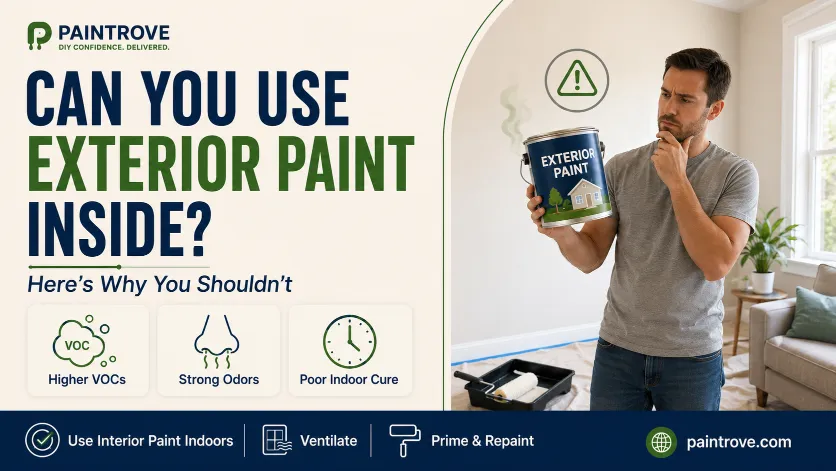
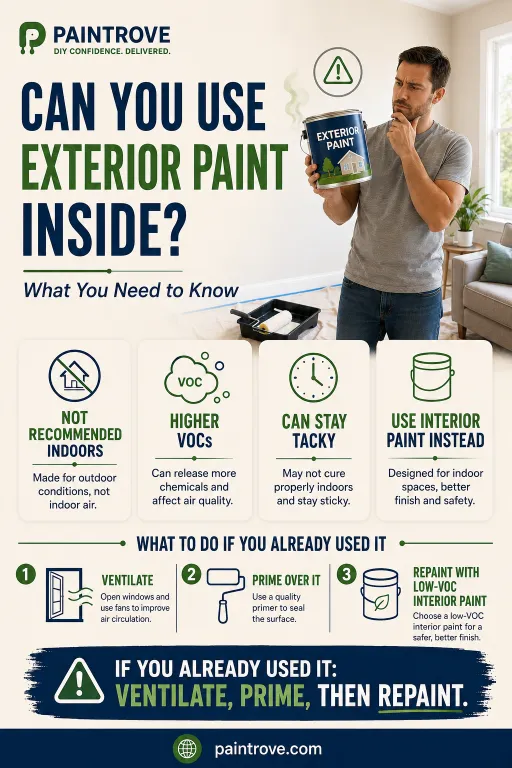
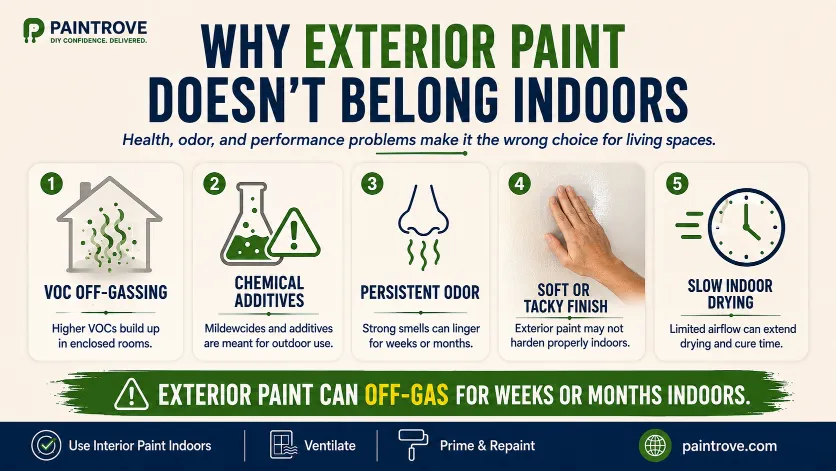
Can You Use Exterior Paint Inside? No, you should not use exterior paint inside your house — and the reason goes beyond just performance. Exterior paint contains higher levels of VOCs and chemical additives that are safe when they off-gas into open air outdoors, but become a genuine health risk in enclosed living spaces.
This guide explains exactly why exterior paint doesn’t belong indoors, what happens if you’ve already used it, and which situations — like garages and sheds — sit in a grey zone.
What Makes Exterior Paint Different from Interior Paint
The label “exterior” or “interior” on a paint can isn’t just marketing — it reflects a fundamentally different chemical formulation designed for a completely different environment.
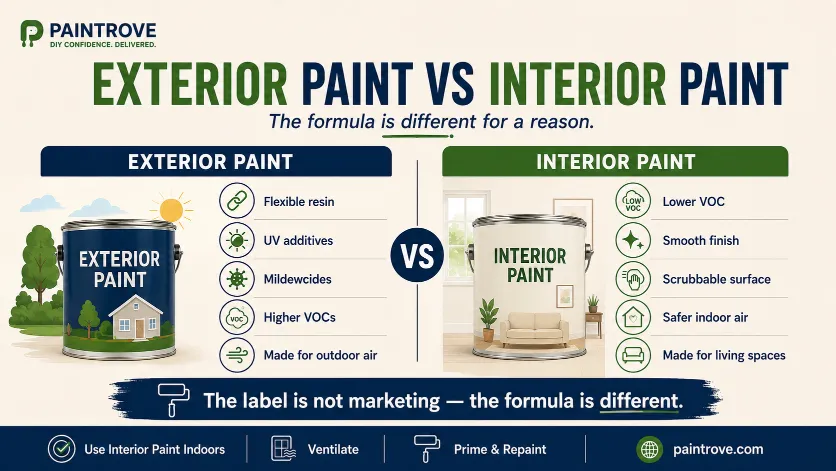
Exterior paint is built to survive the outdoors. It contains flexible resins that allow the dried paint film to expand and contract with temperature swings without cracking. It includes mildewcides to prevent mold and fungal growth in humid conditions, UV-resistant additives to prevent color fading from sunlight, and higher levels of VOCs (volatile organic compounds) that help the paint cure properly in open air. These additives make exterior paint extremely durable on outdoor surfaces — decks, siding, fences, trim — but they create serious problems when used in enclosed spaces.
Interior paint is built for the environment you live in. It uses more rigid resins that create a smooth, scrubbable surface. It has significantly lower VOC levels — with many modern interior paints now offered in low-VOC or zero-VOC formulas — because the people living in the space are breathing the air around it. Interior paint is engineered to be washable, stain-resistant, and fast-drying, and to maintain good indoor air quality throughout its lifespan.
The core difference comes down to the resin and the additives. Exterior paint uses a softer, more flexible resin suited to outdoor temperature extremes. Interior paint uses a harder resin designed for scrubability and low emissions. Those two goals pull in opposite directions — which is why using exterior paint indoors causes both health and performance problems.
Why You Should Not Use Exterior Paint Inside a House
VOCs and Indoor Air Quality
Volatile organic compounds are gases released from certain chemicals in paint as it dries and cures — a process called off-gassing. Outdoors, these gases disperse quickly into the atmosphere and pose minimal risk. Inside a home, they concentrate in the air you’re breathing.
Exterior paint contains significantly higher VOC levels than interior paint because those compounds are part of what makes it weather-resistant and durable outdoors. The EPA has linked elevated indoor VOC exposure to a range of health effects including headaches, dizziness, eye irritation, nose and throat irritation, respiratory problems, and worsened symptoms in people with asthma or chemical sensitivities.
Critically, exterior paint doesn’t finish off-gassing once it looks dry. It can continue releasing VOCs for weeks or even months after application in an enclosed indoor environment — long after the smell has faded.
Harmful Chemical Additives
Beyond VOCs, exterior paint contains mildewcides and fungicides formulated to prevent mold growth on outdoor surfaces. These compounds work well when exposed to open air. Indoors, in a confined space with limited ventilation, they can create persistent strong odors and cause allergic reactions — particularly in people with respiratory sensitivities.
The additives that make exterior paint resilient against UV rays, rain, and temperature fluctuations are simply not designed for the controlled temperature and humidity of an interior living space.
Performance Problems Indoors
Exterior paint also underperforms on interior surfaces in practical terms:
The softer, flexible resin that allows exterior paint to handle outdoor temperature swings means it never fully hardens indoors — where temperatures remain stable. This can leave a tacky, soft finish that picks up dirt, marks, and scuffs more easily than a properly cured interior paint.
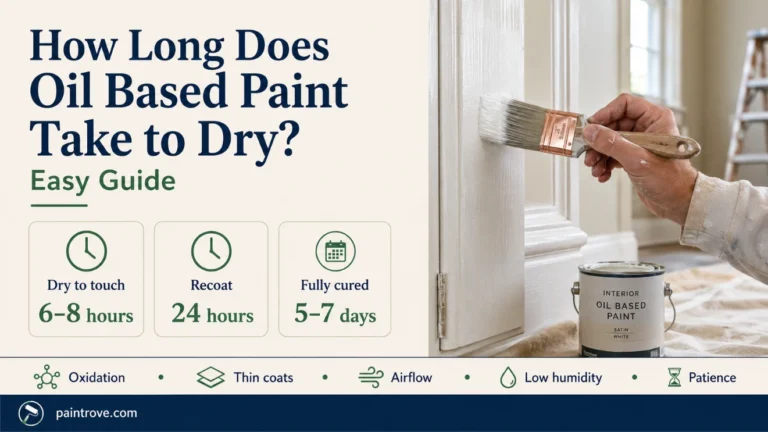
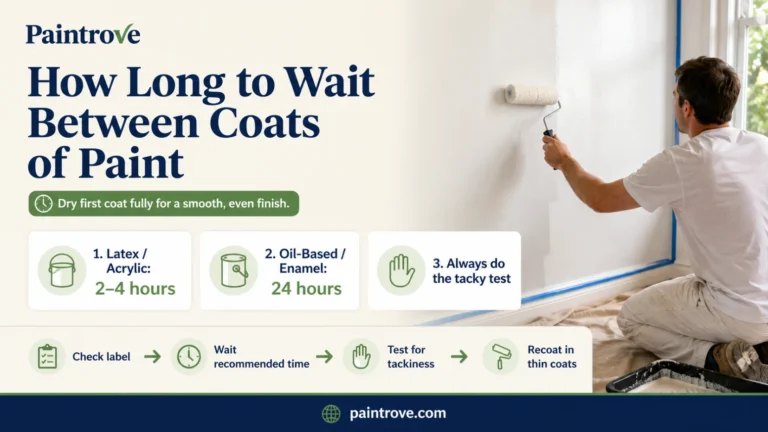
Exterior paint is formulated to cure slowly in outdoor conditions with natural airflow. Indoors, with limited air circulation, dry times extend significantly — a wall that might dry in a few hours outside can stay tacky for much longer inside.
Exterior paint often dries with a slightly rougher texture than interior paint, which is engineered for a smooth, even finish on drywall and plaster.
Can You Use Exterior Paint Inside a Garage?
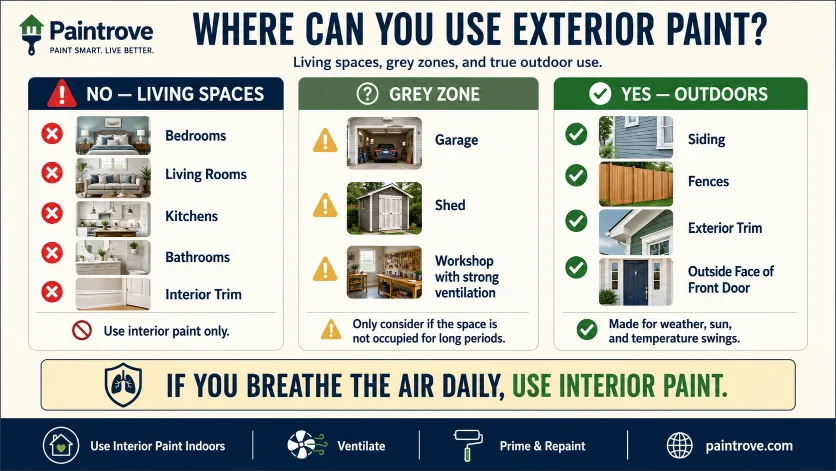
This is the most commonly asked grey-area question, and the answer is: it depends on how the garage is used.
Garages differ from living spaces in two important ways: they’re frequently ventilated (doors open regularly), and people generally don’t spend long periods of time living or sleeping in them. Because of this, some contractors consider exterior paint acceptable for garage walls where ventilation is adequate.
However, interior paint is still the better option even for garages. If you regularly work in your garage — as a workshop, gym, or hobby space — you’re spending significant time breathing the air in that space. The health considerations that make exterior paint inappropriate in a living room apply equally in a garage where you’re present for extended periods.
If you want a durable finish for a garage that can handle moisture and temperature fluctuation, choose an interior paint with a semi-gloss or gloss finish, or use a product specifically formulated for garage floors and walls.
Can You Use Exterior Paint Inside a Bathroom?
No. A bathroom is exactly the kind of enclosed, poorly ventilated space where exterior paint’s VOC off-gassing becomes most problematic. The concentrated fumes have nowhere to go, and the mildewcides in exterior paint can cause persistent odors in a confined space.
For bathrooms, use an interior paint specifically formulated for high-moisture environments. Many paint brands offer bathroom-specific formulas with built-in mildew resistance and moisture protection — these are designed to handle bathroom humidity without the VOC risks of exterior paint.
Semi-gloss and gloss interior finishes are also good choices for bathrooms because their harder surfaces resist moisture better than flat or eggshell finishes.
Can You Use Exterior Paint Inside a Shed?
Sheds sit in similar territory to garages — they’re not living spaces and are frequently ventilated. For an unheated, unoccupied storage shed where you’re not spending extended time, exterior paint’s durability against moisture and temperature swings can actually be an advantage. A shed that gets hot in summer, freezes in winter, and has gaps in ventilation will see conditions closer to an outdoor environment than an indoor one.
If you’re using a shed as a workshop or spending regular time in it, the same logic as the garage applies — opt for a quality interior paint instead.
Can You Use Exterior Paint on Interior Trim?
No — not on trim inside living spaces. Interior trim, baseboards, and door frames inside the home are part of the occupied indoor environment and the same VOC and off-gassing concerns apply. The fact that the trim surface area is smaller doesn’t meaningfully reduce the risk.
There is one legitimate use case worth noting: interior/exterior paints. Several major brands — including Sherwin-Williams, Benjamin Moore, and Behr — produce paints explicitly labeled for both interior and exterior use. These are formulated to balance the durability of exterior paint with lower VOC levels closer to interior paint. For high-wear areas like interior trim, door frames, and baseboards that take daily abuse, interior/exterior paints can offer a longer-lasting finish than standard interior paint. They’re more expensive, but a legitimate option for trim specifically.
Do not confuse interior/exterior paint with standard exterior-only paint. The interior/exterior designation on the label is the key distinction.
Can You Use Exterior Paint on the Inside of Your Front Door?
The inside face of an exterior front door is a borderline case worth thinking through carefully. The door itself is an exterior element, but the inside face is in your home’s interior air environment.
For the outside face of a front door, use exterior paint — it will face UV, rain, and temperature swings.
For the inside face, interior paint is the safer and better-performing choice. The inside face doesn’t face weather exposure, so exterior paint’s additives provide no benefit — and the VOC concerns remain. Use a durable interior paint with a semi-gloss or high-gloss finish for a hard-wearing, easy-to-clean surface on the interior face of your front door.
Can You Use Sherwin-Williams Exterior Paint Inside?
Sherwin-Williams exterior paints — like their A-100, Duration, or Emerald Exterior lines — are exterior-formulated products and should not be used inside living spaces for the same reasons outlined above. They contain the same VOC levels and chemical additives as other exterior paints.
Sherwin-Williams does offer interior/exterior products that are approved for indoor use. If you want a Sherwin-Williams product for a tough interior application, look specifically for their interior/exterior range. Their Emerald Interior paint and SuperPaint Interior are both high-quality, durable options designed for indoor use.
The same applies to Benjamin Moore and Behr exterior lines — the exterior label means it is not formulated for indoor use, regardless of brand.
I Accidentally Used Exterior Paint Inside — What Now?
First: don’t panic. Using exterior paint inside is not an emergency requiring evacuation, but it does need to be addressed.
Immediately:
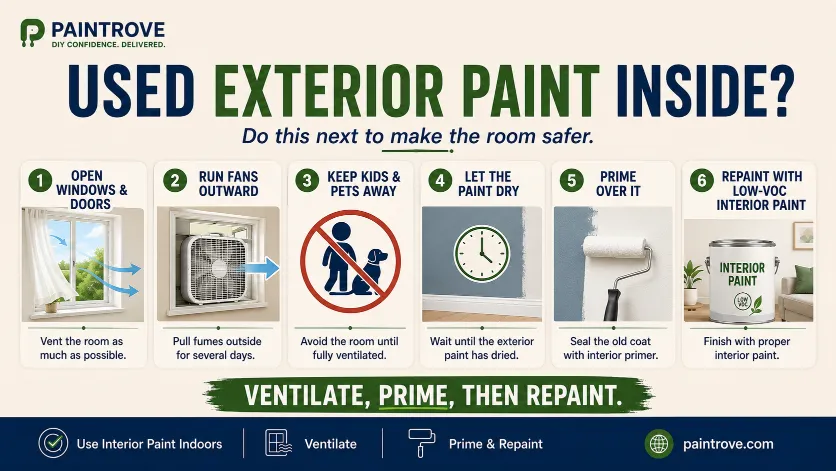
- Open all windows and doors in the affected room to maximize ventilation.
- Run exhaust fans and consider pointing a box fan outward in a window to actively pull fumes outside.
- Keep the room well ventilated for as long as possible — at minimum several days, ideally longer.
- Keep children, pets, and anyone with respiratory sensitivities out of the space until the paint has fully cured and the room has been ventilated thoroughly.
Once the paint has dried: Apply a quality interior primer over the exterior paint. The primer seals in any remaining chemical residue from the exterior paint and provides a proper bonding surface. Then repaint with a low-VOC or zero-VOC interior paint. With the walls primed and repainted with proper interior paint, the risk from the exterior paint is effectively contained.
Do not simply paint interior paint directly over exterior paint without priming first — the different resin systems may not bond reliably without a primer in between.
What to Use Instead of Exterior Paint for Interior Projects
Standard interior latex paint is the right choice for the vast majority of interior walls, ceilings, and surfaces. Modern interior paints from brands like Sherwin-Williams, Benjamin Moore, Behr, and PPG are formulated for durability, washability, and low VOC emissions. They come in every sheen level from flat to high-gloss.
Low-VOC and zero-VOC interior paints are the best option for households with children, pets, or anyone with respiratory sensitivities. Most major brands now offer low-VOC lines as standard. Zero-VOC options produce minimal off-gassing during and after application.
Interior/exterior paints are a legitimate option for high-wear areas like trim, baseboards, door frames, and cabinets where extra durability is genuinely needed indoors. Confirm the label explicitly states “interior/exterior” before using in a living space.
Moisture-resistant interior paints are formulated for bathrooms, laundry rooms, and other high-humidity interior spaces. These include mildew-inhibiting additives specifically designed for safe indoor use — unlike the mildewcides in exterior paint.
Paint vs. Primer: Do You Need Primer for Interior Repainting?
A common point of confusion when switching from exterior to interior paint (or repainting over exterior paint that was applied by mistake): always use primer when the surface condition changes significantly. Primer ensures proper adhesion, seals any chemical residue from the underlying coat, and reduces the number of topcoats needed for full coverage.
Skip primer only when repainting the same interior paint color or a similar shade on a surface in good condition. In any other situation — covering exterior paint, switching from dark to light colors, painting new drywall — primer is the right first step.
FAQs
Can you use exterior paint inside?
Technically you can apply it, but you should not. Exterior paint contains higher VOC levels and chemical additives that are safe outdoors but pose health risks in enclosed indoor spaces. It also underperforms indoors — drying slowly, potentially staying tacky, and producing a rougher finish than interior paint.
What happens if you use exterior paint inside?
The paint will release higher levels of VOCs into your indoor air, which can cause headaches, dizziness, eye, nose, and throat irritation, and respiratory issues. Off-gassing can continue for weeks or months. The finish may also remain soft and tacky indoors rather than curing properly.
Can you use exterior paint inside a garage?
Garages with good ventilation sit in a grey zone — some painters consider it acceptable since garages aren’t living spaces. However, interior paint is still the better choice, especially if you spend significant time working in the garage.
Can you use exterior paint inside a bathroom?
No. Bathrooms are enclosed and poorly ventilated — exactly the conditions where exterior paint’s VOC off-gassing is most harmful. Use an interior paint with built-in moisture resistance instead.
Can you use exterior paint on interior trim?
Standard exterior paint should not be used on interior trim. For high-durability interior trim applications, use an interior/exterior paint — a product explicitly formulated and labeled for both uses, with lower VOC levels than standard exterior paint.
Can you use Sherwin-Williams exterior paint inside?
No. Sherwin-Williams exterior paints are formulated for outdoor use. Sherwin-Williams offers interior/exterior products that are safe for indoor use — look for that specific designation on the label.
I accidentally used exterior paint inside — is it dangerous?
Not an emergency, but it needs to be addressed. Ventilate the room immediately and thoroughly. Once dry, apply an interior primer over the exterior paint, then repaint with a proper interior paint. This seals in any chemical residue and makes the surface safe.
Can exterior paint be used on interior walls if you ventilate well?
Ventilation helps, but it doesn’t eliminate the risk. Exterior paint continues off-gassing for weeks to months even after it looks dry, and no practical level of residential ventilation fully compensates for the higher VOC content of exterior paint in a living space.
What is interior/exterior paint?
Interior/exterior paint is a specific product category formulated to balance the durability of exterior paint with the lower VOC levels required for safe indoor use. It can be used on both interior and exterior surfaces. It is not the same as standard exterior paint — the label must explicitly say “interior/exterior.”