What Color Do Red and Purple Make When Mixed?
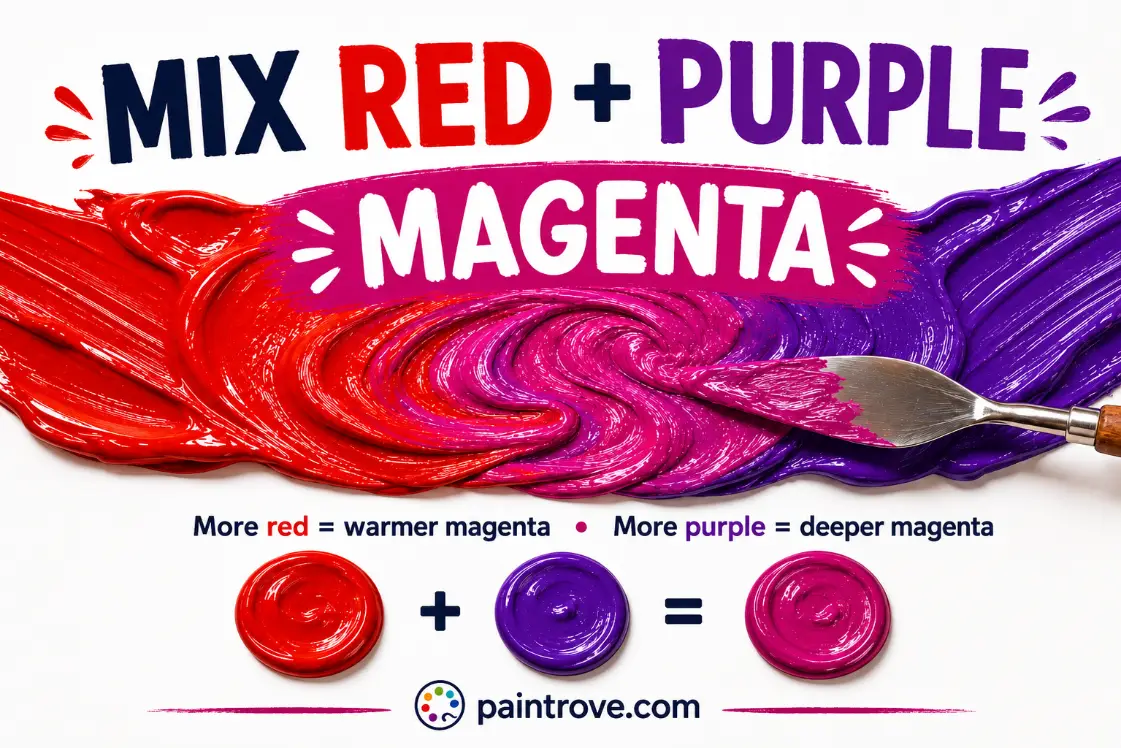
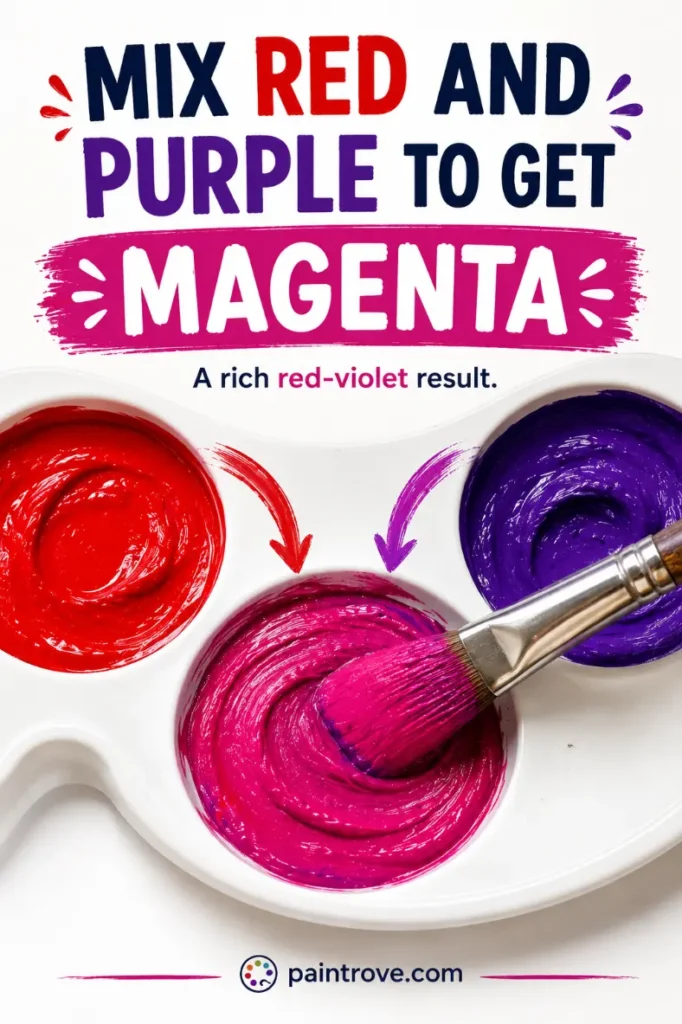
What Color Do Red and Purple Make? Mix red and purple together and you get magenta, also called red-violet. It is a warm, rich reddish-purple that sits at hex #C71585 in its deeper form and around hex #FF00FF at its brightest. Use a darker purple like plum, and the same mix slides toward burgundy and wine tones instead.
So when someone asks what color red and purple make, the one-word answer is magenta. But the honest answer is that red and purple mixed can produce anything from electric fuchsia to a moody merlot, and the difference comes down to which red, which purple, and how much of each.
This guide walks through all of it: the color theory, the exact ratios, the hex codes, the pigments worth buying, and the fixes when your mix goes wrong.
Why Red and Purple Make Magenta
Red and purple are neighbors. Look at the color wheel and you will find purple sitting right next to red, with no gap between their families. Colors that sit side by side like this are called analogous colors, and mixing them is the most forgiving kind of mixing there is. Analogous mixes stay clean and vivid, unlike opposite-side mixes, which cancel each other out into browns and grays.

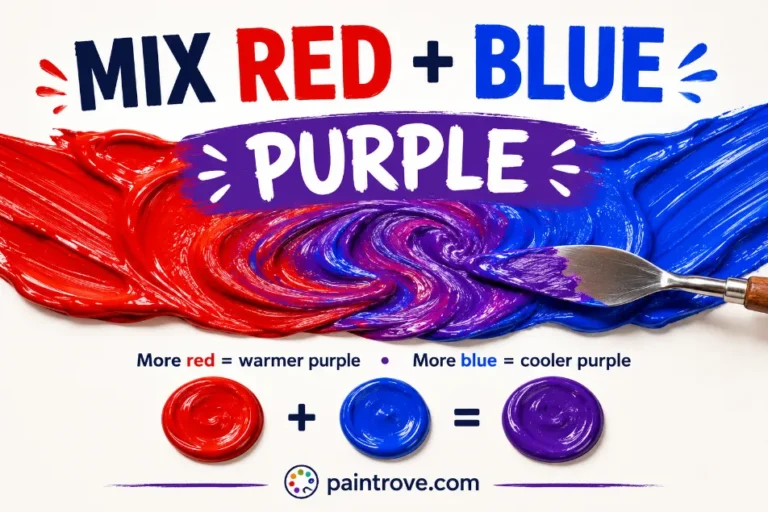
There is also a simple logic hiding inside this mix. Purple is a secondary color, made from red and blue, as we cover in our guide to what red and blue make. So when you add red to purple, you are not introducing anything new. You are just increasing the amount of red that purple already contains. The mix tips away from the balanced red-blue center of purple and toward the red side.
In color theory terms:
- Red is a primary color. It cannot be mixed from anything else.
- Purple is a secondary color, made from two primaries.
- Red mixed with purple gives you a tertiary color: red-purple, better known as red-violet or magenta.
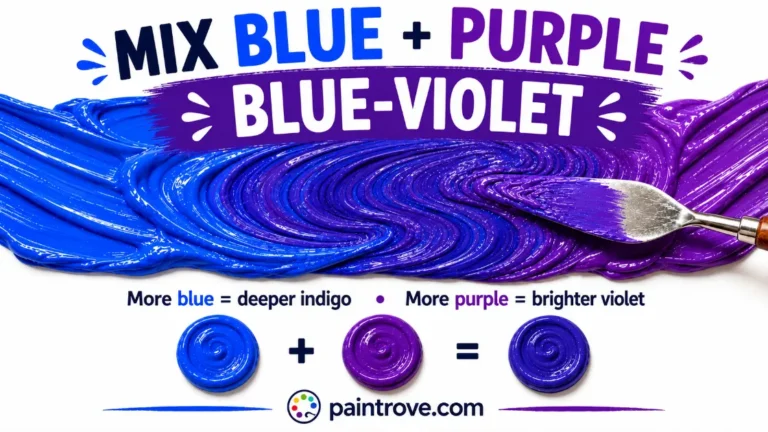
Tertiary colors always come from a primary plus its neighboring secondary. Red-violet is one of six, alongside red-orange, yellow-orange, yellow-green, blue-green, and blue-violet, all covered in our guide to tertiary colors. The blue-side twin of this mix, by the way, is what you get from blue and purple mixed: blue-violet, the cool mirror image of magenta.
Magenta, Red-Violet, Fuchsia, Burgundy: What Is the Difference?
The red-purple family has a lot of names, and they get used loosely. Here is how they actually differ:
| Color | Hex code | Character |
|---|---|---|
| Magenta | Hex #FF00FF | Bright, balanced red-blue, electric |
| Red-violet | Hex #C71585 | Deeper, warmer, more pigment-like magenta |
| Fuchsia | Hex #FF00FF (digital) / brighter in print | Pinker, higher energy, leans hot pink |
| Burgundy | Hex #800020 | Dark, wine-like, red-dominant |
| Maroon | Hex #800000 | Brownish dark red |
| Mulberry | Hex #C54B8C | Muted pinkish red-purple |
| Wine | Hex #722F37 | Deep red with a purple undertone |
A few useful distinctions:
Magenta vs fuchsia. In digital color they often share the same values, but in paint, print, and fashion, fuchsia reads pinker and brighter while magenta reads slightly deeper and more purple. If your red and purple mix comes out looking like hot pink, you have landed on fuchsia. Curiously, you can reach fuchsia from the other direction too, by mixing pink and purple.
Magenta vs violet. Violet is a true spectral color with its own wavelength at the far end of the rainbow. Magenta has no wavelength at all. Your brain constructs it when it sees red and blue signals together. One is physics, the other is perception.
Red-violet vs burgundy. Same family, different depth. Red-violet keeps its brightness. Burgundy is what happens when the mix goes dark, either because you used a dark plum-like purple or added black.
Mixing Red and Purple in Paint: Ratios and Results
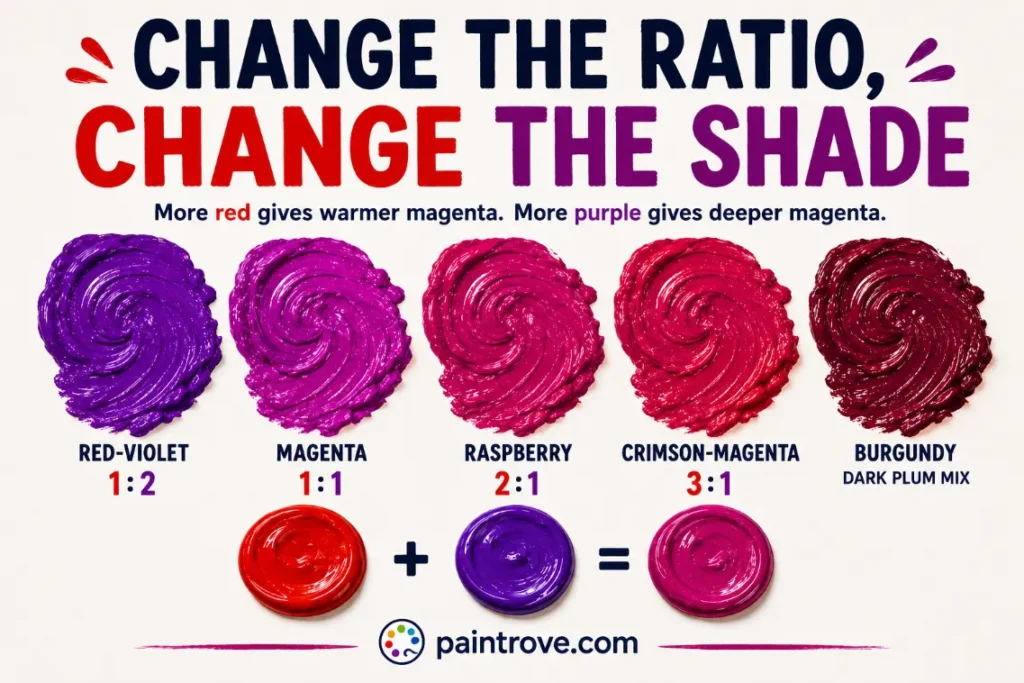
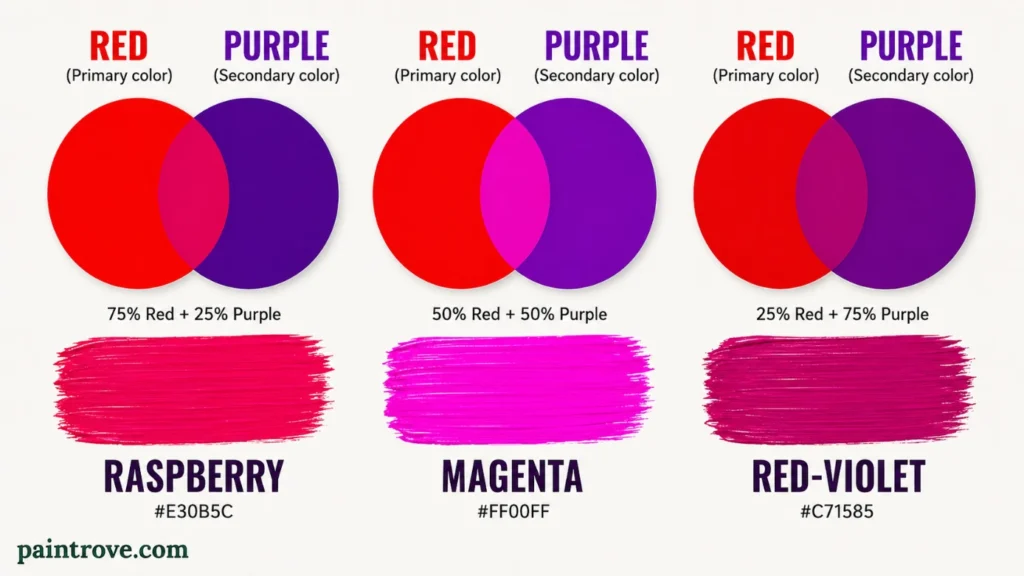
The ratio of red to purple decides where in this family your mix lands. Here is a practical chart with hex code targets:
| Ratio (Red : Purple) | Resulting shade | Hex code |
|---|---|---|
| 1 : 3 | Reddish purple | Hex #953553 leaning purple |
| 1 : 2 | Red-violet | Hex #C71585 |
| 1 : 1 | Magenta | Hex #D02090 |
| 2 : 1 | Raspberry / crimson-magenta | Hex #E30B5C |
| 3 : 1 | Deep warm red with purple undertone | Hex #A4133C |
| 1 : 1 with dark plum purple | Burgundy | Hex #800020 |
| 1 : 1 plus white | Orchid pink | Hex #DA70D6 |
| 1 : 1 plus black | Deep mulberry / wine | Hex #5D1A36 |
Practical mixing steps:
- Start with purple on the palette, since red shifts a mix faster than purple does.
- Add red in small amounts, mixing fully between additions. Half-mixed paint always looks darker than the final blend.
- Judge the color on scrap paper, not on the palette. Surrounding colors trick the eye.
- Adjust: more red for warmth, more purple to pull it back, white to lighten, black to deepen.
Which Red and Which Purple to Use
Just like every red carries a bias, so does every purple, and the pairing decides how clean your magenta comes out:
| Goal | Red to use | Purple to use | Result |
|---|---|---|---|
| Bright, clean magenta | Quinacridone magenta or permanent rose | Dioxazine purple | Vivid, saturated magenta |
| Rich red-violet | Alizarin crimson | Dioxazine purple | Deep, slightly moody red-violet |
| Burgundy / wine | Cadmium red | Dark plum or violet-heavy purple | Warm burgundy |
| Soft mulberry | Permanent rose | Purple lightened with white | Dusty pinkish purple |
Cool, blue-leaning reds like alizarin crimson and quinacridone magenta blend into purple almost seamlessly because they already share DNA with it. Warm reds like cadmium red carry a trace of yellow, and since yellow sits opposite purple on the wheel, that trace mutes the mix slightly. Sometimes that muting is exactly what you want. A cadmium red plus a deep purple is the classic route to burgundy.
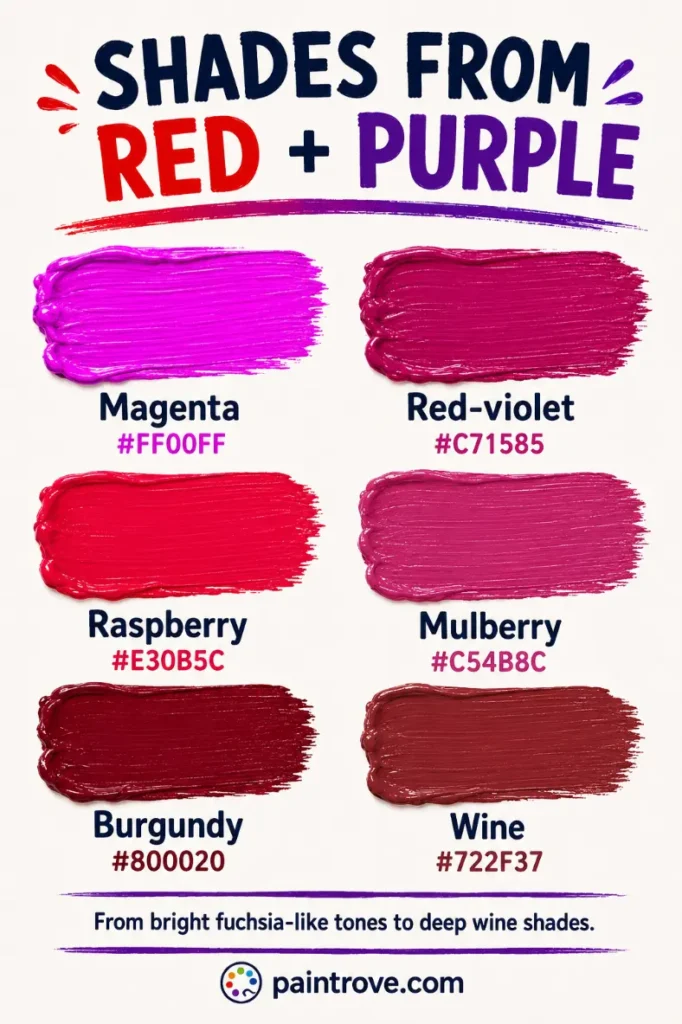
Every Shade You Can Make from Red and Purple
Between the ratio, the pigment choice, and additions of white or black, red mixed with purple covers a surprisingly wide corridor of color. Here is the reference table:
| Shade | Hex code | How to mix it |
|---|---|---|
| Magenta | Hex #FF00FF | Equal parts bright red and bright purple |
| Red-violet | Hex #C71585 | One part red, two parts purple |
| Fuchsia | Hex #FF00FF | Pink-leaning red plus bright purple |
| Raspberry | Hex #E30B5C | Two parts red, one part purple |
| Crimson | Hex #DC143C | Red-heavy mix, minimal purple |
| Mulberry | Hex #C54B8C | Equal mix plus a touch of white and gray |
| Orchid | Hex #DA70D6 | Equal mix plus white |
| Plum | Hex #8E4585 | Purple-heavy mix, touch of red |
| Burgundy | Hex #800020 | Red plus dark plum purple |
| Wine | Hex #722F37 | Red-heavy mix plus a touch of black |
| Maroon | Hex #800000 | Red-heavy mix plus black |
| Byzantium | Hex #702963 | Purple-heavy mix plus a touch of black |
| Tyrian purple | Hex #66023C | Deep red plus deep purple, small touch of black |
Lighter Versions (Tints)
Add white to a red and purple mix and you move through orchid into pink-lavender territory. These tints are soft without being cold, which makes them popular for florals, portrait highlights, and spring palettes. If you push far enough with white, you essentially arrive at the same soft purples you would get from pink and blue mixed, just approached from the opposite direction. And since pink itself is red plus white, as covered in what colors make pink, all these routes are related.
Darker Versions (Shades)
Add black carefully and magenta deepens into mulberry, wine, and near-Tyrian purples. Go slowly. Black overpowers everything, and a red-purple mix that goes too dark loses the glow that makes this family special. An alternative to black: add a touch more dark purple, or a whisper of green, which is red’s complement and darkens it more naturally. For dark reds specifically, the classic recipe is red and black mixed, which lands on maroon.
Muted Versions (Tones)
A small amount of gray turns bright magenta into dusty mauve and mulberry tones. These muted red-purples are heavily used in vintage-styled design, wedding palettes, and autumn fashion.
Red and Purple in Light: The RGB Answer
Everything above describes paint and pigment. Mix red and purple as light, and the logic changes because screens use the RGB color model, where colors add together instead of subtracting.
In RGB, purple on a screen is already built mostly from red and blue light. Add more red light to it and you increase the red signal, which pushes the result toward a bright, glowing magenta, noticeably more electric than anything paint can manage. Screens can display magenta at full intensity, hex #FF00FF, because they are emitting light rather than reflecting it.
| System | Type | Red + Purple makes | Hex code |
|---|---|---|---|
| RYB (paint) | Subtractive | Magenta / red-violet | Hex #C71585 |
| RGB (screens and light) | Additive | Bright magenta | Hex #FF00FF |
| CMYK (printing) | Subtractive | Magenta is a base ink | Hex #FF00FF equivalent |
Printing flips the relationship entirely. In the CMYK model, magenta is not a mix at all. It is one of the four base inks, and printers build reds and purples from magenta rather than the other way around. It is a good reminder that “what do red and purple make” has a different answer depending on which color system you are standing in.
Troubleshooting Your Red and Purple Mix
The mix looks brown or muddy. Your red likely carries a yellow bias (cadmium red is the usual suspect) or your purple was already muddy to begin with. Purple that was mixed from a yellow-leaning red or a green-leaning blue carries hidden mud into every mix it joins. Rebuild with a cool red and a clean purple.
The mix looks like pink, not magenta. Too much white in the purple, or you used a pink-leaning red. Add more purple, or switch to a deeper red.
The mix is too dark to read as magenta. Alizarin crimson plus a dark purple can drop straight into wine territory. If you want brightness, use quinacridone magenta or permanent rose instead, and save the darker pairing for when burgundy is the goal.
The mix leans too blue. Your purple is violet-heavy. Add more red in small steps until the balance tips warm.
It looks great wet and dull dry. Common with acrylics, which dry darker. Mix your target color slightly brighter than you want the final result.
Red-Purple Colors in Art, Fashion, and Design
The magenta and burgundy family carries a lot of cultural weight, and it earns its place in almost every design field.
In Art
The word magenta has a battlefield origin. The dye was created in the late 1850s by French chemist Francois-Emmanuel Verguin, originally named fuchsine, and was renamed to mark the Battle of Magenta in Italy in 1859. Before synthetic dyes, this corner of the color wheel belonged to Tyrian purple, the snail-derived dye so costly that ancient Rome reserved it for emperors. Painters today lean on red-violets for florals, sunsets, jewel-tone still lifes, and the warm side of shadow work, where a red-purple reads far more alive than a flat gray.
In Fashion
Magenta had a global moment when Pantone named Viva Magenta its Color of the Year for 2023, and the family has stayed prominent since. Bright magentas and fuchsias dominate summer collections and statement pieces, while the darker end of the mix, burgundy, wine, and plum, owns autumn and winter. Burgundy in particular is one of the most reliable colors in fashion: it flatters nearly every skin tone, dresses up denim, and reads expensive without effort. Red and purple worn together, unmixed, is a bolder move, a jewel-tone clash that designers use deliberately when they want energy.
In Interiors and Branding
Deep burgundy and mulberry bring warmth and drama to interiors: accent walls, velvet upholstery, moody dining rooms. Bright magenta shows up in branding where a company wants to feel creative, confident, and impossible to ignore, which is why it anchors the identities of several major telecom and beauty brands. Because red-violet sits between passionate red and luxurious purple, it inherits both messages at once: energy plus elegance.
Quick Reference: Red + Purple Cheat Sheet
| Question | Answer |
|---|---|
| Red + purple in paint | Magenta / red-violet (hex #C71585) |
| Red + purple in light | Bright magenta (hex #FF00FF) |
| With a dark plum purple | Burgundy (hex #800020) |
| More red | Raspberry, crimson, wine |
| More purple | Red-violet, plum |
| Plus white | Orchid, soft pinks |
| Plus black | Mulberry, wine, maroon |
| Color type | Tertiary (primary + secondary) |
FAQs
What color do red and purple make when mixed together?
Magenta, also called red-violet. It is a warm reddish-purple that sits between the two parent colors on the color wheel. With darker purples or added black, the same mix produces burgundy and wine tones.
Do red and purple make burgundy?
Yes, when the purple is dark. A red mixed with a deep plum-like purple, or a standard red-purple mix deepened with a touch of black, lands on burgundy at around hex #800020.
Is magenta the same as fuchsia?
Close but not identical. Digitally they can share the same values, but in paint and fashion, fuchsia reads pinker and brighter while magenta is slightly deeper and more purple.
Why did my red and purple mix turn brown?
Hidden yellow. Either your red carries a yellow bias or your purple was mixed from biased primaries. Yellow is purple’s complement and mutes it on contact. Switch to a cool red like quinacridone magenta and a clean purple like dioxazine.
Do red and purple go together without mixing?
Yes. They are analogous colors, neighbors on the wheel, so they harmonize naturally. Designers use the pairing for bold, jewel-toned looks in fashion and maximalist interiors.
Is red-violet warm or cool?
Warm. It contains more red than blue, which places it on the warm side of the purple family. Its cool counterpart is blue-violet, the result of mixing blue and purple.
What two colors make magenta without red and purple?
In printing, magenta is a base ink and is not mixed at all. In paint, you can approximate it with a very cool red like quinacridone rose used nearly straight, or by lightening a red-purple mix. There is no way to build a truly vivid magenta from dull parent colors, so pigment choice matters more than recipe here.
Red and purple mixed give you magenta at their brightest and burgundy at their darkest, with raspberry, mulberry, orchid, and wine scattered in between. It is one of the most forgiving mixes on the palette, so experiment freely.
To zoom out to the full color family, read our complete guide to what colors make purple, or explore how mixes like this fit into the bigger system with our guide to the color wheel.