What Colors Make Blue? Mixing Guide And Shades
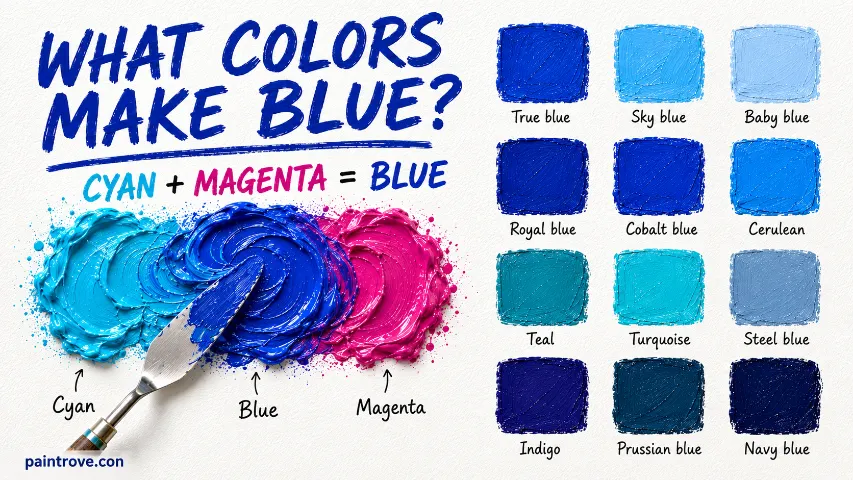
Here is the honest answer most pages dance around: in paint, no colors make blue. Blue is a primary color in the traditional RYB model, which means it cannot be mixed from other colors. You have to start with a blue pigment.
But that is not the end of the story, because there are three real answers to what colors make blue, depending on what you are actually trying to do:
- In printing (CMYK): cyan + magenta make blue. This is a genuine two-color recipe.
- In paint: green + violet make a muted, steely blue. Not a pure blue, but a usable one.
- From an existing blue: every shade of blue is mixable. Navy, sky, teal, royal, denim, and the rest of the family come from adjusting a base blue with other colors.
This guide covers all three routes, with mixing ratios, hex codes for every major blue shade, the best pigments to start from, and links to detailed guides for each individual blue mix.
Why You Cannot Mix a True Blue in Paint
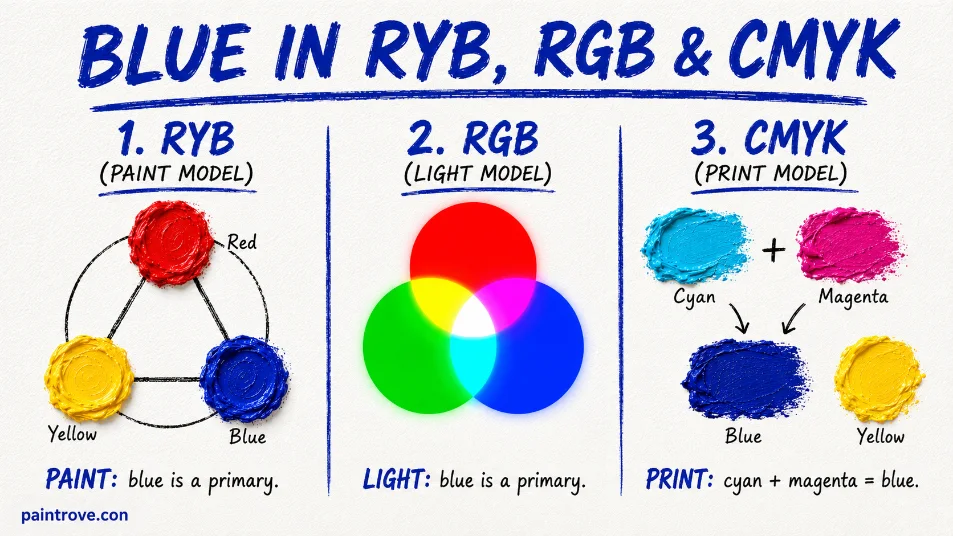
Blue is one of the three primary colors in the RYB system, alongside red and yellow. Primary colors are the starting ingredients of the color wheel: everything else is mixed from them, and nothing mixes into them. Red and blue make purple, blue and yellow make green, but no combination runs the other way. The full explanation of why paint behaves like this lives in our guide to the RYB color model.
The same is true for light. Screens use the RGB model, where blue is again a primary. Your phone displays blue from a dedicated blue sub-pixel; no combination of red and green light can produce it.
So when a mix “makes blue,” one of two things is happening: either you are working in a color system where blue is not primary, or you are producing something blue-ish rather than a pure blue. Both are worth knowing.
Route 1: Cyan + Magenta Make Blue (The Printing Answer)
Printers do not carry blue ink. They build every color from four inks: cyan, magenta, yellow, and black, the system covered in our guide to the CMYK color model. In that system:
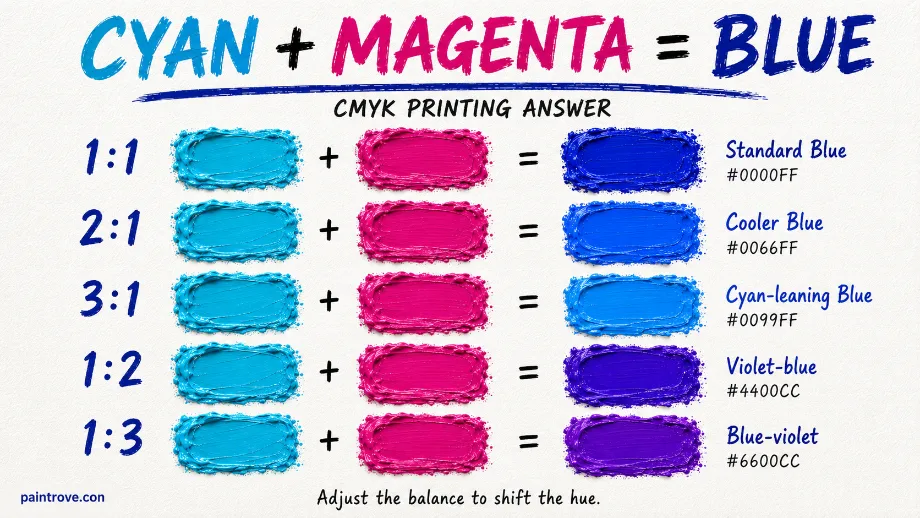
Cyan + Magenta = Blue
It works because cyan absorbs red light and magenta absorbs green light. Layer them and the only strong wavelengths left to reflect are blue. Adjust the balance and the blue shifts:
| Ratio (Cyan : Magenta) | Result | Hex code |
|---|---|---|
| 1 : 1 | Standard blue | Hex #0000FF territory |
| 2 : 1 | Cooler blue, toward azure | Hex #0066FF |
| 3 : 1 | Cyan-leaning sky blue | Hex #0099FF |
| 1 : 2 | Violet-blue | Hex #4400CC |
| 1 : 3 | Blue-violet, toward purple | Hex #6600CC |
If you own cyan and magenta paints or inks, this recipe genuinely works on the palette too, because cyan and magenta are closer to the true “primaries” of pigment than the red and blue we grow up with. It is the one legitimate answer to what two colors make blue.
Route 2: Green + Violet Make a Muted Blue (The Painter’s Workaround)
Ran out of blue paint mid-painting? There is a workaround artists use: mix green and violet.
Green sits on one side of blue on the color wheel, violet on the other. Mixing two colors that flank a hue produces something close to the hue between them. The result is never as clean as tube blue. Mixed blues from green and violet come out muted, steely, and slightly gray, closer to a stormy sea than a summer sky. But muted blues are exactly what many subjects need: shadows, denim, slate roofs, overcast water.
Recipe: 1 part green (phthalo green works well) + 1 part violet (dioxazine purple), adjusted by eye. More green pushes toward teal; more violet pushes toward indigo. A touch of white reveals the mix’s true hue if it reads too dark to judge.
Route 3: Mixing Every Shade of Blue from a Base Blue
This is where the real everyday work happens. One tube of blue unlocks the entire family. Here is the master shade table, with hex codes in plain text and the recipe for each:
| Shade | Hex code | How to mix it |
|---|---|---|
| True blue | Hex #0000FF | Base pigment (ultramarine or cobalt) |
| Navy blue | Hex #000080 | Blue plus a small amount of black, about 8:1 |
| Midnight blue | Hex #191970 | Blue plus black, slightly more than navy |
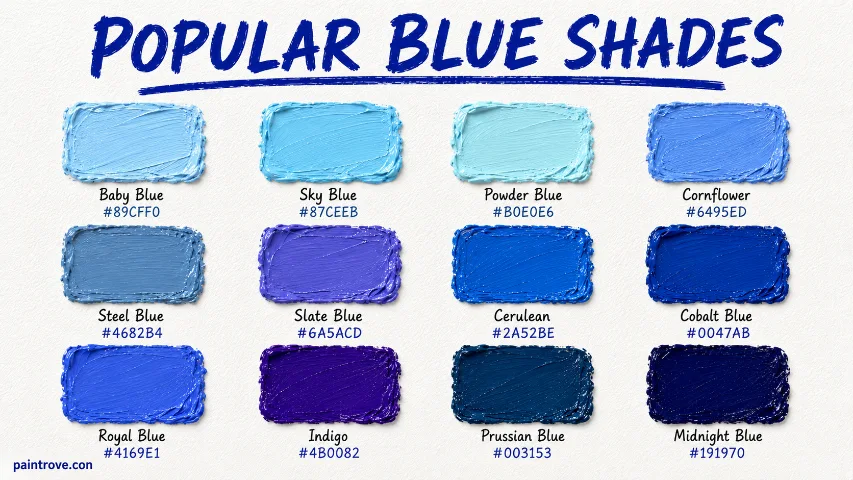
| Royal blue | Hex #4169E1 | Blue plus a touch of magenta or violet |
| Sky blue | Hex #87CEEB | Blue plus generous white |
| Baby blue | Hex #89CFF0 | Blue plus even more white |
| Powder blue | Hex #B0E0E6 | Blue plus white plus a whisper of gray |
| Cornflower | Hex #6495ED | Blue plus white plus a touch of gray |
| Steel blue | Hex #4682B4 | Blue plus gray |
| Slate blue | Hex #6A5ACD | Blue plus gray plus a touch of violet |
| Denim | Hex #1560BD | Blue plus a touch of gray and black |
| Teal | Hex #008080 | Blue plus green |
| Turquoise | Hex #40E0D0 | Blue plus green plus white |
| Cerulean | Hex #2A52BE | Cool blue base, touch of white |
| Cobalt | Hex #0047AB | Base pigment, or ultramarine cooled slightly |
| Indigo | Hex #4B0082 | Blue plus violet plus a touch of black |
| Periwinkle | Hex #CCCCFF | Blue plus violet plus lots of white |
| Prussian blue | Hex #003153 | Deep blue base, touch of black and green |
Each of the core adjustments has its own detailed guide:
| Add to blue | Result | Full guide |
|---|---|---|
| White | Sky, baby, powder blue | Blue and white mixed |
| Black | Navy, midnight blue | Blue and black mixed |
| Gray | Steel, slate blue | Blue and gray mixed |
| Green | Teal, turquoise | Blue and green mixed |
| Purple | Blue-violet, indigo | Blue and purple mixed |
For the blue-green branch specifically, which is big enough to be its own world of aqua, teal, and turquoise, see our full guide to what colors make turquoise.
A Note on Navy: Skip the Black Sometimes
The standard navy recipe is blue plus black, but black can gray a blue out and leave it flat. Painters often build a livelier navy by darkening ultramarine with burnt umber instead, or with a touch of its complement, orange. The mix stays dark but keeps a warmth underneath that black kills. Our guide to blue and orange mixed shows what happens when that complementary pair goes further, all the way to brown.
Warm Blues vs Cool Blues: Picking Your Base Pigment
Every blue in the art store leans one direction or the other, and picking the right base decides how your mixes behave:
| Pigment | Temperature | Leans toward | Best for |
|---|---|---|---|
| Ultramarine blue | Warm | Violet | Purples, rich darks, skies at dusk |
| Cobalt blue | Neutral-cool | Slightly green | All-purpose, portraits, daylight skies |
| Phthalo blue | Cool | Green | Teals, turquoises, intense saturation |
| Cerulean blue | Cool | Green | Soft daylight skies, pastel mixes |
| Prussian blue | Cool | Green-black | Deep moody darks, night scenes |
The rule of thumb: mix a warm blue with a cool red (say, ultramarine with quinacridone magenta) and you get clean purples, as covered in what red and blue make. Mix a cool blue with a cool yellow (phthalo with lemon yellow) and you get vivid greens, as covered in what blue and yellow make. Cross the temperatures wrongly and the mixes gray out. This one principle prevents most mixing disappointments.
Phthalo blue deserves a warning label: it is ferociously strong. A brush-tip amount tints an entire puddle of white. Add it in amounts that feel too small, because they will not be.
The Strange History of Blue Pigment
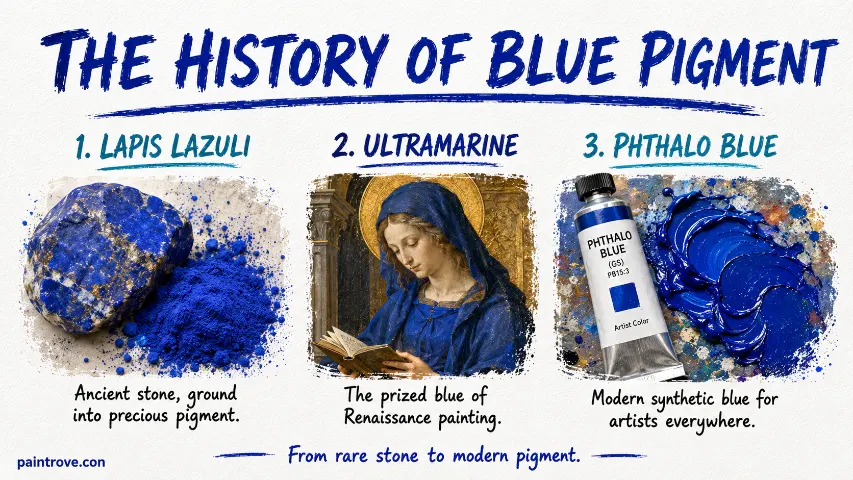
Blue’s status as an unmixable primary made it precious for most of human history. Ultramarine, the finest blue, was ground from lapis lazuli mined almost exclusively in Afghanistan, and during the Renaissance it cost more than gold. Painters saved it for the most important subject in a commission, which is why the Virgin Mary wears blue in centuries of European art. Vermeer reportedly drove his family into debt buying it.
The pressure to find cheaper blues drove chemistry forward. Prussian blue was discovered by accident in Berlin around 1704, the first modern synthetic pigment. Cobalt blue followed in 1802, synthetic ultramarine in 1826, and phthalo blue in the 1930s. The newest famous blue, YInMn blue, was discovered by accident at Oregon State University in 2009, the first new inorganic blue pigment in over two centuries. Blue is the color humanity kept having to invent.
Blue in Art, Fashion, and Design
Blue consistently tops favorite-color surveys worldwide, and every creative field leans on it.
In Art
Beyond the ultramarine story, blue defines entire artistic identities. Picasso had a Blue Period. Yves Klein patented his own ultramarine formula, International Klein Blue, and built a career on it. Hokusai’s Great Wave is a masterclass in Prussian blue. For working painters, blues carry the cool half of every painting: skies, water, shadows, atmospheric distance. The warm-cool conversation between blues and oranges or browns is the engine of most landscape work.
In Fashion
Blue is the most worn color on the planet for one reason: denim. Indigo-dyed jeans made blue the default of casual dress everywhere. Beyond denim, navy is the backbone of tailoring, reading as authoritative but softer than black, while lighter blues carry spring and summer. Blue is also famously the safest color across skin tones, which is why it dominates uniforms, suits, and shirting.
In Interiors and Branding
Designers use soft blues in bedrooms and bathrooms for their calming effect, and deep navies for studies and dining rooms where richness matters. In branding, blue signals trust, stability, and competence, which is why banks, tech companies, and social platforms overwhelmingly choose it. It is the least risky color in the corporate palette, and everyone knows it.
Troubleshooting Blue Mixes
Your “blue” mix from other colors looks gray or dull. That is expected. Mixed approximations of a primary are always muted. If you need a vivid blue, there is no substitute for a blue pigment.
Your blue turned green when lightened. Your white or your blue carries a green bias, or you are using phthalo, which leans green naturally. Switch to ultramarine for lightened mixes that stay blue.
Your navy looks flat and dead. Too much black. Remix and darken with burnt umber or a smaller quantity of black, or start from Prussian blue, which is already deep.
Your blue-purple mixes keep turning muddy. Your blue is green-leaning. Purples need a warm, violet-leaning blue like ultramarine.
The mix dries darker. Standard acrylic behavior. Aim a step lighter than the target while wet.
Quick Reference: What Makes Blue Cheat Sheet
| Question | Answer |
|---|---|
| Can you mix true blue in paint? | No, blue is a primary color |
| What makes blue in printing? | Cyan + magenta (CMYK) |
| Closest paint approximation | Green + violet, a muted steel blue |
| Navy | Blue + a little black, or blue + burnt umber (hex #000080) |
| Sky blue | Blue + white (hex #87CEEB) |
| Teal | Blue + green (hex #008080) |
| Royal blue | Blue + a touch of magenta (hex #4169E1) |
| Indigo | Blue + violet + a touch of black (hex #4B0082) |
| Warm base pigment | Ultramarine |
| Cool base pigment | Phthalo or cerulean |
FAQ
What two colors make blue?
In printing and with cyan and magenta pigments, cyan plus magenta make blue. In traditional paint, no two colors make a true blue, because blue is a primary. Green plus violet produces the closest approximation, a muted steely blue.
Can you make blue without blue?
Only approximately. Green and violet flank blue on the color wheel, and mixing them lands nearby: a grayish, stormy blue. For a pure, saturated blue, you need a blue pigment such as ultramarine, cobalt, or phthalo.
How do you make dark blue?
Add a small amount of black to your base blue for navy, or darken with burnt umber for a richer result. A touch of violet plus black takes you to indigo and midnight blue.
How do you make light blue?
Add white gradually. Blue plus white gives sky blue, then baby blue, then powder blue as the white increases. Keep the base blue clean, since any green bias shows once the mix lightens.
Why do red and green light not make blue?
In the RGB light system, blue is itself a primary. Red and green light combine into yellow, not blue. Screens produce blue directly from blue sub-pixels.
What colors make royal blue?
Start with a strong base blue and add a small touch of magenta or violet, roughly five parts blue to one part magenta. Avoid black, which dulls the brightness that defines royal blue.
Is blue warm or cool?
Blue is the anchor of the cool side of the color wheel. Within the blue family, though, temperature is relative: ultramarine is a warm blue because it leans violet, while phthalo and cerulean are cool blues because they lean green.
So what colors make blue? In printing, cyan and magenta. In paint, nothing makes a true blue, but green and violet get close, and one good tube of blue unlocks navy, sky, teal, royal, and the whole family beyond it.
For the theory underneath, start with primary colors and the color wheel, or jump into any of the individual blue mixes linked above.