What Does Blue and Black Make When Mixed? (Navy / Midnight Blue)
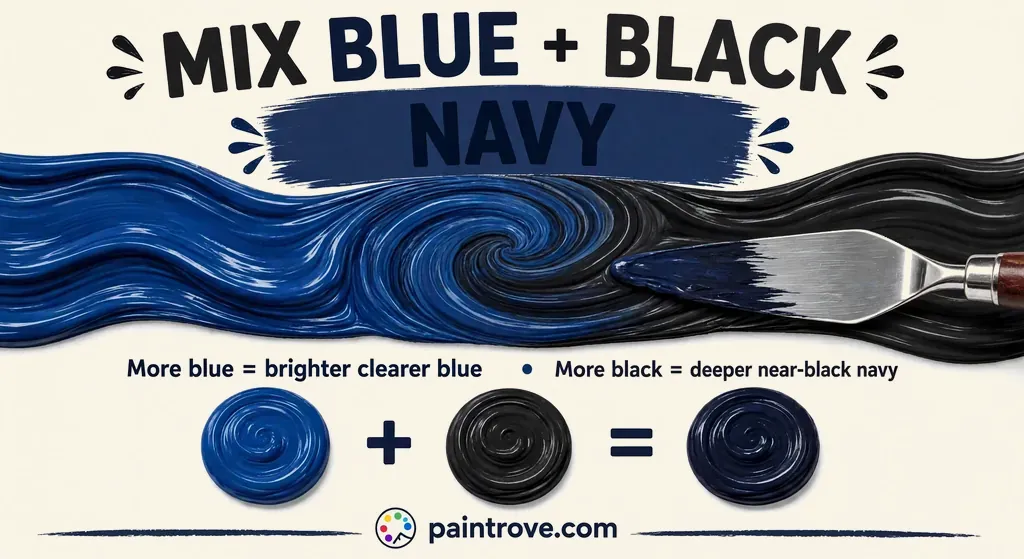
Blue and black make navy, deepening into midnight blue and eventually a near-black blue as you add more black. A small amount of black gives a rich navy around Hex #000080. More gives midnight blue near Hex #191970. Past that the blue disappears almost entirely.
Black carries no hue of its own, so it cannot turn blue into another color. All it does is lower the value. What color does blue and black make at any ratio is still blue, just darker and considerably less vivid.
That loss of vividness is the catch, and it is why most painters reach for something other than black when they want navy. This guide covers the ratios, the better routes to a navy that stays rich, what blue black means as a named shade, and the dark blue hex codes worth having.
What does blue and black make?
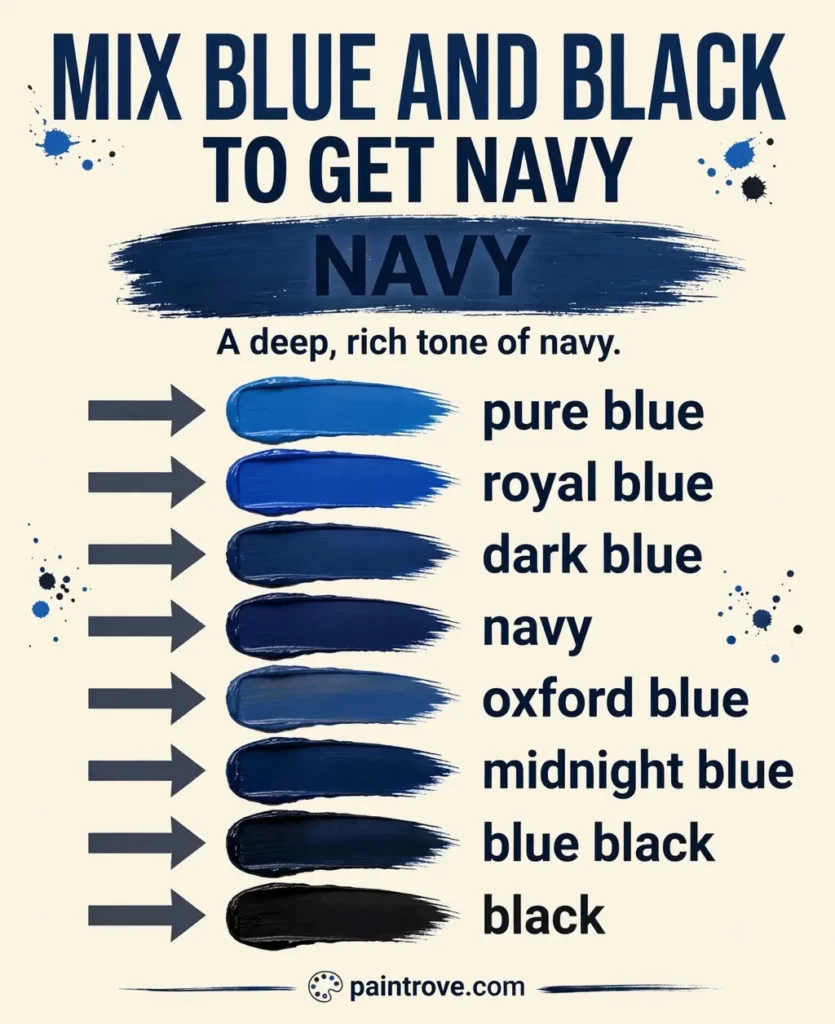
A shade of blue. That is the technical term and it explains the entire result, and it is the same answer whichever way round you ask what does black and blue make.
Color theory has three ways of modifying a hue. A tint is a hue plus white, which lightens it. A tone is a hue plus gray, which mutes it. A shade is a hue plus black, which darkens it. Blue and black produce the third of these.
Because black absorbs across the whole visible spectrum, adding it to blue reduces the amount of light the mixture reflects without favouring any wavelength. The hue stays put. The value drops. The saturation drops with it, which is the part people do not expect.
Blue has one property that makes this especially noticeable: it is already the darkest of the three primaries. Yellow sits at a very high value and can take a lot of darkening before it looks dark. Blue starts low, so there is far less room to work with. A little black goes a very long way, and black and blue make what color is effectively black much faster than most people anticipate.
For the broader picture of how blue itself is built and how its many shades relate, the guide to what colors make blue covers the full family.
Blue and black mixing ratios
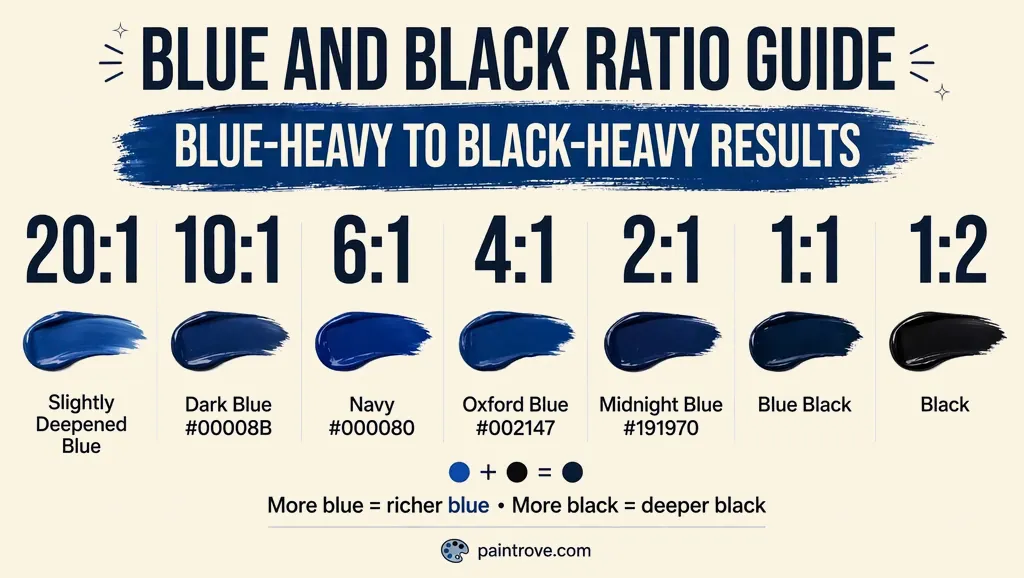
Every ratio below is an approximate starting point rather than a formula. Blues vary enormously in strength and blacks vary in undertone, so add gradually and test before committing.
| Approximate ratio (blue : black) | Result | Roughly matches |
|---|---|---|
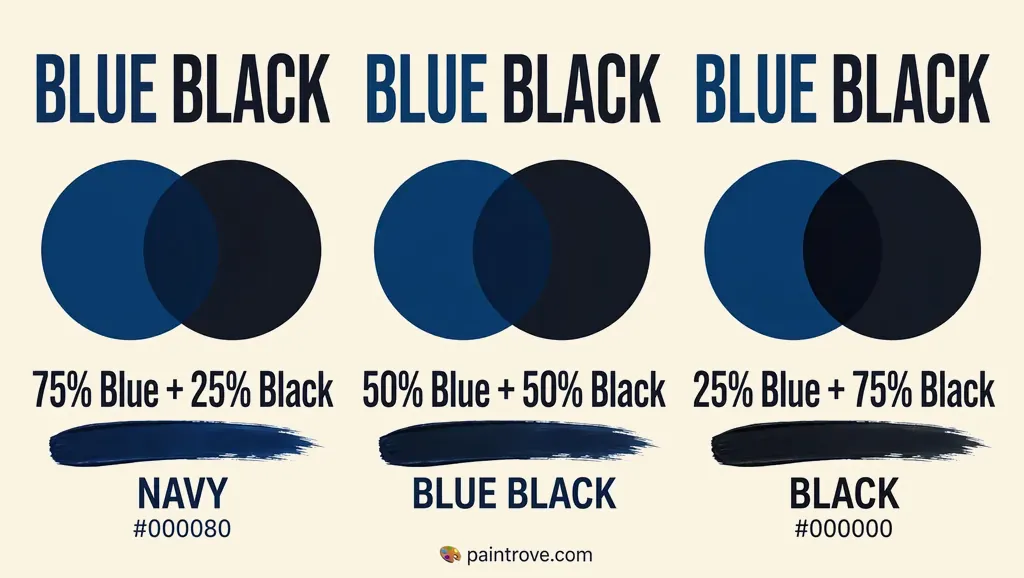
| 20 : 1 | Slightly deepened blue | Royal blue going dark |
| 10 : 1 | Rich dark blue | Dark blue, Hex #00008B |
| 6 : 1 | Navy | Navy, Hex #000080 |
| 4 : 1 | Deep navy | Oxford blue, Hex #002147 |
| 2 : 1 | Midnight blue | Midnight blue, Hex #191970 |
| 1 : 1 | Near-black with a blue cast | Blue black |
| 1 : 2 | Black for practical purposes | Barely distinguishable from black |
What color does blue and black make at each step down this scale is still blue, right up until it is not. Add black into blue, never blue into black. Black has enormous tinting strength and blue is already dark, so the window between “nicely deepened” and “ruined” is narrow. Work from the blue and introduce black a brushtip at a time.
A workable sequence:
- Put out the blue you want to darken.
- Pick up the smallest trace of black your brush will carry.
- Blend fully before judging. Streaky dark paint always reads darker than it will once mixed.
- Stop one step before you think you should.
- Test on your actual surface and let it dry, since acrylic dries darker and watercolor dries lighter.
Overshooting here is effectively unrecoverable. Adding blue back to an over-blackened mix needs a very large quantity before the hue returns, and the result stays dull because the black is still in there.
Why black dulls blue, and how to darken it instead
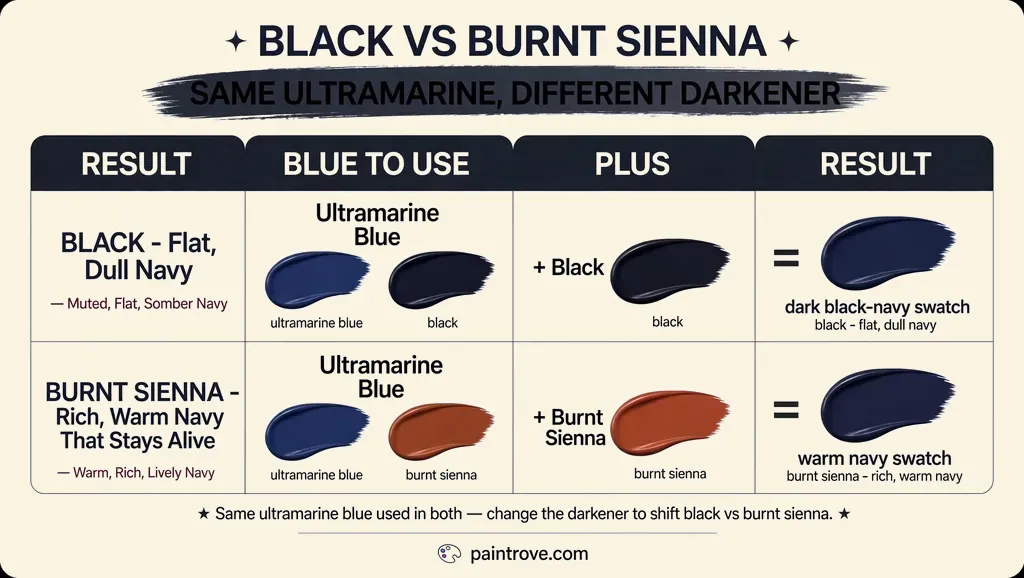
Here is the problem every painter runs into. Blue and black make what color you asked for in terms of value, but not in terms of life. Black does not just darken blue, it deadens it. A navy mixed from blue and black often looks flat and slightly dirty next to a navy mixed another way, and under some lighting it reads almost grey.
Two things cause this:
Black removes chroma along with light. Saturation and value drop together, so you cannot darken without also dulling. A deep blue that still looks vivid has to get its darkness from something other than black.
Most blacks are not neutral. Lamp black and carbon black lean cool and blue, which sounds helpful but flattens the mixture further. Ivory black leans warm and slightly brown, which can push a blue toward a muddy, greyish navy. Mars black is the most neutral but also the strongest, so it overwhelms quickly.
The alternatives that painters actually use:
| Method | What to add | Result |
|---|---|---|
| Complementary darkening | Burnt sienna or burnt umber | Rich, warm navy that stays alive |
| Violet darkening | Dioxazine purple | Deep, cool, luminous midnight blue |
| Pre-mixed dark blue | Prussian blue, Indanthrone blue | Naturally dark straight from the tube |
| Payne’s gray | A blue-violet gray | Soft atmospheric navy, good for shadows |
Ultramarine blue with a small amount of burnt sienna is the classic route to navy. The two are near-complements, so the burnt sienna knocks back the blue’s brightness without introducing the deadness black brings, and the mixture keeps a subtle warmth. Pushed further, the same pair produces a convincing near-black. The mechanism is the same one described in what blue and orange make, where blue meets its complement and both neutralize, and the underlying relationship is explained in the guide to complementary colors.
Adding a violet instead keeps the result cool. Dioxazine purple with ultramarine gives a midnight blue that stays luminous, which is the same direction explored in blue and purple mixed.
Which blue you start with changes the
navy
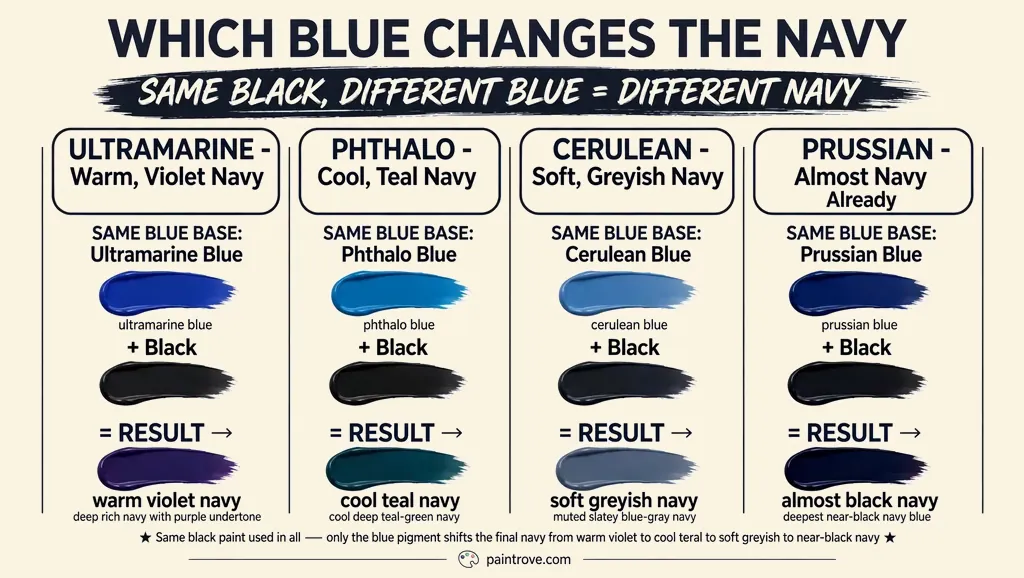
Blue is not one color, and the bias of your starting blue survives into the mixture.
| Blue | Bias | Navy it produces |
|---|---|---|
| Ultramarine | Warm, slightly violet | Rich, warm navy with depth |
| Phthalo Blue | Cool, slightly green | Hard, intense, slightly teal navy |
| Cerulean | Cool, greenish, weak | Soft, greyish navy; needs little black |
| Cobalt | Fairly neutral | Clean, balanced navy |
| Prussian Blue | Very dark, slightly green | Almost navy already; add very little black |
| Indanthrone Blue | Deep, neutral | The closest to navy straight from the tube |
What color does black and blue make therefore depends on the tube as much as the ratio. If your navy came out looking slightly green or teal, your blue was phthalo or cerulean. If it came out looking violet or purple-leaning, it was ultramarine. Neither is wrong, but knowing which you have saves guessing.
What is blue black as a colour?
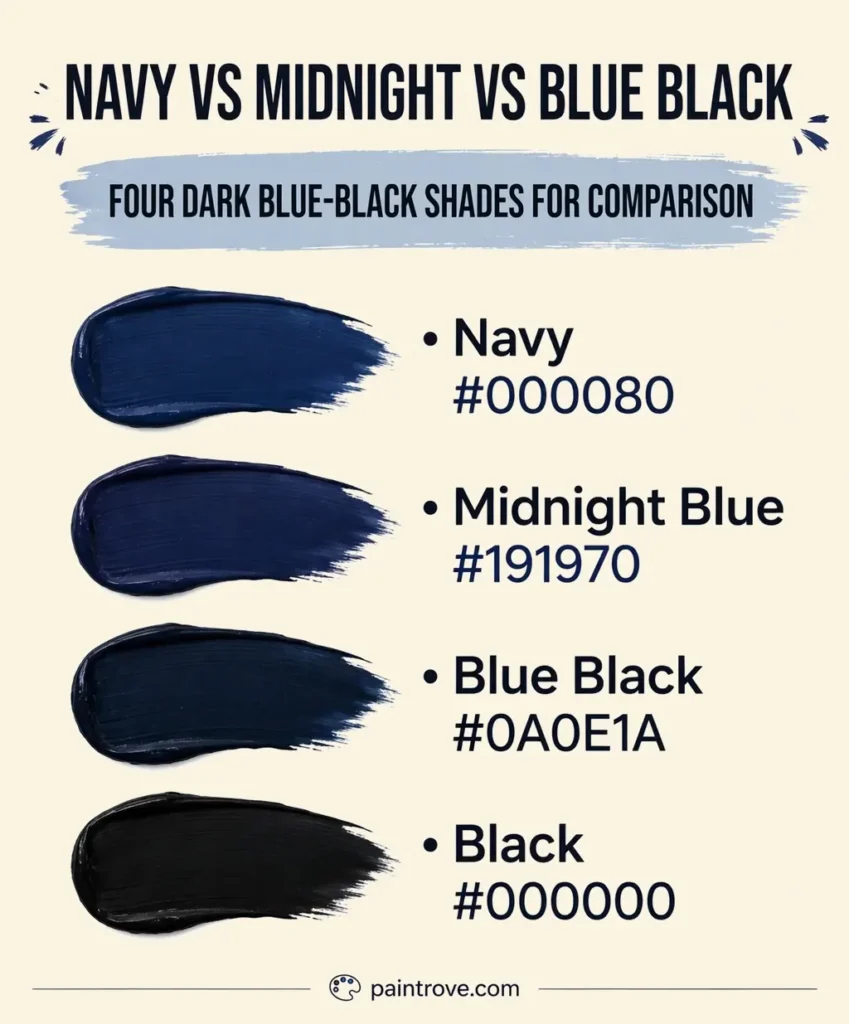
Blue black is a named shade in its own right, distinct from what does black and blue make on a palette, and it comes up in three contexts.
As a near-black with a blue undertone. Visually this is black that has not quite committed, reading cooler and deeper than a flat neutral black. It has no single standard value; it generally sits in the Hex #0A0E1A to #141E30 range depending on who is specifying it.
As a hair colour. Blue black is one of the most common dark hair shades, a black base with a visible blue reflect that catches cool light. It is a dye formulation rather than a mix you would make.
As an ink. Blue black ink is a traditional fountain pen colour dating back to iron gall formulations. Historically it went down blue and oxidised to a dark grey-black over hours, which is why the name describes a transition rather than a single colour.
The blue black colour most people picture is the first of these: not navy, which still reads clearly as blue, but a black that reveals blue only in strong light or against a true neutral black.
Dark blue hex codes
| Name | Hex | RGB | Character |
|---|---|---|---|
| Blue | #0000FF | 0, 0, 255 | The pure primary |
| Royal blue | #4169E1 | 65, 105, 225 | Bright, slightly violet |
| Dark slate blue | #483D8B | 72, 61, 139 | Muted, violet-leaning |
| Dark blue | #00008B | 0, 0, 139 | Deepened but still clearly blue |
| Navy | #000080 | 0, 0, 128 | The standard dark blue |
| Midnight blue | #191970 | 25, 25, 112 | Deeper, slightly softened |
| Prussian blue | #003153 | 0, 49, 83 | Dark with a green lean |
| Oxford blue | #002147 | 0, 33, 71 | Very deep, formal |
| Blue black | around #0A0E1A | 10, 14, 26 | Reads black until compared |
| Black | #000000 | 0, 0, 0 | No hue at all |
Notice what happens down that list. Navy at 0, 0, 128 is pure blue at half intensity, which is exactly what adding black does: it scales every channel down while keeping their relationship. Midnight blue at 25, 25, 112 has a small amount of red and green lifted, which is why it reads slightly softer and less saturated than navy.
Blue and black in RGB and on screens
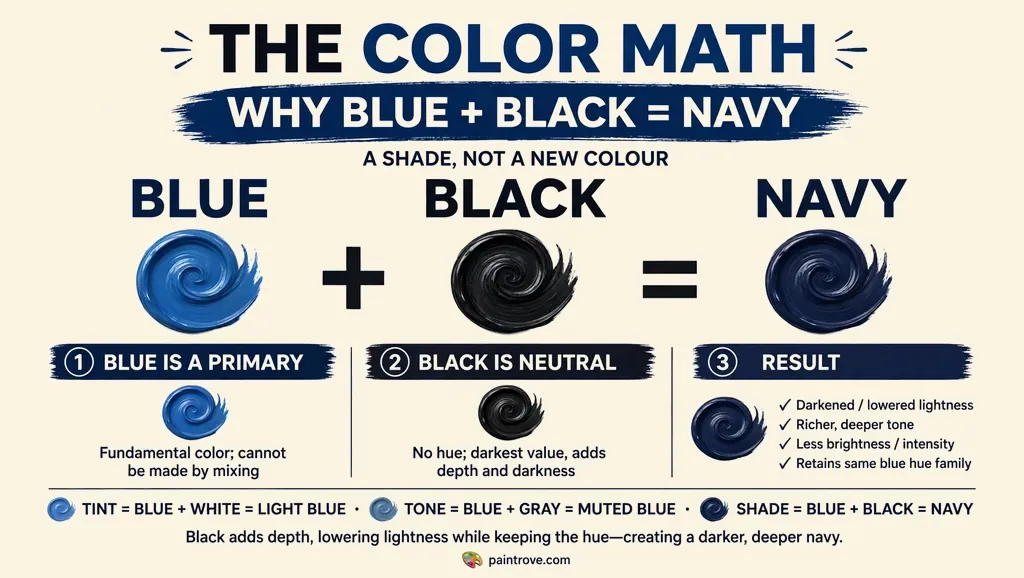
Digital color darkens blue the same way, by scaling down, but there is no black channel to mix in.
- Paint (subtractive). Blue plus black pigment gives a shade: the hue stays and both value and saturation drop.
- Screens (additive RGB). Darkening means lowering the blue value toward zero. Blue at 255 gives pure blue; at 128 it gives navy; at 26 it gives blue black. There is no black to add, because black on a screen is simply the absence of light.
- Print (CMYK). Navy comes from cyan and magenta with a heavy percentage of black ink, typically around 100, 100, 0, 50.
This is the same logic that applies whenever black meets a hue. Adding black to green gives dark forest green, as shown in green and black mixed, and adding it to purple gives dark plum, as in purple and black mixed. In every case the hue survives and the value falls.
Do blue and black go together?
Worth answering separately, because the pairing question comes up as often as the mixing one.
Yes, though it is a harder pairing than most. Navy and black sit close in value, so there is very little contrast between them, and in poor light they can look like a mistake rather than a decision. The old rule that you should never wear navy with black came from exactly this problem.
What makes it work:
- Push the values apart. A bright or mid blue against black reads as deliberate. Navy against black often does not.
- Vary the texture. Matte black with a sheen navy, or wool with leather, gives the eye something to separate the two.
- Add a light third element. White, cream, grey or metallic breaks the heaviness and makes the pairing look intentional.
- Commit to it. A near-monochrome dark scheme works when it is clearly the whole point, rather than two dark colours that happen to be adjacent.
In interiors, black and blue works best when the blue is either much lighter than the black or deeply saturated enough to read as a colour rather than as a failed black.
Why your mix came out wrong
It looks grey, not navy. Too much black, or a black with a brown undertone neutralizing the blue. Start again and use a fraction of the black.
It looks dull and flat. This is black doing what black does. Switch to burnt sienna or dioxazine purple for darkening instead.
It looks greenish. Your blue is phthalo or cerulean, both of which lean green, or an ivory black has pushed it that way. Use ultramarine instead, and check the color wheel if you are unsure which side of blue your tube sits on.
It went black almost immediately. Expected. Blue is already dark, so the usable range is short. Measure the black in brushtips, not in parts.
What does blue and black make when mixed?
Navy, deepening to midnight blue and then to a near-black blue as more black is added. Black carries no hue, so it only lowers the value and saturation of the blue. A small amount gives navy near Hex #000080, and roughly equal parts gives a blue black that reads almost as black.
What does black and blue make in paint?
A shade of blue, meaning blue with black added. The hue stays blue throughout; only the value and saturation change. Because blue is already the darkest primary, a very small amount of black is enough, and the result turns effectively black far faster than with lighter hues.
What color does blue and black make at equal parts?
A blue black, meaning a near-black that only reveals its blue undertone in strong light or beside a true neutral black. Equal parts is well past navy. For a navy that still reads clearly as blue, use roughly six parts blue to one part black.
What color does black and blue make if you keep adding black?
Progressively darker blues, moving through navy and midnight blue to blue black and finally to something indistinguishable from pure black. The hue never changes along that range. What drops is the value and, less obviously, the saturation.
Blue and black make what color exactly?
That depends on your blue. Ultramarine gives a warm, slightly violet navy. Phthalo blue gives a harder navy with a green lean. Prussian and indanthrone blues are so dark already that they need almost no black at all. The black matters too, since most blacks carry an undertone.
Black and blue make what color of navy in practice?
A navy that is darker but noticeably duller than a navy mixed another way. Black removes chroma along with light, so the result lacks the depth of a navy built from ultramarine with burnt sienna or dioxazine purple. Use black when flatness is acceptable and a complement when it is not.
How do you make navy blue without black?
Mix ultramarine blue with a small amount of burnt sienna or burnt umber. The two are near-complements, so the brown knocks back the blue’s brightness without the deadening effect black produces. Dioxazine purple is the alternative if you want the navy to stay cool rather than warm.
What is blue black colour?
A near-black with a visible blue undertone, generally around Hex #0A0E1A to #141E30, though there is no single standard value. It also names a common dark hair shade and a traditional fountain pen ink. It is distinct from navy, which still reads clearly as blue rather than as black.
Why does my blue and black mix look grey?
Either you used too much black, or your black has a warm brown undertone that is partially neutralizing the blue. Ivory black is the usual culprit. Switch to a neutral black such as Mars black, use far less of it, or darken with a complement instead.
Does blue and black go together?
Yes, though it needs care because navy and black sit close in value and can read as a mistake in low light. Push the values apart by using a brighter blue, vary the texture between the two, and add a light third element such as white, grey or metallic to make the pairing look deliberate.
Blue + black = what color in RGB?
There is no black to add in RGB, since black on a screen is the absence of light. Darkening blue means lowering its value: 0, 0, 255 is pure blue, 0, 0, 128 is navy, and 10, 14, 26 is blue black. Scaling the channel down is the digital equivalent of adding black pigment.
What is the difference between navy and midnight blue?
Navy at Hex #000080 is pure blue at half intensity and still reads clearly as a blue. Midnight blue at Hex #191970 is slightly darker and slightly desaturated, with small amounts of red and green lifted, which makes it softer and less electric. Both come from the same mixture at different ratios.
Blue and black at a glance
| If you want | Do this |
|---|---|
| A slightly deepened blue | 20 parts blue to 1 part black |
| Navy | Roughly 6 parts blue to 1 part black |
| Midnight blue | Roughly 2 parts blue to 1 part black |
| Blue black | Roughly equal parts |
| A navy that stays rich | Ultramarine plus burnt sienna, no black |
| A cool luminous midnight blue | Ultramarine plus dioxazine purple |
| Navy with no mixing at all | Use Prussian or indanthrone blue |
| The pairing to work in design | Push the values apart and add a light third element |
What does blue and black make, in one line: a shade of blue running from navy through blue black to near-black, with the hue intact and the vividness reduced. Three things are worth remembering: measure the black in brushtips rather than parts, check whether your blue leans warm or green before blaming the ratio, and reach for burnt sienna instead of black when the navy needs to stay alive.