How Long Does Exterior Paint Take to Dry? Easy Guide

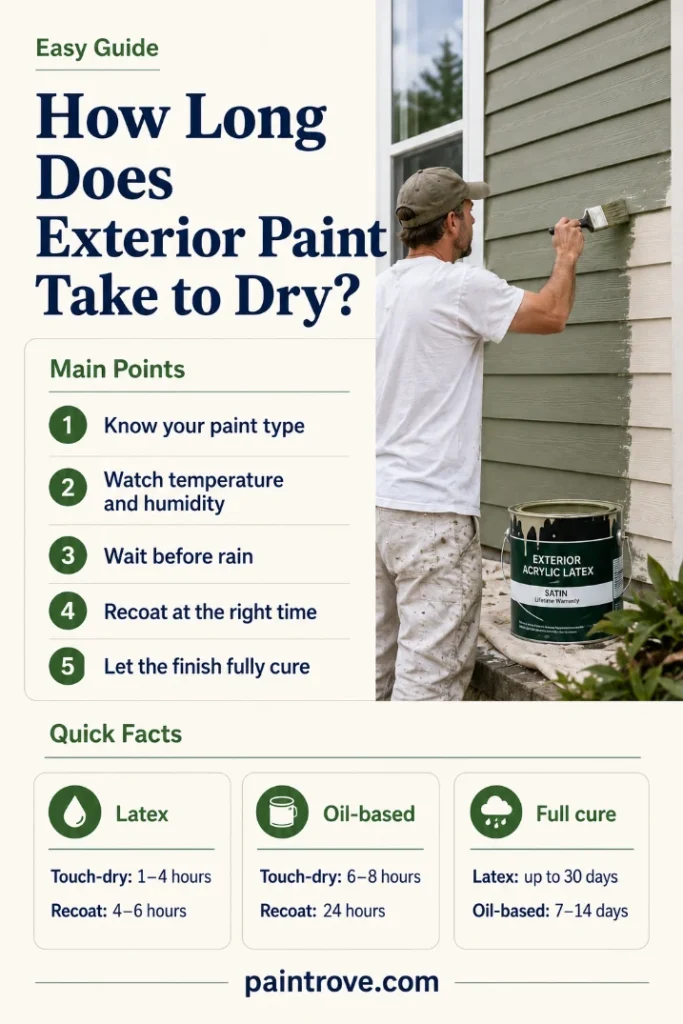
How long does exterior paint take to dry? Most latex exterior paint is dry to the touch in 1 to 4 hours and ready for a second coat in 4 to 6 hours. Oil-based paint takes longer, about 6 to 8 hours to touch-dry and 24 hours before recoating. But “dry” and “cured” aren’t the same thing, and full curing can take up to 30 days.
That gap matters more outdoors than anywhere else, because your fresh paint has to survive rain, dew, sun, and temperature swings while it sets. Time it wrong and you’ll see peeling, blistering, or streaks.
This guide breaks down exact dry times by paint type and surface, how weather changes everything, how long to wait before rain, and how to avoid the mistakes that ruin an exterior paint job.
Quick Answer: Exterior Paint Dry Times
Here are the typical numbers in ideal conditions (60–80°F, low humidity).
- Latex/acrylic, dry to touch: 1 to 4 hours
- Latex/acrylic, recoat: 4 to 6 hours
- Oil-based, dry to touch: 6 to 8 hours
- Oil-based, recoat: 24 hours
- Before rain: wait 24 hours if possible (4 to 6 hours minimum for light rain)
- Full cure: latex up to 30 days; oil-based 7 to 14 days
Always check the label, and adjust for weather. Read on for the full detail.
Drying vs. Curing: Why the Difference Matters
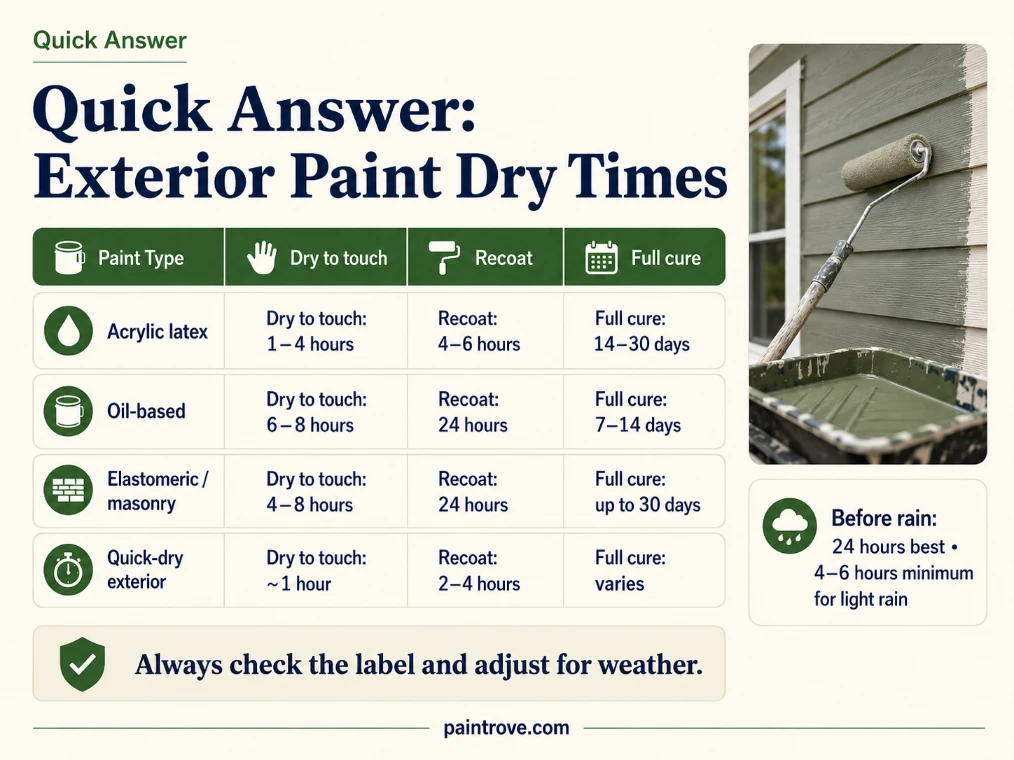
This is the part that trips up most homeowners. Drying and curing are two different stages.
Drying is when the water or solvent evaporates and the surface feels dry to the touch. This happens in hours and tells you when you can recoat.
Curing is when the paint hardens completely and bonds to the surface at full strength. This takes weeks, even though the paint feels dry long before.
Why it matters outdoors: a dry-but-uncured finish can still be damaged by rain, scrubbing, or objects leaning against it. Avoid washing or pressure-cleaning your freshly painted exterior for about 30 days so the cure isn’t disturbed.
The same principle applies to indoor jobs. Our guide on how long paint takes to dry covers the bigger picture across paint types.
How Long Does Exterior Paint Take to Dry by Type
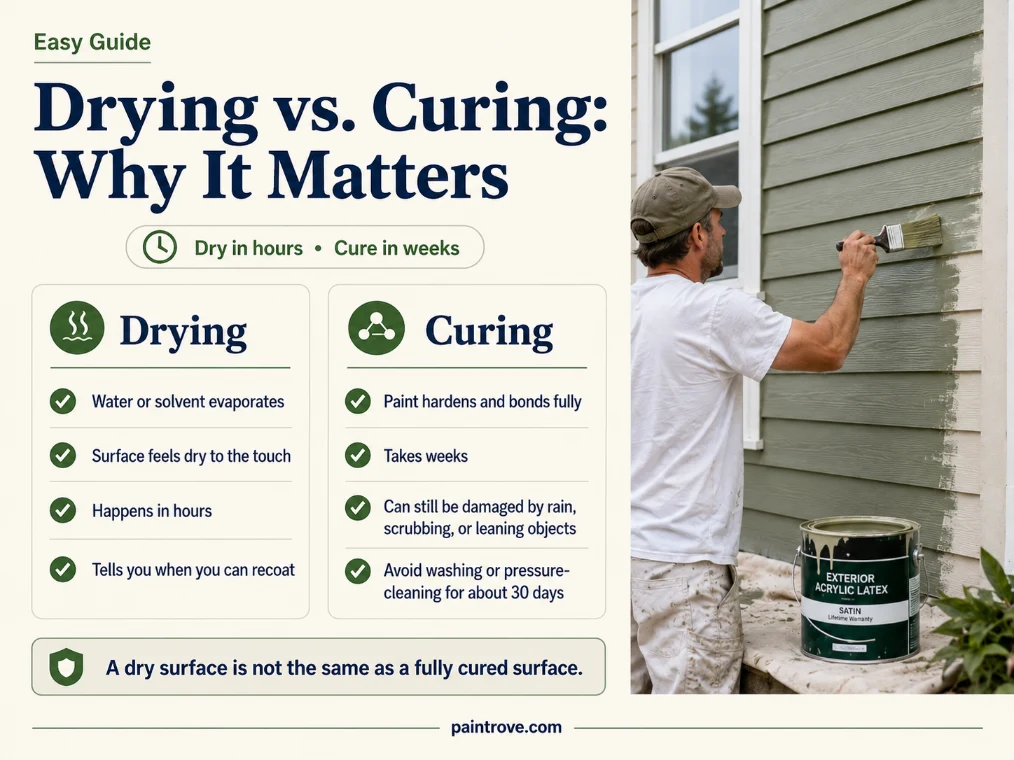
The paint formula is the biggest factor. Here’s the breakdown.
| Paint Type | Dry to Touch | Recoat | Full Cure |
|---|---|---|---|
| Acrylic latex | 1–4 hours | 4–6 hours | 14–30 days |
| Oil-based | 6–8 hours | 24 hours | 7–14 days |
| Elastomeric / masonry | 4–8 hours | 24 hours | up to 30 days |
| Quick-dry exterior | ~1 hour | 2–4 hours | varies |
Acrylic Latex Paint
Latex is the go-to for exteriors. It dries fast (1 to 4 hours to the touch), cleans up with water, and is more environmentally friendly. Its only quirk is a long full cure of up to 30 days. Most homeowners use premium acrylic latex like Sherwin-Williams Duration or Behr’s exterior lines.
Oil-Based Paint
Oil-based paint takes longer to dry to the touch (6 to 8 hours) but cures faster, in 7 to 14 days. It’s tough and durable, though less common for exteriors today because of upkeep and cleanup. It needs 24 hours between coats.
Elastomeric and Masonry Paint
These thick, flexible coatings for stucco, brick, and concrete need extra time to penetrate and bond. Expect longer dry and cure times, and always prep and prime the surface first.
Exterior Paint Dry Times by Surface
The material you’re painting changes the timing too. Porous surfaces soak up paint and can dry unevenly.
- Wood siding: Bare or rough cedar absorbs paint and may take longer to dry. Primer helps it dry more evenly.
- Stucco and masonry: Porous and thirsty. Masonry paint needs extra penetration and cure time.
- Brick: Very porous; soaks up the first coat. Prime first for consistent drying.
- Metal: Non-porous, so paint sits on top. Watch surface temperature, as metal heats up fast in sun.
- Vinyl siding: Use paint made for vinyl, and avoid dark colors that absorb heat and warp it.
In all cases, clean, dry, well-prepped surfaces dry faster and bond better. After power washing, let the surface dry 24 to 48 hours before painting.
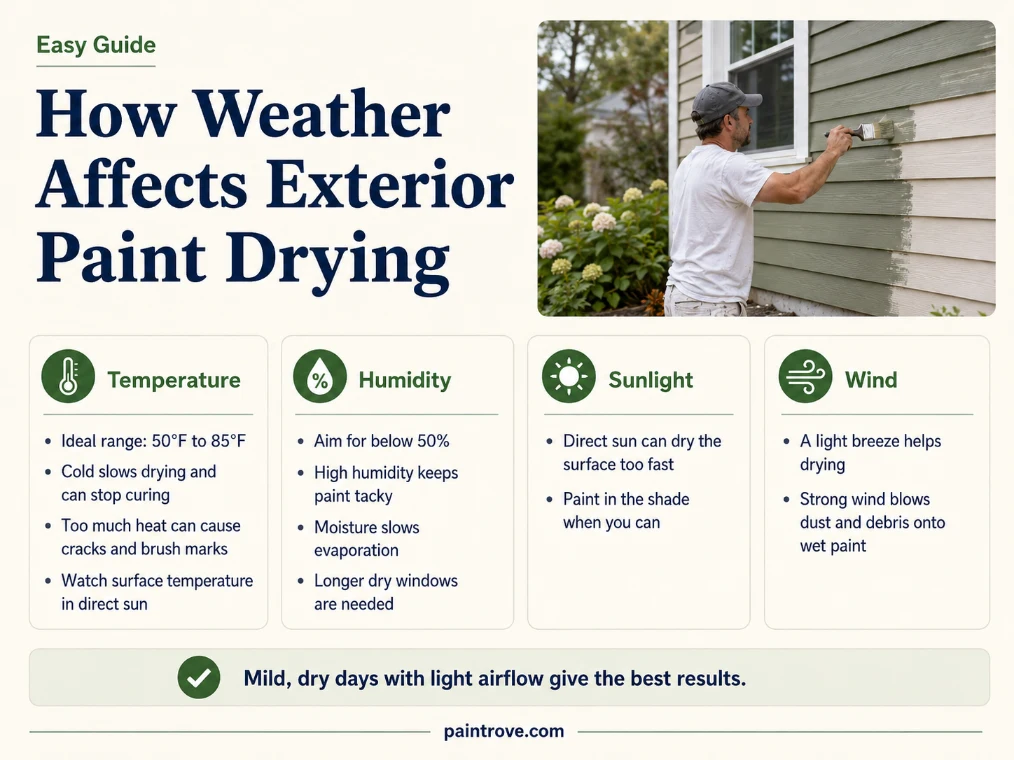
How Weather Affects Exterior Paint Drying
Outdoors, the weather is in charge. Four conditions matter most.
Temperature. The ideal range is 50°F to 85°F. Cold slows drying dramatically and can stop the paint from curing, causing peeling. Heat dries the surface too fast, leading to cracks and brush marks. Watch surface temperature too, since a wall in direct sun can be much hotter than the air.
Humidity. Aim for below 50%. High humidity keeps moisture from evaporating, so paint stays tacky, attracts dust, and may blush. Coastal and humid climates need longer dry windows.
Sunlight. Direct sun can dry the surface before the layer beneath sets. Paint in the shade when you can, following the shade around the house.
Wind. A light breeze speeds drying, but strong wind blows dust and debris onto wet paint. Gentle airflow is ideal.
How Long Should Exterior Paint Dry Before Rain?
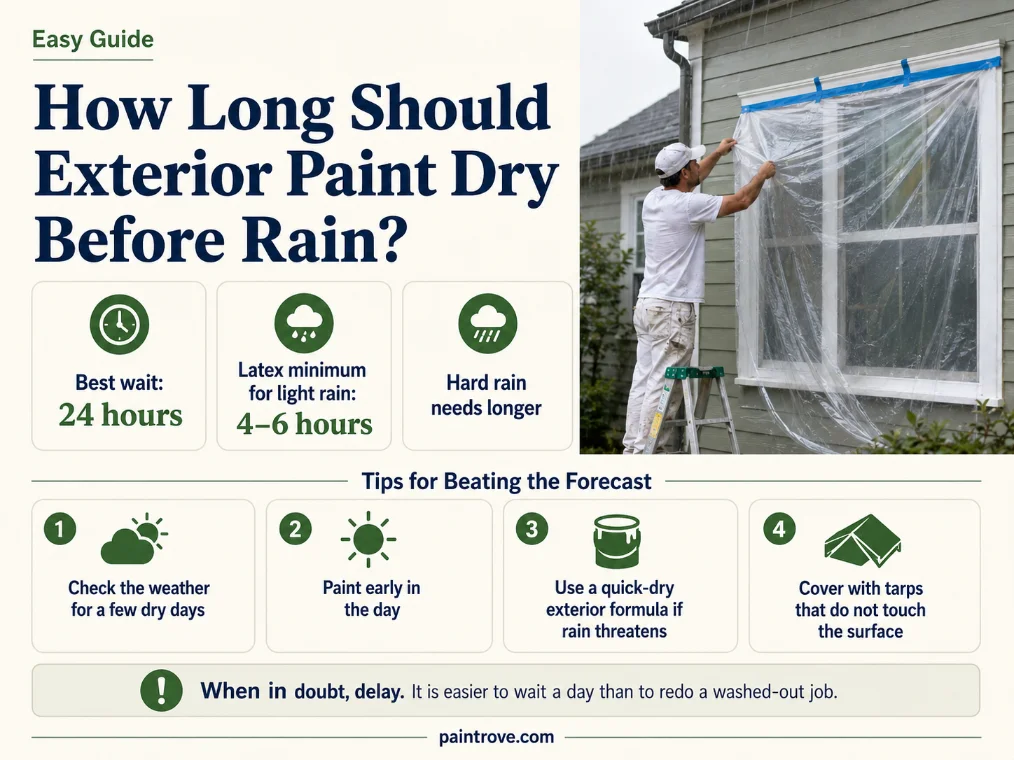
This is the big outdoor question. Rain on fresh paint can wash it off, or cause bubbling, streaking, and blistering.
The safe answer: wait 24 hours before expected rain for the best results, and ideally a window of dry weather. At an absolute minimum, latex paint needs 4 to 6 hours to survive light rain, while a hard rain needs more.
Tips for beating the forecast:
- Check the weather and look for at least a few dry days.
- Use a quick-dry exterior formula if rain threatens.
- Paint early in the day so the surface has daylight hours to dry.
- Cover painted areas with tarps if a surprise shower hits, secured so they don’t touch the surface.
When in doubt, delay. It’s far easier to wait a day than to redo a washed-out job.
Cold Weather and Surface Temperature Traps
Cold weather causes more exterior paint failures than almost anything else, and it’s often overlooked.
Even if the air warms up midday, surfaces that have been cold for months can stay below the paint’s minimum temperature. Retained moisture in the surface also blocks adhesion. It can take hours of sunshine before a wall is warm enough to paint.
A few cold-weather rules:
- Check the paint’s minimum temperature. Many need 35°F to 50°F; some newer paints allow 35°F application.
- Use a moisture meter and aim for a reading below 15%.
- Allow at least 4 hours before dew falls, and 24 hours before the temperature drops near freezing.
- Store paint somewhere warm overnight, not a cold garage.
For comparison, one popular premium paint recoats in 4 hours above 45°F, but needs 24 to 48 hours between 35°F and 40°F. Cold genuinely changes everything.
How to Speed Up Exterior Paint Drying
On a deadline or racing the weather? These help, safely.
- Apply thin coats. They dry far faster and more evenly than thick ones, and prevent runs.
- Paint in the sweet spot. Mild, dry days in the 60s and 70s with low humidity dry fastest.
- Use airflow. A natural breeze or a fan in sheltered areas speeds evaporation.
- Pick a quick-dry formula if rain or cold is a risk.
- Prime porous surfaces so they don’t drink up paint and dry unevenly.
- Follow the shade to avoid the surface drying too fast in direct sun.
Avoid forcing it with excessive direct heat, which causes cracking and poor adhesion.
Mistakes to Avoid
These are the errors that ruin exterior paint jobs.
- Don’t ignore the forecast. Rain or a cold snap within 24 hours can wreck fresh paint.
- Don’t recoat too soon. Trapped moisture between coats causes bubbling and peeling. For more on timing, see our guide on how long to wait between coats of paint.
- Don’t paint in extreme temperatures. Too cold means peeling; too hot means cracking.
- Don’t use interior paint outside. It won’t survive the elements.
- Don’t skip surface prep and drying. Wet or dirty surfaces won’t bond.
- Don’t wash the paint for 30 days. Let it cure fully first.
FAQs
How long does exterior paint take to dry?
Most acrylic latex exterior paint is dry to the touch in 1 to 4 hours and ready to recoat in 4 to 6 hours. Oil-based paint takes 6 to 8 hours to touch-dry and 24 hours before recoating. Full curing, when the paint reaches maximum hardness, takes up to 30 days for latex and 7 to 14 days for oil-based.
How long should exterior paint dry before a second coat?
For acrylic latex, wait 4 to 6 hours between coats. For oil-based paint, wait a full 24 hours. Cool temperatures and high humidity lengthen these times, so check the surface is fully dry first and follow the manufacturer’s label. Recoating too soon traps moisture and causes peeling and bubbling.
How long does exterior paint need to dry before rain?
Ideally, allow 24 hours of dry weather before rain for the best, most durable finish. At a minimum, latex paint needs about 4 to 6 hours to withstand light rain, while heavy rain needs longer. If a surprise shower threatens, cover the area with tarps that don’t touch the surface, or use a quick-dry formula.
Does exterior paint dry faster in heat or coldDoes exterior paint dry faster in heat or cold??
Exterior paint dries faster in warm, dry conditions, ideally 50°F to 85°F. Cold slows drying dramatically and can prevent curing, causing peeling. Very hot weather or direct sun can dry the surface too fast, leading to cracks and brush marks. Watch surface temperature, since walls in sun get much hotter than the air.
How long does exterior paint take to fully cure?
Full curing takes up to 30 days for acrylic latex paint and 7 to 14 days for oil-based paint, depending on weather. Curing is when the paint hardens completely and bonds to the surface. Even though it feels dry in hours, avoid washing or scrubbing the surface for about 30 days.
Can you paint the exterior of a house in cold weather?
Yes, but carefully. Many paints need a minimum of 35°F to 50°F, and surfaces stay colder than the air. Use a moisture meter (aim below 15%), paint midday when it’s warmest, allow 24 hours before the temperature nears freezing, and store paint somewhere warm. Some newer paints are formulated for 35°F application.
Why is my exterior paint still tacky?
Tacky exterior paint usually means high humidity, cold temperatures, or coats that were too thick. The moisture can’t evaporate, so the paint stays soft. Give it more time in warmer, drier conditions with good airflow. If it stays tacky for days, a too-thick coat may need to be removed and redone with thinner layers.
How long does exterior paint last once cured?
A quality exterior paint job typically lasts 5 to 10 years, depending on the paint, surface, climate, and prep. Premium acrylic latex on a well-prepped surface lasts longest. Sun exposure, moisture, and harsh weather shorten it. Good prep and full curing are the keys to maximum longevity.
Final Thoughts
So, how long does exterior paint take to dry? Plan on 1 to 4 hours to the touch and 4 to 6 hours to recoat for latex, or 6 to 8 hours and 24 hours for oil-based, with full curing stretching up to 30 days. Outdoors, the weather rules the timeline: aim for 50°F to 85°F, humidity below 50%, and a dry window of at least 24 hours before rain.
Work in thin coats, mind the temperature and surface conditions, and respect the difference between dry and cured. Get the timing right, and your exterior paint job will look sharp and protect your home for years to come.