What Colors Make Yellow? Light and Dark Shades
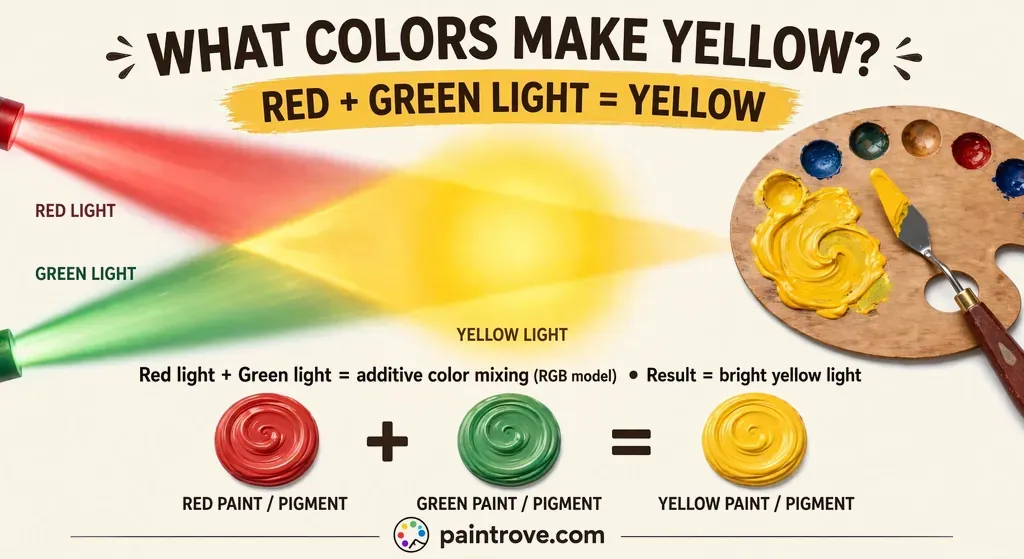
In paint, no colors make yellow. Yellow is a primary color in the red-yellow-blue model, which means it cannot be mixed from anything else. It has to come from a tube, a pigment or a dye.
In light, red and green make yellow. On a screen, yellow is full red plus full green with no blue at all, which is Hex #FFFF00 or RGB 255, 255, 0.
Those two answers sound contradictory and both are correct. They describe different systems: paint works by subtracting light, screens work by adding it. What colors make yellow depends entirely on which one you are working in, and most guides never make the distinction clear.
What you can always do is change a yellow you already have. This guide covers how to make yellow lighter, how to make it darker without turning it olive, every RGB and hex value you are likely to need, and the full range of yellow shades from butter to mustard.
What colors make yellow in paint?
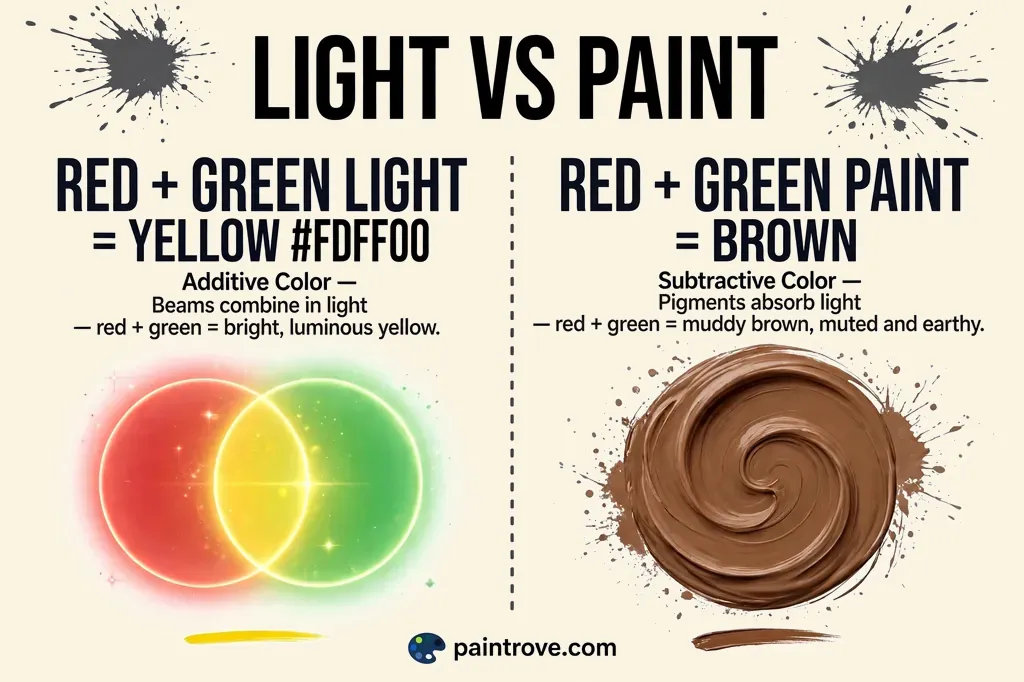
Nothing. This is the honest answer and it deserves to be stated plainly, because a surprising number of pages imply otherwise.
Yellow sits alongside red and blue as one of the three primary colors in the traditional model that paint mixing uses. Primaries are defined by the fact that they cannot be produced by combining other hues. Every other color on the color wheel descends from them: red and yellow give orange, blue and yellow give green, red and blue give purple.
So if a guide tells you to mix orange and green to get yellow, test it before trusting it. Orange contains red, green contains blue, and combining them gives you all three primaries in one place, which produces a muddy brown rather than yellow. The same applies to every other proposed shortcut.
Two things sometimes get mistaken for mixing yellow:
- Earth pigments. Yellow Ochre, Raw Sienna and Naples Yellow are naturally yellow minerals, not mixtures. They are muted and earthy rather than bright, which is why they read as “mixed” yellows to some people.
- Recovering a dulled yellow. If a yellow has been contaminated and gone greenish or brownish, adding fresh yellow restores it. That is correction, not creation.
The practical consequence: buy the yellow you need. A warm yellow such as Cadmium Yellow Deep and a cool yellow such as Lemon Yellow between them cover almost every mix you will want, since the color to mix for yellow-based secondaries depends far more on bias than on brand.
What RGB colors make yellow?
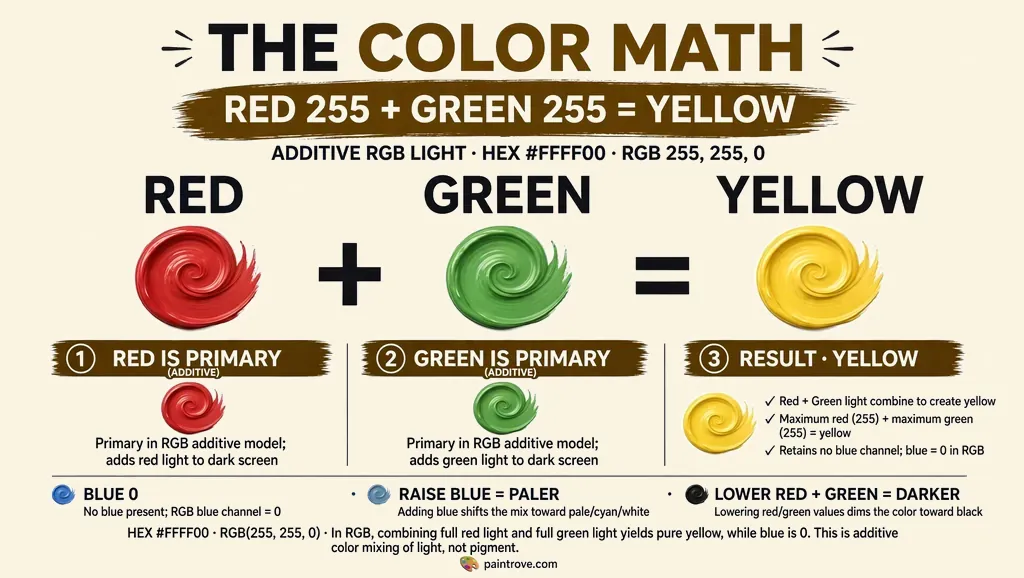
Red and green. RGB yellow is produced by firing the red and green subpixels at full intensity and leaving blue off entirely.
This surprises people because red and green paint make brown. The difference is additive versus subtractive mixing. Paint pigments absorb wavelengths, so each one you add removes more light and the mixture darkens. Light sources add wavelengths together, so each one you add brightens the result. The University of Wisconsin–Madison Ingersoll Physics Museum demonstrates both side by side.
In the additive model, yellow is not a primary at all. It is a secondary, made from two of the three light primaries, exactly as orange and purple are secondaries in paint. The three additive secondaries are yellow (red plus green), cyan (green plus blue) and magenta (red plus blue).
How to make yellow with RGB, in practice:
- Set red to 255
- Set green to 255
- Set blue to 0
Lowering both red and green together darkens the yellow toward olive. Raising blue desaturates it toward white or grey. Lowering green alone shifts it toward orange, and lowering red alone shifts it toward green.
Yellow RGB and hex codes
These are the values worth having to hand. The yellow RGB code most people are looking for is 255, 255, 0, and the full RGB for yellow across the family follows a single pattern set out below the table.
| Name | Hex | RGB | Notes |
|---|---|---|---|
| Yellow | #FFFF00 | 255, 255, 0 | The pure additive secondary |
| Light yellow | #FFFFE0 | 255, 255, 224 | CSS standard, near-white |
| Lemon chiffon | #FFFACD | 255, 250, 205 | Very pale, slightly warm |
| Cornsilk | #FFF8DC | 255, 248, 220 | Soft off-white yellow |
| Pale goldenrod | #EEE8AA | 238, 232, 170 | Muted, slightly green |
| Khaki | #F0E68C | 240, 230, 140 | Soft, dusty yellow |
| Moccasin | #FFE4B5 | 255, 228, 181 | Warm, peachy yellow |
| Mustard | #FFDB58 | 255, 219, 88 | Deep, warm, slightly brown |
| Gold | #FFD700 | 255, 215, 0 | Rich and metallic in feel |
| Saffron | #F4C430 | 244, 196, 48 | Deep warm yellow |
| Amber | #FFBF00 | 255, 191, 0 | Yellow leaning orange |
| Goldenrod | #DAA520 | 218, 165, 32 | Dark, earthy yellow |
| Dark khaki | #BDB76B | 189, 183, 107 | Muted olive-yellow |
| Olive | #808000 | 128, 128, 0 | The darkest true yellow family member |
The pattern in that table is worth noticing. Every yellow in RGB has red and green at similar values with blue lower. Raise blue and the color pales toward white. Drop red and green together and it darkens toward olive. That single relationship explains the whole yellow family in digital color.
Written as a yellow color RGB triplet, every member of the family keeps red and green within a few dozen points of each other. In CMYK, yellow is a primary ink rather than a mixture, printed as 0, 0, 100, 0. This is why yellow behaves as a primary in both paint and print but as a secondary on screens.
Butter yellow hex code and the soft yellow family
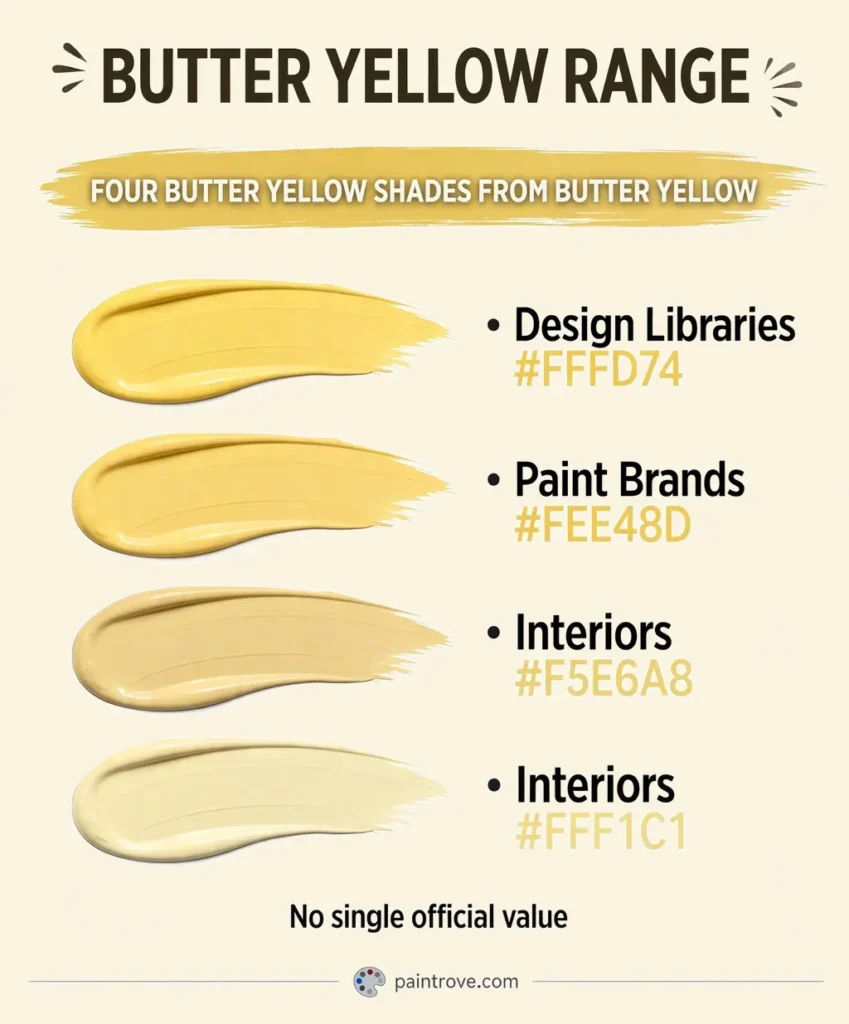
Butter yellow has become one of the most searched yellows, driven by its run as a fashion and interiors trend colour.
It has no single official value, which is worth knowing before you try to match it. It is a descriptive name rather than a standardised one, so sources differ:
| Source type | Approximate value |
|---|---|
| Design colour libraries | Around Hex #FFFD74, a soft bright butter |
| Paint brand equivalents | Paler and warmer, around Hex #FEE48D |
| Common interiors usage | Softer still, in the Hex #F5E6A8 to #FFF1C1 range |
If you need a butter yellow color code for a specific project, pick one and stay consistent rather than hunting for an authoritative answer that does not exist. For a digital palette, something in the Hex #FFF1C1 to #FFFD74 range reads as butter to most people.
To mix butter yellow in paint, start with a pale warm yellow such as Naples Yellow, or add titanium white to a Cadmium Yellow Light. A trace of yellow ochre warms it and stops it looking acidic.
How to make yellow lighter
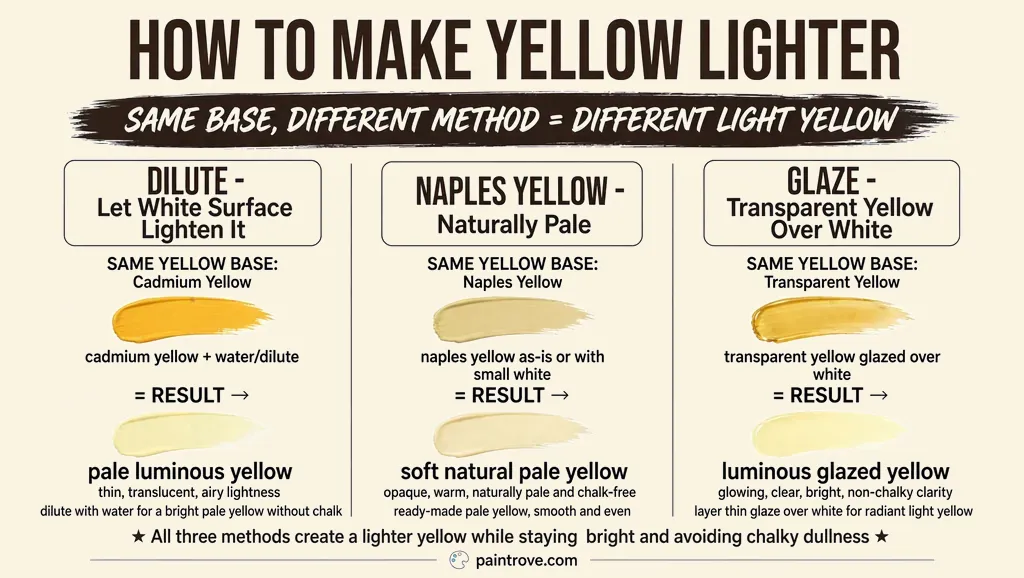
This is where most people go wrong, and the fix is counterintuitive.
Adding white does lighten yellow, but it also kills it. Yellow is already the lightest hue on the wheel, sitting at a high value naturally. White has nowhere much to raise it to, so instead of brightening it, white mostly drains the saturation and leaves a chalky, milky result.
Better routes to a light yellow:
- Dilute instead of tinting. In watercolor, ink or thin acrylic, thin the yellow and let the white of the surface do the lightening. This keeps it luminous.
- Use a paler yellow pigment. The simplest answer to how to make yellow color paler is to start with a paler one: Naples Yellow and Lemon Yellow are naturally lighter and cleaner than Cadmium Yellow Deep.
- Use a transparent yellow over white. Glazing a transparent yellow over a white ground gives a glow that no opaque tint can match.
- If you must use white, use it sparingly. Fold the yellow into white rather than white into yellow, and stop early.
What colors make yellow light in the digital sense is simpler: raise the blue channel. Light yellow at Hex #FFFFE0 is just pure yellow with blue lifted from 0 to 224.
| Light yellow target | How to mix it |
|---|---|
| Pale buttery yellow | Naples Yellow, or Cadmium Yellow Light with a little white |
| Luminous light yellow | Transparent yellow thinned over a white ground |
| Cream | Yellow plus white plus the smallest trace of ochre |
| Pastel lemon | Lemon Yellow with white, kept cool |
How to make yellow darker
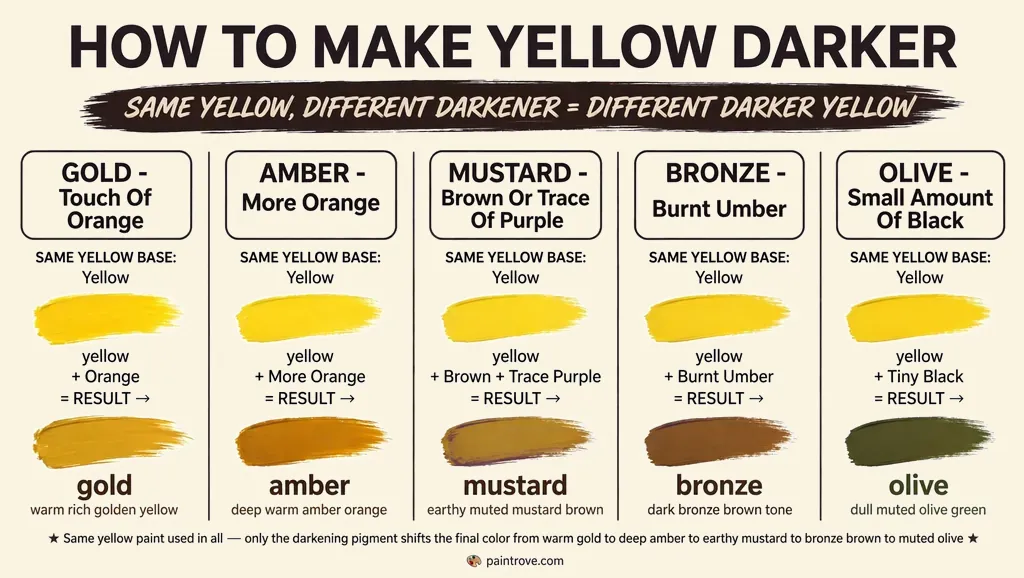
The opposite problem, and it has a genuine trap in it.
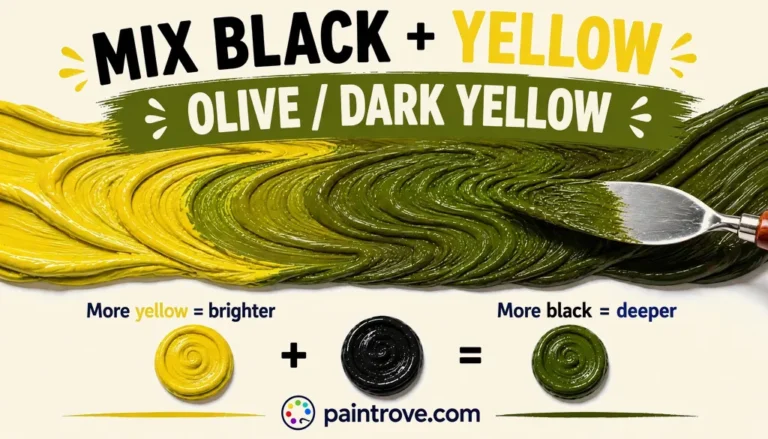
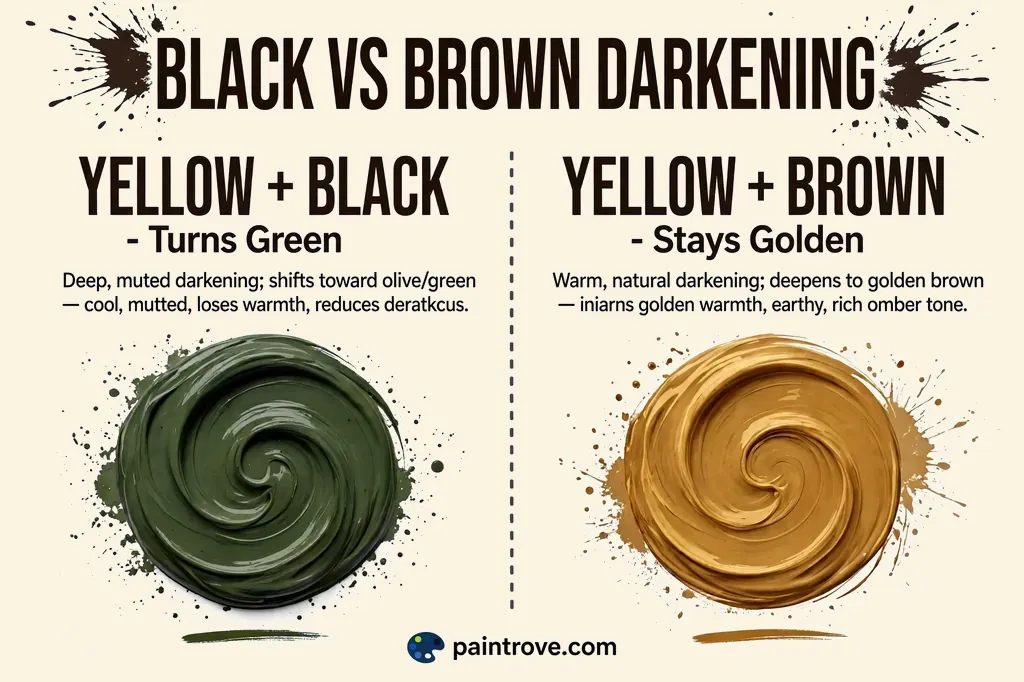
Adding black to yellow does not give dark yellow. It gives green. Most black pigments carry a cool, slightly blue or green undertone, and blue plus yellow makes green. This is the single most common yellow-mixing mistake, and it is why a “dark yellow” mixed with black so often comes out looking like army olive.
Routes that actually work:
- Yellow ochre or raw umber. These darken yellow while keeping it in the yellow family, giving mustard and bronze tones.
- A touch of orange or red. This darkens by increasing warmth rather than by adding grey, producing amber, saffron and gold.
- A trace of purple. Purple is yellow’s complement, so it darkens and neutralizes at once. Use very little, and expect a muted result rather than a rich one. The full behaviour is covered in what purple and yellow make, which lands on muddy brown when overdone.
- Brown. The most reliable route to mustard and golden tan, covered in brown and yellow mixed.
| Dark yellow target | How to mix it |
|---|---|
| Gold | Yellow plus a touch of orange or ochre |
| Amber | Yellow plus more orange |
| Mustard | Yellow plus brown, or yellow plus a trace of purple |
| Bronze | Yellow plus burnt umber |
| Olive | Yellow plus a small amount of black or green |
If you want olive deliberately rather than accidentally, that is the one case where black works, and the relationship is the same one shown in yellow and green mixed.
Shades of yellow, from lightest to darkest
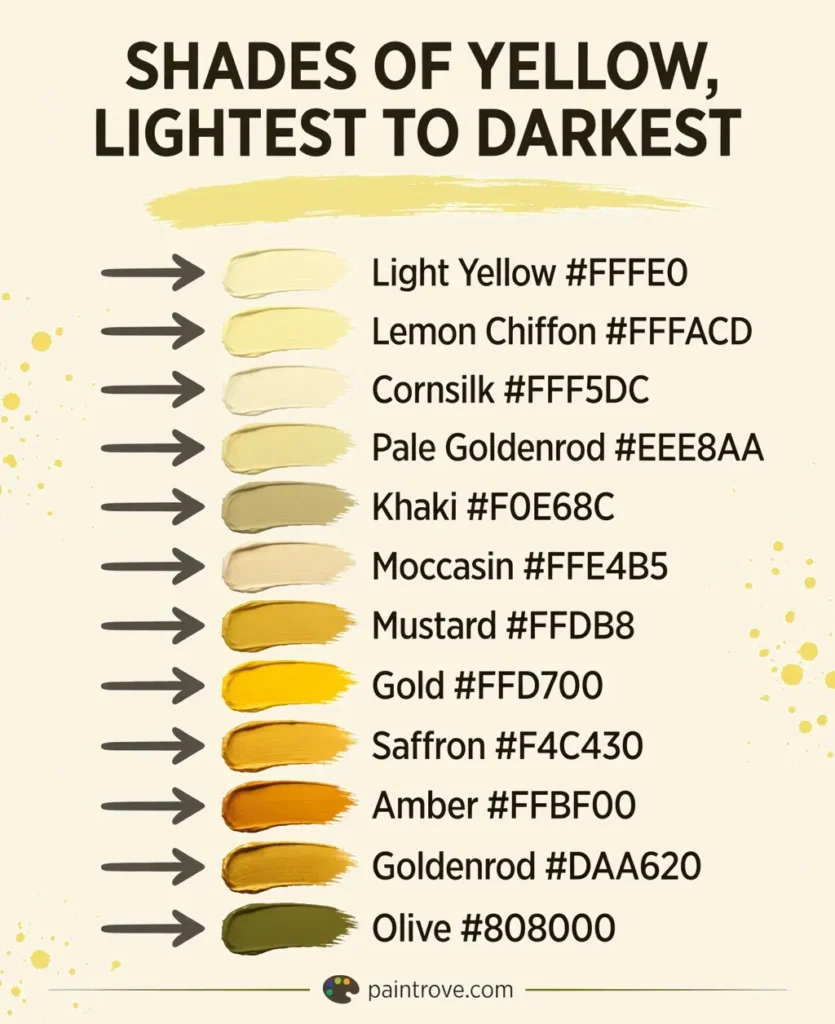
Yellow shades run from near-white through to olive, which most people do not think of as yellow at all, so the family is unusually wide. The shades of yellow below are grouped by the adjustment each one needs.
Pale yellows: light yellow, lemon chiffon, cornsilk, cream, vanilla, butter yellow, blonde.
Bright yellows: yellow, lemon, canary, school bus yellow, daffodil.
Warm yellows: gold, saffron, amber, marigold, honey, maize.
Muted and earthy yellows: khaki, flax, yellow ochre, Naples yellow, pale goldenrod.
Dark yellows: goldenrod, mustard, bronze, dark khaki, olive.
Those five groups are more useful than a long alphabetical list, because they tell you which adjustment to reach for. Pale yellows come from dilution or a pale pigment. Bright yellows come straight from the tube. Warm yellows come from adding orange or red. Muted yellows come from earth pigments or a trace of the complement. Dark yellows come from brown or umber.
Why yellow is harder to work with than other colors
Three properties make yellow behave differently, and knowing them saves a lot of frustration.
It has the highest value of any hue. Yellow is naturally light, so there is very little room to lighten it further and a great deal of room to darken it. Every adjustment downward is dramatic.
It is easily contaminated. Because it sits at the extreme light end, any darker pigment entering the mix shows immediately. A brush that still holds a trace of blue will turn a pool of yellow green in one stroke. Clean your brush more carefully for yellow than for anything else.
Its bias matters enormously in secondary mixes. A warm yellow such as Cadmium Yellow Deep leans toward orange and mixes clean oranges but dull greens. A cool yellow such as Lemon Yellow leans toward green and mixes bright greens but dull oranges. This is why blue and yellow make green at very different levels of brightness depending on which yellow you reach for, and the same logic governs the complementary relationships explained in complementary colors.
Common problems and fixes
My yellow turned green. Something blue or green entered the mix, most often from a dirty brush, dirty water, or black paint with a cool undertone.
My yellow looks chalky. Too much white. Yellow does not tint well. Start again and lighten by dilution or with a paler pigment instead.
My yellow went brown. All three primaries are present. A yellow with red and blue content in the mixture will always neutralize toward brown.
I cannot get a bright enough yellow. You are probably working over a dark or coloured ground. Yellow has very poor covering power over dark surfaces. Lay white underneath first.
My dark yellow looks like army green. You used black. Switch to brown, umber or a touch of orange.
Frequently asked questions
What colors make yellow?
In paint, none. Yellow is a primary color in the red-yellow-blue model and cannot be mixed from other hues. In light, red and green make yellow, which is why screens show yellow as RGB 255, 255, 0. In printing, yellow is a primary ink rather than a mixture.
What two colors make yellow?
Red and green, but only as light. Asked as what 2 colors make yellow in paint, the answer is none. On a screen, full red plus full green with no blue produces yellow at Hex #FFFF00. In paint the same two colors make brown, because pigments subtract light rather than adding it. There is no pair of paints that produces yellow.
What RGB colors make yellow?
Red at 255 and green at 255, with blue at 0. Yellow is a secondary color in the additive model, formed from two of the three light primaries. Lowering red and green together darkens it toward olive, while raising blue desaturates it toward white.
What is the yellow RGB code?
Yellow in RGB is 255, 255, 0, which is Hex #FFFF00. Light yellow is 255, 255, 224 and gold is 255, 215, 0. In every yellow, red and green sit at similar values with blue lower, which is the defining pattern of the yellow family in digital color.
How to make yellow colour lighter without it going chalky?
Dilute it rather than tinting it, or switch to a naturally paler pigment such as Naples Yellow. White drains yellow’s saturation because yellow is already the lightest hue and has little room to be raised, so a heavily tinted yellow reads as milky rather than bright.
How do you make dark yellow?
The reliable route to how to make yellow color darker is yellow ochre, raw umber, brown or a small amount of orange. Avoid black, which carries a cool undertone and turns yellow green rather than dark. A trace of purple, yellow’s complement, darkens and mutes at the same time and gives mustard tones.
What is the butter yellow hex code?
There is no single standard value. Design colour libraries place it around Hex #FFFD74, paint brand equivalents sit paler around Hex #FEE48D, and interiors usage often runs softer still, between Hex #F5E6A8 and #FFF1C1. Pick one value and stay consistent across a project.
What colors make yellow light in paint?
Nothing lightens yellow well. Dilution in a transparent medium is the best route, letting the white of the surface raise the value. A pale pigment such as Naples Yellow is the next best option. Titanium white works only in very small amounts before the result turns chalky.
Can you mix orange and green to make yellow?
No. Orange contains red and green contains blue, so combining them puts all three primaries in the mixture, which neutralizes toward brown. This claim appears on several colour sites and does not hold up in practice. Yellow has to come from a yellow pigment.
What are the main shades of yellow?
Yellow shades fall into five useful groups: pale yellows such as cream and butter, bright yellows such as lemon and canary, warm yellows such as gold and amber, muted yellows such as khaki and ochre, and dark yellows such as mustard and olive. Each group needs a different adjustment to reach.
Why does my yellow keep turning green?
Blue contamination. Yellow sits at the extreme light end of the value range, so even a trace of a darker, cooler pigment shows immediately. A brush holding leftover blue, dirty water, or a black with a cool undertone will all turn yellow green in a single stroke.
Is yellow a primary color?
In paint and in printing, yes. In the red-yellow-blue model used for pigment and the CMYK model used for ink, yellow is a primary that cannot be mixed. On screens it is a secondary, made from red and green light. The answer genuinely depends on which colour system you mean.
Yellow at a glance
| If you want | Do this |
|---|---|
| Yellow in paint | Buy it; it cannot be mixed |
| Yellow on screen | Red 255, green 255, blue 0 |
| A light yellow | Dilute, or use Naples Yellow; avoid heavy white |
| Butter yellow | Pale warm yellow, around Hex #FFF1C1 to #FFFD74 |
| Gold or amber | Add a touch of orange or ochre |
| Mustard | Add brown, or a trace of purple |
| Olive or dark khaki | Add a small amount of black or green |
| A clean bright yellow | Clean brush, white ground, straight from the tube |
What colors make yellow has two correct answers depending on the system: none in paint, because yellow is a primary, and red plus green in light. Three things are worth remembering: yellow cannot be mixed in pigment, white makes it chalky rather than brighter, and black turns it green instead of dark.