How Long Does Paint Last? Know Before You Use Old Paint
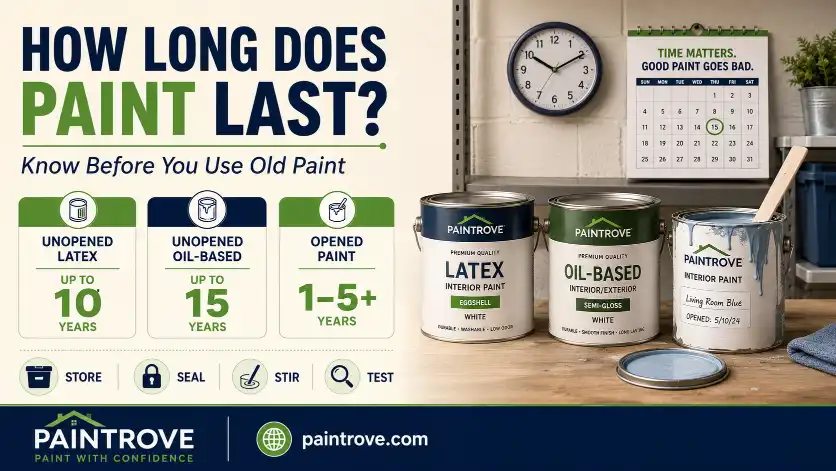
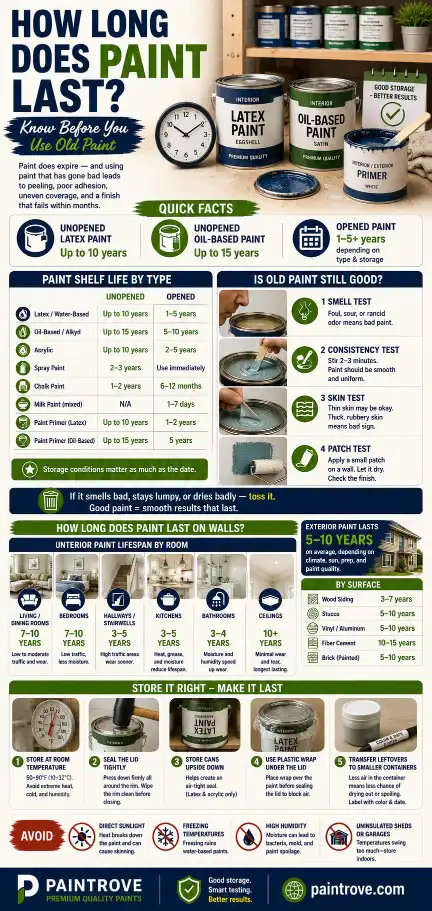
How Long Does Paint Last? How long paint lasts depends on two things: whether the can has been opened, and how it has been stored. Unopened latex paint lasts up to 10 years. Unopened oil-based paint lasts up to 15 years.
Once opened, both types shrink to 1–5 years depending on storage conditions. On walls, interior paint lasts 5–10 years and exterior paint lasts 5–10 years before it needs refreshing. Paint does expire — and using paint that has gone bad leads to peeling, poor adhesion, uneven coverage, and a finish that fails within months.
Paint Shelf Life by Type: Quick Reference
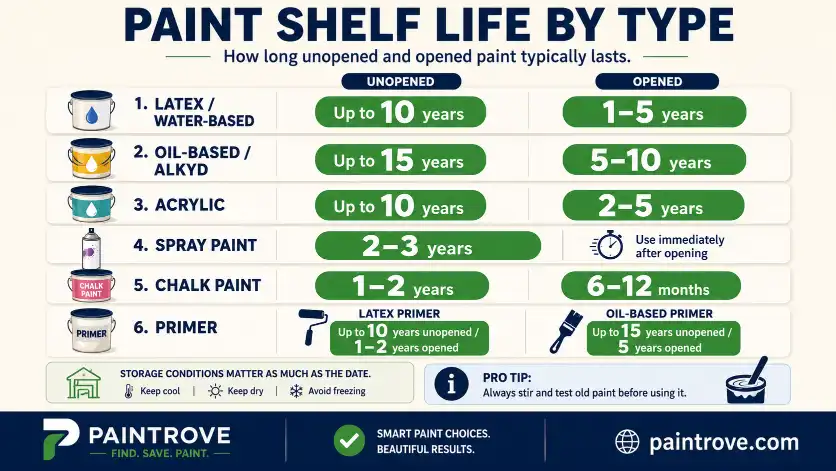
| Paint Type | Unopened | Opened |
|---|---|---|
| Latex / water-based | Up to 10 years | 1–5 years |
| Oil-based / alkyd | Up to 15 years | 5–10 years |
| Acrylic | Up to 10 years | 2–5 years |
| Spray paint | 2–3 years | Use immediately |
| Chalk paint | 1–2 years | 6–12 months |
| Milk paint (mixed) | N/A | 1–7 days |
| Paint primer (latex) | Up to 10 years | 1–2 years |
| Paint primer (oil-based) | Up to 15 years | 5 years |
These are general benchmarks. Sherwin-Williams estimates a 1-year shelf life for some of its latex lines. PPG (maker of Glidden paints) estimates 2 years for unopened latex. Benjamin Moore and Behr do not publish expiration dates on cans — use the test method below to determine usability.
How Long Does Latex Paint Last?
Unopened latex paint lasts up to 10 years when stored properly in a cool, dry location away from temperature extremes. Once opened and resealed, expect 1 to 5 years of usable life — the wide range depends on how tightly the lid was resealed and how consistent the storage conditions are.
Latex paint is water-based, which makes it more vulnerable than oil-based paint in two ways. First, freezing temperatures permanently damage the emulsion — a can that has frozen and thawed will produce streaky, inconsistent coverage even if it looks normal after mixing. Second, bacteria thrive in the moist, dark environment of a sealed paint can. Modern low-VOC and zero-VOC latex formulas are more susceptible to bacterial growth than older formulations because they contain fewer preservative chemicals. Bacteria break down the paint’s binder compounds — the result is reduced adhesion and a tendency to streak or peel shortly after application.
Signs latex paint has gone bad: foul or sour odor, visible mold on the surface, a thick skin that will not mix back in, or chunky lumps that remain after thorough stirring.
How Long Does Oil-Based Paint Last?
Unopened oil-based paint lasts up to 15 years. After opening, a properly resealed can holds for 5 to 10 years — significantly longer than latex. The solvent base in oil-based paint (mineral spirits or linseed oil) resists both freezing and bacterial growth, which is why it outlasts water-based alternatives in storage.
The risk with oil-based paint is oxidation, not bacteria. Once a can is opened, air contact begins hardening the surface of the paint. If the lid is not sealed tightly — pressed down firmly across the full rim — a thick skin forms within days. That skin can often be removed with a paint strainer to reveal usable paint underneath, but repeated skin formation degrades the overall quality.
Signs oil-based paint has gone bad: rock-hard skin that has penetrated deep into the can, a strong rancid or chemical odor beyond the normal solvent smell, or paint that will not return to a smooth consistency after 5 minutes of mixing with a paint mixer tool.
Does Paint Expire?
Yes. Paint expires — though it does not have a printed expiration date on the can the way food does. The shelf life depends on the type, the seal, and where it has been kept.
The three main failure mechanisms:
Bacterial growth (latex paint): Bacteria need moisture, darkness, and warmth — conditions inside any paint can in a garage or shed. They break down the binders, causing adhesion failure and streaking.
Solvent evaporation (oil-based paint): Even in a sealed can, solvents slowly evaporate over years, thickening the paint and changing its application properties.
Freeze-thaw damage (any water-based paint): Latex and acrylic paints are permanently damaged by freezing. The pigment and binder separate and cannot be recombined. The result looks like cottage cheese when opened.
How to Tell If Paint Is Still Good
Do not rely on the purchase date alone. Run these tests before using old paint.
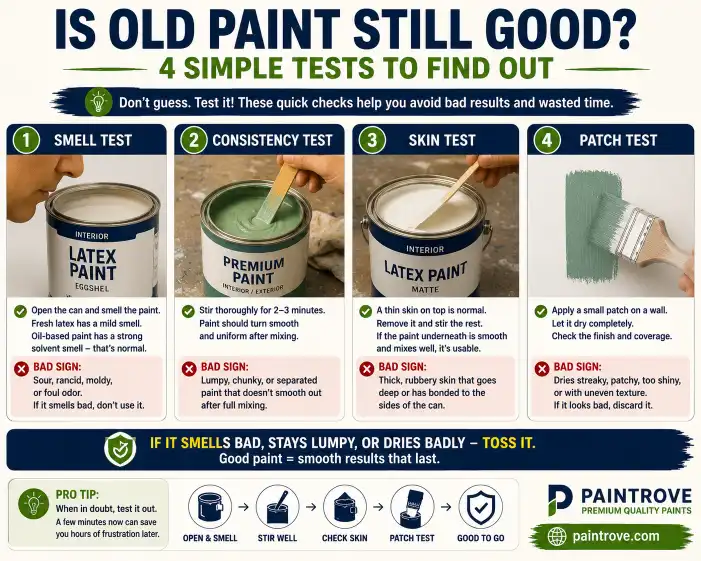
The smell test: Open the can and check for a foul, sour, or rancid odor. Fresh latex paint has a mild chemical smell. Oil-based paint has a strong solvent smell — that is normal. A spoiled smell — think sour milk, sulfur, or mold — means the paint has gone bad. Do not use it.
The consistency test: Stir the paint thoroughly for 2–3 minutes with a stir stick or paint mixer tool. Pigment settling is normal — that is just gravity at work. After thorough mixing, the paint should return to a smooth, uniform consistency. If clumps remain after full mixing, or if the paint is lumpy and thick throughout (not just on the surface), it cannot be restored.
The skin test: A thin skin on the surface of latex paint is normal after storage. Lift it out with a paint strainer or a stick and stir what remains. If the paint under the skin is smooth and mixes cleanly, it is still usable. A thick, rubbery skin that has bonded to the sides of the can and extends deep into the paint indicates the can has been compromised.
The patch test: If the paint passes the smell and consistency tests but you are still unsure, apply a small test patch on an inconspicuous section of wall. Let it dry completely. If it dries evenly with good coverage and no unusual texture, the paint is fine. If it dries streaky, shiny in patches, or with an odd texture, discard it.
How Long Does Paint Last on Walls?
Paint on walls has a different lifespan than paint in a can. Once applied, the question is not expiration but durability — how long before it fades, chips, peels, or needs refreshing.
Interior Paint Lifespan by Room
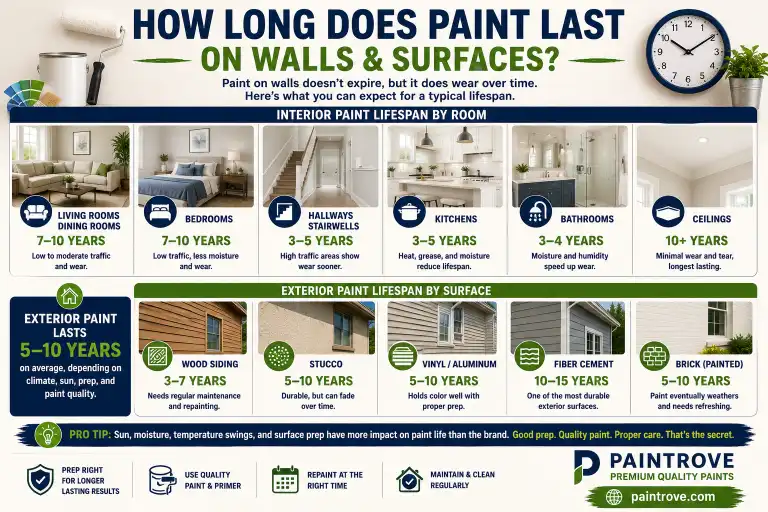
Interior paint lasts 5 to 10 years on average, but high-traffic and high-humidity rooms wear faster.
| Room | Average Repaint Frequency |
|---|---|
| Living rooms, dining rooms | 7–10 years |
| Bedrooms | 7–10 years |
| Hallways, stairwells | 3–5 years (high traffic) |
| Kitchens | 3–5 years |
| Bathrooms | 3–4 years (humidity damage) |
| Ceilings | 10+ years |
Kitchens and bathrooms fail sooner because of ongoing moisture, grease, and steam exposure. High-humidity rooms need paint specifically formulated for moisture resistance — standard eggshell or flat paint in a bathroom will begin peeling within 1–2 years.
High-traffic areas like hallways and stairwells show scuffs, marks, and scratches faster because they take more physical contact. A semi-gloss or satin finish holds up better in these spaces than flat or matte — the higher binder content resists abrasion.
How Long Does Exterior Paint Last?
Exterior paint lasts 5 to 10 years under typical conditions, with a wide range depending on siding material, climate, and paint quality.
| Surface Material | Exterior Paint Lifespan |
|---|---|
| Wood siding | 3–7 years |
| Stucco | 5–10 years |
| Aluminum or vinyl siding | 5–10 years |
| Fiber cement (Hardie Board) | 10–15 years |
| Brick | 3–5 years |
| Metal siding | 10 years |
| Concrete / masonry | 5–10 years |
South and west-facing walls receive the most direct sunlight and fade fastest — noticeable fading after 5–7 years on these walls usually signals the final third of the paint’s useful life. In coastal salt spray environments, paint on exposed metal and wood surfaces degrades significantly faster. In climates with repeated freeze-thaw cycles, paint on wood siding can begin cracking at the 3–5 year mark.
Signs Your Painted Walls Need Repainting
Fading or discoloration. Color appears washed out or uneven, particularly on sun-facing walls. Fading is cosmetic at first but indicates the paint film is breaking down.
Scratches and marks that won’t clean off. Scuffs that resist washing with a mild soap solution mean the paint has worn past its washable surface and the underlying film is compromised.
Peeling paint. Paint peeling away from the surface means adhesion has failed — from moisture, poor initial prep, or age. Peeling requires scraping back to sound material before repainting.
Bubbling paint. Bubbles form when moisture is trapped beneath the paint film. On interior walls, this often signals a plumbing leak or condensation problem. On exterior walls, it indicates water infiltration behind the siding.
Stubborn stains. Stains that can’t be cleaned with standard household cleaners and show through touch-ups indicate the paint film has been saturated. A stain-blocking primer coat before repainting is essential.
Powdery residue (chalking). A chalky white powder on exterior painted surfaces — especially brick — results from UV degradation of the paint binder. The paint is releasing its pigment as it breaks down.
How Long Does Paint Last on a Car?
Paint on a car lasts 10 to 15 years under normal conditions with regular maintenance, though the clear coat on most modern vehicles begins showing wear at the 5 to 7 year mark. A professional automotive paint job lasts 10 to 20 years depending on exposure, maintenance, and paint quality.
Factors that shorten automotive paint life:
- Constant sun exposure without protective wax or ceramic coating
- Parking outdoors in climates with harsh UV, acid rain, or salt spray
- Bird droppings, tree sap, and road tar left on the surface — these etch the clear coat chemically within days
- Automatic car washes with abrasive brushes that create micro-scratches over time
After a fresh paint job, avoid washing the car for the first 30 days and skip wax until the 90-day mark — automotive paint takes 90 days to fully cure and harden.
How Long Does Paint Last in Storage? 5 Proven Tips
Storage conditions determine whether your leftover paint is still usable in 2 years or ruined in 6 months. These practices extend paint shelf life significantly.
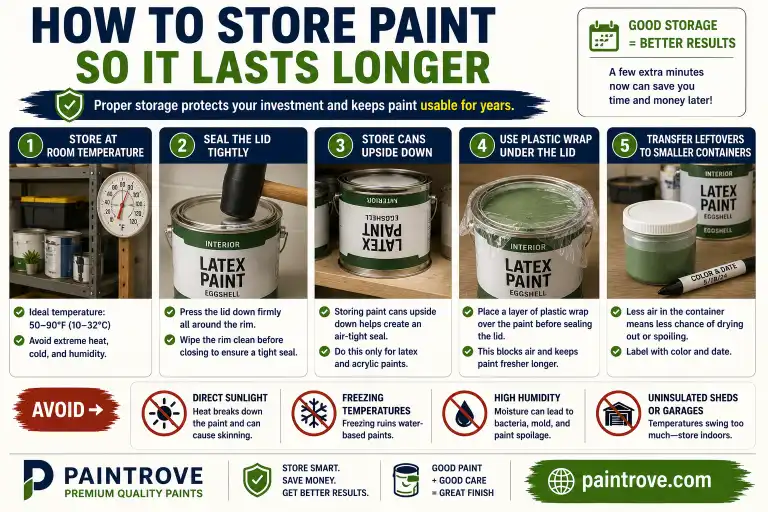
1. Store at room temperature, away from extremes. The ideal storage temperature for latex paint is 60°F to 75°F (15°C to 24°C). A basement that stays cool year-round is better than a garage that freezes in winter and bakes in summer. Temperature fluctuations — not just cold — degrade paint faster than steady cool conditions.
2. Seal the lid properly. Before sealing, wipe the rim of the can clean of any paint. Dried paint on the rim prevents a complete seal. Press the lid down firmly and evenly — tap around the full perimeter with a rubber mallet, not just in one spot. Paint can rust develops at the rim when moisture contacts the metal under a poor seal.
3. Store cans upside down. Storing a paint can upside down creates a seal of paint along the lid interior. This slows both evaporation and skin formation. Flip it right-side up before opening to allow the skin to settle before stirring.
4. Use plastic wrap under the lid. Cut a circle of plastic wrap and lay it directly on the paint surface before sealing. The plastic wrap prevents oxygen from reaching the paint and dramatically slows skin formation — especially effective for oil-based paints.
5. Transfer small amounts to smaller containers. If you have a quarter-can of leftover paint, transfer it to a smaller container — a mason jar works well — so there is minimal air space above the paint. Air is the enemy of stored paint. A full jar with a tight lid stores far better than a nearly empty gallon can with a large air gap.
How Long Does Paint Last if Stored Improperly?
Paint stored in a garage that experiences below-freezing temperatures over winter is likely permanently damaged by the following spring — even if it has been there less than a year. The emulsion in latex paint breaks down irreversibly after one freeze-thaw cycle. The result: cottage-cheese-like chunks that will not mix smooth.
Paint stored in direct sunlight on a deck or shed that reaches high summer temperatures will thicken and partially cure in the can. The binder begins crosslinking from the heat even without being applied to a surface. This paint may look normal when opened but will apply poorly — dragging, pulling, and drying with an uneven texture.
Paint stored in poorly ventilated sheds with high humidity is at high risk for paint can rust at the rim, which contaminates the paint and accelerates bacterial growth.
The short answer: a can that has been through any of these conditions should be tested with the smell, consistency, and patch test before use on any visible surface.
Can You Use Expired Paint?
Old paint that passes all three tests — smell, consistency, and patch — is safe to use. Age alone does not disqualify paint. A 15-year-old can of oil-based paint stored in stable, moderate conditions can perform as well as a freshly purchased can.
Old paint that fails any of the three tests should not be used. The risks:
- Uneven or blotchy finish from degraded binder
- Poor adhesion leading to peeling within months
- Longer or incomplete drying time
- A lingering foul odor in the painted room
- Potential mold or bacterial contamination in painted surfaces
If the paint is borderline — slightly thick but no bad smell, mixes smooth — a paint conditioner can help restore workability. Floetrol works for latex; Penetrol works for oil-based. These do not restore expired paint, but they improve the application of paint that is slightly past its prime.
How to Dispose of Old Paint
Paint that has failed its tests needs to go. Do not pour liquid paint down the drain — it is regulated as a hazardous material in most areas.
Latex paint disposal options:
- Allow the paint to dry completely by opening the lid and leaving it in a ventilated area — once fully hardened, dried latex paint can go in regular trash in most municipalities
- Use a commercial paint hardener (available at Home Depot and Lowe’s) to accelerate drying
- Donate usable paint to a local Habitat for Humanity ReStore, community paint swap, or similar program
Oil-based paint disposal:
- Oil-based paint is classified as hazardous waste and cannot go in regular trash in any liquid form
- Take it to your local household hazardous waste collection site — most municipalities run collection days several times per year
- Rust-Oleum, Behr, and other manufacturers sometimes offer recycling programs — check the brand’s website
Never pour any paint — latex or oil — down a sink drain, toilet, or storm drain. Paint pigments and binders contaminate water systems.
How Long Does Paint Last on Different Surfaces?
| Surface | Interior Paint Lifespan | Exterior Paint Lifespan |
|---|---|---|
| Drywall (living rooms, bedrooms) | 7–10 years | N/A |
| Drywall (bathrooms, kitchens) | 3–5 years | N/A |
| Wood trim and baseboards | 5–7 years | 3–7 years |
| Wood siding | N/A | 3–7 years |
| Vinyl siding | N/A | 5–10 years |
| Concrete / masonry | 5–10 years | 5–10 years |
| Metal | 5–10 years | 5–10 years |
| Furniture (painted wood) | 3–5 years (high use) | N/A |
| Vehicle (automotive paint) | N/A | 10–20 years |
What Makes Paint Last Longer on Walls?
Start with proper surface prep. Paint applied to dusty, greasy, or improperly primed surfaces fails faster than paint applied to a clean, primed surface. Poor surface prep is the leading cause of early paint failure — peeling, chipping, and bubbling all trace back to it.
Use high-quality paint. Premium paints from Benjamin Moore, Sherwin-Williams, and Behr — lines like Behr Dynasty, Valspar Reserve, and HGTV Home by Sherwin-Williams — contain more binder and UV stabilizers than budget options. They cost more per gallon and last 2–3 years longer on average. Consumer Reports testing consistently shows premium paint lines outperforming budget lines in scrub resistance and color retention over time.
Match the finish to the room. Flat and matte finishes in high-traffic or high-humidity rooms wear faster and are harder to clean. Use eggshell or satin in kitchens, bathrooms, hallways, and stairwells. Use semi-gloss on all trim, baseboards, window frames, and doors — the higher binder content resists impact and moisture far better.
Apply two proper coats over primer. One thick coat is not equal to two thin coats. Two coats cure harder, provide better hide, and resist scrubbing and impact better. Primer seals the surface, improves adhesion, and extends the topcoat’s life.
Maintain the painted surface. Wash walls with a mild soap solution periodically — especially in kitchens and hallways. Touch up chips and scratches before they expand. Seal exterior caulking annually around windows and trim to prevent moisture infiltration.
FAQs
How long does paint last if never opened?
Latex paint: up to 10 years. Oil-based paint: up to 15 years. These estimates assume the paint has been stored in stable conditions — moderate temperature, away from freezing, out of direct sunlight.
How long does paint last after opening?
Latex paint: 1–5 years with a proper seal. Oil-based paint: 5–10 years. Both shrink significantly once opened because air contact begins degradation.
How long does a 5 gallon bucket of paint last?
The same as any other container — the volume does not change the chemistry. A 5-gallon bucket of latex paint lasts up to 10 years unopened and 1–5 years after opening. The larger the container, the more critical a complete lid seal becomes — air gaps in partially used 5-gallon buckets accelerate degradation.
How long does paint last on a house exterior?
5 to 10 years is the standard range. Wood siding repaints every 3–7 years. Fiber cement and vinyl siding can go 10–15 years with quality paint and thorough prep.
How long should you wait before putting a second coat of paint?
For latex paint: minimum 2 hours, ideally 4. For oil-based paint: 24 hours. Applying a second coat too soon traps moisture in the first coat and causes peeling.
Does paint last longer in a sealed container?
Yes. Every time a can is opened, moisture and oxygen enter and accelerate degradation. Minimize how often you open stored paint and reseal the lid completely each time.
Is paint still good if it has separated?
Separation — pigment sinking to the bottom — is normal in stored paint. Stir thoroughly for 2–3 minutes. If the paint returns to a smooth, uniform consistency, it is usable. If lumps remain or the smell is foul, discard it.
The Bottom Line
Paint does go bad — but not as fast as most people assume when stored correctly. Unopened latex paint at room temperature, away from freezing and direct sunlight, is good for up to 10 years. Oil-based paint lasts up to 15. Open cans degrade faster, but proper resealing and stable storage extends usable life to 1–5 years for latex and up to 10 for oil-based.
On walls, interior paint holds for 5–10 years with proper prep and quality product. Exterior paint lasts the same, with wood siding and high-sun exposures at the shorter end. The biggest factors are not time — they are surface prep, paint quality, and the conditions the painted surface lives in every day.
Before using old paint, smell it, stir it, and patch test it. Two minutes of testing is cheaper than repainting a wall that failed three months later.
Related Articles:
- How to Paint a Room: 7 Proven Steps to a Perfect Finish
- How Long Does Paint Take to Dry? Every Surface, Every Paint Type
- How to Fix Chipped Paint on a Wall: A Complete Repair Guide
- Best Paint Finishes: Flat vs. Eggshell vs. Satin vs. Semi-Gloss
- How to Store Leftover Paint So It Lasts