What Color Do Green and Gray Make When Mixed?
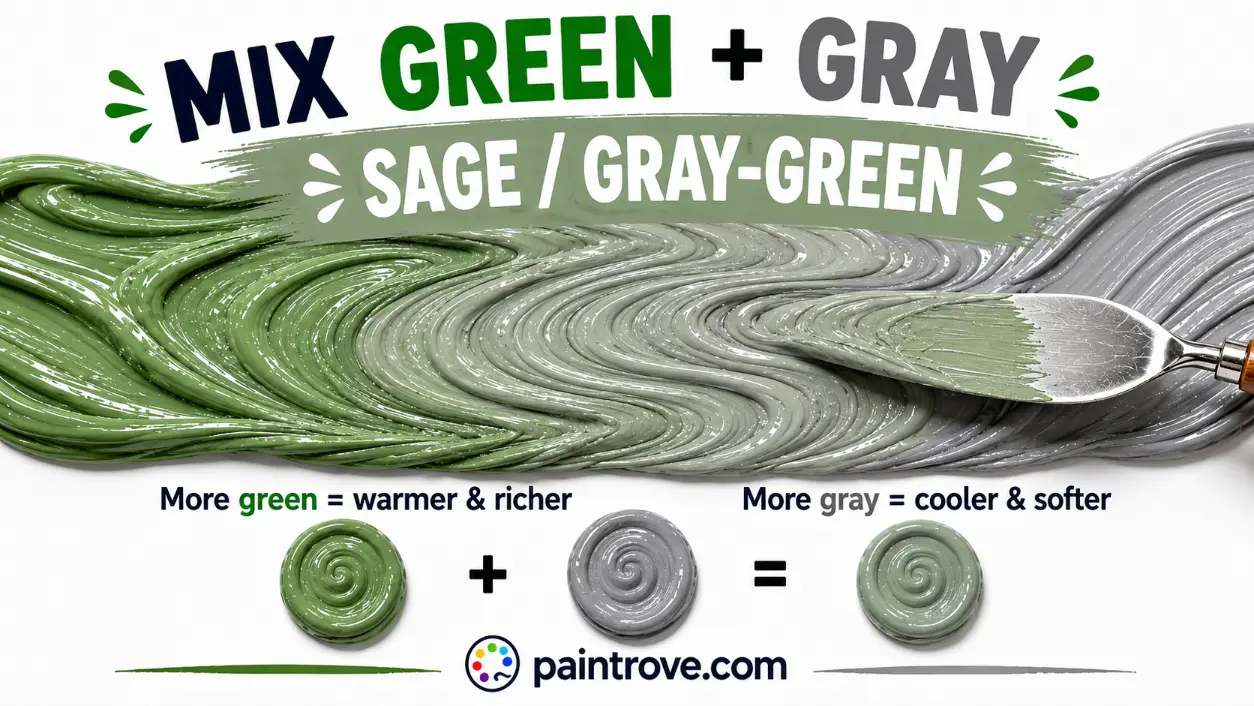
What Color Do Green and Gray Make ? Mix green and gray together and you get sage, a soft, muted gray-green that sits at hex #9CA18C. Adding more gray gives cooler, more subdued tones toward seafoam and silver-sage, while keeping more green gives a richer, earthier result closer to olive. Gray does not change green into a new hue; it mutes it, draining the vividness to leave a calm, natural, desaturated green.
Sage is one of the most sought-after colors in design right now, and green plus gray is the most direct way to mix it. The trick is that adding gray creates what artists call a tone, a muted version of a color, and the exact sage you get depends on your green’s undertone and how much gray you add.
This guide covers the ratios with hex codes, how to mix warm versus cool sage, the full gray-green range, and how to avoid the mix going flat or dead.
Why Green and Gray Make Sage
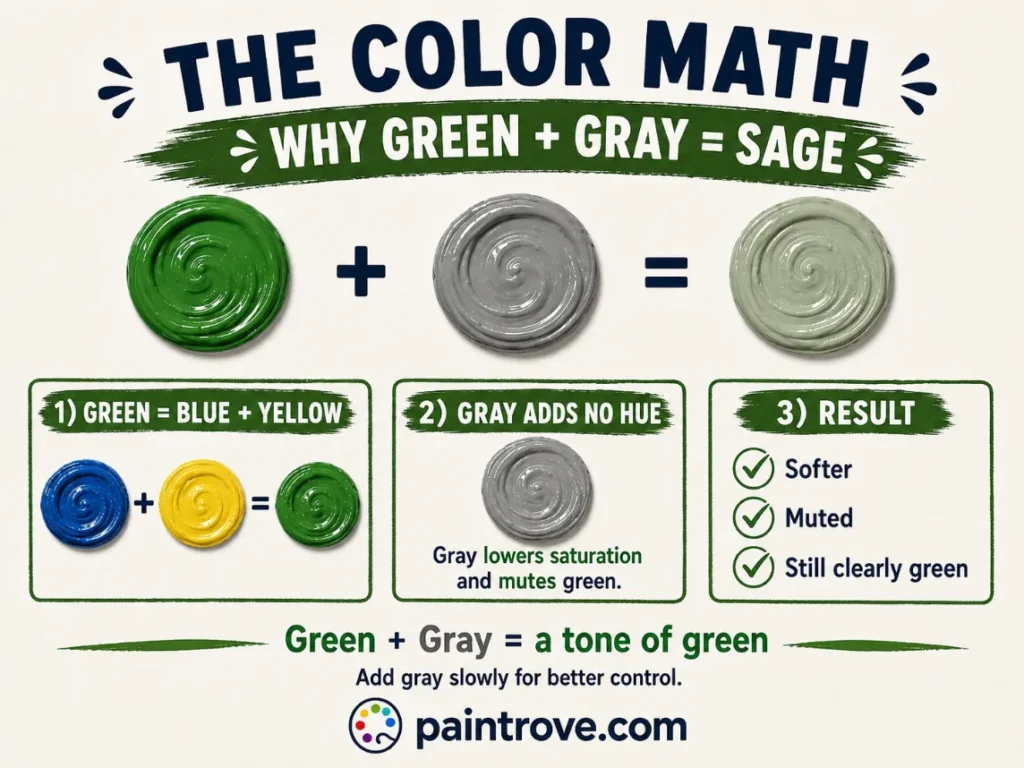
Gray is a neutral, a mix of black and white with no hue of its own. When you add gray to a color, you lower its saturation without changing its basic hue, which the eye reads as a muted, softened version of the original. In color theory terms:
- Adding white to a color makes a tint (lighter). Green plus white gives mint, as covered in green and white mixed.
- Adding black makes a shade (darker). Green plus black gives forest green, as covered in green and black mixed.
- Adding gray makes a tone (muted). Green plus gray gives sage.
Because gray is itself made of black and white, adding it both slightly darkens and slightly lightens while mainly desaturating, which is exactly what gives sage its soft, dusty quality. That muting is the defining characteristic of sage: it is what separates sage from the clean, saturated brightness of mint or lime.
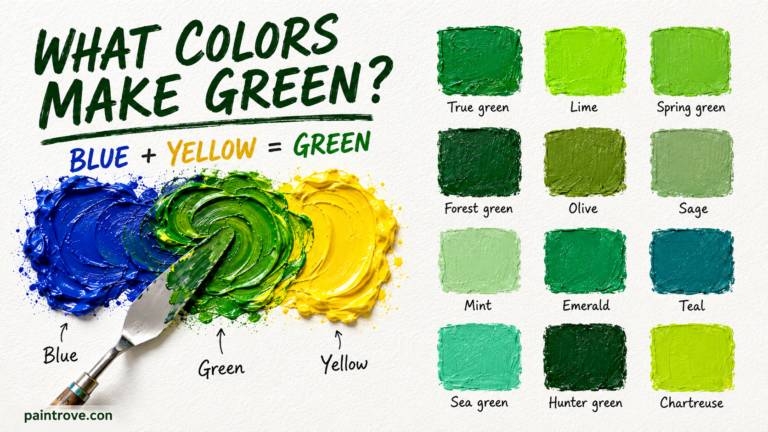
Green itself is a secondary color, made from blue and yellow, as covered in what blue and yellow make. Gray mutes the whole mix without disturbing that balance, so the undertone of your green carries through. For the full range of the parent color, see what colors make green.
Green and Gray Ratios and Hex Codes
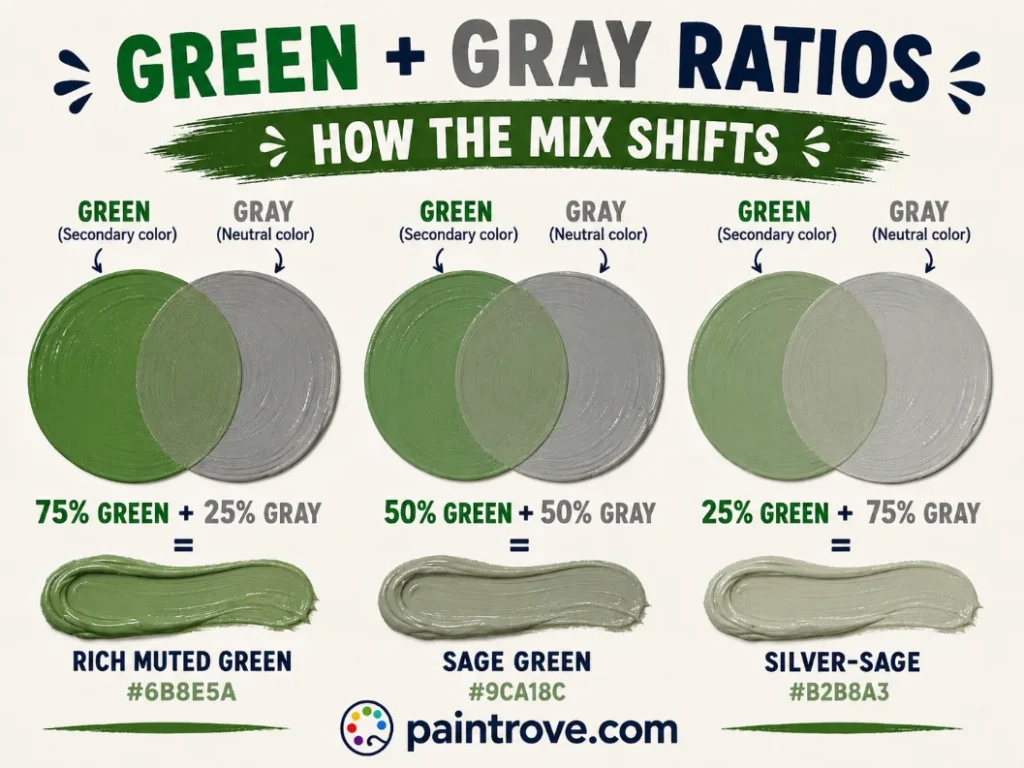
The ratio decides how muted and how light your sage turns out. Here is the working chart with hex targets in plain text:
| Ratio (Green : Gray) | Resulting shade | Hex code |
|---|---|---|
| 3 : 1 | Rich muted green, earthy | Hex #6B8E5A |
| 2 : 1 | Deep sage | Hex #7D8471 |
| 1 : 1 | Sage green | Hex #9CA18C |
| 1 : 2 | Soft silver-sage | Hex #B2B8A3 |
| 1 : 3 | Pale gray-green | Hex #C5CBBB |
| 1 : 1 with a warm green | Warm sage | Hex #A3A76F |
| 1 : 1 with a cool green | Cool silver-sage | Hex #9DAAA0 |
| 1 : 1 plus extra white | Pale sage | Hex #C8CDBE |
Practical notes:
- Mix your gray first, or use a pre-mixed neutral gray. A gray of roughly three parts white to one part black gives a medium-light gray ideal for sage.
- Add gray to green gradually. It is easy to overshoot into a dull, lifeless mix, so build the muting slowly.
- Mix thoroughly before judging, and test on white paper. Muted colors are especially hard to read in a pile, and acrylics dry slightly darker.
Warm Sage vs Cool Sage: Undertone Is Everything
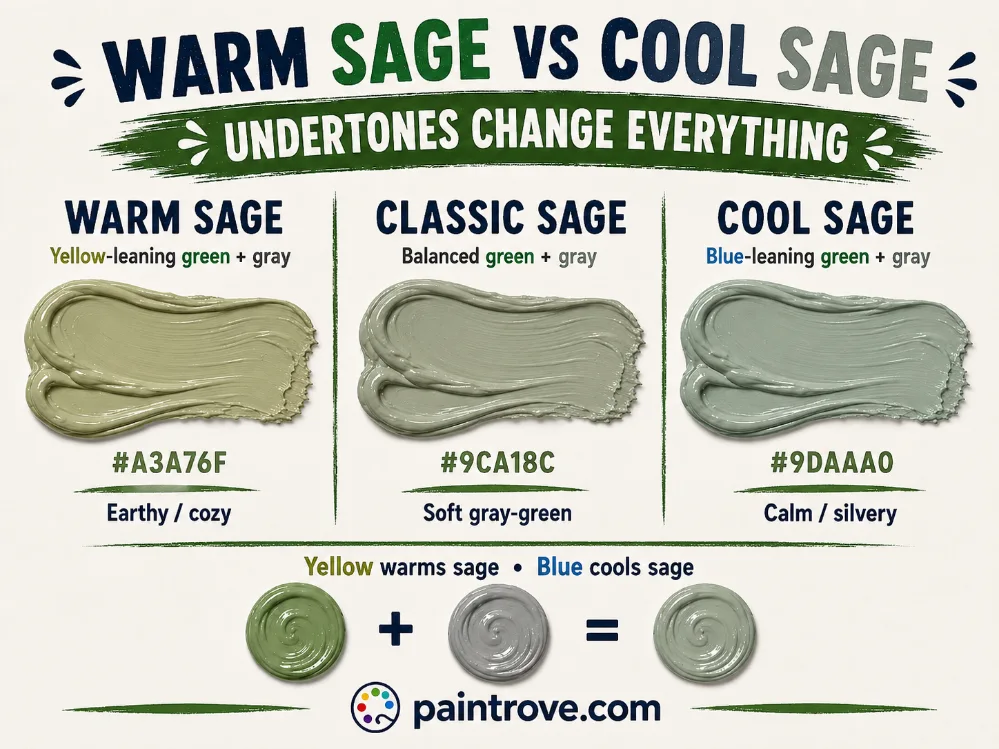
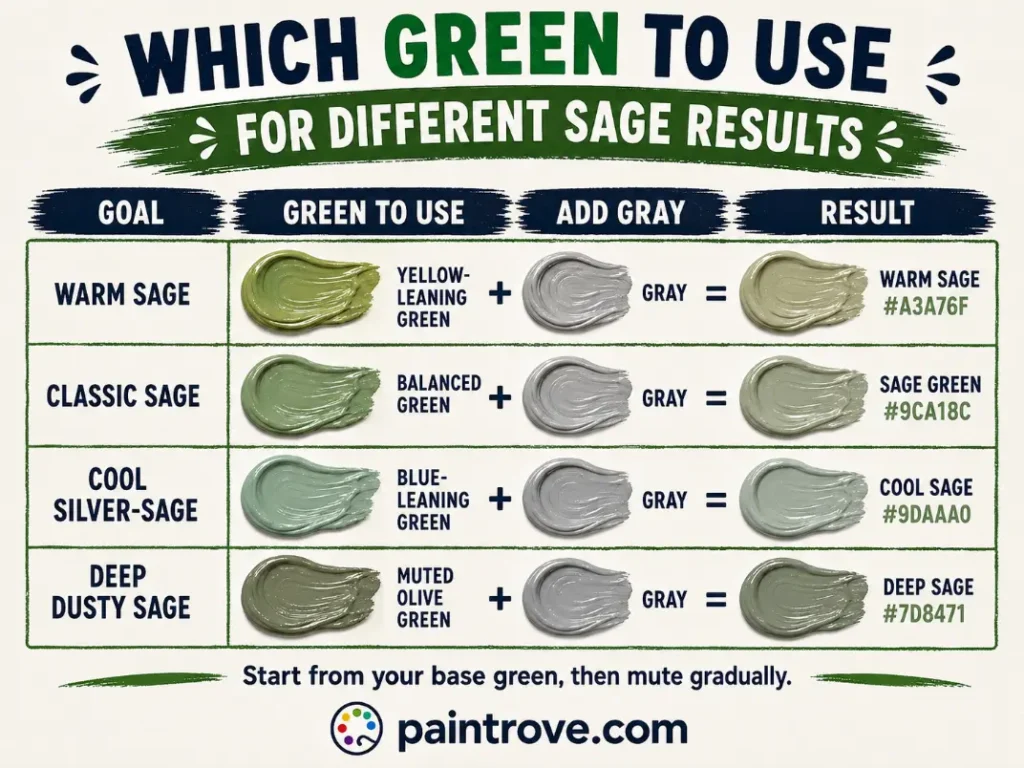
Here is what separates a good sage from a muddy one. The undertone of your green decides the character of the sage:
| Starting green | Resulting sage | Character |
|---|---|---|
| Yellow-leaning green | Warm sage / mossy sage | Earthy, cozy, natural |
| Balanced green | Classic sage | The popular soft gray-green |
| Blue-leaning green | Cool sage / silver-sage | Fresh, calm, slightly teal |
| Muted green already | Deep, dusty sage | Rich and subdued |
The rule: yellow warms sage, blue cools it. A sage mixed from a lemon-yellow-and-blue green reads warm and mossy, while a sage mixed from a blue-leaning green reads cool and silvery. This is why sage can feel cozy in one room and crisp in another. If you know which direction you want, choose or adjust your base green before adding gray, rather than trying to correct it afterward.
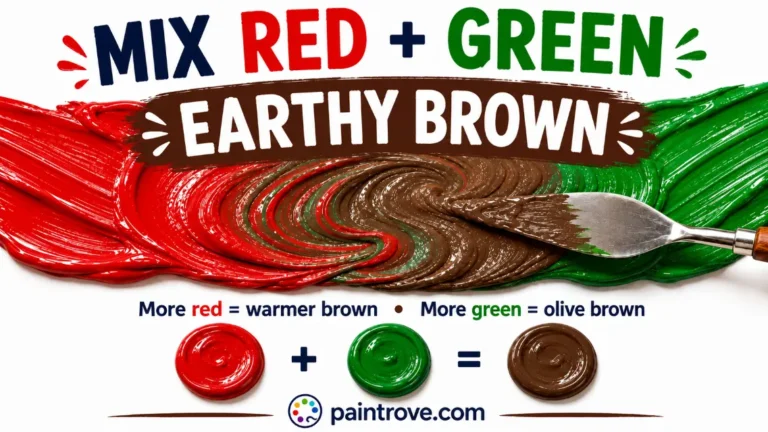
There is also a second route to sage worth knowing. Instead of gray, some painters mute their green with a tiny amount of red, green’s complement. Red neutralizes green the way gray does but adds a subtle warmth, producing a slightly different, often livelier sage. Too much red, though, tips the mix into the brown territory of red and green mixed, so use the smallest amount.
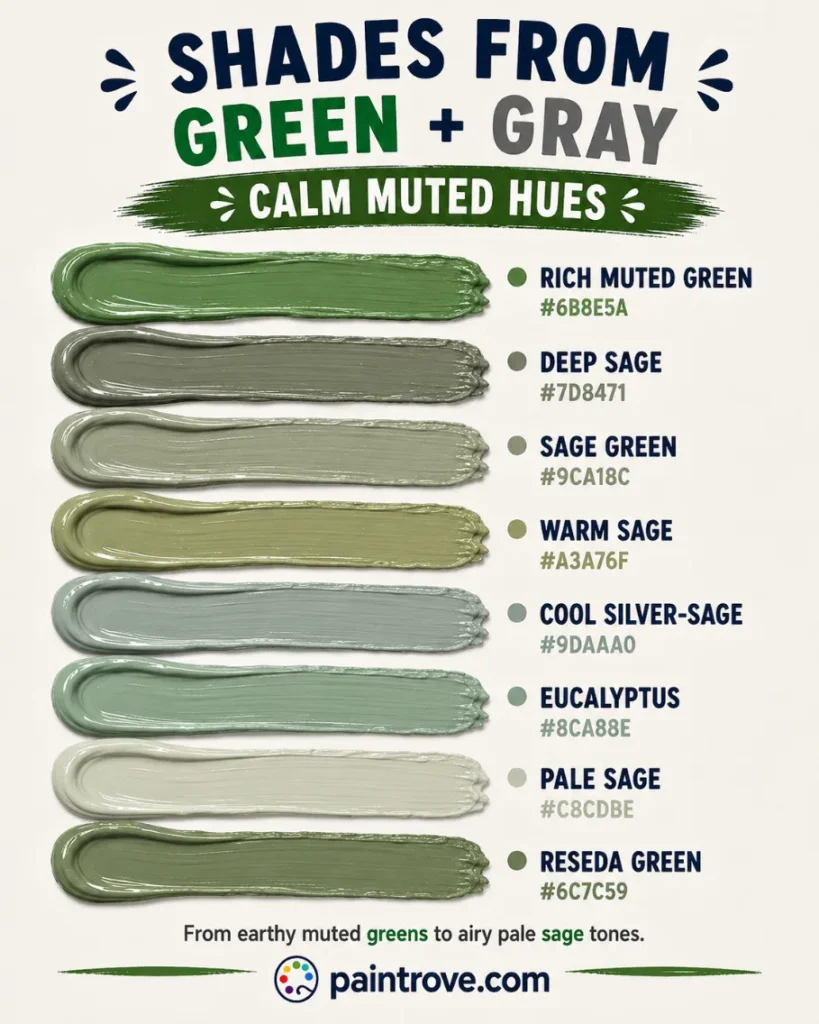
Every Gray-Green Shade You Can Make
Between ratio, green undertone, and adjustments of white or black, green and gray cover a wide band of muted greens. The reference table:
| Shade | Hex code | How to mix it |
|---|---|---|
| Sage green | Hex #9CA18C | Equal parts green and gray |
| Warm sage | Hex #A3A76F | Yellow-green plus gray |
| Cool sage / silver-sage | Hex #9DAAA0 | Blue-green plus gray |
| Seafoam | Hex #93E9BE | Blue-green plus gray plus white |
| Moss green | Hex #8A9A5B | Green-heavy mix plus gray |
| Sage gray | Hex #B2B8A3 | Gray-heavy mix |
| Eucalyptus | Hex #8CА88E | Balanced sage, slight blue lean |
| Reseda green | Hex #6C7C59 | Muted olive-green plus gray |
| Artichoke | Hex #8F9779 | Green plus gray, warm lean |
| Pale sage | Hex #C8CDBE | Sage plus white |
| Deep sage | Hex #7D8471 | Green-heavy mix plus gray |
| Olive drab | Hex #6B8E23 | Yellow-green plus a little gray |
Lighter Versions
Add white to move sage into pale silver-sage and soft eucalyptus tones, the palest and airiest members of the family, popular in modern interiors and bridal palettes. Because the mix is already muted, these stay soft rather than turning chalky. The lightening route in general is covered in green and white mixed.
Darker Versions
Add a little black, or more green plus a darker gray, to deepen sage into reseda and forest-sage tones. Go gently, since sage’s charm is its softness, and too much black flattens it. The darkening route is covered in green and black mixed.
Shifting Toward Olive or Seafoam
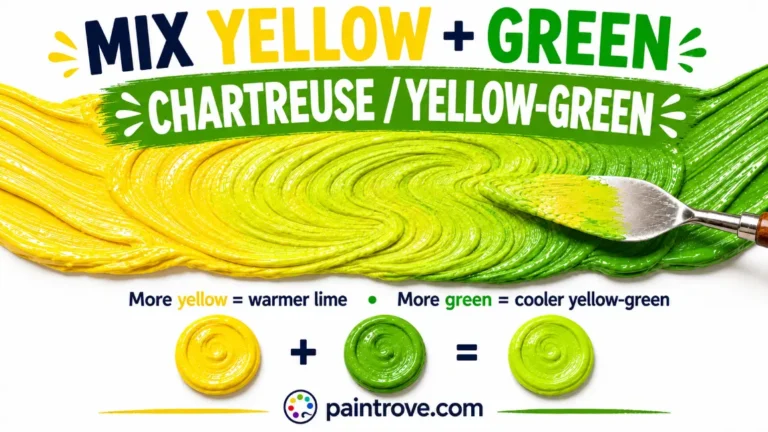
Push a warm sage further with yellow and it moves toward the olive of yellow and green mixed. Push a cool sage toward blue and add white and it moves toward the seafoam of blue and green mixed. Sage sits at the calm center of a whole family of muted greens.
Green and Gray in Light and Print
Everything above describes paint. Other systems behave differently.
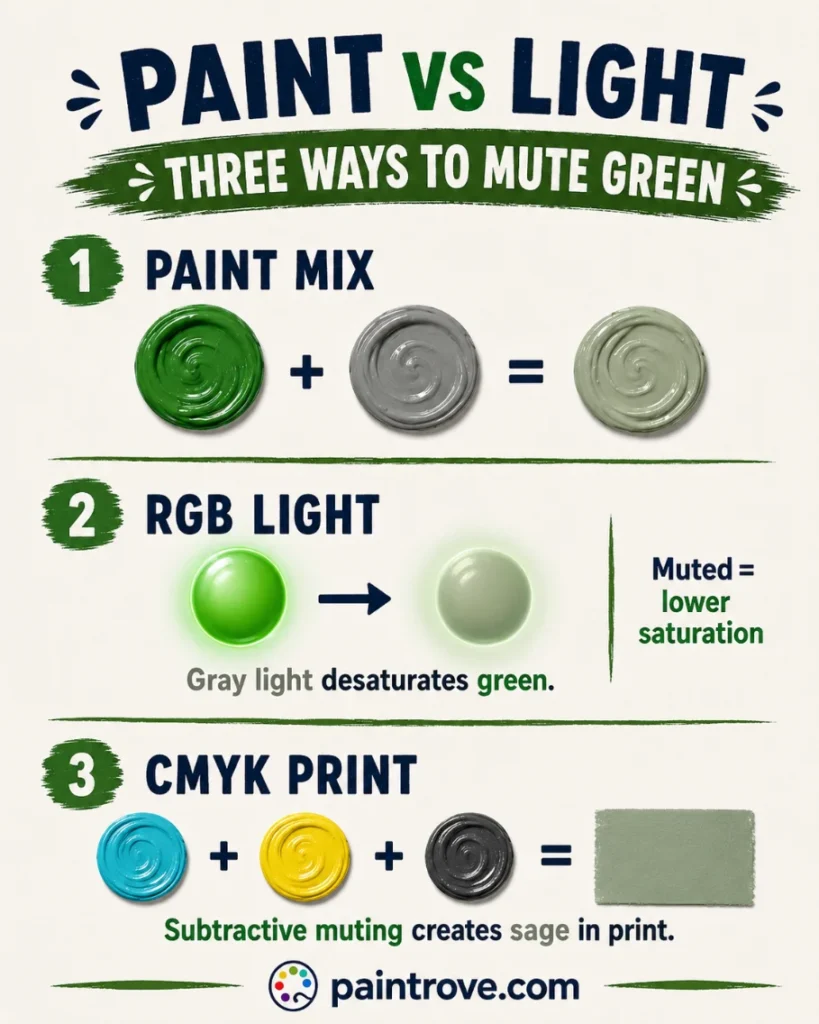
In light, using the RGB model, green is a primary color and gray is all three primaries at low-to-medium brightness. Adding gray light to green produces a muted, desaturated green, similar in effect to the paint version but reached by adjusting brightness and saturation rather than by mixing pigments.
In printing, using the CMYK color model, sage comes from green ink combined with small amounts of its complement and black to mute it, much like the paint approach in a subtractive system.
| System | How sage is made | Notes |
|---|---|---|
| RYB (paint) | Green plus gray, or green muted with red | Reliable, undertone-dependent |
| RGB (light) | Green at reduced saturation | Muted desaturated green |
| CMYK (printing) | Green plus complement and black | Subtractive muting |
Troubleshooting Green and Gray Mixes
The sage looks dead and muddy. Too much gray, which over-muted the green. Add a little of your original green back to bring life to it.
The sage is too gray to read as green. The green lost the battle. Sage still needs green to dominate. Add more green until the hue is clearly, if softly, green.
The sage is warmer or cooler than you wanted. That is the undertone of your green. Adjust the base green toward yellow for warmth or blue for coolness, then re-mute.
The mix looks flat. A gray made purely from black and white can deaden a color. Try muting with a touch of red (green’s complement) instead, which mutes while keeping the mix alive.
It dried duller. Standard acrylic behavior, more noticeable with muted colors. Mix a step brighter and lighter than your target.
Mixing Green and Gray in Different Mediums
Sage behaves a little differently depending on your medium, and hitting it consistently is easier in some than others.
Acrylics and oils let you mix the gray and green physically and adjust the balance by eye, which suits sage well since it is all about fine control. Acrylics dry darker and slightly duller, so mix a touch brighter than your target. Oils give the longest working time to fine-tune the exact muting.
Watercolor produces the softest, most atmospheric sages, since you can let a green wash and a gray wash meet on wet paper. Rather than pre-mixing gray, many watercolorists mute their green by dropping in a little of its complement, red, which keeps the sage luminous instead of flat.
Gouache stays matte and even, giving the flat, chalky-soft sage favored in illustration and modern design work.
Digital makes sage the easiest of all: simply lower the saturation of a green until it reaches the muted gray-green you want, then nudge the hue warmer or cooler. Nothing to remix, and every step is reversible.
Whichever medium you use, the guiding idea is the same value-first approach experienced painters recommend: get the lightness right, then adjust the hue and muting from there, the same discipline that makes mixing any subtle color like sage reliable rather than a guessing game.
Sage and Gray-Green in Art, Fashion, and Design
Sage has become one of the defining colors of contemporary design, prized for feeling both natural and quietly sophisticated.
In Art
Muted gray-greens are essential to naturalistic painting, capturing the soft, dusty greens of olive trees, eucalyptus, distant foliage, and hazy landscapes far better than any saturated tube green. Because sage is desaturated, it recedes and calms, letting brighter colors sing against it, which is why skilled painters use gray-greens to build the quiet passages that make a composition work. Mixing sage from green and gray, rather than buying it, gives precise control over exactly how warm, cool, light, or muted it sits.
In Fashion
Sage green has become one of fashion’s most reliable soft neutrals, reading as calm, natural, and effortlessly current. It pairs beautifully with cream, tan, blush, rust, and warm browns, and it flatters a wide range of skin tones. Because it is muted, sage functions almost like a neutral, anchoring outfits the way gray or beige would but with more character. Its cooler silver-sage and warmer moss variations extend its range across seasons.
In Interiors and Branding
Sage is arguably the interior color of the era, appearing on kitchen cabinets, bedroom walls, and tilework everywhere, loved for feeling both fresh and grounding. It pairs naturally with wood, brass, rattan, and warm whites in the organic, calming schemes that dominate modern interiors.
In branding, sage and gray-green signal wellness, nature, sustainability, and understated quality, which is why they appear across beauty, wellness, and lifestyle identities aiming for a calm, premium feel.
Quick Reference: Green + Gray Cheat Sheet
| Question | Answer |
|---|---|
| Green + gray in paint | Sage / gray-green (hex #9CA18C) |
| Why | Gray mutes green without changing the hue |
| Yellow-leaning green + gray | Warm sage, mossy |
| Blue-leaning green + gray | Cool sage, silver-sage |
| More green | Richer, earthier green |
| More gray | Softer, paler gray-green |
| Plus white | Pale sage, eucalyptus |
| Plus black | Reseda, deep sage |
| Alternative muting | A tiny touch of red instead of gray |
| The risk | Too much gray makes it dead and muddy |
FAQs
What color do green and gray make when mixed?
Sage, a soft, muted gray-green. Gray mutes the green without changing its hue, producing a calm, desaturated green. More gray gives a cooler, paler result; more green gives a richer, earthier one.
How do you make sage green?
Mix a green base from blue and yellow, then add gray until the green softens into a muted gray-green around hex #9CA18C. Adjust with more yellow for a warm sage or more blue for a cool sage, and lighten with white if needed.
What is the difference between sage, mint, and olive?
All three come from green. Mint is green plus white, a clean pale tint. Olive is a dark, muted yellow-green. Sage is green plus gray, a soft desaturated gray-green sitting between them. Sage’s defining quality is its muted, dusty character.
Why did my sage turn out muddy or dead?
Too much gray over-muted the green, or the gray itself deadened the mix. Add a little green back, or try muting with a tiny touch of red instead of gray, which keeps the color livelier.
Can you make sage without gray?
Yes. Instead of gray, mute your green with a very small amount of red, green’s complement. This neutralizes the green while adding subtle warmth. Use the smallest amount, since too much red turns the mix brown.
Is sage green warm or cool?
It depends on the base green. A yellow-leaning green gives a warm, mossy sage, while a blue-leaning green gives a cool, silvery sage. This flexibility is part of why sage works in so many different settings.
Green and gray make sage, the soft gray-green at the heart of modern design. Control the undertone through your base green, add gray slowly, and keep a touch of green in reserve to bring the mix back to life if it goes flat.
To explore the family further, see our guide to what colors make green, compare the lightening and darkening routes at green and white mixed and green and black mixed, or step back to the color wheel.