What Color Do Orange and Purple Make When Mixed?
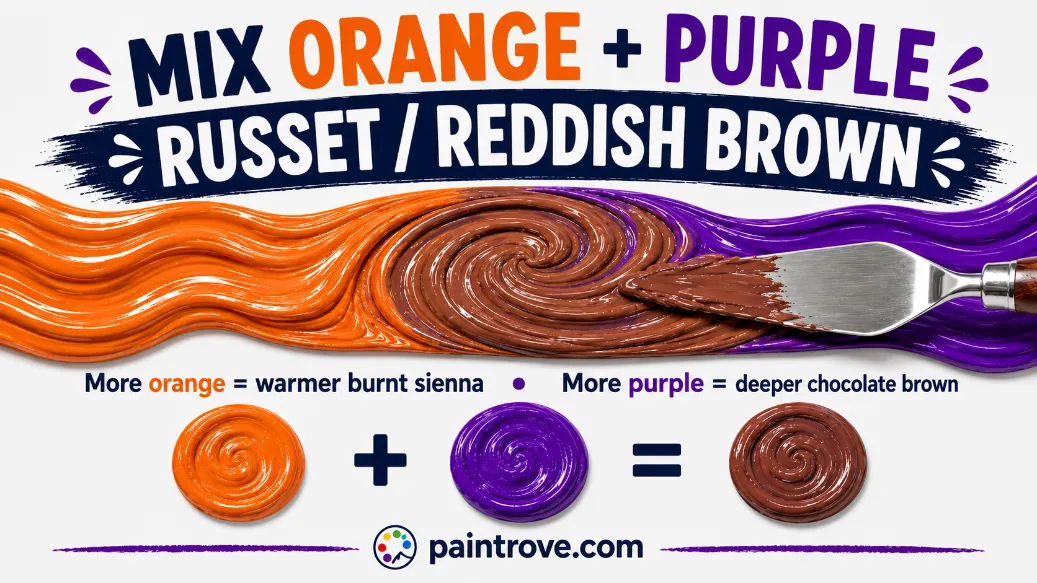
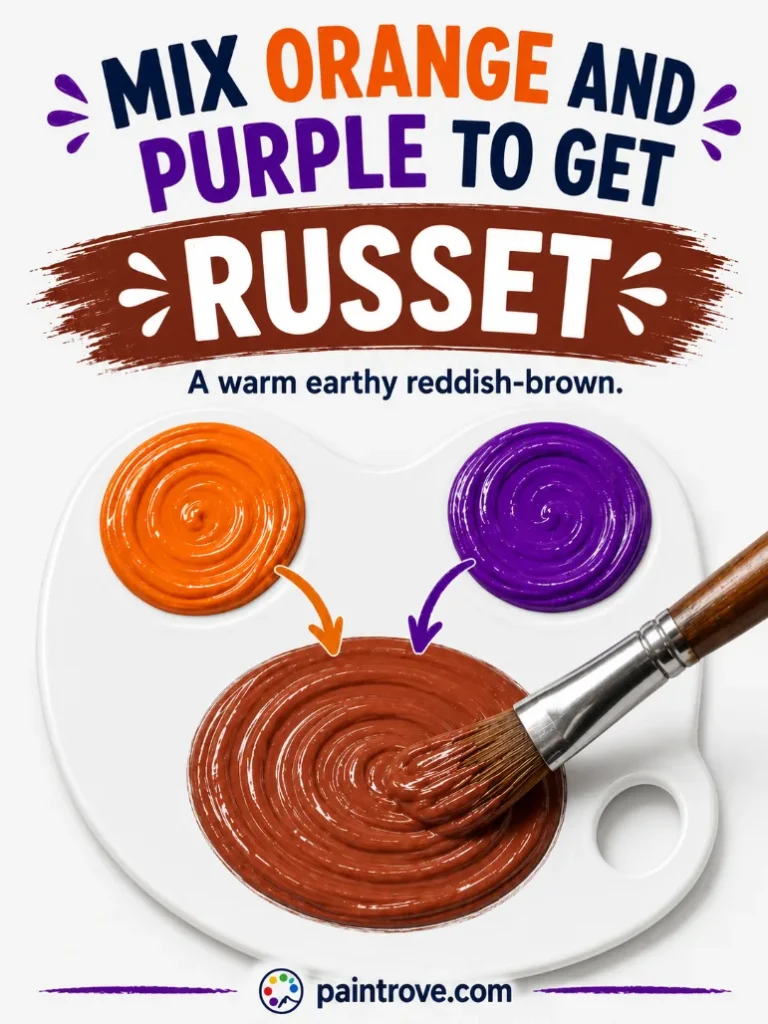
What Color Do Orange and Purple ? Orange and purple make russet, a warm reddish-brown, at around hex #80461B. This happens because both colors contain red, so the mix carries a double dose of red that tints the resulting brown warm and reddish rather than neutral. Leaning the mix toward orange gives lighter, warmer browns like burnt sienna, while leaning toward purple gives deeper, cooler browns closer to chocolate.
Orange and purple are not a pair most people think to combine, but they produce one of the most useful warm browns on the palette. The reason comes down to simple color math, and once you understand it, you can steer the mix precisely from a light terracotta to a near-black brown.
This guide covers why the mix turns russet, the exact ratios with hex codes, the best pigments to use, the full range of shades, and how the answer changes in light versus paint.
Why Do Orange and Purple Make Brown?
Orange and purple both make brown because together they contain all three primary colors, and mixing all three primaries always produces brown.
Here is the breakdown. Orange is a secondary color made from red and yellow, as covered in what colors make orange. Purple is a secondary color made from red and blue, as covered in what red and blue make. So the mix looks like this:
Orange + Purple = (Red + Yellow) + (Red + Blue) = Red + Red + Yellow + Blue
All three primaries are present, which triggers the neutralizing effect that creates brown, the basis of every recipe in our guide to how to make brown. But notice the doubled red. Where a standard brown has roughly equal red, yellow, and blue, this mix is red-heavy. That extra red is what tints the brown warm and reddish, producing russet rather than a plain neutral brown.
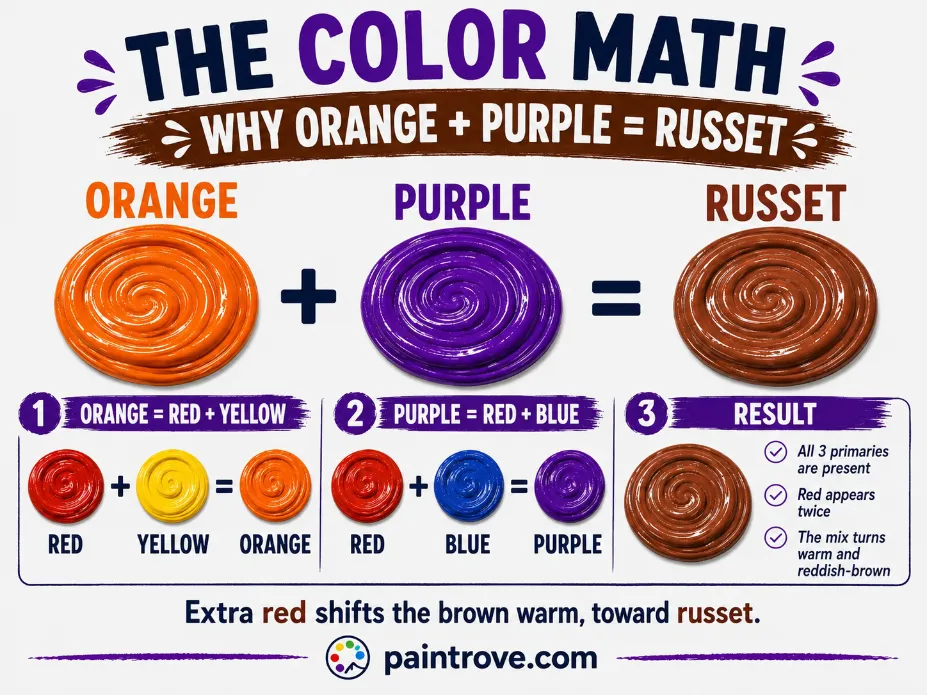
Because brown is really just a dark, desaturated orange, and this mix is red-orange dominant, orange and purple naturally land on the warm, reddish side of the brown family, the same neighborhood as terracotta, burnt sienna, and mahogany.
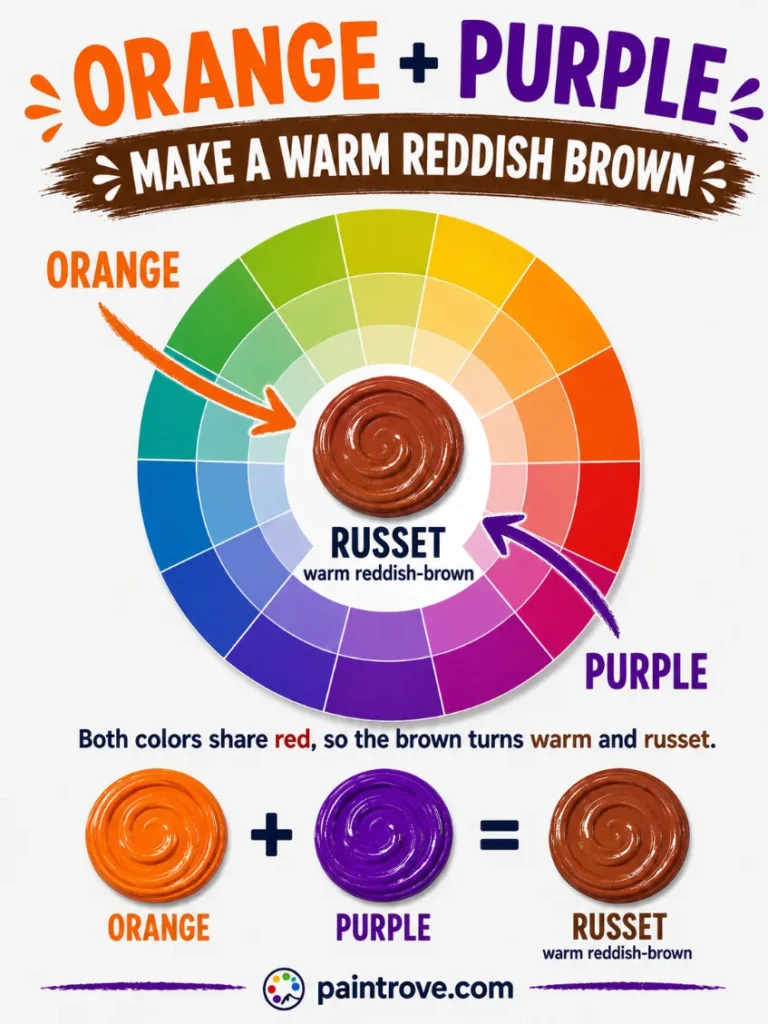
What Is Russet? The Color Orange and Purple Make
Russet is a dark reddish-brown, sitting at around hex #80461B. The name comes from a coarse reddish-brown cloth once worn by peasants in medieval England, and the color appears throughout nature: autumn leaves, animal fur, ripe pears, and rust. It is warm, earthy, and rich, which is exactly what a red-heavy brown should be.
Russet is not the only possible result, though. Because orange and purple each come in many shades, the mix can range across a whole family of warm browns:
| If you use | You get | Hex code |
|---|---|---|
| Balanced orange + balanced purple | Russet | Hex #80461B |
| Orange-heavy mix | Burnt sienna | Hex #E97451 |
| Bright orange + red-purple | Terracotta | Hex #E2725B |
| Purple-heavy mix | Deep chocolate brown | Hex #4A2C2A |
| Blue-leaning purple + orange | Cool, dark, near-black brown | Hex #3B2417 |
| Light versions of both | Dusty mauve-brown | Hex #A47C6D |
Orange and Purple Mixing Ratios and Hex Codes
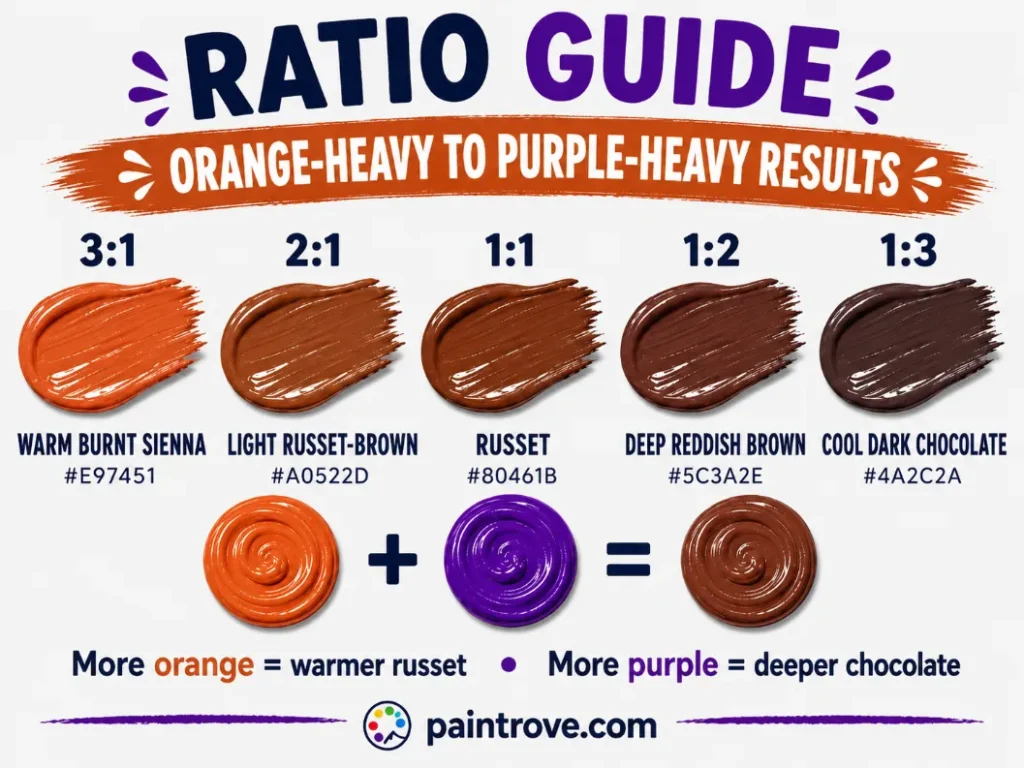
The ratio decides how warm, light, or deep your brown turns out. Here is the working chart with hex targets in plain text:
| Ratio (Orange : Purple) | Resulting shade | Hex code |
|---|---|---|
| 3 : 1 | Warm burnt sienna | Hex #E97451 |
| 2 : 1 | Light russet-brown | Hex #A0522D |
| 1 : 1 | Russet | Hex #80461B |
| 1 : 2 | Deep reddish brown | Hex #5C3A2E |
| 1 : 3 | Cool dark chocolate | Hex #4A2C2A |
| 1 : 1 plus white | Warm tan | Hex #C19A6B |
| 1 : 1 plus black | Espresso brown | Hex #3C2414 |
| 1 : 1 (bluish purple) | Near-black brown | Hex #2E1F1A |
Practical notes:
- Both colors are strong, and purple is darker, so add purple to orange gradually. It is easy to overshoot into a dark, cool brown.
- Mix thoroughly before judging. A half-mixed blend looks streaky and darker than the finished color.
- Test on white paper and let it dry. Browns are hard to read in a pile, and acrylics dry darker.
Which Orange and Purple Pigments Should You Use?
Pigment choice steers the exact brown. The undertones of your orange and purple decide the result:
| Orange used | Purple used | Resulting brown |
|---|---|---|
| Cadmium orange (warm) | Dioxazine purple | Rich, warm russet |
| Cadmium orange | Blue-leaning violet | Deep, cool chocolate brown |
| Yellow-orange | Red-purple | Light golden-brown |
| Burnt orange | Deep purple | Dark mahogany brown |
| Bright orange | Bright red-purple | Warm terracotta |
The pattern: a warm orange with a balanced purple gives the classic warm russet, while a blue-leaning purple pulls the mix toward a cooler, darker, almost black brown. A yellow-orange lightens and warms the result toward golden tan. If you want the warmest, most glowing russet, reach for cadmium orange and a red-leaning purple. For a deep, moody brown, use a blue-violet purple.
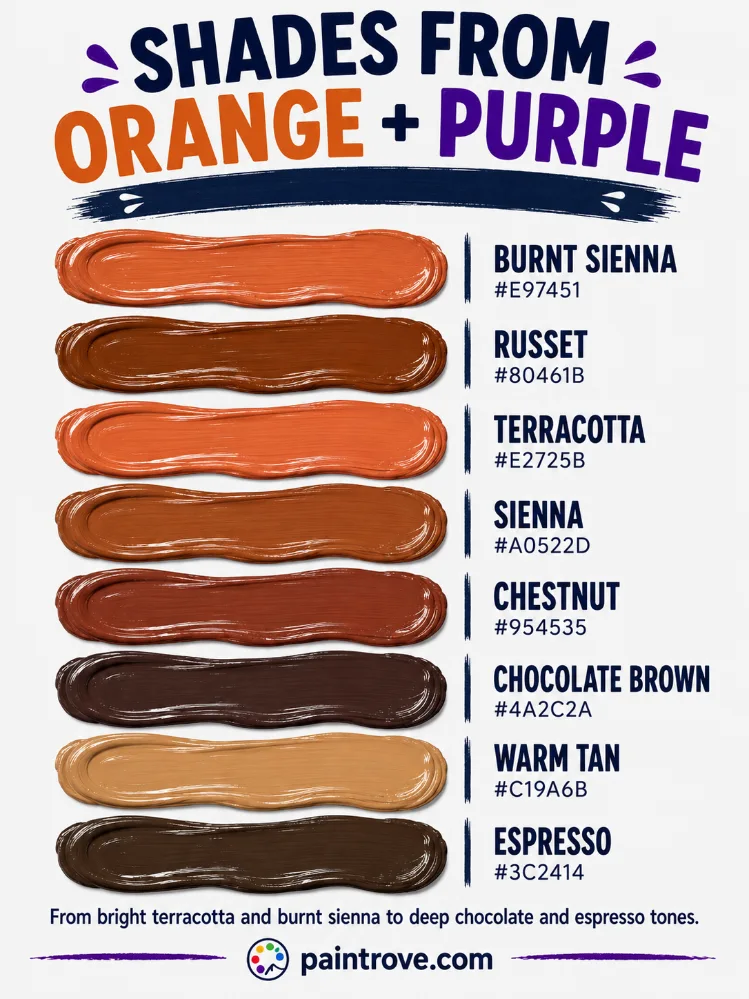
Every Warm Brown Shade You Can Make from Orange and Purple
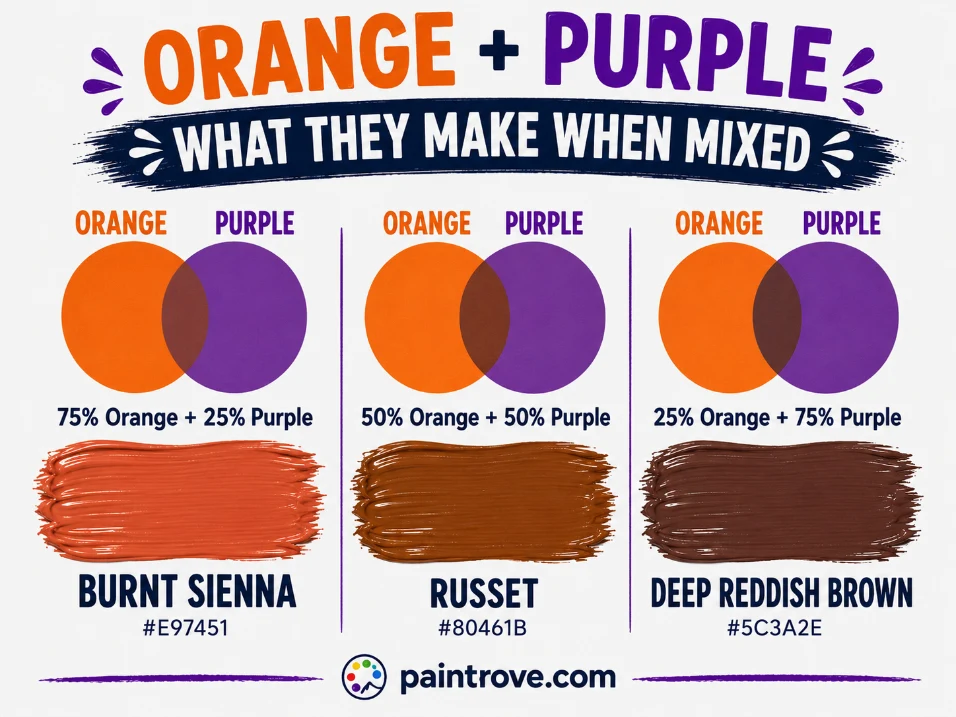
Between ratio, pigment choice, and additions of white or black, orange and purple cover the warm side of the brown family. The reference table:
| Shade | Hex code | How to mix it |
|---|---|---|
| Russet | Hex #80461B | Equal parts orange and purple |
| Burnt sienna | Hex #E97451 | Orange-heavy mix |
| Terracotta | Hex #E2725B | Bright orange plus red-purple |
| Mahogany | Hex #C04000 | Orange-heavy warm mix |
| Chestnut | Hex #954535 | Balanced mix, warm pigments |
| Sienna | Hex #A0522D | Orange-heavy mix |
| Chocolate brown | Hex #4A2C2A | Purple-heavy mix |
| Cedar chest | Hex #C05340 | Balanced mix, red-orange lean |
| Warm tan | Hex #C19A6B | Russet plus white |
| Dusty mauve-brown | Hex #A47C6D | Light orange plus light purple |
| Espresso | Hex #3C2414 | Balanced mix plus black |
| Auburn | Hex #A52A2A | Orange-heavy mix, deep red lean |
How Do You Make Light Brown from Orange and Purple?
Add white to move the mix into warm tan, dusty mauve-brown, and soft caramel tones. Because the mix is warm and red-rich, these tints stay cozy rather than turning chalky. To lighten while keeping warmth and vibrancy, add a little orange along with the white. The full lightening route is covered in brown and white mixed, and the closely related warm earth color has its own guide at terracotta color.
How Do You Make Dark Brown from Orange and Purple?
Use a purple-heavy mix, especially with a blue-leaning purple, to reach deep chocolate and espresso browns. A small amount of black deepens it further, but adding more purple is the better route, keeping the brown rich rather than flat. This connects to the deep browns of red and brown mixed.
Toward Terracotta and Mahogany
Push the mix warm with more orange and you approach terracotta and mahogany, the glowing red-browns of clay pots and fine wood. These are among the most prized warm browns in art and design, and orange and purple is one of the cleanest ways to mix them.
What Does Orange and Purple Make in Light?
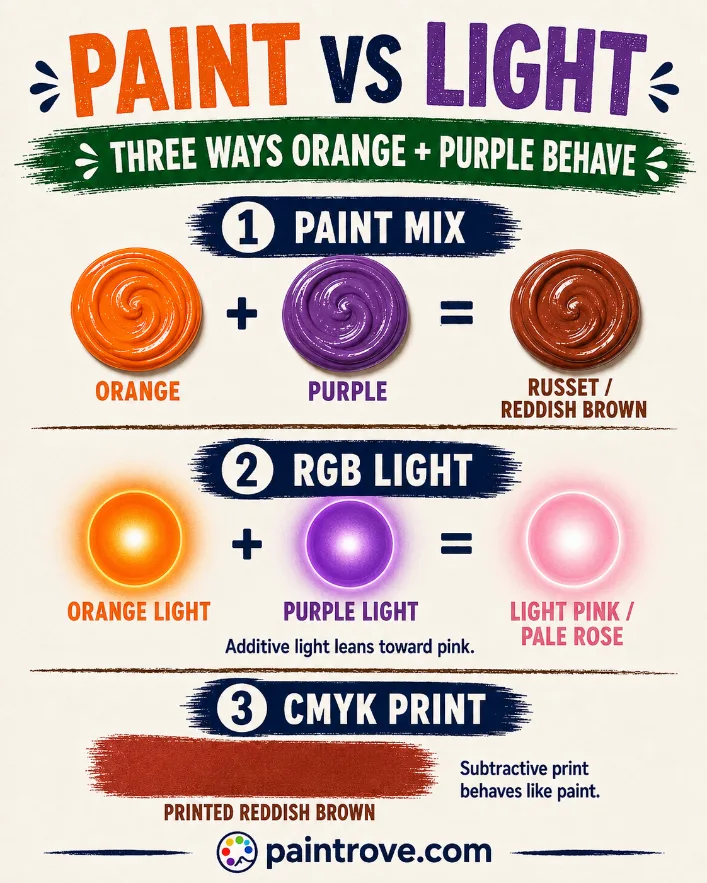
In light, orange and purple make a light pink or pale pinkish neutral, not brown. This is the opposite of the paint result.
Screens use the RGB model, where colors add together and brighten. Orange light contains red and some green, and purple light contains red and blue. Combine them and you have a strong dose of red plus some green and blue, which the eye reads as a washed-out light pink or pale rose rather than a dark brown. The shared red dominates, and because light adds rather than subtracts, the result is pale and luminous.
| System | Type | Orange + Purple makes | Result |
|---|---|---|---|
| RYB (paint) | Subtractive | Russet, reddish brown | Hex #80461B |
| RGB (light and screens) | Additive | Light pink or pale rose | Bright, washed-out |
| CMYK (printing) | Subtractive | Reddish brown | Varies |
Printing, covered in our guide to the CMYK color model, behaves like paint since it is subtractive, producing reddish browns from combined inks.
Troubleshooting Orange and Purple Mixes
The mix is too dark or cool. Your purple is winning, or it leans blue. Add more orange to warm and lighten it toward russet, or switch to a red-leaning purple.
The mix looks muddy rather than a clean russet. Too many competing undertones. Simplify to a warm cadmium orange and a clean dioxazine purple.
The mix is almost black. Equal parts of two strong, dark pigments absorb nearly all light. Use less purple, or lighter versions of both, and add white to recover a usable brown.
You wanted terracotta and got plain brown. Add more orange and a touch of red. Terracotta is a lighter, more orange russet.
It dried duller. Standard acrylic behavior. Mix a step warmer and lighter than your target.
Orange and Purple in Art, Fashion, and Design
Orange and purple share the paradox of all near-complementary pairs: they mix into warm brown but create a vivid, energetic contrast when placed side by side.
In Art
The russet and burnt-brown tones from orange and purple are staples of autumn and landscape painting, capturing fallen leaves, animal fur, rusted metal, and warm earth. Because the mix is warm and reddish, it reads as alive and sunlit where a neutral brown would feel flat.
Painters also use this pairing to mix natural shadow tones for warm objects, since a shadow built from these colors harmonizes with the warm light around it. Used unmixed, orange and purple form a bold, jewel-toned contrast that appears throughout Art Nouveau and psychedelic art.
In Fashion
Orange and purple together is a daring, high-energy combination, used deliberately when a look needs to stand out, and it carries associations from sunsets to sports teams.
The browns the mix produces, russet, mahogany, and terracotta, are far more wearable, anchoring autumn wardrobes season after season. Russet and terracotta in particular flatter warm skin tones beautifully and pair naturally with cream, olive, gold, and denim.
In Interiors and Branding
Russet, terracotta, and warm brown are cornerstone interior colors for cozy, earthy, natural schemes, working beautifully with wood, rattan, cream, and sage green. Used unmixed, orange and purple create a rich, exotic, jewel-toned palette popular in bohemian and maximalist design.
In branding, warm browns signal craft, warmth, and authenticity, while the orange-purple contrast signals creativity and energy.
Quick Reference: Orange + Purple Cheat Sheet
| Question | Answer |
|---|---|
| Orange + purple in paint | Russet, reddish brown (hex #80461B) |
| Orange + purple in light | Light pink or pale rose |
| Why reddish | Both contain red, so red is doubled |
| More orange | Burnt sienna, terracotta, tan |
| More purple | Deep chocolate, near-black brown |
| Blue-leaning purple | Cool, dark brown |
| Plus white | Warm tan, dusty mauve-brown |
| Plus black | Espresso |
| Color type | Warm brown, red-dominant |
| Best pigments | Cadmium orange + dioxazine purple |
FAQs: what does orange and purple make
What color do orange and purple make when mixed?
Orange and purple make russet, a warm reddish-brown, at around hex #80461B. Both colors contain red, so the mix carries extra red that tints the resulting brown warm and reddish rather than neutral. The exact shade ranges from burnt sienna to deep chocolate depending on the ratio.
Why do orange and purple make brown?
Because together they contain all three primary colors. Orange is red plus yellow, and purple is red plus blue, so mixing them combines red, yellow, and blue, which always neutralizes into brown. The doubled red makes it a warm, reddish brown specifically.
Do orange and purple make russet?
Yes. A balanced mix of orange and purple produces russet, a dark reddish-brown named after a medieval cloth. It is the classic result because the red shared by both parents tints the brown warm and reddish.
what does purple and orange make in light?
In light, orange and purple make a light pink or pale rose, not brown. Because screens add light rather than subtracting it, and both colors share red, the mix comes out pale and pinkish rather than dark and earthy.
How do you make a warm brown from orange and purple?
Use a warm cadmium orange with a red-leaning purple in roughly equal parts for a glowing russet. Lean toward orange for lighter, warmer browns like burnt sienna and terracotta, and add a little red to intensify the warmth.
How do you make a dark brown from orange and purple?
Use a purple-heavy mix, ideally with a blue-leaning violet, to reach deep chocolate and near-black browns. Adding more purple keeps the brown richer than adding black, which can flatten it.
Are orange and purple a good color combination?
Side by side, they form a bold, jewel-toned contrast popular in bohemian, Art Nouveau, and maximalist design. Mixed, they produce warm russet and terracotta browns. Both uses come from their near-complementary relationship on the color wheel.
What is the difference between russet, terracotta, and burnt sienna?
All three are warm reddish-browns from this color family. Russet is the deep, balanced reddish-brown at hex #80461B. Terracotta is lighter and more orange at hex #E2725B. Burnt sienna is a bright, warm orange-brown at hex #E97451. They differ mainly in how much orange and lightness each carries.
Orange and purple make russet, one of the warmest and most useful browns on the palette, thanks to the extra red both colors share. Steer it toward burnt sienna and terracotta with more orange, or toward deep chocolate with more purple, and the whole warm brown family is yours.