How to Make Brown: The Complete Paint Mixing Guide
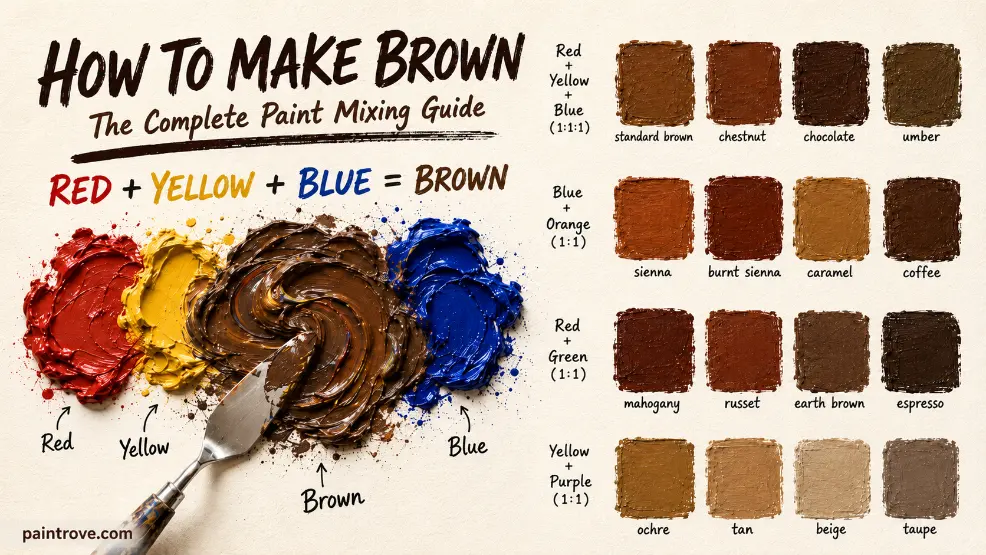
How to Make Brown? To make brown, mix the three primary colors: red + yellow + blue in equal parts. You can also mix any pair of complementary colors, so blue + orange, red + green, or yellow + purple all make brown too. Adjust the ratio toward the warm color for a warmer brown, or toward the cool color for a deeper, cooler brown.
That covers the quick answer to how to make brown. The rest of this guide covers what actually separates a rich chocolate brown from a lifeless gray puddle: which recipe to choose, exact ratios and hex code targets for every major shade, how to shift a brown warmer, cooler, lighter, or darker, and how to rescue a mix that went muddy.
Brown deserves this much attention because it is everywhere in painting. Wood, soil, hair, skin, bark, leather, bread, shadows on warm objects. You will mix brown more often than almost any other color, and buying a single tube of it locks you into one shade when the brown family contains hundreds.
Why So Many Combinations Make Brown
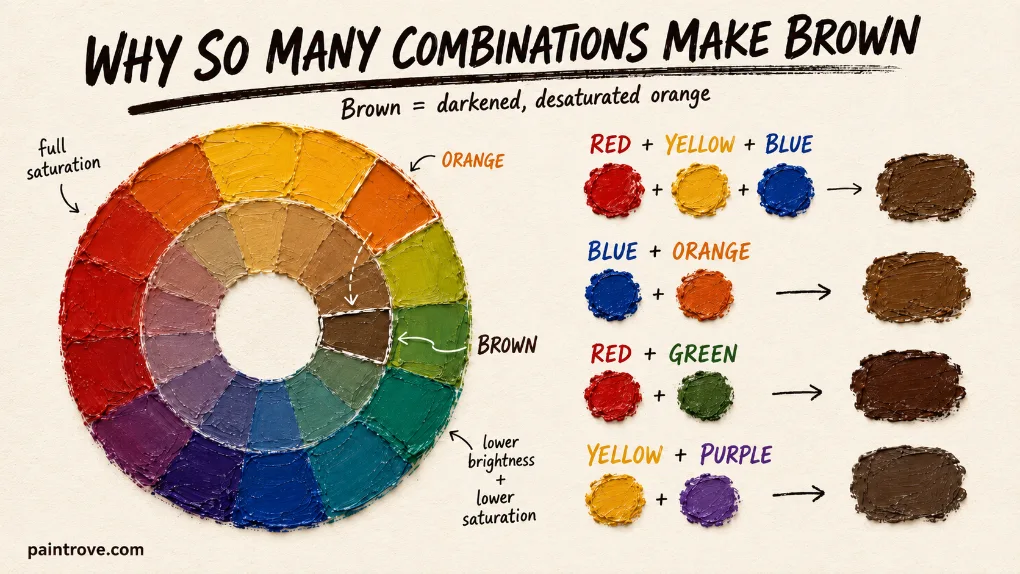
Here is the insight that makes brown finally click: brown is not really its own hue. Brown is dark, desaturated orange.
Take a bright orange, lower its brightness and intensity, and you get brown. That is the whole secret. It also explains why brown does not appear on the standard color wheel: the wheel shows colors at full saturation, and brown only exists once saturation drops.
Once you know brown lives in the darkened orange zone, every brown recipe makes sense:
- Red + yellow + blue. Red and yellow make orange, and the blue darkens and dulls it. Orange, muted. Brown.
- Blue + orange. Same math, one step shorter. Orange plus its opposite.
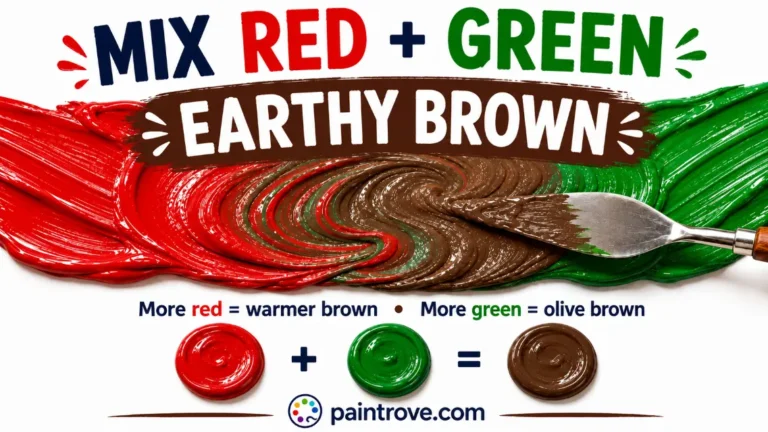
- Red + green. Green contains yellow and blue, so red plus green secretly equals red plus yellow plus blue.
- Orange + black. Darkened orange, directly.
Every road leads to the same neighborhood because every road combines all three primaries in some disguise, with the warm side dominating.
Method 1: Make Brown from the Three Primary Colors
The classic recipe, and the one that gives you the most control.
Recipe: 1 part red + 1 part yellow + 1 part blue
- Place equal dabs of red, yellow, and blue on your palette with space between them.
- Mix red and yellow first to form orange.
- Add blue gradually, a little at a time. The orange will dull, deepen, and settle into brown.
- Adjust. More red or yellow warms the brown. More blue cools and darkens it.
- Test a swipe on white paper. Browns look different against white than they do in a pile on the palette.
The primary colors you choose matter. Cadmium red, cadmium yellow, and ultramarine blue give a rich classic brown. Swap in lemon yellow and phthalo blue and the mix turns cooler and murkier. Phthalo blue in particular is extremely strong, so halve the amount if that is your blue.
| Ratio (Red : Yellow : Blue) | Result | Hex code |
|---|---|---|
| 1 : 1 : 1 | Standard brown | Hex #8B4513 |
| 2 : 2 : 1 | Warm chestnut brown | Hex #954535 |
| 1 : 2 : 1 | Golden yellow-brown | Hex #996515 |
| 1 : 1 : 2 | Cool dark brown | Hex #5C4033 |
| 2 : 1 : 1 | Reddish brown | Hex #A0522D |
Method 2: Make Brown from Complementary Colors
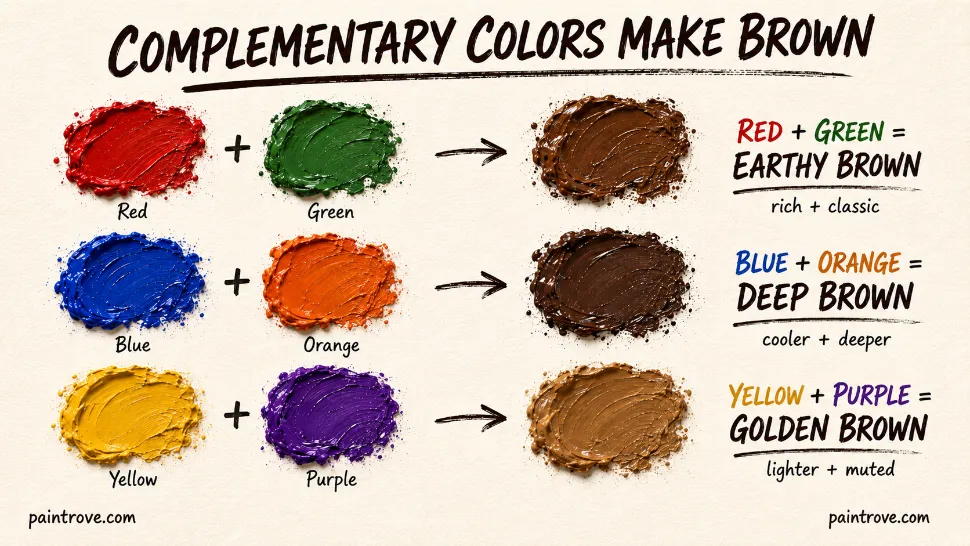
Complementary colors sit opposite each other on the color wheel, and mixing any complementary pair neutralizes both colors into brown or gray. Each pair produces its own personality of brown, and we have a full guide for every one:
| Pair | Character of the brown | Full guide |
|---|---|---|
| Red + Green | Rich, earthy, classic brown | What red and green make |
| Blue + Orange | Cooler, deeper brown | What blue and orange make |
| Yellow + Purple | Lighter, gold-tinted muddy brown | What purple and yellow make |
Use equal parts as a starting point, then push the ratio toward the warm color. A 50/50 red-green mix can lean gray; nudging it to 60/40 in red’s favor brings out the earthiness.
Complementary mixing extends beyond the three classic pairs. Any two colors sitting roughly opposite each other will neutralize into a brown-adjacent tone:
- Orange and green mixed make an olive brown.
- Green and purple mixed make a murky brown-slate.
- Orange and purple mixed make russet, a reddish brown.
- Pink and green mixed make a soft muted brown-gray.
- Orange and black mixed make a dark burnt brown, the shortcut version of the whole system.
Method 3: Adjust an Existing Brown
If you already have brown, from a tube or a mix, you can steer it anywhere in the family by adding one more color. Each of these adjustments has its own dedicated guide:
| Add to brown | Result | Mix |
|---|---|---|
| White | Tan, beige | Brown and white mixed |
| Yellow | Mustard, golden tan | Brown and yellow mixed |
| Red | Maroon, mahogany | Red and brown mixed |
| Blue | Muted navy-brown | Brown and blue mixed |
| Green | Forest, olive | Brown and green mixed |
| Pink | Dusty rose, mauve | Brown and pink mixed |
| Purple | Deep plum-brown | Brown and purple mixed |
This is how painters actually work in practice. Mix one good base brown, divide it into piles, and adjust each pile toward the exact wood tone, hair color, or shadow you need.
Every Shade of Brown: Recipes and Hex Codes
Here is the full reference table for the brown family, with hex codes written in plain text and the mixing route for each:
| Shade | Hex code | How to mix it |
|---|---|---|
| Standard brown | Hex #8B4513 | Equal parts red, yellow, blue |
| Chocolate | Hex #7B3F00 | Primaries mix, extra red, touch of black |
| Chestnut | Hex #954535 | Red-heavy primaries mix |
| Sienna | Hex #A0522D | Orange plus a small amount of blue |
| Burnt sienna | Hex #E97451 | Orange plus a touch of blue and red |
| Umber | Hex #635147 | Primaries mix, blue-heavy |
| Burnt umber | Hex #8A3324 | Red-heavy mix plus a touch of black |
| Ochre | Hex #CC7722 | Yellow-heavy primaries mix |
| Tan | Hex #D2B48C | Brown plus white |
| Beige | Hex #F5F5DC | Brown plus generous white |
| Taupe | Hex #483C32 | Brown plus gray |
| Khaki | Hex #C3B091 | Yellow-brown plus white and a touch of gray |
| Coffee | Hex #6F4E37 | Standard brown plus a touch of black |
| Mahogany | Hex #C04000 | Brown plus red |
| Caramel | Hex #AF6E4D | Orange-brown plus white |
| Espresso | Hex #3C2414 | Dark brown plus black |
| Mocha | Hex #967969 | Brown plus white and a touch of gray |
| Sand | Hex #C2B280 | Yellow-brown plus white, see how to make sand color |
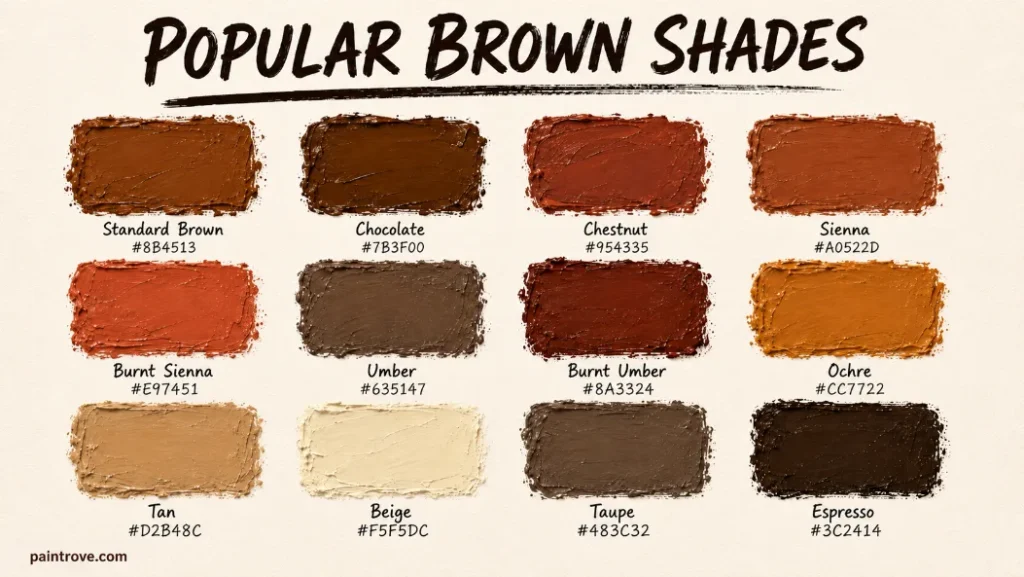
The classic earth pigment names in that table, sienna, umber, and ochre, come from actual pigments dug out of the ground, some of the oldest colors humans have ever used. Raw sienna and raw umber are named after Siena in Italy and the Umbria region. “Burnt” versions are the same earths roasted to deepen them. If you paint regularly, a tube of burnt sienna and one of burnt umber are worth owning even if you mix every other brown yourself, because they are cheap, permanent, and consistent.
Warm Browns vs Cool Browns
Temperature is the single biggest decision in mixing brown, and it decides whether your brown feels like firelight or wet stone.
Warm browns lean red, orange, or yellow. Use them for sunlit wood, brick, autumn leaves, bread, terracotta pots, and warm skin. To warm a brown, add small amounts of red, orange, or yellow. Push far enough with red-orange and you reach terracotta territory, hex #E2725B.
Cool browns lean blue or green. Use them for shadowed wood, wet earth, winter trees, driftwood, and dark hair. To cool a brown, add small touches of blue or green. Ultramarine blue produces a soft, foggy coolness; phthalo blue produces a sharper one.
A practical exercise worth doing once: mix one base brown, split it into six piles, and adjust each with a different color. Label the swatches. That single sheet will teach you more about brown than any article can.
How to Make Light Brown and Dark Brown
Light brown, tan, and beige. Add white gradually to any brown base. The more white, the closer you get to tan (hex #D2B48C) and eventually beige (hex #F5F5DC). If the lightened brown turns chalky or gray, restore warmth with a touch of yellow or orange. For soft pinkish light browns like the ones used in skin work, our guide to how to make nude color covers the recipes in detail.
Dark brown, chocolate, and espresso. You have two routes. The careful route: add black in tiny increments, since black overwhelms quickly and can turn brown flat and dirty. The painter’s route: darken with more blue instead, especially ultramarine, which deepens brown while keeping it alive. A dark brown from blue reads richer than a dark brown from black in most paintings. For chocolate tones, add extra red alongside the darkener.
Muted, grayish browns. Add gray, or add a little of whichever complement pulls the mix toward neutral. Taupe and mocha both live in this zone. Push it far enough and you cross out of brown entirely into the territory covered by what colors make gray, which is brown’s close cousin: the same neutralizing math with the cool side winning instead of the warm side.
Troubleshooting: When Your Brown Goes Wrong
The mix looks gray, not brown. Too much blue, or your mix has no dominant warm color. Brown needs the warm side to win. Add red and yellow, or straight orange, until warmth returns.
The mix looks like mud with no character. It probably contains too many competing pigments. Muddy browns come from overloaded mixes. Start fresh with just two or three pigments and keep the recipe simple.
The brown is too red / too yellow / too blue. Add a small amount of that color’s complement: green to cancel red, purple to cancel yellow, orange to cancel blue. Tiny amounts. You are steering, not slamming.
It dries darker than it looked. Normal, especially with acrylics. Mix your browns a step lighter and warmer than the target.
It looks flat and dead. Usually a black problem. If you darkened with black, remix and darken with blue or with a deeper version of the dominant hue instead. Browns stay alive when they are built from chromatic pigments rather than deadened with black.
Different mediums behave differently. Oils and acrylics mix physically on the palette and are forgiving. Watercolor mixes optically on paper, where an overworked brown puddle turns lifeless fast; watercolorists often layer the component colors as glazes instead of premixing. Colored pencils build brown through layered strokes of the same complementary logic.
Brown in Art, Fashion, and Design
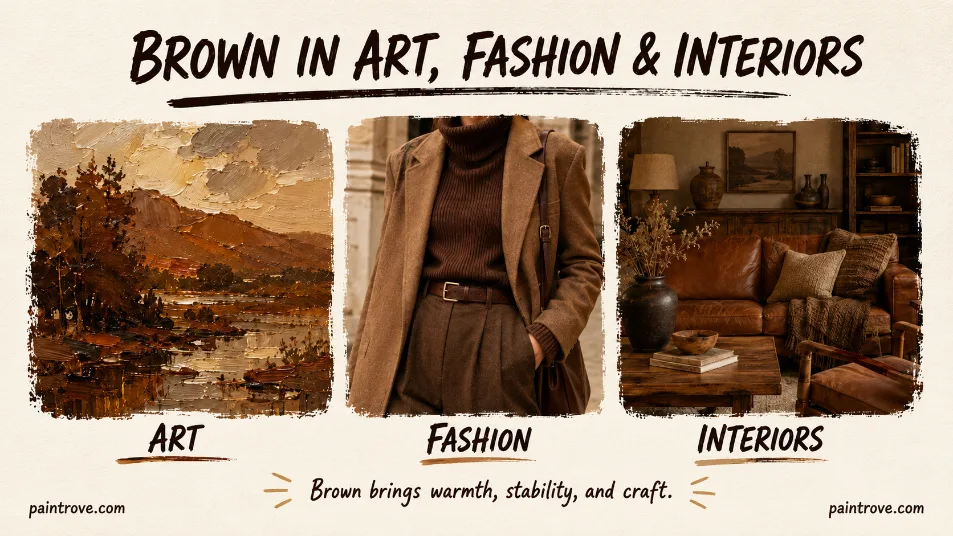
Brown rarely gets called anyone’s favorite color, and yet it quietly holds up most of the visual world.
In Art
The old masters practically lived in brown. Rembrandt built entire portraits on umber and sienna grounds, letting warm browns do the work of shadow and atmosphere. Landscape painters depend on the brown family for soil, bark, and the muted distances that make brighter colors sing by contrast. There is a well-worn truth in painting: the intense colors get the attention, but the neutrals make the picture. A painter who can mix ten distinct browns on demand controls the entire mood of a canvas.
In Fashion
Brown has moved from safe to statement. Chocolate and espresso tones anchor autumn and winter collections year after year, and the quiet-luxury wave pushed camel, taupe, and mocha to the front of the wardrobe. Brown flatters nearly everyone because it echoes natural hair, eye, and skin tones, and it pairs with almost anything: cream, denim blue, olive, burgundy, gold. A camel coat over any outfit reads expensive. That is brown doing its work.
In Interiors and Branding
Interior designers lean on brown for warmth and groundedness: wood floors, leather furniture, linen in oatmeal and sand tones. Browns make spaces feel stable and lived-in, which is why coffee brands, chocolate makers, and outdoor companies build their identities around it. Brown communicates reliability, nature, and craft, the exact opposite of flashy, and sometimes that is precisely the message.
Quick Reference: How to Make Brown Cheat Sheet
| Goal | Recipe |
|---|---|
| Basic brown | Red + yellow + blue, equal parts (hex #8B4513) |
| Fast two-color brown | Orange + blue, or red + green |
| Warm brown | Add red, orange, or yellow |
| Cool brown | Add blue or green |
| Light brown / tan | Add white (hex #D2B48C) |
| Dark brown / espresso | Add blue or a touch of black (hex #3C2414) |
| Reddish brown / mahogany | Add red (hex #C04000) |
| Muted brown / taupe | Add gray (hex #483C32) |
| Fix a gray mix | Add warmth: red, yellow, or orange |
| Fix a flat mix | Remove black from the recipe, darken with blue |
FAQ
What two colors make brown? Any complementary pair: blue and orange, red and green, or yellow and purple. Orange and black also work, since brown is essentially darkened orange. Each pair gives a different character of brown.
How do you make brown with primary colors? Mix red, yellow, and blue in roughly equal parts. Mix the red and yellow into orange first, then add the blue gradually until the orange settles into brown. Adjust the balance to warm or cool the result.
How do you make brown without blue? Mix red and green. Green already contains blue, so the mix covers all three primaries. Orange plus black also produces brown with no visible blue in the recipe.
Why does my brown look gray? The cool colors are winning. Brown needs the warm side, red through yellow, to dominate. Add orange or red and the gray will shift back to brown. If it stays stubbornly gray, there is too much blue in the mix to save efficiently; start again with less.
How do you make light brown? Add white to a brown base for tan and beige, and restore a touch of yellow or orange if the mix turns chalky. Starting from lighter versions of the component colors also works.
How do you make dark brown? Add more blue for a rich dark brown, or a very small amount of black for espresso tones. Blue keeps the brown alive; black is faster but risks flattening it.
Is brown a warm or cool color? Brown is fundamentally warm, since it is built on an orange base. But individual browns can lean cool when blue or green dominates the mix, which is why taupe and umber read cooler than sienna and caramel.
What colors make skin tone brown? Start with the standard red, yellow, and blue mix, then adjust: more yellow for golden undertones, more red for warm undertones, more white for lighter skin, more blue and red for deeper skin. Our guide to how to make nude color walks through specific recipes.
Every brown you will ever need comes from the same simple system: all three primaries in disguise, warm side winning, adjusted for temperature and depth. Master one base recipe and the whole family opens up.
For the theory underneath all of this, start with our guides to the color wheel and secondary colors, or jump into any of the individual mixes linked above to see each brown recipe in detail.